
Instruction modeling rehearsal feedback RBT training can use is a structured practice sequence: explain the task, show the skill, let the RBT rehearse it, and provide specific feedback. It supports learning but does not replace supervisor verification.
Table of Contents
- Instruction modeling rehearsal feedback RBT training: the basic idea
- Step 1: give clear instruction
- Step 2: model the task
- Step 3: rehearse the skill
- Step 4: give specific feedback
- A worked RBT practice example
- When practice needs more verification
- Frequently asked questions
- Sources and scope note
RBT SKILL BUILDING · SUPERVISION PRACTICE
Instruction Modeling Rehearsal Feedback RBT: How Supervision Builds Skills
A repeatable practice loop for explaining a task, showing the steps, rehearsing the skill, and giving useful feedback.
Instruction modeling rehearsal feedback RBT training can use is a structured practice sequence: explain the task, show the skill, let the RBT rehearse it, and provide specific feedback. It supports learning but does not replace supervisor verification.
The sequence is useful because “I understand” and “I can implement this current procedure accurately” are not always the same. A practice loop gives the supervisor and RBT observable information about the steps, errors, questions, and next practice opportunity.
Use it for a defined task, such as a data-collection routine, a trained prompt sequence, a documentation workflow, or a communication step. The current plan, workplace process, supervision arrangement, and applicable requirements still control what the RBT may implement.
Instruction modeling rehearsal feedback RBT training: the basic idea
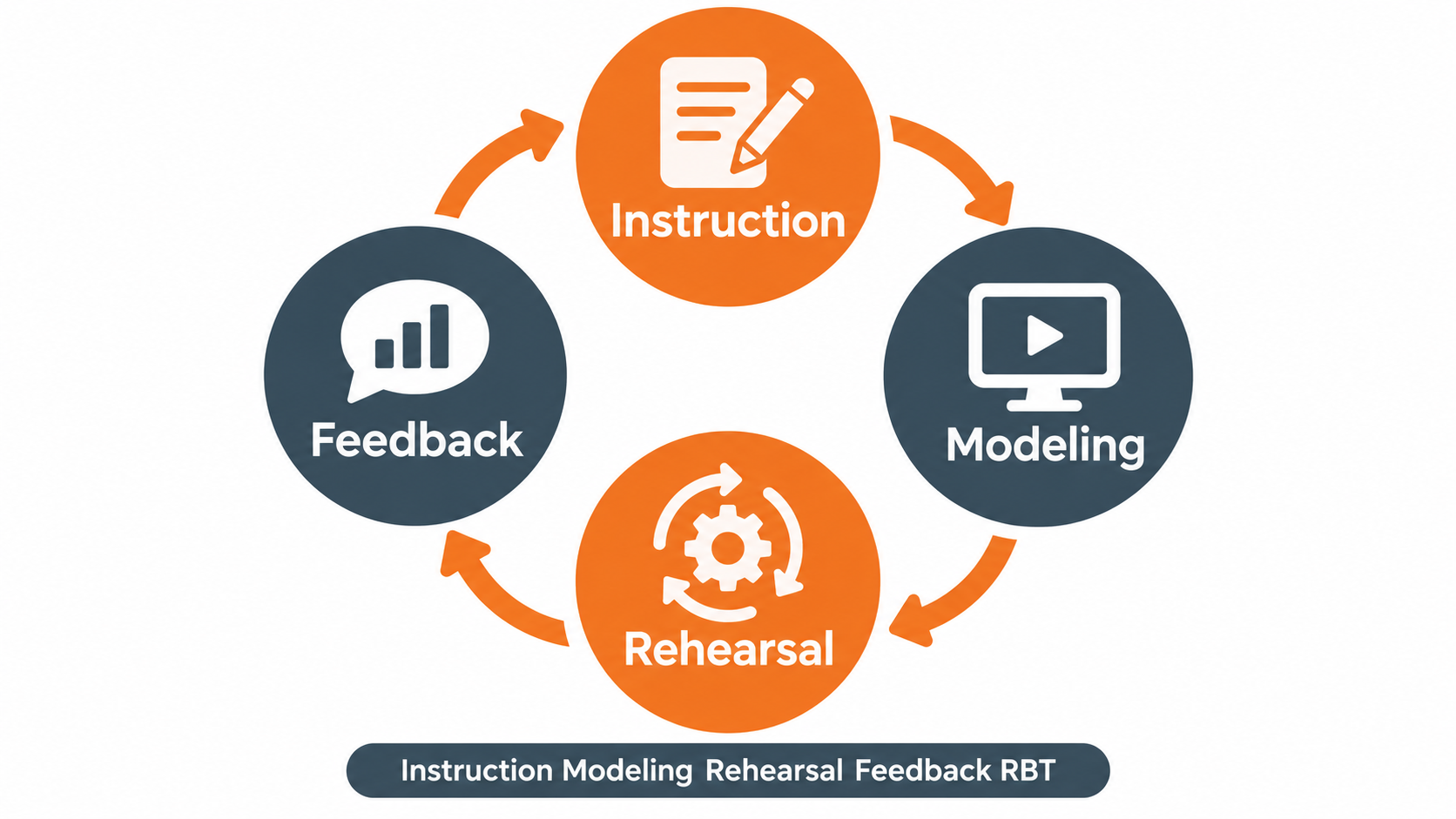
The four parts work together:
- Instruction: Explain what the task is, why it matters, and which steps or conditions are essential.
- Modeling: Show the task as it should be performed, using the current materials and procedure when possible.
- Rehearsal: Let the RBT practice the task in a safe training condition or an appropriate service opportunity.
- Feedback: Describe what matched the procedure, identify the specific change needed, and give the RBT another chance to practice when appropriate.
The sequence can repeat. If the RBT misses a step, the supervisor can clarify, model again, rehearse, and give another focused correction. The goal is not to rush to a pass; it is to make the task and the evidence clear.
Step 1: give clear instruction
Begin with the current task and its observable standard. Avoid presenting a large policy manual as if it were one skill. Name the procedure, the important steps, the measurement or documentation rule, and the condition that requires the RBT to pause and ask.
For example, an instruction for duration data might specify when timing starts, when it stops, which form to use, and what to do if the timer fails. An instruction for a prompt procedure might state the order, wait interval, response definition, and recording requirement.
Ask the RBT to restate the key steps. This is not a trick question. It reveals whether the wording needs clarification before the practice begins.
Step 2: model the task
Modeling makes the invisible parts of a task visible. The trainer can demonstrate the timing, materials, language, positioning, data entry, and response to an unexpected event. Explain decisions that the RBT is expected to notice, but do not introduce an unapproved variation just to make the demonstration look easy.
Use the current form, software, communication system, or session materials when possible. A paper demonstration may not answer whether the RBT can use the electronic record system accurately. If the training context differs from service, state the difference clearly.
Model respectful behavior as well as mechanics. Protect client dignity, avoid unnecessary identifying details, and follow safety and confidentiality rules throughout the demonstration.
Step 3: rehearse the skill
Rehearsal gives the RBT a chance to perform the task rather than only describe it. Role-play, simulation, guided practice, and direct observation can all be useful when selected for the task and context.
Keep the practice target narrow enough to observe. Instead of “run the whole session,” the target might be “record the start and stop of three duration examples using the current form” or “deliver the trained prompt sequence across two role-play opportunities.” The supervisor determines what evidence is appropriate.
Rehearsal should make errors safe to identify and correct. It should not pressure the RBT to hide uncertainty or improvise a clinical decision. If the practice reveals that the written procedure is unclear, stop and ask for clarification.
Step 4: give specific feedback
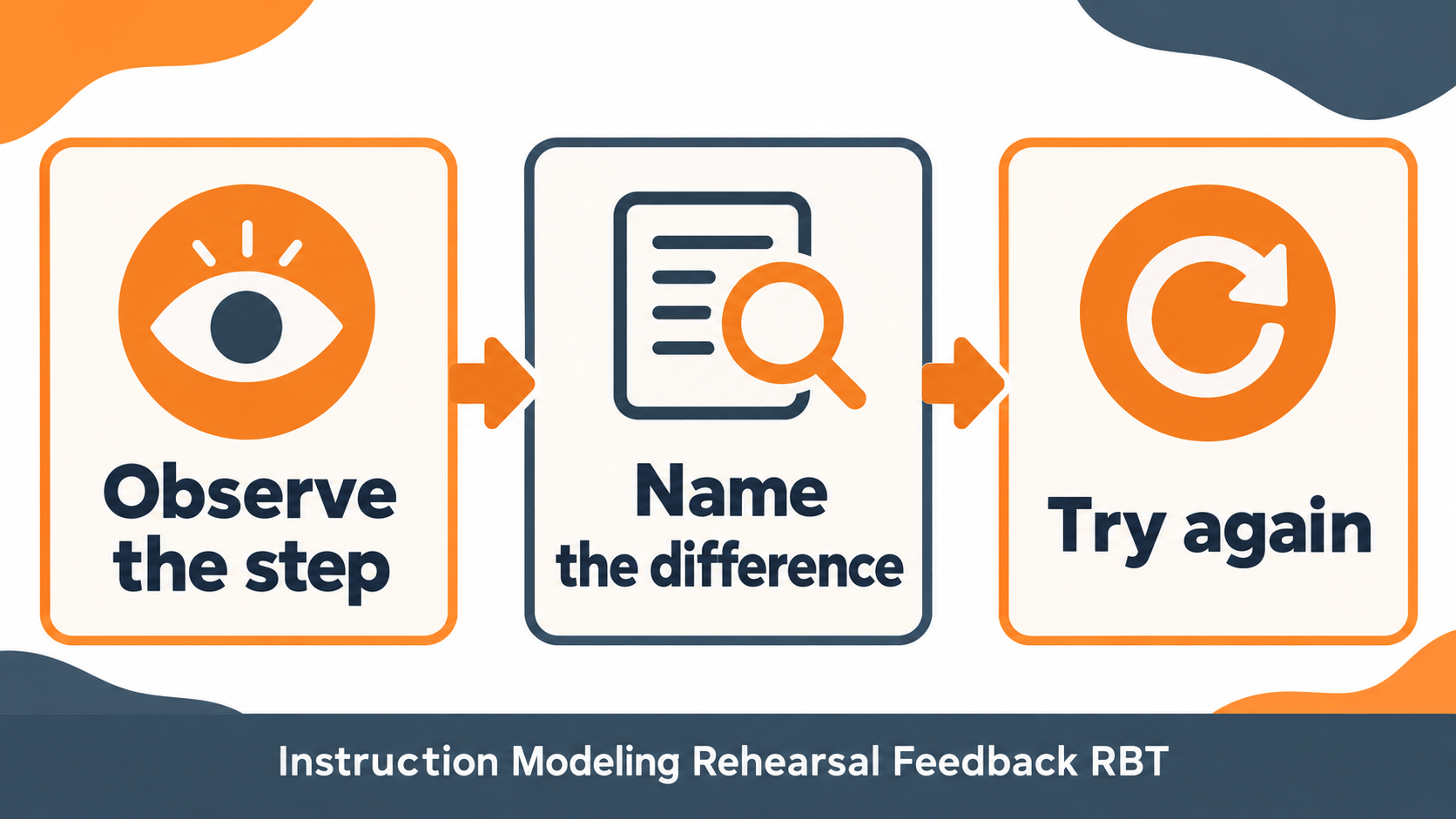
Useful feedback points to behavior, not personality. It can follow a simple pattern:
- name the step that was observed;
- describe what matched or differed from the current procedure;
- explain the correction or why the step matters;
- invite a repeat attempt or identify the next support.
“You were careless with the data” is difficult to act on. “You entered the duration after the event ended, but the current procedure requires starting the timer at the defined onset; let’s rehearse that timing again” is specific and practice-ready.
Feedback should be respectful and appropriately private. A strength can be named when it helps the RBT know what to preserve, but praise should not replace a needed correction. The RBT can ask for an example, restate the correction, and request another observation.
A worked RBT practice example
Suppose an RBT is learning a current data procedure for recording frequency. The supervisor first explains the operational definition and what counts as one event. The supervisor models identifying the event and entering it in the approved system. The RBT then rehearses with several role-play examples and records each response.
During feedback, the supervisor notes that the RBT counted two parts of one defined event as separate events. The correction names the definition and the decision point. The RBT explains the rule, rehearses new examples, and asks what to do when the event is partially obscured. The supervisor documents the practice and decides whether another observation is needed before routine implementation.
This example shows why a single correct answer is not the whole process. The RBT also needs to recognize ambiguity, use the current system, and know when to ask for direction.
When practice needs more verification
Practice is evidence for learning, not automatic authorization. More verification may be needed when the task is safety-sensitive, the client or setting changes, the procedure is revised, the communication system is new, the RBT has had a long gap from the task, or performance is inconsistent.
The supervisor selects the assessment method and confirms when the RBT may provide service. The RBT should not treat a rehearsal as permission to change a treatment plan, select a new intervention, or work independently when supervision is unclear.
If asked to perform beyond certification or competence, promptly inform the supervisor or another appropriate workplace person and document the communication through the required process. When feedback reveals a possible plan problem, report the observation; do not solve it with an unapproved workaround.
Frequently asked questions
Is this four-step sequence an official RBT certification test?
No. It is a practical training sequence for explaining and practicing a task. The supervisor and applicable requirements determine the competency assessment and readiness decision.
Can modeling replace direct observation?
Modeling supports learning, but it does not automatically show that the RBT can perform the task in the current service context. The supervisor chooses the evidence needed.
What if I still make errors after rehearsal?
Report the pattern honestly and ask for more instruction, practice, modeling, or observation. The next step may be additional training or a narrower task assignment while competence is reviewed.
Can feedback authorize a new procedure?
No. Feedback should help implement the current authorized procedure. Plan or procedure changes belong to the authorized supervisor or treatment team.
Sources and scope note
This guide is based on the BACB RBT Test Content Outline (3rd ed.), the BACB RBT Ethics Code (2.0), and the BACB Registered Behavior Technician Handbook. Requirements can change, and employer, payer, school, state, and legal rules may add obligations. Check current official sources and ask the appropriate supervisor about your situation.
Ready to practice the RBT concepts you just reviewed?
Try an independent, original RBT practice resource with exam-style questions, scoring, and answer explanations.
References
- Behavior Analyst Certification Board. RBT Test Content Outline, 3rd edition.
- Behavior Analyst Certification Board. RBT Handbook.
- Behavior Analyst Certification Board. RBT Ethics Code.