
The RBT Certificant Registry is the BACB’s public starting point for checking an individual’s certification status. A careful verification confirms the person, selects RBT, reads the current status and dates, reviews any visible supervisor or disciplinary marker, and records when the result was checked. It does not decide whether someone is clinically effective, employed, licensed by a state, or suitable for a particular case.
Table of Contents
- What the RBT Certificant Registry is for
- How to use the RBT Certificant Registry: a five-step workflow
- How to read status, dates, supervisors, and the disciplinary marker
- What the RBT Certificant Registry does not prove
- What to do when a record is missing or unclear
- Registry terms, written letters, and evidence capture
- Frequently asked questions
- Official sources and scope
RBT certification verification guide
RBT Certificant Registry: How to Verify Status
Follow a careful BACB registry check, preserve the date and source, and understand which decisions the public record cannot make for you.
The RBT Certificant Registry is the BACB’s public starting point for checking an individual’s certification status. A careful verification confirms the person, selects the RBT certification type, reads the current status and dates, reviews any visible supervisor or disciplinary marker, and records when the result was checked. It is a status-verification tool—not a complete portrait of a practitioner.
That distinction matters to several audiences. An RBT may want to confirm that a public record is accurate. A family or employer may need to verify that a person holds the certification they represent. A supervisor, payer, licensing authority, or regulator may need a dated public source before continuing a separate review. Each person still has to apply their own privacy, employment, clinical, regulatory, and safeguarding rules.
What the RBT Certificant Registry is for
BACB describes its online Certificant Registry as the primary resource for quickly verifying an individual’s certification status and determining whether reportable disciplinary actions are associated with the record. BACB also says the Registry is updated daily. That makes it useful for a current point-in-time check, but it also means a saved result should include the access date rather than being treated as timeless proof.
The Registry can help answer a narrow question: “What public BACB certification information is displayed for this person when I check it?” It may show the certification type, current status, certification dates, location, current RBT Supervisor(s), Requirements Coordinator information when relevant, and a visible disciplinary-action indicator. The exact fields and display can change, so use the live official page as the source of truth.
Begin with the BACB Verify Certification page. It links to the Registry and explains the difference between the free online search and a formal written verification letter. Do not use a third-party directory, an old screenshot, or a social-media profile as a substitute for the official record.
How to use the RBT Certificant Registry: a five-step workflow
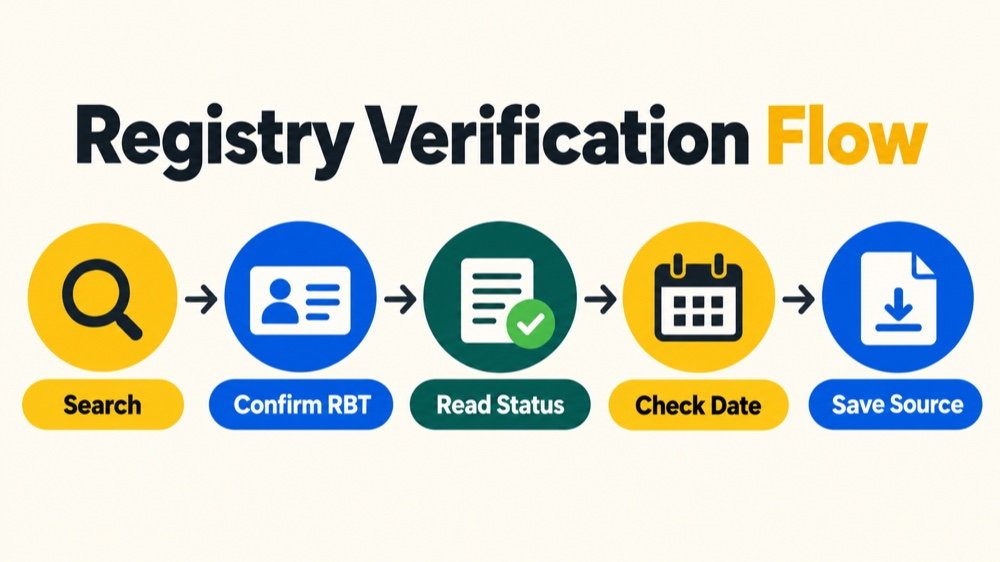
- Open the official Registry. Navigate from BACB’s Verify Certification or consumer-resources page. Check the page address before entering a name or certification number.
- Search the right identity. Use the person’s name or certification number supplied through an authorized business or care process. Compare the result with another non-sensitive identifier so a similar name is not mistaken for the correct person.
- Confirm the certification type. Set or read the filter for RBT. A record for a BCBA or BCaBA is not evidence that the person holds RBT certification, even if the name is identical.
- Read the status and dates. Note whether the record is active, inactive, or expired, and record the initial certification and expiration dates when displayed. Treat the status as current only as of the date you checked.
- Save a proportionate source record. Record the official URL, access date, search terms or certification number, visible status, and any relevant marker. Store only what the authorized process needs, and protect personal information.
Do not broaden a simple verification into unnecessary data collection. If you are checking a record for a family, employer, or payer, define the purpose first. A focused record is easier to audit and less likely to expose private information to people who do not need it.
How to read status, dates, supervisors, and the disciplinary marker
Status is a certification field, not a quality rating
An active status generally indicates that the BACB record is active at the time displayed. Inactive and expired are different states and should not be collapsed into one label. Read the Registry’s current wording and check the dates before describing what the record means. If a status is time-sensitive, repeat the verification when the decision will actually be made.
An RBT who sees an unexpected status should use the official BACB account or contact route to resolve it. A person reviewing someone else’s record should not diagnose the reason for an inactive or expired status from a search result alone.
Dates establish the time frame you observed
Initial certification and expiration dates can help you understand the record’s time frame. They do not prove that the person worked continuously, delivered services during every date in the range, or met every employer or state requirement. Write down the access date alongside the displayed dates; otherwise, a later reader may not know whether the check was current when it was used.
Supervisor and Requirements Coordinator information has a specific purpose
For an RBT, the Registry may display current Supervisor(s) and, when relevant, Requirements Coordinator information. This can help a person locate the correct supervision relationship or reconcile an account-maintenance question. It is not a rating of the supervisor, proof that every supervision hour was completed, or proof that a treatment decision was clinically appropriate.
A disciplinary marker is a signal to read the official details
The public Registry may use a dagger symbol or similar marker to indicate one or more published disciplinary actions. Treat the marker as a prompt to open the official details, not as a complete narrative. A marker alone does not tell you the allegation, findings, dates, scope, or outcome. Do not repeat it as if it were a verdict about current clinical practice.
This article is intentionally separate from a guide about disciplinary actions or reporting an alleged violation. Those topics concern interpretation, reporting routes, and formal processes. This article concerns the narrower task of verifying what the public Registry currently displays.
What the RBT Certificant Registry does not prove
A public status record is valuable because it is limited. It can support a certification check, but it cannot answer every question an employer, family, payer, or regulator may have. Use the record for the question it was designed to answer, then complete any separate review required by the situation.
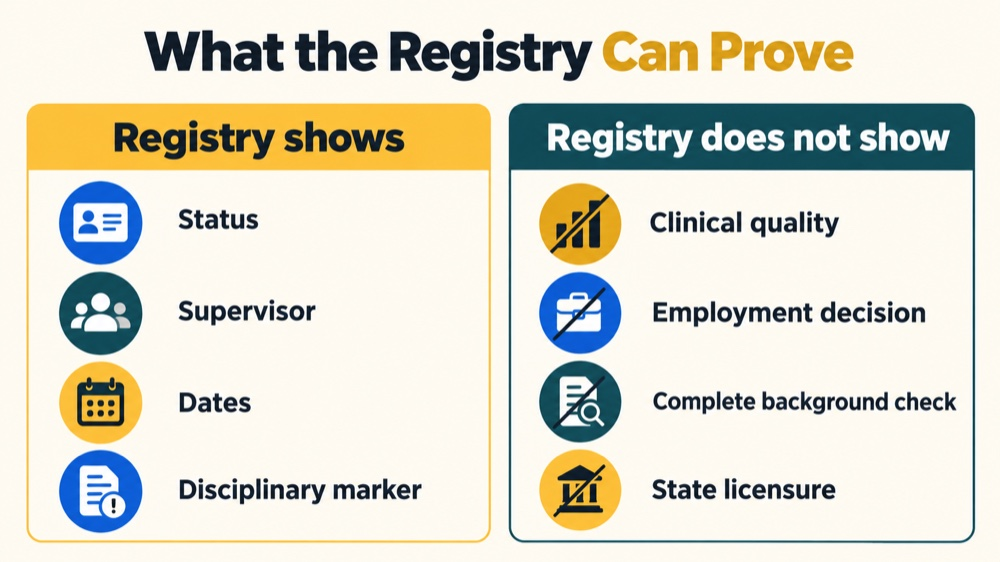
- Clinical quality: status does not measure treatment quality, communication, skill, outcomes, or fit for a client.
- Employment: the Registry does not prove that the person works for a particular company, is available, or is authorized to provide a particular service.
- Complete background screening: a certification record does not replace criminal-history, safeguarding, reference, identity, or employment checks required by an organization.
- State licensure or local permission: BACB certification and state or local legal requirements are separate questions. Check the applicable regulator.
- Every concern or complaint: the public record does not necessarily display every report, allegation, investigation, or non-published matter.
- Current supervision performance: a listed supervisor relationship does not prove that all required activities occurred or that the relationship is appropriate for every service context.
What to do when a record is missing or unclear
A missing result is a reason to verify the search—not a reason to announce that a person is uncertified or has no disciplinary history. First check the spelling, punctuation, name order, certification number, and certification-type filter. Try the status filters only when you understand what changing them does. Avoid searching a nickname when the person’s official account uses a legal name, but do not collect extra identity documents unless your authorized process requires them.
If a name is common, compare the certification number or another appropriate field. If the record appears to belong to someone else, stop and do not save or distribute it. If the result remains unclear, use BACB’s official contact route or ask the individual to provide a current verification report or written verification letter through the appropriate process.
When a person is active, BACB says the portal may offer a printable verification report. BACB also describes a written verification letter for current certificants for a fee; the letter includes core identity and certification details, while a letter is not provided for expired certifications. Confirm the current fee and instructions on BACB’s live page because administrative procedures can change.
Registry terms, written letters, and evidence capture
For routine internal verification, a short evidence note is often enough: the official Registry URL, access date, person or certification-number search, certification type, displayed status, relevant dates, and the reviewer’s initials or role. If your organization has a retention or audit rule, follow it. Do not publish a screenshot with unnecessary personal data.
Use the Registry only for a legitimate verification purpose. BACB’s Terms of Use restrict commercial activities, solicitation, employment solicitation, data harvesting, and creating email databases. In practical terms, do not scrape the Registry, sell lists of certificants, use records to market a course, or contact people with unsolicited offers. A public page is not permission to repurpose personal information.
If a regulator, employer, or formal process requires stronger documentation than a web lookup, follow that process’s instructions. A written letter or portal report may be more appropriate than a screenshot, but neither one turns the certification record into a clinical evaluation or a complete background check.
Frequently asked questions
Is the RBT Certificant Registry free?
The online Registry is presented by BACB as a free public verification resource. A separate written verification letter for a current certificant may involve a fee. Check the official Verify Certification page for current options and pricing.
How often is the Registry updated?
BACB says the Registry is updated daily. Still, record the date and time of your own check because status, relationships, and published information can change after you view the page.
Does an active RBT status prove someone is allowed to practice in my state?
No. BACB certification and state or local requirements are separate. Check the relevant regulator, employer policy, payer rules, and supervision requirements for the actual service setting.
What does the dagger symbol mean?
It indicates that one or more published disciplinary actions are associated with the public record. Open the official details and read the scope and dates; do not treat the symbol alone as a complete finding or current-risk assessment.
Can I use Registry data for marketing?
No. BACB’s Terms of Use restrict commercial and solicitation uses, including employment solicitation, data harvesting, and creating email databases. Use the resource for legitimate verification within its stated purpose.
Official sources and scope
This guide was checked against BACB’s Verify Certification page, Consumer Resources, Employer Resources, Contact Us guidance, the Terms of Use, and the current RBT Handbook. Requirements, display fields, fees, and forms can change. Use the live official source for a real verification and apply any separate legal, clinical, employment, licensing, safeguarding, or privacy requirements.
Ready to practice the RBT concepts you just reviewed?
Try an independent, original RBT practice resource with exam-style questions, scoring, and answer explanations.
References
- Behavior Analyst Certification Board. RBT Test Content Outline, 3rd edition.
- Behavior Analyst Certification Board. RBT Handbook.
- Behavior Analyst Certification Board. RBT Ethics Code.