
A free resource can be a useful starting point, but an RBT study guide free search result is not automatically a complete or current preparation system. Some pages offer a printable PDF, some organize lessons by domain, and some place the most useful explanations behind a quiz or signup. The decision is not simply whether the download costs zero; it is whether the resource helps you make accurate, observable decisions from the current outline.
Table of Contents
- RBT Study Guide Free: What It Should Help You Do
- Check the edition and source before you study
- Audit the six-domain coverage
- How to study with an RBT study guide free resource
- Test explanations with fresh scenarios
- Build a correction log
- Know what free material cannot replace
- Common free study-guide mistakes
- Frequently Asked Questions
- References
This guide gives you a practical way to evaluate free RBT study materials, build a six-domain review path, and turn missed questions into targeted corrections. It also explains the difference between an independent study aid and an official BACB source, so you can use free content without confusing convenience with authority.
RBT Training is an independent educational resource. It is not affiliated with, operated by, or endorsed by the Behavior Analyst Certification Board (BACB). The examples and practice prompts below are newly written for independent study; they are not official, recalled, leaked, or BACB-endorsed questions. No free guide, course, or practice score can guarantee a passing result.
RBT Study Guide Free: What It Should Help You Do
A useful guide should move you through four jobs: locate the concept in the current source, understand it in plain language, distinguish it from a nearby concept, and apply it to a new situation. A page that only lists definitions may support recognition, but it does not show whether you can choose the correct measurement, follow a teaching procedure, document objectively, or ask for supervision when a plan is unclear.
| Study-guide feature | Question to ask | Evidence of usefulness |
|---|---|---|
| Source and edition | Does the page name the current RBT Test Content Outline? | The edition, source link, and update date are visible. |
| Domain map | Can you see what is covered and what is not? | Topics are organized under domains and tasks, not only broad slogans. |
| Application | Does it show how a decision changes in a scenario? | Examples include the observable clue and the reason for the choice. |
| Feedback | Can you find and correct an error? | Questions include explanations, contrasts, or a correction method. |
| Role boundary | Does it keep the RBT within the written plan and supervision route? | It does not tell an RBT to diagnose, redesign treatment, or improvise outside scope. |
Free access can remove a cost barrier, but it does not remove the learner’s evaluation task. Before you invest hours in a guide, skim one explanation from each major area. Look for specific language, an example, a nearby confusion, and a clear next action. If every section repeats “memorize this term” without a decision rule, add another source or change the study method.
Check the edition and source before you study
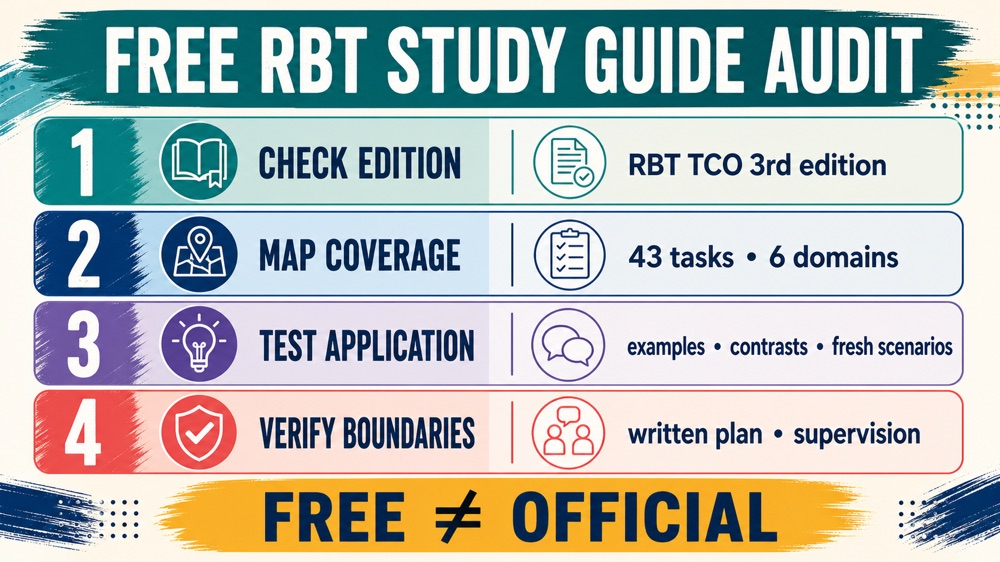
The academic anchor for current RBT exam preparation is the RBT Test Content Outline, 3rd edition. It describes 43 tasks across six domains. The exam context used in this workflow includes 75 scored questions and 10 unscored pilot questions. Those numbers are useful checks against a resource that quietly mixes old and new material, but they are not a reason to treat an independent guide as an official BACB publication.
| Check | What to record | Why it protects your study time |
|---|---|---|
| Edition | RBT Test Content Outline, 3rd edition | A page labeled only “RBT task list” may use an older structure. |
| Task count | 43 tasks across A–F | Shows whether the guide maps the current scope or only selected popular terms. |
| Exam context | 75 scored plus 10 unscored pilot questions | Prevents a study page from treating every presented item as scored. |
| Source trail | Official TCO, handbook, and ethics source | Lets you verify requirements and role boundaries independently. |
| Revision date | Last update and broken-link check | Free pages can remain online after their source assumptions change. |
When a free PDF and a current official source disagree, the official source controls scope. Use the independent guide as an explanation layer, not as a replacement. Keep a note beside every older term: “current label,” “historical cross-reference,” or “not confirmed.” That small habit prevents an outdated heading from becoming an outdated study plan.
Audit the six-domain coverage
A broad RBT study guide should make the six current domains visible. You do not need every guide to explain every task at textbook length, but you should be able to tell where each area is introduced and how to review it. The six-domain map is:
- A — Data Collection and Graphing: selecting and applying measurement, recording data, and interpreting displays.
- B — Behavior Assessment: supporting assessment procedures and observing or communicating information objectively.
- C — Behavior Acquisition: implementing teaching procedures, prompts, reinforcement, shaping, chaining, and generalization as written.
- D — Behavior Reduction: implementing behavior-reduction procedures safely and recognizing the importance of function and the written plan.
- E — Documentation and Reporting: completing accurate records, protecting information, and communicating relevant session details.
- F — Ethics: respecting dignity, boundaries, supervision, competence, confidentiality, and professional responsibilities.
Use the map diagnostically. If you repeatedly miss measurement questions, do not reread the entire guide; return to the specific distinction, such as duration versus latency or partial-interval versus whole-interval recording. If you miss an ethics scenario, identify whether the decisive clue is confidentiality, a dual relationship, supervision, or an instruction outside your role.
How to study with an RBT study guide free resource
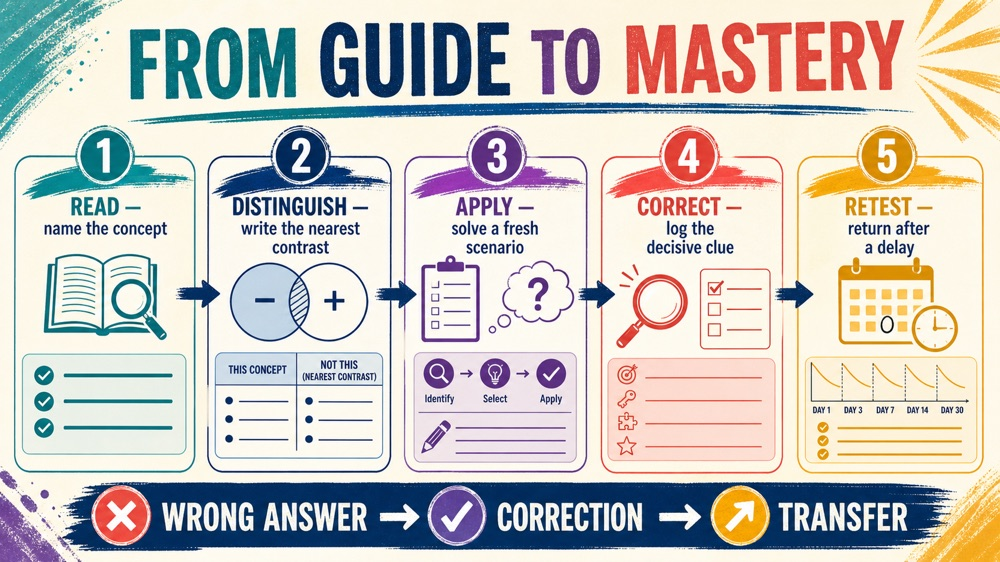
Reading can be the first pass, not the whole method. Use a short loop that turns a free resource into evidence about what you can do:
- Preview: list the domains, tasks, examples, quizzes, and source links before starting.
- Learn: read one small concept and write the rule in your own words.
- Discriminate: add the closest confusion and the clue that separates the two.
- Apply: solve a fresh scenario without looking at the explanation first.
- Correct: record why your answer was wrong and what you will look for next time.
- Recheck: return after a delay and solve a different scenario from the same task.
For example, a guide may define momentary time sampling correctly. Your next step is to ask: “Is the behavior scored at a specific moment, or at any point during the interval?” If a new stem changes the observation rule, the correct measurement can change. This is why active discrimination is more useful than copying a definition into a flashcard without a contrast.
For a printable guide, leave a margin for the decision clue and next action. For an online guide, use a separate correction document or spreadsheet. The format can change; the feedback loop should not.
Test explanations with fresh scenarios
Free material becomes more valuable when you test whether its explanation transfers. Write one short scenario after each concept and change only the decisive feature:
| Area | Original practice variation | Decisive question |
|---|---|---|
| Measurement | An observer records whether a response occurs at the exact end of each interval. | Is the method momentary time sampling, whole interval, or partial interval? |
| Assessment | A learner chooses one item repeatedly, but performance after access has not changed. | What can be said about preference, and what still requires evidence? |
| Skill acquisition | The learner responds only after a prompt and the written plan specifies fading. | Which teaching step follows the plan without turning the prompt into a permanent crutch? |
| Behavior reduction | A behavior changes after an intervention, but the RBT is asked to alter the procedure independently. | What should the RBT document and whom should the RBT contact? |
| Documentation | A note says the client was “lazy” instead of describing what was observed. | How can the note be rewritten in objective, observable language? |
| Ethics | A coworker asks for identifying client details in a public group chat. | Which confidentiality and communication boundary controls the response? |
These are original study prompts, not recalled or official exam items. The point is to make the controlling clue visible. A guide that provides only an answer letter does not give enough information to repair reasoning; a stronger guide explains why the selected option fits and why the nearby options do not.
Build a correction log
Keep one line for every wrong answer, guessed answer, or answer that took too long. A useful correction log contains:
- Domain and task: identify where the concept lives in the current map.
- Stem clue: copy only the short observable feature that controlled the decision.
- My choice: record the answer you selected without rewriting the whole question.
- Correct rule: state the distinction in one sentence.
- Next variation: write a new scenario that changes the clue.
- Retest: return later and mark whether the rule transfers.
Suppose you chose duration when the stem asked for the time from an instruction to response onset. Your correction should say “latency measures the delay before the response starts,” then include a new example with two different response times. The correction is complete only when you can use the rule in a changed context.
Know what free material cannot replace
A free study guide can explain concepts and organize practice. It cannot replace official eligibility and certification information, required training, competency assessment, supervision, or client-specific direction. The BACB handbook and official requirements pages are the places to verify current process rules.
- Training: exam study is separate from completing the required training pathway.
- Competency: a quiz score does not establish practical competence or authorize independent clinical decisions.
- Supervision: when the written plan is unclear or a safety issue arises, follow the supervision route rather than inventing a procedure.
- Confidentiality: do not place identifying client information into public notes, screenshots, or study examples.
- Source authority: use independent explanations for learning, but use official documents for current requirements and boundaries.
These limits are not a reason to avoid free resources. They are a reason to label their job correctly. A free guide can be excellent at retrieval practice while still being the wrong place to verify a current application requirement.
Common free study-guide mistakes
- Choosing by page count: long does not mean complete or accurate.
- Ignoring edition language: check the source and task map before building a schedule.
- Studying only definitions: add contrasts and fresh scenarios.
- Trusting answer letters: require an explanation tied to the decisive clue.
- Confusing practice with authority: keep independent content separate from official BACB requirements.
- Skipping the correction loop: a wrong answer without a next action is just a repeated mistake.
- Letting a guide make scope decisions: RBTs implement within training, written plans, and supervision; they do not diagnose or independently redesign treatment.
Bottom line: choose a free RBT study guide because it is current, traceable, six-domain aware, explanation-rich, and usable in a correction loop—not only because it has a download button. Start with the official 3rd-edition outline, use independent material to learn and practice, and keep every uncertain decision connected to the correct source or supervisor.
Ready to turn free study into active practice?
Use independent RBT practice questions, then log the domain, clue, correction, and next variation.
Try Free RBT Practice Questions →
Frequently Asked Questions
Is a free RBT study guide enough by itself?
Usually not. Use it to learn and organize review, then verify current requirements in official BACB resources and test understanding with fresh scenario practice.
How do I check whether a free guide is current?
Look for the RBT Test Content Outline, 3rd edition, a visible source link, a revision date, and a map of 43 tasks across six domains.
What should I do if a free guide conflicts with the official source?
Use the official source to control scope and requirements, and treat the independent guide as a study aid until its explanation is corrected or replaced.
Should I study every RBT domain equally?
Cover all six domains, then allocate extra correction time to the tasks where your scenario decisions remain inconsistent. Do not use a competitor’s claimed weighting as a substitute for the current official outline.
How can I remember more from a free study guide?
After each concept, write the nearest contrast, solve a fresh scenario, record the decisive clue, and retest the rule after a delay.
References
- Behavior Analyst Certification Board. RBT Test Content Outline, 3rd edition.
- Behavior Analyst Certification Board. RBT Handbook, updated June 2026.
- Behavior Analyst Certification Board. RBT Ethics Code.
- Free RBT study guide resource. Reviewed for competitor research; not an endorsement.
- Autivic free RBT study guide resource. Reviewed for competitor research; not an endorsement.
- Free RBT study guide resource with practice links. Reviewed for competitor research; not an endorsement.