

The RBT Test Content Outline 3rd edition is the blueprint for the RBT certification examination beginning in 2026. It organizes 43 entry-level behavior-technician tasks into six domains and shows the approximate number and percentage of scored questions assigned to each domain. Use it to prioritize study and understand role expectations—but not to predict exact exam questions or replace the current RBT Handbook, training, competency assessment, or ethics resources.
Table of Contents
- What the RBT Test Content Outline 3rd edition is
- How the 2026 exam blueprint is organized
- The six RBT Test Content Outline 3rd edition domains
- How to turn the TCO into a study plan
- What the RBT Test Content Outline does not tell you
- Common outline-reading mistakes
- Frequently asked questions
- Official sources and scope
RBT examination blueprint explainer
RBT Test Content Outline 3rd Edition: 2026 Exam Guide
Read the six domains, question weights, 43 tasks, and study limits behind the current RBT examination.
The RBT Test Content Outline 3rd edition is the blueprint for the RBT certification examination beginning in 2026. It organizes 43 entry-level behavior-technician tasks into six domains and shows the approximate number and percentage of scored questions assigned to each domain.
Use it to prioritize study and understand the role. Do not use it as a prediction of exact exam questions, a replacement for training, or a guarantee of a passing result. BACB’s live outline and current RBT Handbook control if a resource, date, or test rule changes.
What the RBT Test Content Outline 3rd edition is
A test content outline, or TCO, translates a job-task analysis into an examination blueprint. In this case, the outline describes knowledge, skills, and abilities identified as important for entry-level behavior technicians. It gives candidates a structured map of what the examination is designed to sample.
The outline is not a lesson plan. It names tasks such as implementing measurement procedures, participating in assessment components, implementing acquisition and reduction procedures, documenting and reporting, and acting ethically. To perform those tasks safely, an RBT also needs training, competency assessment, supervision, feedback, and the current RBT Handbook and Ethics Code.
BACB’s official RBT Test Content Outline page is the best place to read the current document. The page states that the third edition applies to examinations beginning in 2026 and identifies the six-domain blueprint.
How the 2026 exam blueprint is organized
The current RBT examination includes 75 scored questions and 10 unscored pilot questions. The TCO contains 43 tasks across six domains. The percentages in the blueprint describe the share of scored examination content and are rounded.
The current RBT Handbook also states that each question has four possible answers with one correct answer, and candidates have 90 minutes to complete the examination. These are examination-structure facts, while the TCO domains are content-coverage facts. Keeping the two categories separate makes the document easier to use.
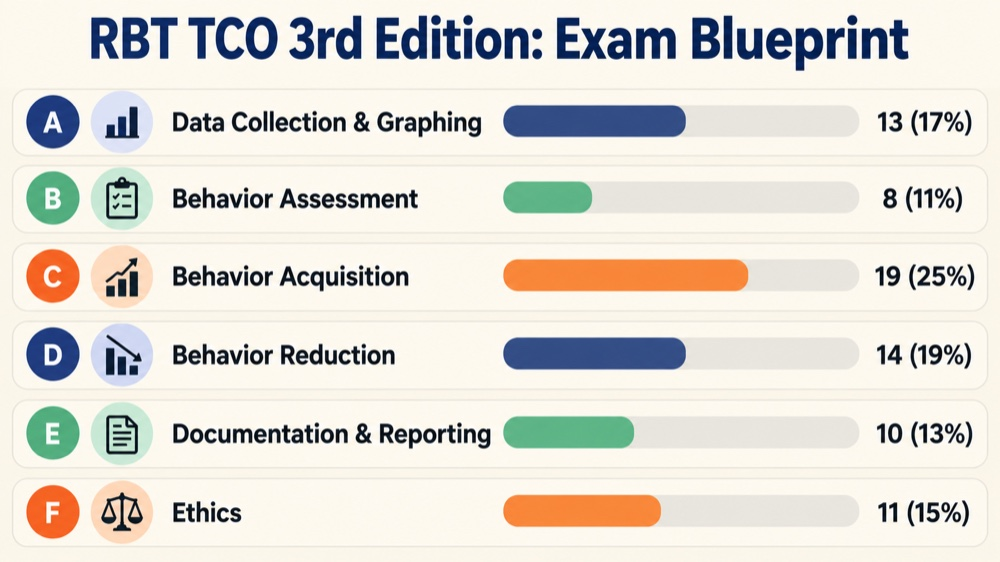
The six RBT Test Content Outline 3rd edition domains
A. Data Collection and Graphing — 13 questions, 17%
This domain includes continuous and discontinuous measurement, permanent-product recording, entering data, updating graphs, describing behavior and environment in observable terms, calculating and summarizing data, identifying trends, and recognizing the risks of unreliable collection or poor procedural fidelity. For study, connect definitions to accurate implementation and data quality.
B. Behavior Assessment — 8 questions, 11%
This domain includes conducting preference assessments, participating in assessments of relevant skill strengths and deficits, and participating in components of functional assessment procedures. The word participate matters: the outline should be read with the RBT role and supervision structure in mind. It is not a grant of independent assessment or diagnostic authority.
C. Behavior Acquisition — 19 questions, 25%
This is the largest domain. It includes reinforcement, conditioned reinforcers, discrete-trial teaching, naturalistic teaching, task-analyzed chaining, discrimination training, prompts and fading, generalization, maintenance versus acquisition, shaping, and token economies. A study plan should give this area substantial time while still practicing how procedures are implemented under the supervising professional’s direction.
D. Behavior Reduction — 14 questions, 19%
This domain covers behavior-reduction procedures and related implementation tasks in the current outline. Study should connect procedures to safety, measurement, treatment integrity, and the written plan. The TCO does not authorize an RBT to independently select or change a behavior plan.
E. Documentation and Reporting — 10 questions, 13%
This domain highlights accurate documentation and communication. Review how an RBT records information, reports relevant events, protects confidentiality, and follows the organization’s and supervising professional’s procedures. Documentation is not administrative filler; it helps the team evaluate implementation and respond to risk.
F. Ethics — 11 questions, 15%
Ethics covers professional conduct, boundaries, privacy, communication, supervision, and responsibilities to clients and the profession. Use the current RBT Ethics Code and real role-based examples. An ethics question may test what an RBT should do next, not merely whether the learner can recite a term.
How to turn the TCO into a study plan
Start with the blueprint, then add learning evidence. A practical plan can follow this sequence:
- Map the domains. Copy the six domains and tasks into a checklist without changing their meaning.
- Rate current confidence. Mark each task as unfamiliar, developing, or ready to practice. Do not equate familiarity with competence.
- Prioritize by weight and risk. Spend more time on larger domains, but do not ignore Ethics, Documentation and Reporting, or any task that affects client safety or data quality.
- Use more than one learning mode. Read the relevant training material, explain the concept in your own words, work through an original practice scenario, and ask for feedback from the qualified supervisor or trainer when appropriate.
- Review implementation, not just vocabulary. For a task such as graphing, prompting, or preference assessment, practice identifying what to do, what to record, and when to ask for direction.
- Recheck the current source. Before the exam, compare your plan with the live TCO, Handbook, and examination instructions rather than an old outline or an unofficial summary.
The weights help you allocate time; they do not tell you which individual tasks will appear or guarantee that a weak area will be tested in a predictable way. Overall performance determines the result. A focused plan therefore combines weighted review with broad coverage and role-appropriate practice.
What the RBT Test Content Outline does not tell you
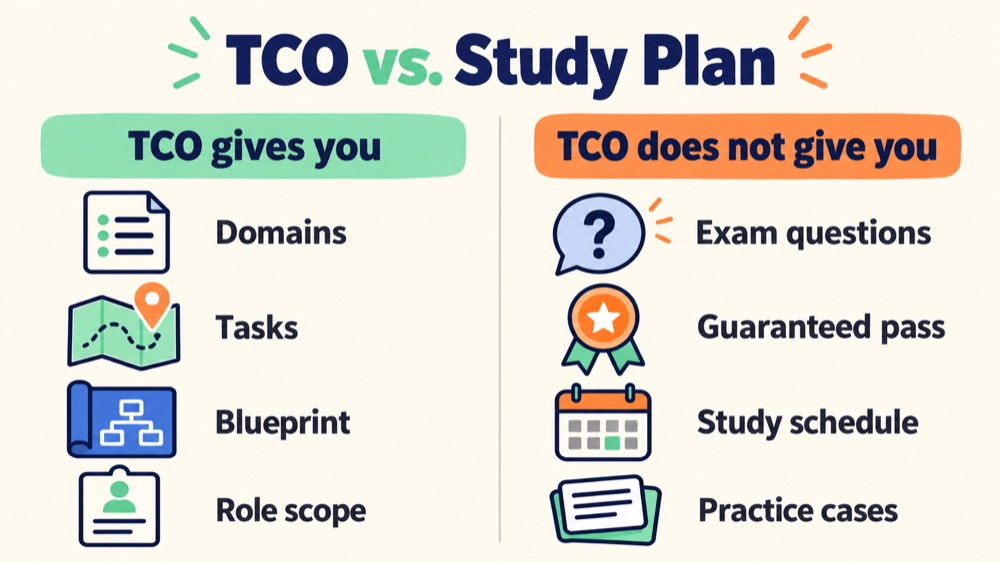
A blueprint is useful because it has boundaries. The TCO does not provide:
- the exact questions or answer choices on a particular examination form;
- a set of leaked or “most likely” exam questions;
- a guaranteed pass score from studying one domain;
- a personal calendar for how many hours you should study;
- complete examples for every client, setting, or population;
- permission to work outside the RBT role or required supervision; or
- a substitute for the 40-hour training, competency assessment, Handbook, Ethics Code, or supervision.
Common outline-reading mistakes
- Using the old Task List: the third-edition TCO is the current RBT examination framework beginning in 2026.
- Studying only C: Behavior Acquisition has the largest share, but every domain contributes to the blueprint.
- Treating percentages as exact predictions: the percentages are rounded blueprint guidance, not a promise about one test form.
- Memorizing titles without practicing: the tasks describe skills and abilities, not only vocabulary.
- Confusing exam scope with practice authority: being tested on a concept does not allow independent clinical decisions.
- Buying a guarantee: BACB does not endorse specific study guides, and purchasing study materials does not guarantee passing.
- Ignoring the live date: check the current edition and Handbook if a new outline becomes effective during your authorization period.
Frequently asked questions
When does the RBT Test Content Outline 3rd edition apply?
BACB states that the third edition describes examination content beginning in 2026. Candidates should test under the current edition applicable to their examination authorization and follow the live BACB instructions.
How many questions are on the RBT examination?
The current RBT Handbook describes 75 scored questions and 10 unscored pilot questions. The TCO’s percentages refer to the scored examination blueprint.
Which RBT domain has the most questions?
Behavior Acquisition has the largest allocation at 19 questions, or 25% of the scored blueprint. Use that information to prioritize time, not to ignore the other five domains.
Is the TCO the same as a study guide?
No. It is an examination-content blueprint. A study plan must add current training materials, practice, feedback, role boundaries, and enough time to review all domains.
Does the TCO show the exact exam questions?
No. It describes domains and tasks. It does not reveal the questions or answer choices on an individual examination form.
Official sources and scope
This guide was checked against BACB’s RBT Test Content Outline 3rd edition page, the official outline, the current RBT Handbook, the RBT examination resources, and BACB’s Examination Information. Editions, examination structure, and requirements can change. Use the live BACB sources for current preparation.
Ready to practice the RBT concepts you just reviewed?
Try an independent, original RBT practice resource with exam-style questions, scoring, and answer explanations.
References
- Behavior Analyst Certification Board. RBT Test Content Outline, 3rd edition.
- Behavior Analyst Certification Board. RBT Handbook.
- Behavior Analyst Certification Board. RBT Ethics Code.