
Professional activity social media RBT questions usually combine two duties: protect people’s confidential information and represent professional activity accurately. The current RBT Ethics Code says not to share identifying client information on social media or websites, while the RBT Test Content Outline places social-media activity inside public-statement responsibilities. This guide turns those requirements into a pre-post review for privacy, credentials, role, permission, and service outcomes without treating a checklist as individualized legal or ethics advice.
Table of Contents
- What professional activity social media RBT means
- Protect client identity before anything is shared
- Check credential and role accuracy
- Review photos, videos, permission, and context
- Describe service outcomes without promises
- The five-step social post review
- What to do when a post is already online
- Frequently asked questions
- Official sources and scope
RBT social-media ethics guide
Professional Activity Social Media RBT: Privacy and Accuracy Guide
A practical review for client privacy, credential accuracy, role boundaries, permissions, and outcome claims.
Professional activity social media RBT questions usually combine two duties: protect people’s confidential information and represent professional activity accurately. The current RBT Ethics Code says not to share identifying client information on social media or websites, while the RBT Test Content Outline places social-media activity inside public-statement responsibilities.
This guide turns those requirements into a pre-post review for privacy, credentials, role, permission, and service outcomes. It is an educational checklist, not individualized legal or ethics advice. When a post involves a real client, workplace policy, or uncertain status, use the supervisor and organization’s review route before publishing.
What professional activity social media RBT means
Social media can be personal, professional, or mixed. A public profile may show a job title, a certification, a photo from a workplace, a comment about behavior analysis, or a story about service outcomes. Even when a post is written casually, readers may interpret it as a professional statement.
RBT Test Content Outline task F.6 includes public statements about professional activities, including social-media activity and misrepresentation of professional credentials, behavior analysis, and service outcomes. That means social media is not separate from professional responsibility simply because the post appears on a personal account.
The first question is not “Can I make this post sound professional?” It is “What information does this post reveal, and what would a reasonable reader infer?” Start with privacy, then check accuracy and role.
Protect client identity before anything is shared
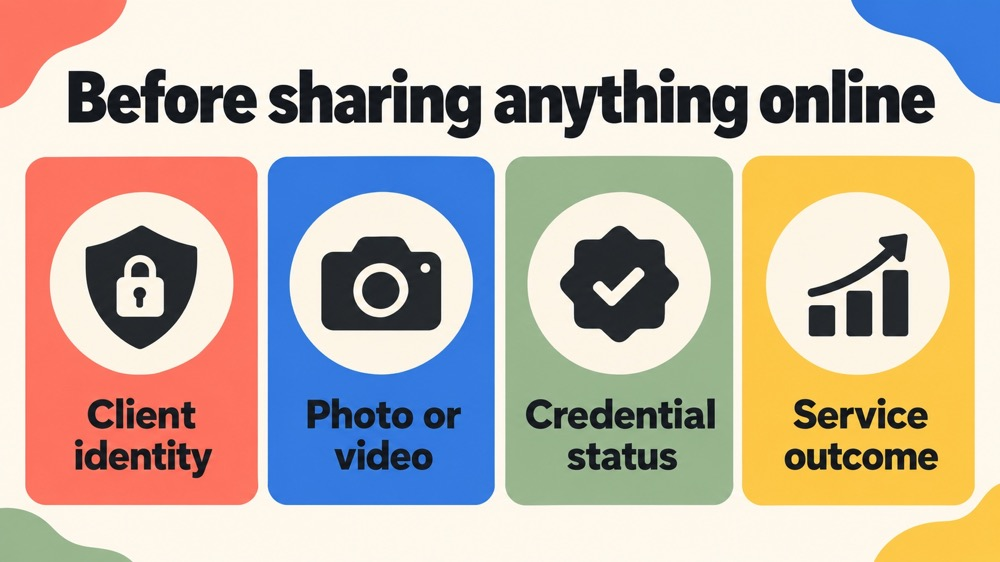
RBT Ethics Code standard 2.09 says RBTs do not share identifying information about clients on social media or websites, including photos, videos, and written information. This is a direct reason to stop before posting a client image, a session clip, a distinctive story, or a screenshot of a record.
Identifying information is broader than a full name. A face, voice, school, neighborhood, unusual event, date, diagnosis, schedule, initials combined with context, or recognizable room can help someone identify a client. A caption can reveal identity even when the image is cropped. Combining several “small” details can create a large disclosure.
Do not treat the following as automatic permission:
- the account is private or limited to followers;
- the client’s face is blurred but the setting is recognizable;
- the caption uses initials instead of a name;
- a coworker or caregiver says informally that the post is fine;
- the post is positive, educational, or intended to celebrate progress; or
- the content was recorded for another workplace purpose.
Check credential and role accuracy
A professional profile should match the person’s current status. BACB’s guidance explains that the BACB is a credentialing organization, not a licensure board or an employer. It also warns against describing an applicant, trainee, or inactive certificant as though the person holds active certification.
Before using “RBT” in a bio, verify the current status and the context. If certification is inactive, the person must not create the impression that it is active. If the person completed training but is not certified, name the training milestone rather than turning it into a credential title.
Check the surrounding wording too. A bio that says “RBT expert” or “BACB clinician” may imply authority or a relationship that the facts do not support. A more accurate description can state the active credential, the assigned role, and the required supervision without suggesting independent diagnosis or treatment design.
Professional activity social media RBT content should also avoid implying that the BACB employs the writer or endorses a personal service. On platforms such as LinkedIn, use the appropriate certification section and keep the employer, credentialing organization, and workplace roles distinct.
Review photos, videos, permission, and context
Photos and videos are high-risk because they can reveal identity, location, voice, behavior, records, and other people who did not expect to appear online. A casual recording from a clinic, classroom, home, or community setting can capture confidential information in the background.
Before sharing professional media, ask:
- Does the frame contain a client, family member, coworker, record, schedule, device screen, or recognizable location?
- Does the audio reveal a name, diagnosis, behavior, school, or private conversation?
- Is there a documented organizational process for recording and sharing this material?
- Does the permission, if any, cover this exact audience, platform, purpose, and duration?
- Would the client’s dignity and privacy still be protected if the post were copied, downloaded, or reshared?
A permission form does not automatically answer every privacy, employment, law, or BACB question. Follow the current organization process and ask the supervisor when the purpose or audience changes. If the answer is uncertain, do not post the media while waiting for clarification.
Describe service outcomes without promises
Public statements about outcomes can mislead even when no client is named. A post can overstate what happened, imply that one method works for everyone, or make the RBT appear to be the person who designed and evaluated treatment.
Prefer an observable, bounded description:
- More careful: “The learner used the programmed response during the observed opportunities; the supervising professional will review the data.”
- Risky: “Our technique solved the learner’s behavior.”
- More careful: “I support implementation of assigned behavior-analytic services under supervision.”
- Risky: “I design behavior treatment for every child.”
- More careful: “This is an educational post about a general concept, not advice for a specific person.”
- Risky: “This strategy will work for your child.”
The goal is not to remove useful professional education from the internet. It is to separate general education from client information, personal experience from clinical evidence, and implementation from independent treatment decisions.
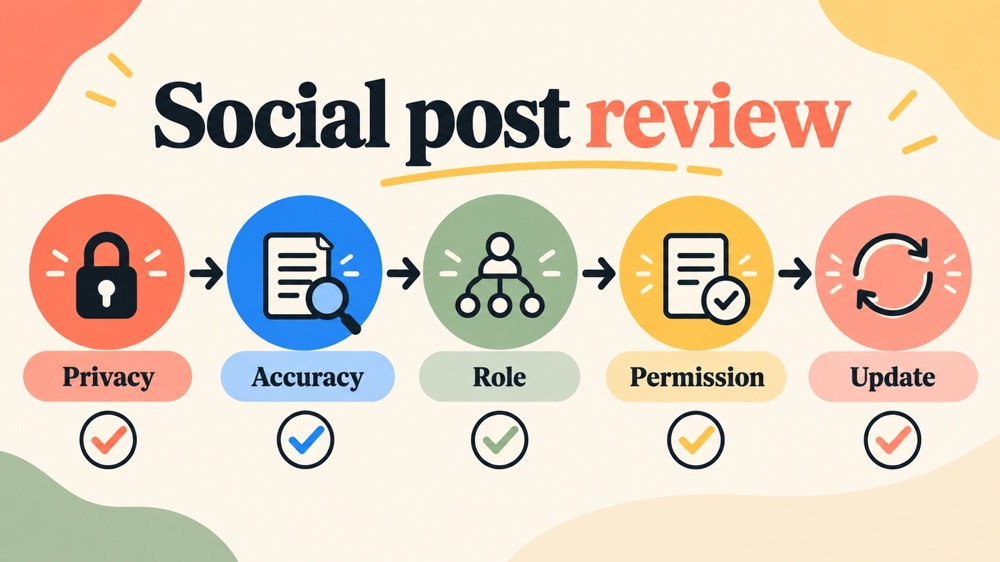
The five-step social post review
Use this short review before posting a professional bio, story, image, video, or outcome statement:
- Privacy: remove client identity, confidential records, and recognizable details.
- Accuracy: verify certification status, employer, training, and claims about BACB.
- Role: describe assigned services and supervision without implying independent authority.
- Permission: check the organization’s process and whether the permission covers the exact media, audience, and purpose.
- Update: review old bios, badges, and posts after changes to certification, employment, or supervision.
What to do when a post is already online
If you discover that a post may reveal confidential information or describe your status inaccurately, act promptly. Preserve the relevant facts through the approved workplace process, remove or restrict the post when appropriate, and tell the supervisor or designated organization contact. Do not simply delete evidence if the organization needs to review the incident.
If the issue involves a public ethics concern, BACB’s reporting information explains that some allegations involving an RBT should first go to the Requirements Coordinator or Supervisor, while other allegations may be reported to BACB. BACB also notes that the Ethics Department does not provide individualized legal or ethics advice. Use the current route rather than making a public accusation.
After correction, check copies and linked profiles. A cached image, repost, employer page, or old bio may continue to create the same impression. Document what was changed and follow the organization’s privacy, incident, and record-retention rules.
Frequently asked questions
Can an RBT post about behavior analysis?
An RBT can share general educational or professional information when the content is accurate, within the person’s role, and consistent with current BACB, workplace, privacy, and legal requirements. Do not include identifying client information or imply unsupported authority or outcomes.
Can I post a client success story without using a name?
Do not assume that removing a name makes the story anonymous. Details, images, voice, setting, and timing can identify a client. Follow the organization’s process and current privacy and ethics requirements before sharing any client-related story.
Should an RBT call the BACB a licensing board?
No. BACB’s public guidance distinguishes certification from licensure. Use accurate wording about the credentialing organization, your certification, and any separate state licensing requirements.
What if a supervisor asks me to post confidential content?
Pause and raise the concern through the appropriate supervision or organizational route. The RBT Ethics Code requires confidentiality and does not make a request automatically safe merely because it came from a workplace.
Are these social-media checks an official BACB approval?
No. They are an original educational aid. The current RBT Ethics Code, BACB guidance, employer policy, and applicable law control the actual decision.
Official sources and scope
This guide was checked against the RBT Ethics Code (2.0), the RBT Test Content Outline 3rd edition, BACB’s certification-status guidance, and its ethics reporting information. Use the live BACB sources, supervisor direction, organization policy, and applicable law for current decisions.
Ready to practice the RBT concepts you just reviewed?
Try an independent, original RBT practice resource with exam-style questions, scoring, and answer explanations.
References
- Behavior Analyst Certification Board. RBT Test Content Outline, 3rd edition.
- Behavior Analyst Certification Board. RBT Handbook.
- Behavior Analyst Certification Board. RBT Ethics Code.