
If you are comparing ABA providers, ask more than whether the clinic meets a supervision minimum. RBT supervision questions should uncover who is responsible for the case, how direct services are observed, how progress information reaches your family, and what happens when an RBT or supervisor changes. The answers help you compare service structures; they do not replace an individualized clinical conversation.
Table of Contents
- RBT supervision questions: the short list
- RBT supervision questions about who supervises the RBT
- RBT supervision questions about observation and feedback
- RBT supervision questions about data, goals, and family communication
- Questions about staff changes and continuity
- How to compare answers without treating the call like a test
- Frequently asked questions
- Official sources and scope
Parent questions, ABA provider comparison, and RBT supervision
Questions to Ask an ABA Provider About RBT Supervision
A practical call sheet for asking who supervises, how sessions are observed, how progress is shared, and what happens when staff change.
If you are comparing ABA providers, the most useful questions to ask an ABA provider about RBT supervision are specific enough to reveal how care works day to day. Ask who is responsible for the program, who works directly with your child, how the RBT is observed, how progress information is shared, and how the provider handles absences or staff turnover.
The goal is not to test a provider with a single magic number. BACB’s current RBT materials describe certification and supervision requirements, while a family also needs to understand the provider’s own staffing, communication, caregiver involvement, scheduling, and escalation processes. Use the answers to compare fit and clarity, then ask follow-up questions about your child’s needs.
RBT supervision questions: the short list
Bring these questions to an intake call, tour, or second interview:
- Who will be the RBT Supervisor or RBT Requirements Coordinator responsible for the RBT working with my child?
- Who will provide most of the direct services, and what is that person’s role?
- How often will the supervising clinician observe sessions directly?
- How does the provider meet the current RBT supervision requirement, and how does that minimum relate to additional clinical oversight for my child?
- How are session data and progress updates reviewed and shared with caregivers?
- How can a parent contact the supervising clinician with a concern?
- What happens when the assigned RBT is absent, changes cases, or leaves the organization?
- How are new staff trained and introduced before working with my child?
- How are goals adjusted when data show that a program is not working or no longer fits?
- What is the process for raising a safety, dignity, communication, or implementation concern?
Write down the provider’s answers and compare the same questions across providers. A clear answer may include a process rather than a fixed promise, because schedules, staffing, payer authorization, and the child’s needs can affect services.
RBT supervision questions about who supervises the RBT
Start by asking for names and roles. An RBT is a paraprofessional who provides behavior-technician services under close, ongoing supervision. The person who designs and directs a child’s clinical program may not be the same person who is in the room for most sessions. Ask:
- Who is the supervising BCBA or other qualified supervisor for this case?
- Will the provider use an RBT Supervisor structure, an RBT Requirements Coordinator structure, or another arrangement?
- Who is responsible for the RBT’s work and for keeping the supervision relationship current?
- Does the responsible supervisor have enough client-specific knowledge to direct the work with my child?
- Who should I contact if I do not know which clinician owns a question?
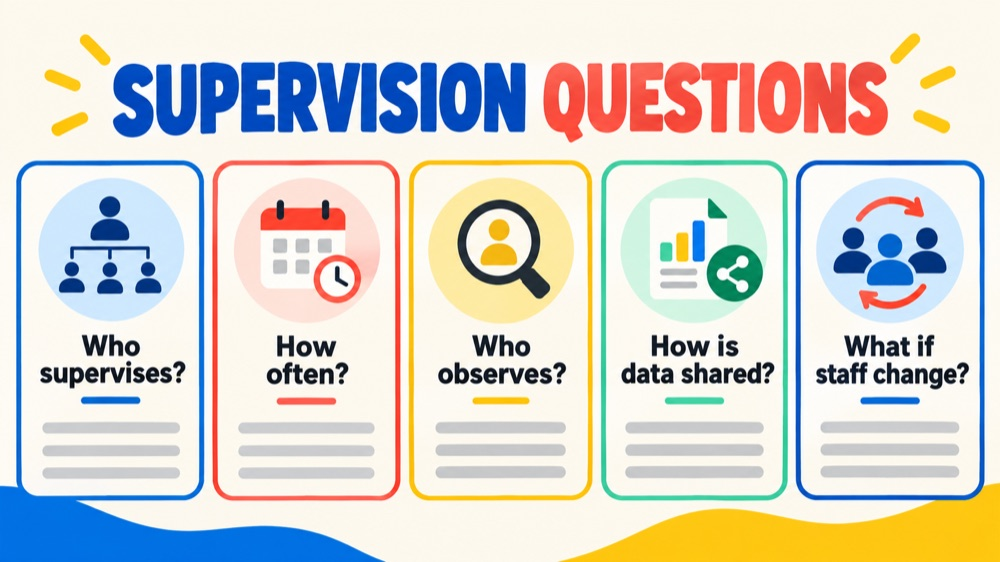
BACB’s current Handbook explains that supervision must be met at each organization where an RBT provides behavior-analytic services. It also describes how supervisors and requirements coordinators may share responsibility. A parent does not need to memorize the structure, but it is reasonable to ask the provider to explain it in plain language.
RBT supervision questions about observation and feedback
“We supervise our RBTs” is a useful starting statement, not a complete description. Ask what supervision looks like during actual services:
- How often will the supervisor observe the RBT working with my child in real time?
- Will observations happen in the home, clinic, school-related setting, community, or through another approved format?
- How does the supervisor provide feedback to the RBT after observing?
- How does the provider check that the written program is being implemented as intended?
- What happens when the supervisor identifies a training need or an implementation concern?
The BACB minimum is a certification requirement, not a universal recommendation for the amount of clinical oversight every child should receive. A provider should be able to explain how the child’s needs, program changes, staff experience, and data review affect the supervision plan. Be cautious of a response that gives only a percentage and cannot describe observation, feedback, or follow-up.
RBT supervision questions about data, goals, and family communication
Supervision is connected to the child’s program, so ask how information travels between sessions and the clinical team:
- What data will the RBT collect, and how will the supervising clinician review it?
- How often will caregivers receive a plain-language progress update?
- Who explains what a graph, percentage, or change in a target means?
- How are caregiver priorities included when goals are selected or reviewed?
- What does the provider do if progress is limited, a goal is not meaningful, or the family has a concern about the approach?
Ask for examples rather than only promises. “We send updates” could mean a brief note, a scheduled meeting, a portal report, or something else. Ask when the update arrives, who is available for questions, and whether caregivers can review relevant information in a format they understand.
Also ask how the provider respects communication, dignity, assent-related behavior, and family priorities. A supervision system should support safe and ethical service delivery, not only produce a completed checklist.
Questions about staff changes and continuity
Even a well-organized provider can experience illness, hiring delays, vacations, or turnover. The useful question is not whether staff will ever change; it is whether the provider has a clear continuity process:
- How will the family be notified if the assigned RBT or supervisor changes?
- How is a new RBT trained on the child’s current program before beginning direct services?
- Will the supervising clinician observe the new RBT and review implementation?
- What happens to scheduling, goals, data, and caregiver communication during the transition?
- Who is the contact person while a permanent staff member is being identified?
Specific answers often include a handoff, review of current programs and safety procedures, supported introduction, and a point of contact. Ask how the family’s observations will be heard during the transition. Continuity is not simply keeping a name on a schedule; it is maintaining understandable communication and responsible oversight.
How to compare answers without treating the call like a test
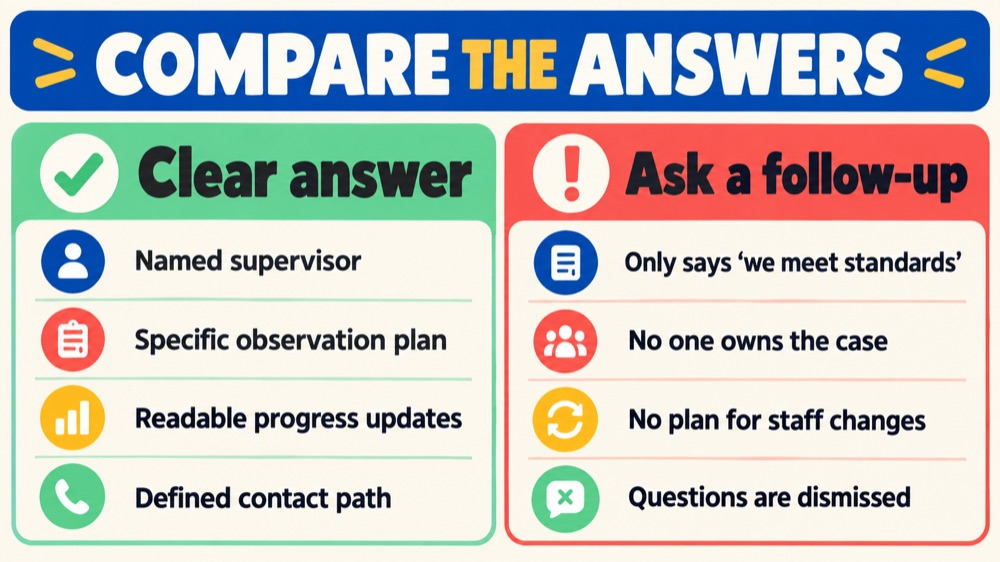
After the call, sort answers into three groups:
- Clear answer: a named role, a realistic process, a defined communication path, and an explanation of what happens when circumstances change.
- Follow-up needed: the answer may be reasonable but lacks a detail you need, such as who reviews data, how often observations occur, or how caregivers receive updates.
- Unresolved concern: no one can explain who is responsible, questions are dismissed, or the provider promises a result without explaining the process behind it.
A provider may not be able to guarantee a specific RBT, schedule, number of weekly hours, or outcome before assessment and authorization. That is different from refusing to explain the decision process. Look for transparent limits, a way to ask questions, and a plan to revisit the fit as the team learns more about your child.
Frequently asked questions
What is the most important question to ask about RBT supervision?
Ask who is responsible for the RBT’s work with your child and how that person will observe, review data, provide feedback, and communicate with the family. A percentage alone does not explain the full supervision relationship.
What does the BACB minimum mean for a family?
The current RBT Handbook describes a minimum of 5% of the hours an RBT spends providing behavior-analytic services each calendar month. It is a credentialing requirement, not a universal recommendation for the amount of clinical oversight every child should receive.
Can parents ask to observe an RBT session?
Ask the provider about its observation policy, setting, privacy requirements, and clinical considerations. Policies vary. A clear provider should explain how caregivers can be involved and how questions or observations are handled.
What if the provider says the RBT is supervised but cannot name the supervisor?
Ask for the responsible role, contact path, and timing for confirmation. You can also ask how the provider handles supervision records and changes. If the answer remains unclear, treat that as an unresolved question before committing.
Should every provider answer these questions identically?
No. Setting, staffing, payer rules, child needs, and organizational structure differ. The useful comparison is whether the provider can give a specific, understandable, accountable answer and explain what happens when the plan changes.
Official sources and scope
This guide was checked against the BACB RBT Handbook, BACB’s supervision and training guidance, the RBT resource page, and the Supervision Checklist for RBTs. BACB requirements and provider policies can change; the current source documents and the qualified clinical team control a particular service arrangement.
Ready to practice the RBT concepts you just reviewed?
Try an independent, original RBT practice resource with exam-style questions, scoring, and answer explanations.
References
- Behavior Analyst Certification Board. RBT Test Content Outline, 3rd edition.
- Behavior Analyst Certification Board. RBT Handbook.
- Behavior Analyst Certification Board. RBT Ethics Code.