
The phrase RBT background check 180 days usually refers to when a criminal background check and abuse registry check must be completed in relation to paying for an RBT certification application. It is not the same as the application’s 90-day active window, and it does not replace state or employer rules. This guide separates the dates, explains what records to keep, and gives you a practical check-before-you-submit workflow.
Table of Contents
- RBT background check 180 days: the short answer
- What the 180-day rule is measuring
- Criminal background check and abuse registry check are separate checks
- What the attesting certificant confirms
- How to build a safe application timeline
- What to verify locally before you pay
- Common timing mistakes
- Frequently asked questions
- Official sources and scope
RBT application timing, screening records, and certification readiness
RBT Background Check 180 Days: Timing, Records, and Application Prep
Separate the BACB timing window from local screening rules, then organize your documents before you pay.
If you are searching for RBT background check 180 days, you are probably trying to answer a date question: how recent must the screening be before you pay for an RBT certification application? The current BACB Handbook says the criminal background check must be completed and passed no more than 180 days before paying for the application. The Handbook also addresses an abuse registry check in the same relationship to payment.
That rule is only one part of the application path. It is not the same as the application’s 90-day active period, and it does not erase additional state, employer, school, healthcare, or agency requirements. Use this article as a planning guide, then check the current BACB Handbook, your portal instructions, and the organization that will rely on the screening.
RBT background check 180 days: the short answer
The practical answer is:
- Plan for the criminal background check to be completed and passed within the allowed 180-day relationship before you pay the RBT certification application fee.
- Track the abuse registry check separately. Do not assume that a criminal background report automatically includes the registry search.
- Keep the result dates, issuing organization, report or confirmation, and any required attestation record in a secure place.
- Ask your employer, state, or placement organization whether it requires fingerprinting, a specific vendor, a new report, or continuous monitoring.
- Do not combine this 180-day timing rule with the application’s active 90-day window or an attestation deadline after payment.
The safest workflow is to confirm the current requirement first, schedule the checks, save proof of the dates and outcomes, and only then pay when the rest of your application file is ready. A calendar reminder helps, but it is not an official extension or approval.
What the 180-day rule is measuring
The key date is the date you pay for the RBT certification application. The screening must be recent enough in relation to that payment date under the current Handbook language. This is different from asking whether a report is “less than six months old” in the abstract, because the relevant comparison is to the application payment and the exact current wording.
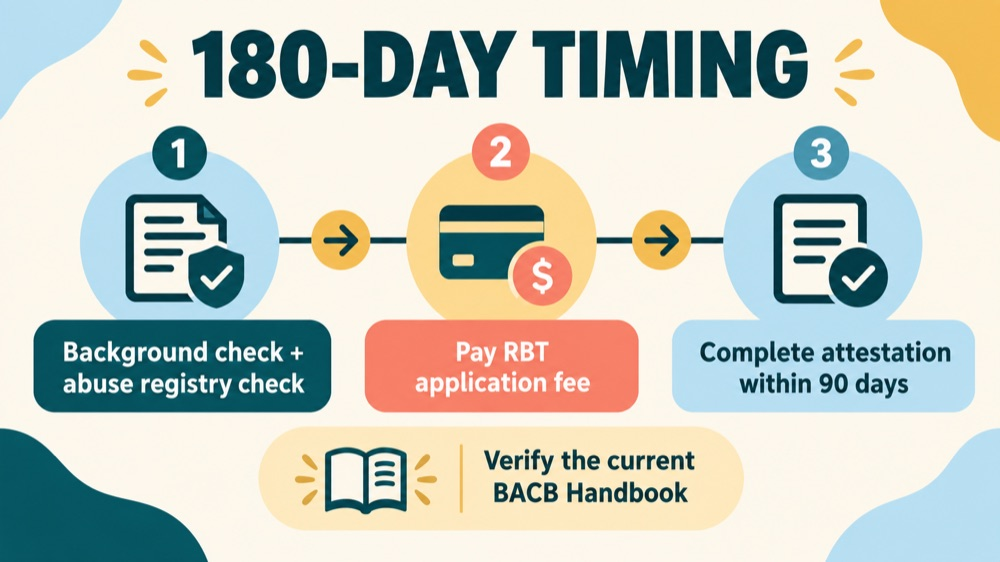
For planning purposes, write down three dates for each report:
- Request date: when you ordered or submitted the check.
- Completion or result date: when the check was completed and the result was issued or confirmed.
- Application payment date: the date you paid the BACB application fee.
Those dates may not be identical. A request can be delayed, a report can be returned later, and an organization may use a separate date for a registry search. Preserve the official confirmation instead of relying on memory or a text message that does not identify what was checked.
Criminal background check and abuse registry check are separate checks
The BACB application guidance treats a criminal background check and an abuse registry check as distinct eligibility items. A criminal check may search records maintained by a court or law-enforcement system. An abuse registry check may be a separate search of a state or jurisdictional registry. The names, providers, and delivery methods can vary.
| Item | What to confirm | Why it matters |
|---|---|---|
| Criminal background check | That it was completed, passed, and dated within the current BACB window before application payment. | This is the core 180-day timing question. |
| Abuse registry check | That the applicable registry was searched and the result date is documented separately. | One report may not prove that a registry search occurred. |
| Local screening rule | Whether a state, employer, school, payer, or agency adds a vendor, fingerprint, or renewal requirement. | Local rules can be stricter or more specific than the BACB baseline. |
| Record retention | Where you can securely keep confirmations, dates, and instructions. | You may need to answer an action item or show the organization what was completed. |
Fingerprinting is a good example of why local verification matters. BACB guidance does not make fingerprinting a universal BACB requirement, but a state or organization can still require it for the work setting. Do not read “not required by BACB” as “never required anywhere.”
What the attesting certificant confirms
The application includes an attestation step in which the person responsible for attesting confirms relevant eligibility information. That person should review the current requirements and the records they are signing. An attestation is not a substitute for completing the underlying check, and it should not be treated as a promise that the application will be approved.
There is also a separate timing relationship after application payment for the attestation and other application items. This is where many applicants accidentally merge two timelines:
- Before payment: the background and registry checks need to fit the current 180-day requirement.
- After payment: the attestation and other application steps may have their own 90-day instructions.
- Throughout review: the portal can issue an action item or request for clarification.
Use the current Handbook and the specific application communication to decide what date applies. If the person who will attest cannot verify the record or does not understand the current form, pause and resolve that before submitting.
How to build a safe application timeline
A simple timeline reduces last-minute errors:
- Start with the current source. Download the current RBT Handbook and application instructions from BACB. Check the revision date before using a saved copy.
- List every check. Put the criminal background check, abuse registry check, employer screening, and state screening on separate lines.
- Ask who accepts the result. Confirm whether the check must come from a particular provider or be sent directly to the organization.
- Complete and save proof. Keep the result or confirmation, completion date, issuing organization, and any follow-up instructions.
- Choose the payment date carefully. Pay only when the screening dates and the rest of the application file fit the current instructions.
- Set the post-payment reminders. Track attestation, action items, and the application’s active window as separate reminders.
This is a planning sequence, not a guarantee that every application will follow the same path. A self-report, a name correction, a jurisdictional issue, or a portal action item can require additional communication.
What to verify locally before you pay
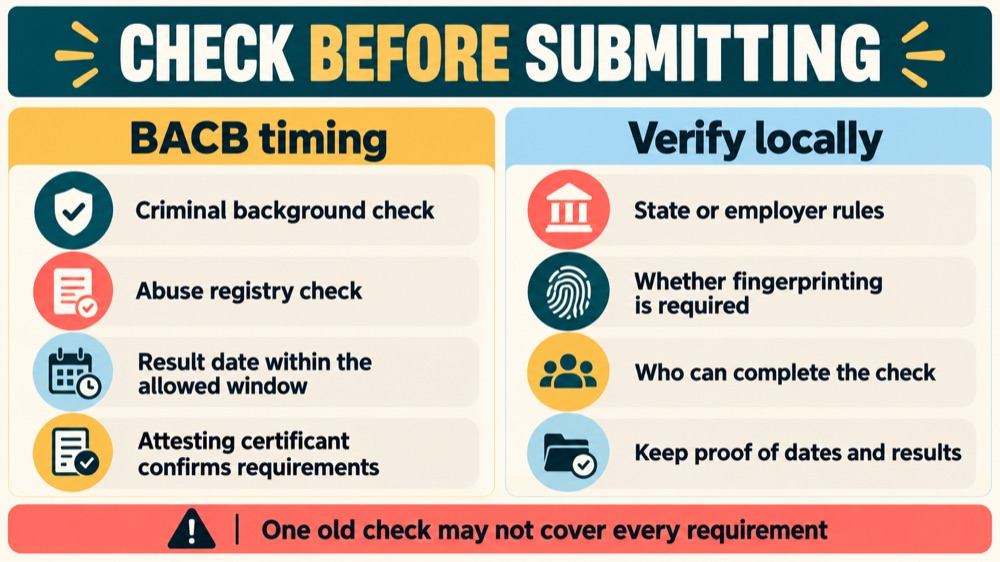
Before you submit payment, ask these questions in writing when possible:
- Does the employer or state require fingerprinting even though BACB does not make it universal?
- Does the organization require a report from a particular vendor or an original result sent directly to it?
- Is there a separate abuse registry or vulnerable-person registry search?
- Does the organization use continuous monitoring, and how should that be documented?
- How long will the organization accept the result, and does that period differ from the BACB window?
- Who is allowed to review or attest to the record?
A continuous monitoring system can change how an organization documents a current screening result, but do not assume it automatically resolves every BACB or local requirement. Follow the current instructions of both the BACB and the organization.
Common timing mistakes
- Counting from the request date. The request date may not be the completion or result date used by the requirement.
- Using one report for two checks. Confirm whether the criminal and abuse registry searches are separately documented.
- Applying with an old report. A report accepted by an employer last year may not fit the current BACB timing relationship.
- Assuming fingerprinting is always unnecessary. BACB and local organization requirements are not identical.
- Confusing 180 days with 90 days. Background-check timing before payment, attestation timing after payment, and application activity are different questions.
- Deleting the proof. Keep a secure copy of dates, results, and the instructions used to obtain them.
- Relying on an old checklist. Current Handbook language and portal messages take priority over a provider’s saved PDF or social-media post.
Frequently asked questions
What does the RBT background check 180 days rule mean?
It generally means the criminal background check must be completed and passed no more than 180 days before you pay for the RBT certification application, under the current BACB Handbook language. The abuse registry check has a related timing requirement, so verify both checks separately.
Can I use a background check from my current employer?
Maybe, but do not assume it qualifies. Confirm the completion date, what was searched, who issued the result, whether the organization accepts it, and whether the current BACB instructions require another format or check.
Does BACB require fingerprints for every RBT applicant?
No universal fingerprinting requirement should be inferred from the BACB baseline. A state, employer, school, healthcare organization, or agency may still require fingerprinting or another screening method. Verify locally.
Is the 180-day background-check window the same as the RBT application’s 90-day window?
No. The background-check window relates to the check’s recency before application payment. The application’s 90-day active period and any post-payment attestation deadline are separate timing questions.
What if my check is outside the allowed window?
Do not guess or submit a date that no longer fits the current instructions. Ask the BACB or the relevant organization whether a new check is needed, and confirm the current Handbook before paying.
Official sources and scope
This guide summarizes public BACB application guidance for educational planning. Requirements, forms, fees, processing updates, and local screening rules can change. Review the current BACB RBT Handbook, BACB application tips, RBT application page, and application-processing updates before acting. This article is not individualized certification, legal, immigration, employment, or financial advice.
Next step: Build your own RBT application checklist with separate lines for the criminal background check, abuse registry check, payment date, attestation, and local employer requirements.
Ready to practice the RBT concepts you just reviewed?
Try an independent, original RBT practice resource with exam-style questions, scoring, and answer explanations.
References
- Behavior Analyst Certification Board. RBT Test Content Outline, 3rd edition.
- Behavior Analyst Certification Board. RBT Handbook.
- Behavior Analyst Certification Board. RBT Ethics Code.