

rbt training start date: this guide explains the planning and recordkeeping question behind the topic, while the current BACB Handbook, forms, and portal instructions control the final requirement.
rbt training start date: The RBT training start date is a record, not a guess
The RBT training start date is the first date that belongs to the required 40-hour training record. It is not automatically the date a learner creates an account, pays a provider, downloads a syllabus, or watches an unrelated orientation. The provider’s attendance or platform record should identify when the required course actually began.
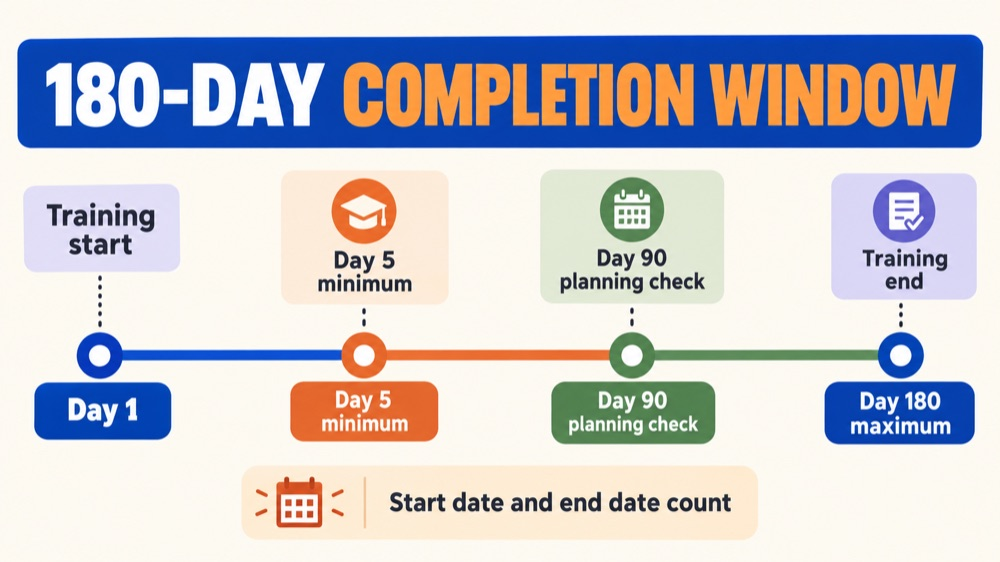
This distinction matters because the current BACB Handbook describes both a minimum five-day duration and a maximum 180-day duration for the 40-hour training. A reliable start date lets an applicant calculate the full window and plan the completion date without confusing training with the later application process.
What should count as the first training date?
Ask the provider how it defines the first course date and keep that answer with the enrollment information. For an instructor-led course, it may be the first scheduled class in the required curriculum. For an approved self-paced format, it may be the first date recorded in the learning platform. The provider’s records should be consistent with the completion certificate.
Do not choose a convenient date after the fact. If the course was paused, the provider should explain whether the original start date remains the start of the same course or whether a new enrollment was created. The goal is not to make the window look shorter; it is to preserve a truthful, reviewable timeline.
Build a start-to-completion timeline
Write the start date on the first line, then list each training session or platform milestone. Add the final date on which the provider recognizes all 40 hours as complete. Include the dates of any pause, transfer, or course version change. If the provider gives only a beginning and ending date, retain that document and ask for a session history if your record needs more detail.
Count calendar days with both the start and end dates included when applying the current rule. A calendar worksheet can show day 1, day 5, and day 180 as planning markers, but it does not override the official wording. If the dates are close to a boundary, ask the provider or BACB for clarification before submitting an application.
Keep training and application dates in separate columns
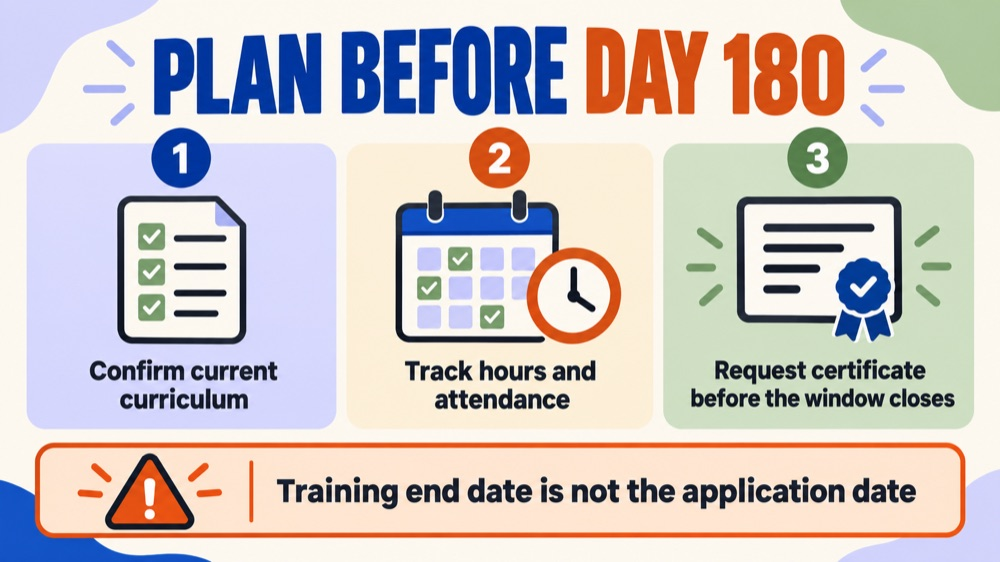
Create one column for training dates and another for certification steps. Training dates include the first session, the last session, and the certificate date. Application dates may include payment, attestation, competency assessment, background checks, and portal notices. This layout prevents a learner from treating the 180-day training maximum as an application extension.
The same separation helps when an application is delayed. Completing the training on time does not by itself submit an application, authorize an examination, or prove that every other requirement is complete. Each row should name the official document that supports the date.
What to do when the provider’s dates conflict
If the enrollment email says one date and the certificate says another, pause before uploading either document. Contact the provider and ask for a corrected certificate or a short written explanation. Save both the request and the response. Do not manually change dates in a PDF or rename a file in a way that hides the original date.
If a provider cannot explain the conflict, compare the course record with the current BACB curriculum and Handbook. Official instructions control, and a portal reviewer may ask for additional evidence. A clean correction is better than submitting two inconsistent dates and hoping the difference is ignored.
A practical calendar review
At the beginning of training, confirm the provider, course version, expected start date, and expected completion date. Midway through, check that hours and sessions are being recorded. Near completion, confirm that the final date stays inside the allowed window and that the certificate will use the same name and dates as the provider record.
After completion, move the final certificate into an application folder and keep the timeline as supporting documentation. Then review the current application instructions separately. The best calendar is one that makes the next action obvious without implying that one deadline controls every other step.
Frequently asked questions
Can the enrollment date be used as the training start date? Only if it is also the date the required training began under the provider’s records. Enrollment and instruction are not always the same event.
What if the training takes longer than planned? Check the official maximum window immediately and ask the provider how the course record should be handled. Do not assume a pause creates an automatic extension.
Does a start date decide application approval? No. It is one part of a training record; the complete current BACB requirements control.
How to keep the decision clear
Before you close the file, write one sentence stating what the record proves and one sentence stating what it does not prove. For example, a training record can show completion, but it cannot by itself show that an application was approved. A signed form can show that an attestor made a confirmation, but it cannot replace a missing eligibility document. A calendar can show the dates you planned, but it cannot change an official deadline. This small distinction keeps a useful checklist from becoming an unsupported promise.
Save the current official source with the review date, then set a reminder to recheck it if your application or recertification cycle continues. Forms, handbook language, fees, portal instructions, and processing information can change. When a source changes, update the plan and preserve the earlier record rather than silently rewriting history. That approach makes the file easier for the applicant, provider, attestor, or assessor to understand later.
When the review is complete, record the next action, the person responsible for it, and the date you intend to revisit it. If the next action depends on an official response, label it as waiting rather than complete. If the next action is a document correction, keep the correction request with the file. This turns the article’s advice into a small workflow that can be checked by someone else without reinterpreting the whole history.
Keep the review brief enough to repeat. A dated checklist, a source link, and a clearly named next action are more useful than a long note with no owner. If another person takes over the file, they should be able to understand the status without changing any original record.
If the record is shared with a provider, attestor, assessor, or organization administrator, share only the portion needed for that person’s task. Keep a private note of what was sent, when it was sent, and whether a correction was requested. This is a practical privacy measure as well as a quality check: it reduces the chance that an old draft, a duplicate file, or an unrelated personal document is used by mistake.
Use the same review method whenever a date, form version, or portal instruction changes. First identify the official source, then compare the source with the saved record, then document the decision and next action. If the source is unclear, mark the item as needing confirmation. A transparent “waiting for confirmation” note is safer than filling in an uncertain answer and treating it as a completed requirement.
When possible, have a second person perform a visual check without changing the substance. A fresh review often catches a missing page, a mismatched name, an unreadable scan, or a date entered in the wrong field. Keep the reviewer’s note separate from the official form so the original record remains intact.
Source and scope: This is an educational summary of public BACB guidance, not individualized certification, legal, immigration, employment, or financial advice. Check the current BACB Handbook, forms, portal instructions, and organization records before acting.