
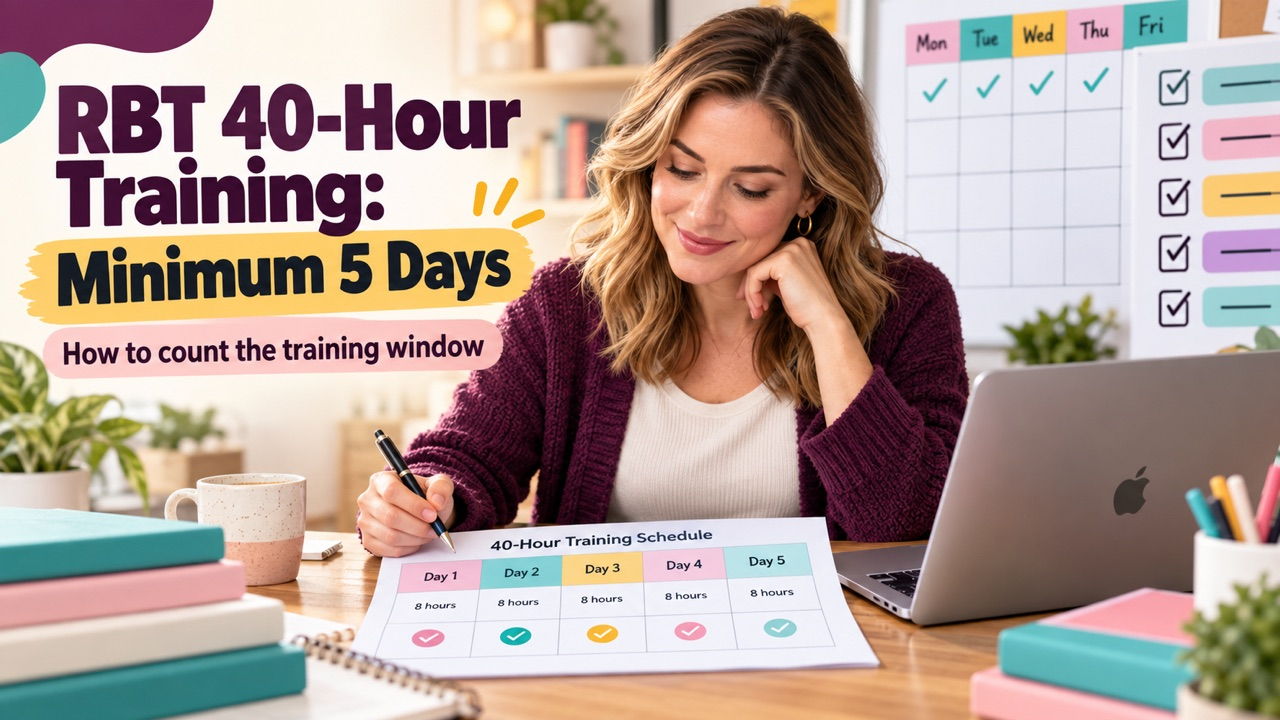
The RBT 40 hour training requirement is not only about reaching 40 clock hours. Under the current BACB RBT Handbook, the training must be completed in no fewer than 5 days and no more than 180 days, with the start date and end date included in the count. This guide focuses on the 5-day minimum, shows how to build a compliant calendar, and separates training duration from later competency assessment and application deadlines.
Table of Contents
- RBT 40 hour training: the 5-day answer
- What the 5-day minimum actually counts
- How to count start and end dates
- 5 days versus 180 days
- How the training certificate fits the application
- Common scheduling mistakes
- Frequently asked questions
- Official sources and scope
RBT 40-hour training, calendar rules, and application readiness
RBT 40-Hour Training: Minimum 5 Days and How to Count It
Reach the required hours while also respecting the calendar window that surrounds the course.
The RBT 40 hour training requirement has two parts that applicants often combine: the course must include at least 40 hours, and it must be spread across a calendar period that meets the current BACB duration rule. The current RBT Handbook says the training must be completed in no fewer than 5 days and no more than 180 days. It also says the start date and end date are included in the total day count.
That means “I finished 40 hours” is not the whole check. Your provider’s dates, curriculum, certificate, and application documents must line up with the current requirements. This guide explains the minimum-duration rule in plain language, then separates it from the maximum duration and the later initial competency assessment.
RBT 40 hour training: the 5-day answer
The short answer is:
- The training must contain at least 40 hours that meet the current RBT 2026 curriculum requirements.
- The training must take place over no fewer than 5 days.
- The start date and end date both count, so a January 1 start and January 5 end is a five-day span under the Handbook example.
- The same training must be completed within the separate maximum window of 180 days.
- The training certificate is one part of the application file; it does not replace the initial competency assessment or other requirements.
For planning, ask the provider to show the official start date, official end date, total hours, curriculum alignment, and certificate process before you enroll. A schedule that looks like five sessions may still need a date check if the first and last dates are closer together than the rule allows.
What the 5-day minimum actually counts
The minimum is a calendar-duration requirement attached to the 40-hour training. It is not permission to compress every hour into a single weekend or to count only the days on which a particular live webinar occurred. The provider should design and document training that meets the current curriculum outline, including the required content areas and training hours.
There are three separate questions:
| Question | What it checks | What to document |
|---|---|---|
| How many hours? | At least 40 hours of training. | Course schedule, modules, attendance or completion record. |
| How many days? | No fewer than 5 days from the start date through the end date, counting both endpoints. | Provider’s official start and end dates. |
| How long overall? | No more than 180 days between the included start and end dates. | Calendar calculation and certificate dates. |
| Does the content qualify? | Alignment with the current RBT 2026 curriculum requirements. | Current outline, provider statement, and certificate. |
Do not use one row to answer another. A course can have 40 hours and still need a date correction. A five-day schedule can still fail to document the required hours. A long enrollment window can still be invalid if the provider’s certificate or curriculum is not current.
How to count start and end dates
For the five-day minimum, count the first training date as day one. Continue counting each calendar date through the final training date. The start date and end date are included; they are not merely timestamps outside the calculation.
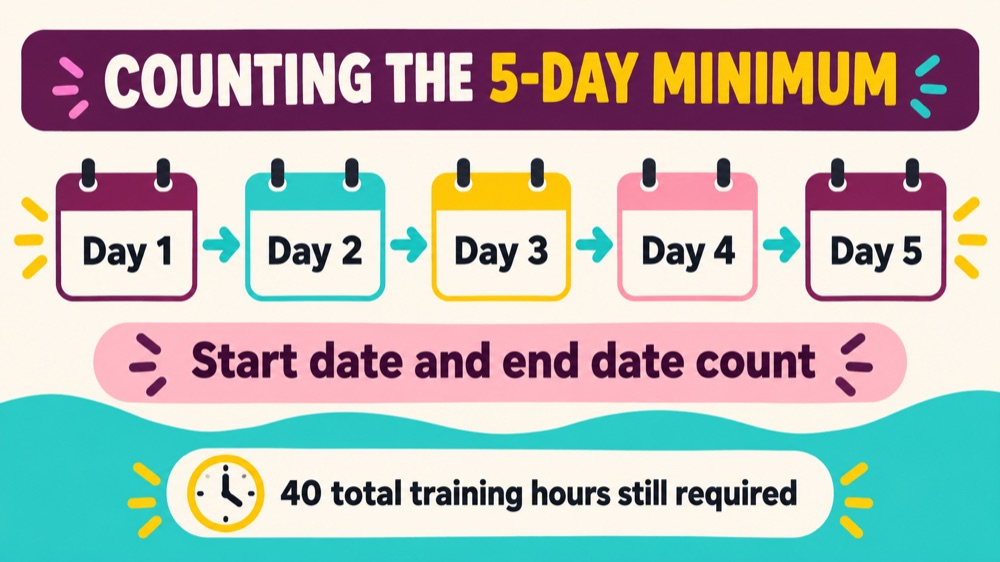
Use this simple review method:
- Write down the provider’s official start date.
- Mark that date as day one.
- Count each calendar day through the official end date.
- Confirm that the count is at least five and no more than 180.
- Compare those dates with the certificate and your application timeline.
For example, January 1 through January 5 includes five calendar dates. January 1 through January 4 includes four dates, even if the course included many hours. This example illustrates the counting method; always use the provider’s actual dates and the current Handbook.
5 days versus 180 days
The minimum and maximum are two boundaries around the same training window. The minimum prevents the training from being compressed below the required duration. The maximum prevents the training from remaining open indefinitely. Neither boundary changes the requirement to complete at least 40 hours of current curriculum-aligned training.
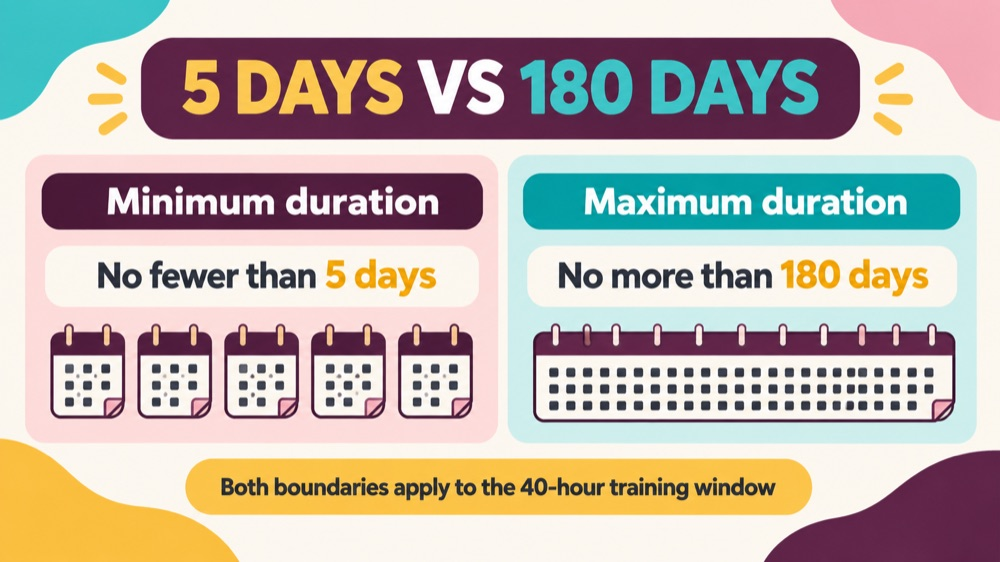
Keep these deadlines separate:
- Training window: from the provider’s start date through its end date, with the 5-day and 180-day boundaries.
- Initial competency assessment: completed after the required training and within the current timing relationship before submitting the application.
- Application timing: the application itself and its active period have separate instructions.
- Background screening: criminal and abuse registry checks have their own relationship to application payment.
Finishing the course does not start a single universal countdown for every later requirement. Build a new reminder for each item and verify the current source before submitting.
How the training certificate fits the application
The current Handbook says to include a copy of the 40-hour training certificate with the RBT certification application. The provider supplies that certificate after completion. Before accepting it, check that the name, start date, end date, total hours, provider identity, and completion statement are clear and consistent.
The BACB does not provide the 40-hour training, issue certificates of completion, or recommend training programs. That means the applicant must evaluate whether the selected course was designed to meet the current requirements. A course title or marketing claim is not a substitute for checking the 2026 curriculum outline.
Also confirm the provider relationship rules. The current Handbook includes restrictions on who may provide the training and who may perform the initial competency assessment. If a provider or assessor is related to, subordinate to, or employed by the applicant in a way the current rule does not permit, ask for clarification before relying on the document.
Common scheduling mistakes
- Counting sessions instead of calendar dates. Five meetings are not automatically five qualifying days if the official start and end dates do not span the required window.
- Counting the start date as zero. The current Handbook counts the start date and end date.
- Focusing on hours only. Reaching 40 hours does not remove the minimum-duration or maximum-duration rule.
- Using an old certificate template. Confirm that the provider’s documents match the current 2026 requirements.
- Confusing training end date with assessment date. The initial competency assessment is a separate requirement with its own timing.
- Waiting too long to finish. The training must remain within the 180-day maximum, even when the applicant is not ready to apply yet.
- Assuming BACB recommends the course. BACB publishes requirements but does not provide or recommend a specific training program.
Frequently asked questions
Can I complete RBT 40-hour training in less than 5 days?
The current Handbook says the training must be completed in no fewer than 5 days. Completing 40 hours does not remove that minimum calendar-duration requirement.
Does January 1 through January 5 count as five days?
Yes, under the Handbook’s endpoint-counting example, the start date and end date are included, so January 1 through January 5 is five calendar dates.
Is the 5-day minimum the same as the 180-day maximum?
No. Five days is the minimum duration and 180 days is the maximum duration for the training window. Both boundaries apply to the same 40-hour training requirement.
Does a 40-hour certificate guarantee application approval?
No. The certificate documents one eligibility requirement. Applicants must still meet the current application, assessment, screening, attestation, and other requirements.
Can the training be online?
The BACB Handbook says the training may be offered by an employer, university, or online training program, but the course still needs to meet the current curriculum, hour, provider, and date requirements.
Official sources and scope
This guide summarizes public BACB training guidance for educational planning. Review the current RBT Handbook, RBT 2026 40-Hour Training Requirements and Curriculum Outline, RBT application resources, and BACB supervision, assessment, and training resources before acting. Requirements, forms, dates, and provider instructions can change. This article is not individualized certification, legal, immigration, employment, or financial advice.
Next step: Ask your training provider to confirm the official start date, end date, 40-hour total, curriculum version, and certificate details before you schedule the initial competency assessment.
Ready to practice the RBT concepts you just reviewed?
Try an independent, original RBT practice resource with exam-style questions, scoring, and answer explanations.
References
- Behavior Analyst Certification Board. RBT Test Content Outline, 3rd edition.
- Behavior Analyst Certification Board. RBT Handbook.
- Behavior Analyst Certification Board. RBT Ethics Code.