

The RBT 40 hour training maximum 180 days rule is the longest period allowed for completing the required training under the current BACB RBT Handbook. The same training also has a minimum duration of 5 days. These are two boundaries around one training window: you cannot compress the course below the minimum, and you cannot leave it open beyond the maximum.
Table of Contents
- RBT 40 hour training maximum 180 days: the short answer
- What the maximum window is measuring
- How to track the 180-day training window
- What to finish before the end date
- Training end date versus application date
- Common maximum-window mistakes
- Frequently asked questions
- Official sources and scope
RBT training duration, completion planning, and application readiness
RBT 40-Hour Training: The 180-Day Maximum Explained
Use the full completion window carefully without confusing training end dates with application deadlines.
The RBT training 180 days rule is the longest period allowed for completing the required 40-hour training under the current BACB RBT Handbook. The same training also has a minimum duration of 5 days. These are two boundaries around one training window: you cannot compress the course below the minimum, and you cannot leave it open beyond the maximum.
The maximum is not an automatic application extension. It does not mean a certificate can be issued after an incomplete course, and it does not replace the initial competency assessment or application requirements. This guide shows how to track the training window and keep the end date separate from later certification dates.
RBT 40 hour training maximum 180 days: the short answer
The practical answer is:
- Complete the required 40 hours within a period of no more than 180 days.
- Count the start date and end date in the total-day calculation.
- Also meet the separate minimum duration of no fewer than 5 days.
- Track curriculum completion, attendance or participation, hours, and the provider’s certificate process before the last day.
- Do not treat the training end date as the application submission date, assessment deadline, or background-check date.
A long window can be useful when work, school, or family responsibilities make a compressed schedule unrealistic. It can also create risk if the applicant waits until the last few weeks to check the curriculum, recover a missing attendance record, or schedule the certificate. Use the maximum as an outside boundary, not as a target to approach without a plan.
RBT 40 hour training maximum 180 days: what the maximum measures
The maximum window is a planning boundary, so write the start date, completion date, and any pause or provider correction in one timeline. The boundary does not replace the current curriculum or completion requirements.
RBT 40 hour training maximum 180 days: how to track it
Use the provider record and the current Handbook together. Check the calendar before the last week, confirm the final certificate, and keep training dates separate from application dates.
What the maximum window is measuring
The 180-day rule measures the period from the official training start date through the official training end date. The provider’s documentation should identify those dates clearly. The fact that a student logs in or studies on scattered days does not remove the need for a valid start-to-end window.
| Training question | What it means | What to verify |
|---|---|---|
| Minimum duration | The training must span no fewer than 5 days. | Start date, end date, and endpoint-inclusive count. |
| Maximum duration | The same training must finish within no more than 180 days. | Provider’s official dates and completion record. |
| Hour total | The course must include at least 40 hours. | Modules, schedule, attendance, and certificate. |
| Curriculum | The course must meet the current RBT 2026 outline. | Current outline and provider confirmation. |
These checks work together. A course can be inside the 180-day window and still lack the required hours. It can have 40 hours and still use dates that fail the minimum or maximum. It can have acceptable dates and hours but use an outdated curriculum. Review the full set before asking for the certificate.
How to track the 180-day training window
Create a simple record when the course begins:
- Record the official start date. Use the date shown by the provider, not the date you first browsed the course page.
- Mark the five-day minimum. This confirms the earliest possible end date under the endpoint-inclusive rule.
- Add planning checkpoints. A 30-day or 90-day review can reveal missing modules, attendance issues, or an unavailable trainer before the final month.
- Mark the 180-day maximum. Keep the date visible in your calendar and ask the provider how its completion date is recorded.
- Confirm the end date. Make sure the final module, required hours, and certificate request are finished before the window closes.
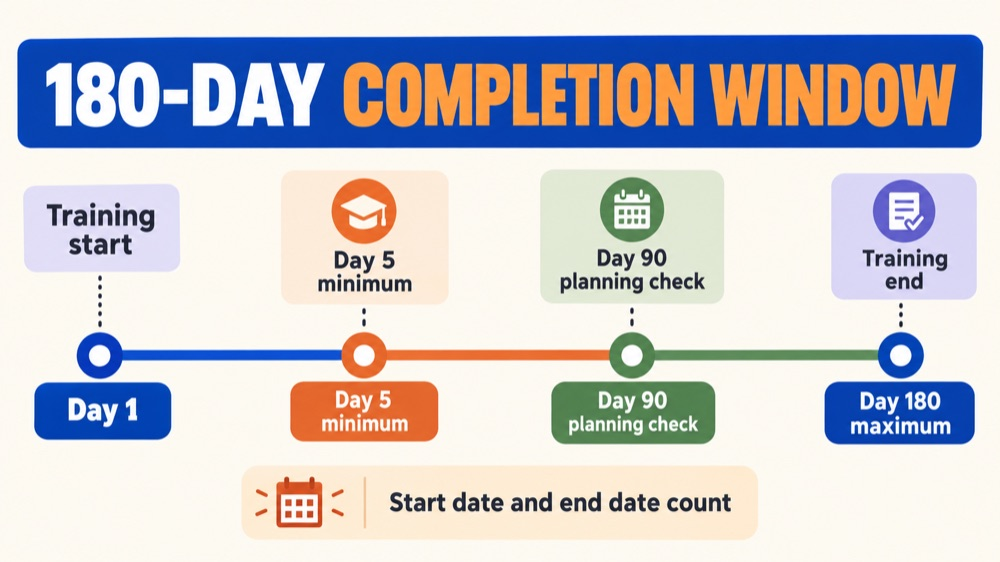
The official Handbook example explains how to count the endpoints: a training start on January 1 can end no earlier than January 5 and no later than June 29 in the example year. The exact calendar dates can change with the start date and year, so use the current source and provider record rather than copying an example blindly.
RBT 40 hour training maximum 180 days: what to finish before the end date
Use the last planning checkpoint to confirm hours, curriculum evidence, the provider certificate, and the next application step. Treat the end date as a boundary to prepare for, not as permission to postpone a missing document.
What to finish before the end date
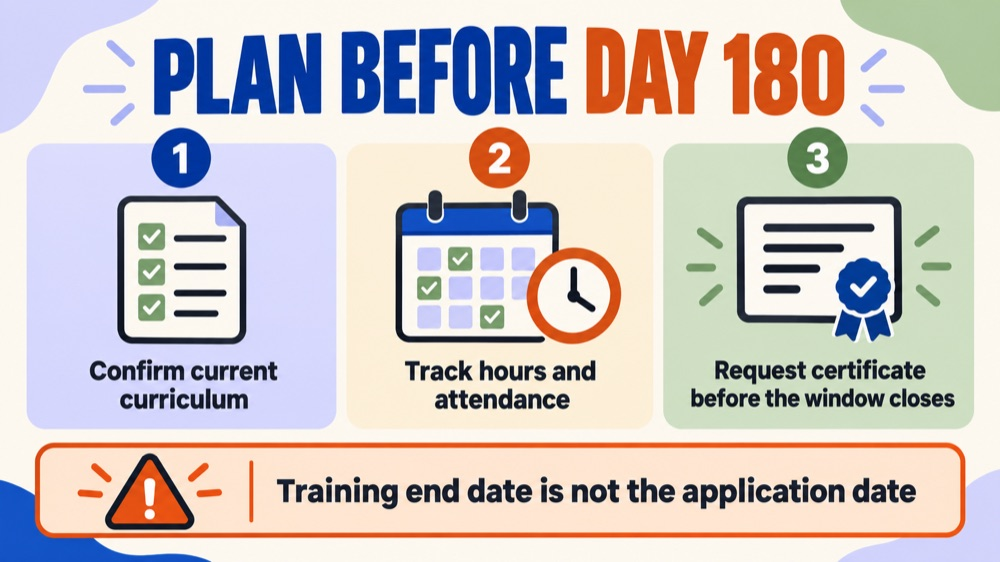
Before the final training date, verify all of the following:
- The course includes the current RBT 2026 curriculum content.
- You have completed at least 40 hours as documented by the provider.
- The attendance or participation record is complete and can be supported if requested.
- The start and end dates appear consistently across the provider record and certificate.
- The provider can issue the certificate required for the application.
- You know when and how to schedule the initial competency assessment after training.
The BACB does not provide 40-hour training, certificates of completion, or training-program recommendations. The applicant therefore needs to confirm that the selected course was designed to meet the current requirements. A course advertisement can be a starting point, but the current curriculum outline and certificate details are the better evidence.
Training end date versus application date
Finishing the 40-hour training is not the same action as submitting an RBT certification application. After the training, the applicant may need to complete the initial competency assessment within the current timing relationship and gather other eligibility documents. The application itself has its own active period and portal instructions.
Keep the dates in separate rows:
| Date | Question it answers |
|---|---|
| Training start | When the 5-day-to-180-day training window begins. |
| Training end | When the 40 hours and current curriculum should be complete. |
| Assessment date | When the initial competency assessment was completed under its own rule. |
| Application payment or submission | When the certification application enters its own process and timing rules. |
This separation prevents a common mistake: assuming that a course completed on day 180 gives unlimited time to submit every later document. Check the current application instructions immediately after training and record the next deadlines separately.
Common maximum-window mistakes
- Using day 181 as a buffer. The maximum is an outside boundary, not a grace period.
- Counting from the wrong date. Use the provider’s official start date, not the date of an informal orientation email.
- Ignoring endpoint counting. Start and end dates both count in the current Handbook’s calculation.
- Waiting to check the certificate. Missing a date, hour total, or curriculum statement can take time to correct.
- Confusing training with assessment. The initial competency assessment is a separate step after the required training.
- Confusing training with application timing. The application’s active window and screening dates are not reset automatically by finishing training.
- Relying on an old course outline. Confirm the current 2026 curriculum requirements and provider documents.
Frequently asked questions
What is the RBT training 180 days rule?
It is the maximum period for completing the required 40-hour training under the current BACB Handbook. The start and end dates count in the total, and the training must also meet the separate minimum of 5 days.
Can I take longer than 180 days to finish the 40-hour training?
The current Handbook says the training must be completed in no more than 180 days. Do not assume a late finish can be accepted; ask the provider how to address a course that is outside the current window.
Does day 180 count?
The Handbook’s endpoint-counting rule includes the start date and end date. The exact date calculation should use the provider’s official start date and the current source language.
Does finishing training mean I can immediately take the RBT exam?
No. Training is one eligibility step. The initial competency assessment, application, screening, attestation, and examination authorization have separate requirements and timing.
What if my provider cannot issue the certificate before day 180?
Contact the provider promptly and review the current BACB instructions. Keep proof of your training dates and hours, but do not assume that proof alone creates an extension or guarantees acceptance.
Official sources and scope
This guide summarizes public BACB training guidance for educational planning. Review the current RBT Handbook, RBT 2026 40-Hour Training Requirements and Curriculum Outline, RBT application resources, and BACB supervision, assessment, and training resources before acting. Requirements, forms, dates, and provider instructions can change. This article is not individualized certification, legal, immigration, employment, or financial advice.
Next step: Add the training start date, day-5 minimum checkpoint, day-90 planning review, and day-180 maximum to your calendar, then confirm the provider’s certificate process.
Ready to practice the RBT concepts you just reviewed?
Try an independent, original RBT practice resource with exam-style questions, scoring, and answer explanations.
References
- Behavior Analyst Certification Board. RBT Test Content Outline, 3rd edition.
- Behavior Analyst Certification Board. RBT Handbook.
- Behavior Analyst Certification Board. RBT Ethics Code.