

A negative reinforcement ABA definition has two parts: something is removed, reduced, or avoided after a behavior, and that behavior becomes more likely in similar conditions. The word negative describes removal; reinforcement describes an increase in behavior. It does not mean the procedure is automatically harmful, and it is not the same as punishment.
Table of Contents
- Negative reinforcement ABA definition: the short answer
- Break down the two parts of the term
- Examples of escape and avoidance
- Negative reinforcement versus punishment
- What to measure and ask
- What an RBT should do
- Common definition mistakes
- Frequently asked questions
ABA definitions, escape and avoidance, examples, measurement, and RBT role boundaries
Negative Reinforcement ABA Definition: Clear Examples
Understand what is removed, why the behavior increases, and why negative reinforcement is not the same as punishment.
A negative reinforcement ABA definition has two parts: something is removed, reduced, or avoided after a behavior, and that behavior becomes more likely in similar conditions. The word negative describes removal; reinforcement describes an increase in behavior. It does not mean the procedure is automatically harmful, and it is not the same as punishment.
In practice, the relation must be defined rather than guessed. A single event where something stops does not prove reinforcement. You need an observable behavior, a clear consequence, and evidence that the behavior changes over time or across similar opportunities. RBTs follow assigned procedures and bring questions to their supervisor.
Negative reinforcement ABA definition: the short answer
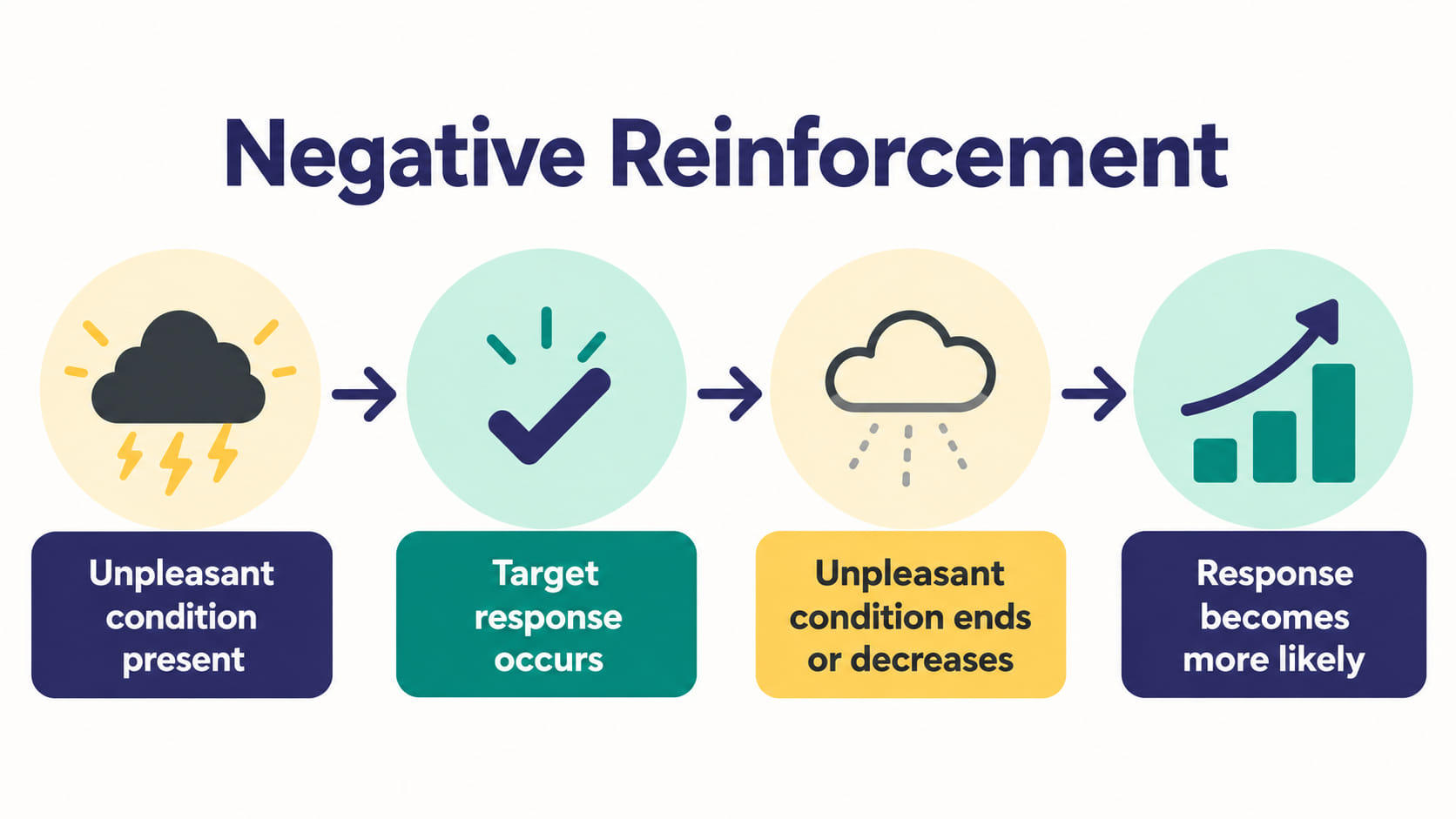
Use this plain-language sequence:
- An unpleasant or aversive condition is present, or a person expects it to occur.
- A target response occurs.
- The unpleasant condition ends, becomes less intense, or is avoided.
- The target response becomes more likely in comparable situations.
“Negative” does not mean bad and “reinforcement” does not mean a reward was added. The defining questions are what changed after the response and whether the response increased. If the behavior decreases instead, the label is not supported by the definition of reinforcement.
Break down the two parts of the term
Negative refers to subtracting, stopping, reducing, or preventing something. The “something” might be an uncomfortable demand, a loud sound, a delay, or another condition identified in a written plan. It is not enough to call an event unpleasant because an observer dislikes it; the relevant condition and response must be described objectively.
Reinforcement means that the behavior becomes more likely. This is a functional description, not a moral judgment. If a learner requests a break and the request is followed by the planned removal of a task, the request could increase in future task situations. Whether that is the intended teaching arrangement depends on the plan, communication goals, safety, and supervisor direction.
Do not assume that removing a demand will reinforce every behavior that happens before the removal. If several responses occur, identify which response was followed by the change and whether that response changes over repeated opportunities.
Examples of escape and avoidance
An escape example begins with an aversive condition already present. A learner is given a difficult task, uses an agreed communication response for a break, and the task is paused according to the written plan. If the communication response becomes more likely when similar tasks are presented, the removal may be functioning as negative reinforcement for that response.
An avoidance example occurs before the condition begins. A learner sees a visual signal for a difficult transition and uses a taught communication response. The transition is adjusted or delayed according to the plan, and that communication response becomes more likely when the signal appears. The relevant question is not whether someone “got out of” a task in a casual sense; it is whether the defined response and consequence have the stated relation.
These examples do not authorize an RBT to remove tasks, change demands, or create new escape contingencies independently. A supervisor and the written program determine what response is taught, what consequence is available, when it is delivered, and how safety and skill acquisition are protected.
Negative reinforcement versus punishment
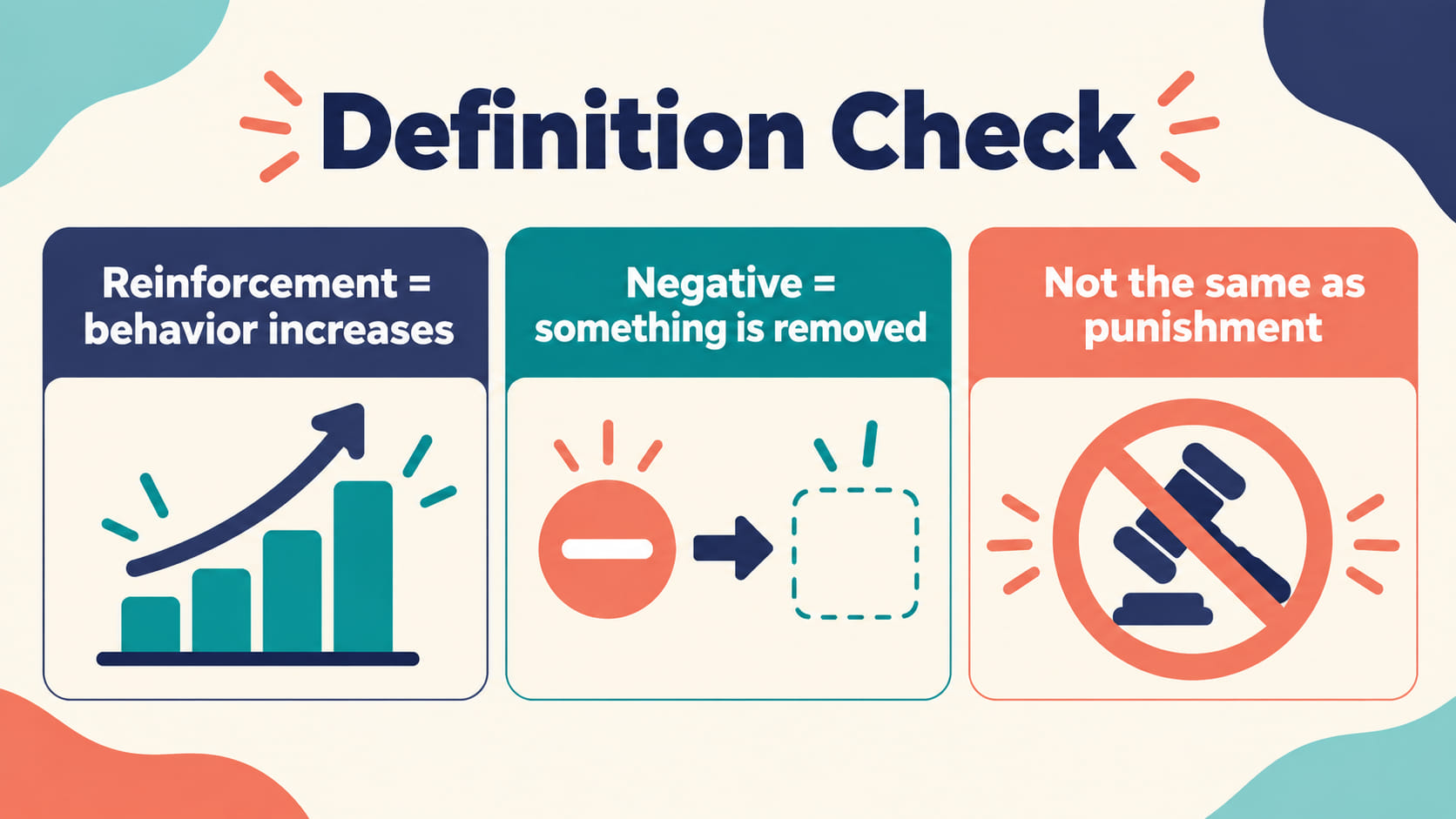
Negative reinforcement and punishment are easy to confuse because both can involve something being removed or added. The difference is the effect on behavior:
- Negative reinforcement: something is removed or avoided, and the behavior increases.
- Positive reinforcement: something is added, and the behavior increases.
- Negative punishment: something is removed, and the behavior decreases.
- Positive punishment: something is added, and the behavior decreases.
The words positive and negative describe addition and removal, not “good” and “bad.” The words reinforcement and punishment describe whether the behavior increases or decreases. Always look at the measured behavior instead of labeling a procedure from the emotion or intention surrounding it.
What to measure and ask
To evaluate a suspected negative-reinforcement relation, describe the antecedent, the target response, the immediate consequence, and the later behavior pattern. Depending on the program, measurement might include frequency, duration, latency, percentage of opportunities, or another defined system. The supervisor chooses the measurement system; the RBT records it accurately.
Ask questions such as: What condition is present? What exactly counts as the response? What is removed or reduced? How quickly does the consequence occur? What behavior should increase? What should happen if the response is unsafe, unclear, or outside the plan? These questions protect against labeling a situation from a vague impression.
Also record exceptions and context. If a task is removed because of a safety concern, that event should not automatically be treated as an instructional reinforcement arrangement. Follow the plan for safety, document objectively, and notify the supervisor as required.
What an RBT should do
- Read the current written plan and identify the defined response, consequence, measurement, and prompting instructions.
- Implement the assigned procedure consistently and record what happened without adding interpretations to the data.
- Use the learner’s taught communication response and follow the supervisor’s direction for breaks, demands, transitions, and reinforcement.
- Ask before changing a task, consequence, schedule, prompt, or data system.
- Report safety concerns, unexpected patterns, missing instructions, and possible side effects through the required supervision channel.
An RBT should not independently create an aversive condition, decide that a learner “needs escape,” or continue a procedure that appears unsafe or inconsistent with the written plan. Competent implementation includes recognizing when a situation needs clarification.
Common definition mistakes
- Calling it punishment: removal alone does not define punishment; the effect on behavior does.
- Calling every break reinforcement: the response and later increase must be defined and measured.
- Confusing negative with harmful: the term describes removal, not a moral verdict.
- Assuming intention proves function: what a person meant to do does not establish the behavioral relation.
- Changing the plan independently: an RBT implements assigned procedures and seeks supervisor direction.
- Ignoring communication: safe, functional communication and appropriate support remain important parts of service delivery.
Frequently asked questions
What is a negative reinforcement ABA definition?
It is a definition in which a condition is removed, reduced, or avoided after a behavior and that behavior becomes more likely. Negative means removal; reinforcement means an increase in behavior.
Is negative reinforcement the same as punishment?
No. Negative reinforcement involves removal and an increase in behavior. Negative punishment involves removal and a decrease in behavior. The measured effect is essential.
Is escape always negative reinforcement?
No. Escape describes a possible relation in which an ongoing condition ends, but the behavior must be defined and shown to increase before reinforcement is concluded. Follow the written plan and supervisor direction.
Can an RBT choose a negative reinforcement procedure?
An RBT should not independently select or change a reinforcement arrangement. Implement the assigned procedure, measure the defined behavior, and ask the supervisor about unclear or unsafe situations.
Role reminder: This is educational information, not individualized treatment advice, clinical direction, legal advice, or a replacement for supervisor instruction. Follow the current written plan and ask a qualified supervisor when a situation is unclear.
Official starting points: the BACB RBT content outline, RBT Handbook, RBT Ethics Code, and ethics resources.
Ready to practice the RBT concepts you just reviewed?
Try an independent, original RBT practice resource with exam-style questions, scoring, and answer explanations.
References
- Behavior Analyst Certification Board. RBT Test Content Outline, 3rd edition.
- Behavior Analyst Certification Board. RBT Handbook.
- Behavior Analyst Certification Board. RBT Ethics Code.