
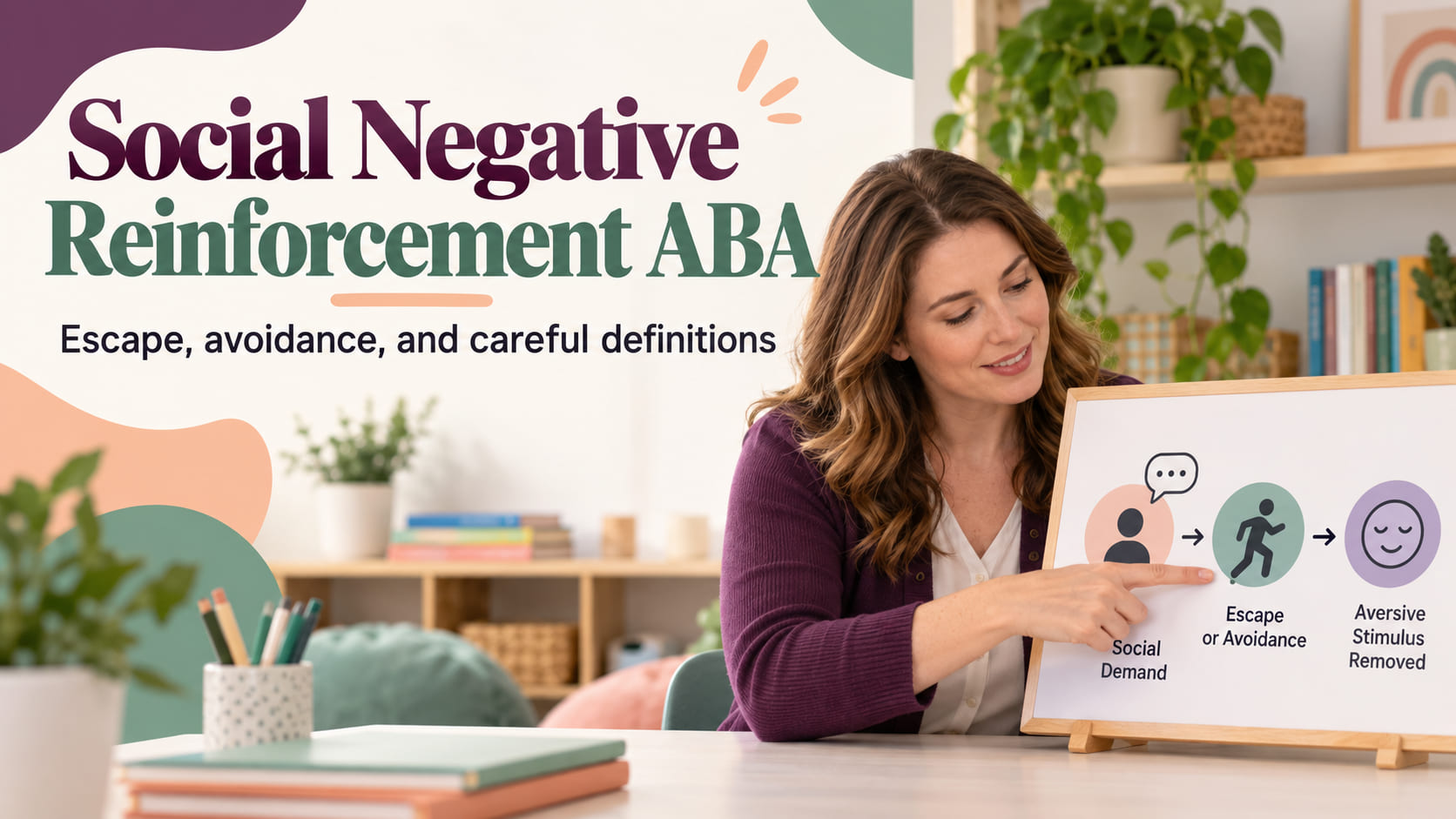
Social negative reinforcement ABA examples involve a social condition that is removed, reduced, or avoided after a response, followed by an increase in that response. The key is not whether the interaction feels positive or negative; the key is the observable relation between the social condition, the behavior, the change, and the later behavior pattern.
Table of Contents
- Social negative reinforcement ABA: the short answer
- What makes a condition social?
- Escape and avoidance are not guesses
- Fictional examples to analyze
- What to measure
- What an RBT should do
- Common labeling mistakes
- Frequently asked questions
Social conditions, escape and avoidance, measurement, communication, and RBT boundaries
Social Negative Reinforcement ABA: Examples and Boundaries
Define the social condition and the behavior carefully before labeling a sequence as negative reinforcement.
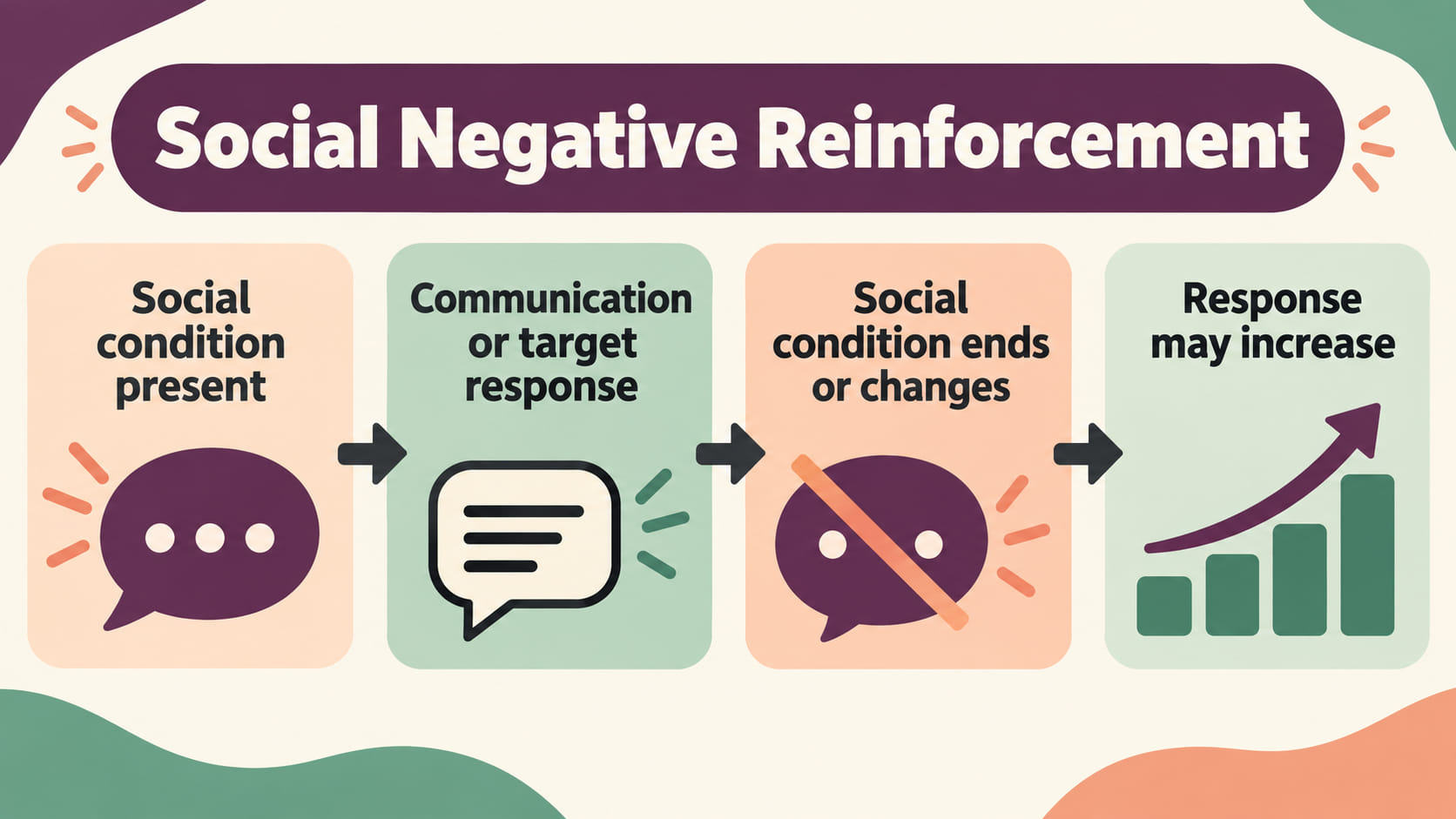
Social negative reinforcement ABA examples involve a social condition that is removed, reduced, or avoided after a response, followed by an increase in that response. The key is not whether the interaction feels positive or negative. The key is the observable relation between the social condition, the behavior, the change, and the later behavior pattern.
A request for privacy, a break, or less conversation is not automatically a problem to eliminate. The same social event can have different meanings in different contexts. Define what happened, protect communication and dignity, follow the written plan, and ask a supervisor when the function or safety implications are unclear.
Social negative reinforcement ABA: the short answer
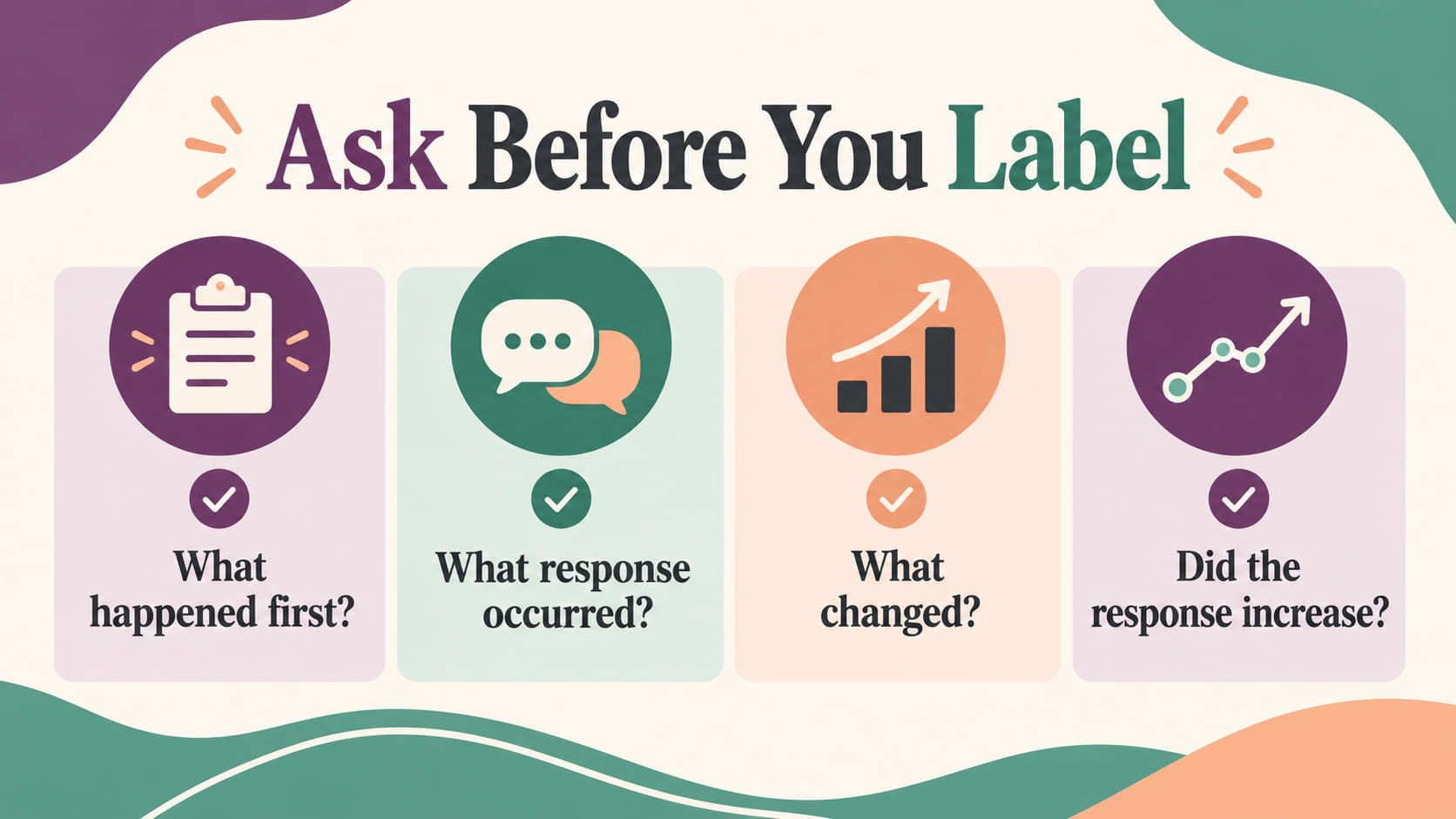
A careful analysis asks four questions:
- What social condition was present or expected?
- What observable response occurred?
- What social condition was removed, reduced, delayed, or avoided?
- Did the defined response become more likely in similar situations?
For example, a learner uses an agreed communication response when a social demand begins. The plan then provides a brief break from that interaction. If that communication response increases across comparable opportunities, the removal or reduction of the social demand may be functioning as negative reinforcement. The conclusion belongs to the data and plan, not to an observer’s assumption.
What makes a condition social?
A social condition involves another person or an interaction between people. It might be a conversation, a request, a correction, a group activity, a transition with others, or a planned interaction. “Social” does not mean that the interaction is inherently harmful. It identifies the context that should be described.
Use observable language. “The learner dislikes people” is an interpretation. “When the instructor presented a two-step conversation prompt, the learner handed over the break card and the instructor paused the prompt for two minutes” gives the team something it can evaluate. Avoid assigning a motive when the available information only shows an event sequence.
Respectful practice also matters. A person can communicate that they need space. The goal is not to force social contact simply to prevent avoidance. A supervisor may design a plan that teaches communication, gradually builds tolerance, changes the demand, provides choice, or supports participation in a way that fits the learner and the service context.
Escape and avoidance are not guesses
Escape describes a situation in which a social condition is already happening and then ends or changes after a response. A conversation may pause, a group demand may stop, or a correction may be delayed according to a plan.
Avoidance describes a response that prevents or postpones the social condition before it begins. A person may use a taught signal before a group activity to request a different arrangement. Again, the response must be defined, the consequence must be clear, and the later pattern must be measured before calling it negative reinforcement.
Escape and avoidance are functional descriptions, not character judgments. They do not prove that a person is manipulative, noncompliant, or refusing to learn. They tell the team to examine the relation between the context and behavior while also checking communication access, skill difficulty, consent, safety, and the written program.
Fictional examples to analyze
Example one: a break response. During a planned social role-play, the instructor presents a short prompt. The learner points to a taught break icon. The instructor pauses the role-play for the interval written in the plan. The team records the prompt, the communication response, whether the break occurred, and the learner’s response at later opportunities. If the communication response increases, the arrangement may be reinforcing that response through removal of the social demand.
Example two: a group transition. Before a group activity, the schedule shows a learner that a transition is coming. The learner uses a taught choice response, and the plan provides a quieter entry option rather than removing all participation. The team measures whether the choice response increases and whether participation remains safe and meaningful. This is different from assuming that every refusal should result in cancelling the activity.
Example three: a conversation correction. A supervisor-approved teaching plan includes a way to request clarification when a conversational correction feels difficult. The RBT follows the written prompt and records the response. The RBT does not invent a new rule that ends all interaction. That boundary protects both accurate implementation and the learner’s right to understandable support.
What to measure
Begin with the measurement system in the written plan. Possible measures include frequency of the communication response, percentage of opportunities, latency to begin a task, duration of participation, or another defined system. Do not select a new measure simply because it is convenient.
Record enough context to distinguish the events:
- What social condition was presented or expected?
- What response met the operational definition?
- What social change followed the response and how quickly?
- Did the response increase across comparable opportunities?
- Were there changes in communication access, task difficulty, staffing, setting, or safety?
If the social condition changed because of an emergency or safety concern, do not automatically label the event as an instructional reinforcement arrangement. Follow safety procedures, document objectively, and report the event through supervision.
What an RBT should do
- Implement the assigned communication, prompting, break, and participation procedures as written.
- Use neutral descriptions instead of labels such as rude, manipulative, attention-seeking, or avoidant.
- Record the defined response and social consequence accurately.
- Ask before changing the amount of interaction, ending a demand, delaying a group activity, or creating a new choice.
- Report missing instructions, unexpected patterns, safety concerns, and possible dignity or privacy issues to the supervisor.
An RBT does not independently decide that social contact should be removed or that a person must tolerate a situation. Implementation includes knowing when to pause and seek direction.
Common labeling mistakes
- Treating social as automatically aversive: describe the condition instead of assuming how it feels.
- Calling every break avoidance: a taught communication response may be an important skill, not a problem to suppress.
- Ignoring the behavior increase: removal alone does not prove reinforcement.
- Confusing intention with function: what an adult intended does not establish the behavioral relation.
- Changing interaction independently: an RBT follows the written plan and supervisor direction.
- Using judgmental notes: objective descriptions protect the learner and the quality of the data.
Frequently asked questions
What is social negative reinforcement ABA?
It describes a possible relation in which a social condition is removed, reduced, or avoided after a defined response and that response becomes more likely. The relation must be described and supported by data.
Is asking for a break negative reinforcement?
It can be part of a plan in which a break follows a communication response, but the label depends on the defined response, the planned consequence, and whether the response increases. Asking for a break is not automatically a problem.
Should an RBT stop a social demand when a learner refuses?
Follow the written plan and ask the supervisor. Do not independently force participation or remove the demand. The plan should address communication, safety, teaching, and dignity.
How do I know whether the response increased?
Use the measurement system selected by the supervising team and compare similar opportunities over time. A single event or impression is not enough.
Role reminder: This is educational information, not individualized treatment advice, clinical direction, legal advice, or a replacement for supervisor instruction. Follow the current written plan and ask a qualified supervisor when a social situation is unclear.
Official starting points: the BACB RBT content outline, RBT Handbook, RBT Ethics Code, and ethics resources.
Ready to practice the RBT concepts you just reviewed?
Try an independent, original RBT practice resource with exam-style questions, scoring, and answer explanations.
References
- Behavior Analyst Certification Board. RBT Test Content Outline, 3rd edition.
- Behavior Analyst Certification Board. RBT Handbook.
- Behavior Analyst Certification Board. RBT Ethics Code.