

When comparing multiple relationships vs dual relationships RBT professionals should look beyond the label. Both terms describe situations where a professional service relationship overlaps with another role or connection; the important questions are how the roles overlap, what power or access exists, whether privacy or objectivity could be affected, and what the current policy and supervisor require.
Table of Contents
- Multiple relationships vs dual relationships RBT: the short answer
- What “multiple relationship” usually signals
- What “dual relationship” usually signals
- Compare the concepts without oversimplifying
- Check power, access, privacy, and possible harm
- Use a safe response path
- Common comparison mistakes
- Frequently asked questions
RBT ethics, overlapping roles, dual roles, power, privacy, supervision, and boundaries
Multiple Relationships vs Dual Relationships RBT: Compare the Concepts
Use the terms as prompts for context and risk review, not as shortcuts that replace policy or supervision.
When comparing multiple relationships vs dual relationships RBT professionals should look beyond the label. Both terms describe situations where a professional service relationship overlaps with another role or connection; the important questions are how the roles overlap, what power or access exists, whether privacy or objectivity could be affected, and what the current policy and supervisor require.
Terminology can vary across professional materials and employer policies. Use the current RBT Ethics Code and the organization’s process as the authority for a real concern. This article gives a comparison framework, not a complete ethics rule or a prediction about any particular situation.
Multiple relationships vs dual relationships RBT: the short answer
As a working comparison:
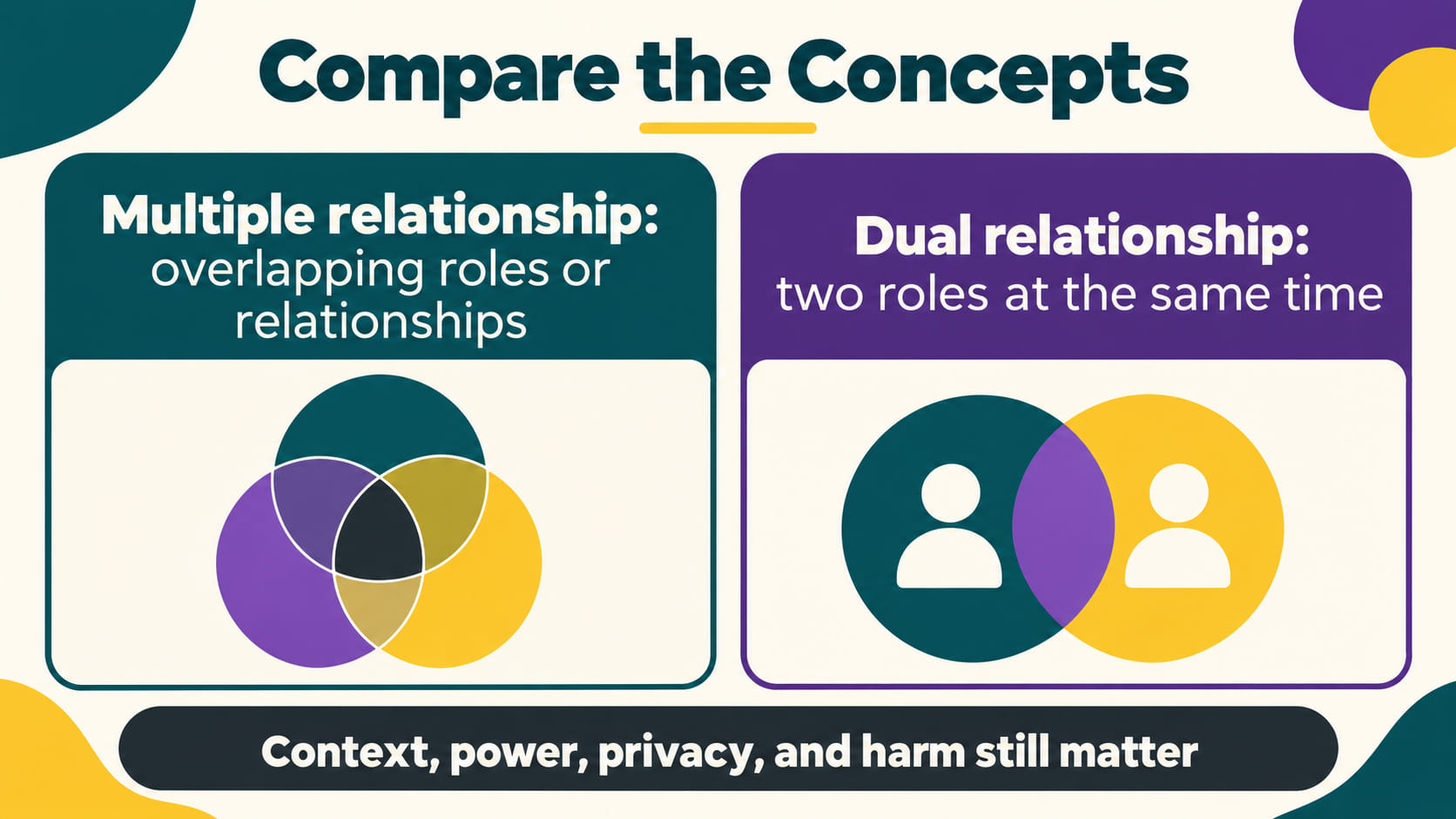
- Multiple relationship: a broad description of an overlap between a professional relationship and one or more other relationships or roles.
- Dual relationship: a common term for two roles held at the same time, such as a service role plus a personal, social, financial, or community role.
A dual relationship can be a type of multiple relationship, depending on the terminology being used. The label does not by itself determine whether the conduct is harmful, prohibited, manageable, or unavoidable. Context, power, access, privacy, objectivity, and possible harm still need review.
What “multiple relationship” usually signals
The word multiple signals more than one connection around the professional relationship. For example, an RBT may have a service role and also share a community organization with a caregiver. A family might ask the RBT to provide private childcare. A technician might be offered a discount by a business connected to the family. The overlap can involve social, financial, community, family, online, or another employment relationship.
When more than one outside connection exists, the risks can compound. A social-media connection may expose personal information; a financial connection may create pressure; a community connection may create public contact; and a family connection may confuse who is speaking as a professional. Describe each relationship separately before deciding what needs to happen.
What “dual relationship” usually signals
Dual relationship usually highlights two roles held at once. One role is the professional service relationship. The second might be friend, neighbor, relative, landlord, employer, tutor, volunteer, customer, or another role. The concern is not that people have only one identity outside work; it is that the overlap may affect professional judgment, consent, confidentiality, expectations, or the ability to end one role freely.
Some overlaps are foreseeable or difficult to avoid, especially in small communities. That does not mean they should be ignored. The team can set communication boundaries, protect records, use a supervisor, change assignments when appropriate, and document the plan. The goal is to manage risk thoughtfully, not to apply a label without analysis.
Compare the concepts without oversimplifying
Use a comparison table in your own notes:
| Question | Multiple relationship lens | Dual relationship lens |
|---|---|---|
| How many roles? | May involve several overlapping relationships or roles. | Usually highlights two simultaneous roles. |
| What to inspect? | Connections, access, expectations, and cumulative effects. | The tension or conflict between the two roles. |
| What is the conclusion? | Not automatic; context and policy control. | Not automatic; power, privacy, and possible harm control. |
| What should an RBT do? | Protect privacy and ask for supervision. | Protect privacy and ask for supervision. |
The table is a learning aid, not a substitute for the current Ethics Code. A real question may fit both descriptions, neither description, or a different policy category. Use the current terms in the organization’s process when reporting the concern.
Check power, access, privacy, and possible harm
Power may come from control over services, scheduling, records, feedback, access to a supervisor, or information about a client. Ask whether another person could reasonably feel that declining a request might affect care. Even if the RBT intends to be helpful, the unequal roles can make a “yes” less freely chosen.
Check privacy in both directions. The RBT may learn sensitive client information, while a personal connection may expose the RBT’s private life or other clients’ information. Do not move service conversations to a personal account because it feels convenient. Use approved channels and share the minimum necessary information.
Possible harm can include favoritism, confusion about consent, financial pressure, public disclosure, blurred records, retaliation concerns, or reduced objectivity. A risk review is not an accusation. It is a way to ask for guidance before a small overlap becomes a bigger problem.
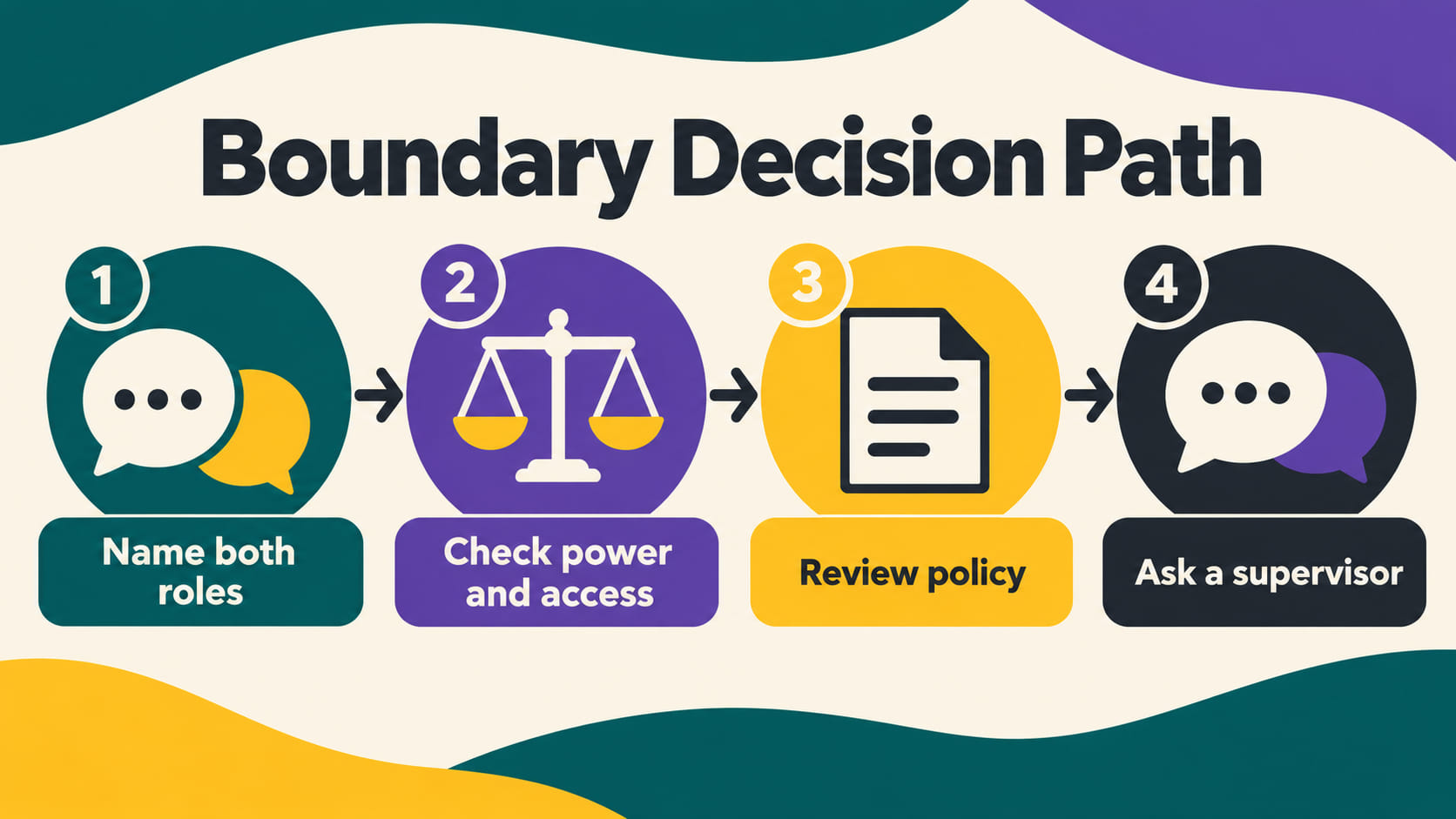
Use a safe response path
- Name both roles: write the professional role and the other connection in neutral words.
- Check power and access: identify control, information, dependency, and possible pressure.
- Review policy: open the current Ethics Code, employer policy, and applicable supervision guidance.
- Ask a supervisor: bring the minimum necessary facts and follow the direction you receive.
Document objectively when required. Include the request or event, the observable facts, the response taken, who was notified, and the direction received. Do not promise secrecy, delete a message, backdate a note, or confront another person alone when the issue is complex.
Common comparison mistakes
- Arguing about the label: the practical risk matters more than winning a vocabulary debate.
- Assuming every overlap is forbidden: check the current code, policy, context, and possible harm.
- Assuming intent removes risk: good intentions do not erase power or privacy concerns.
- Ignoring unavoidable contact: use a plan for greetings, communication, records, and supervision.
- Sharing the full story: use minimum necessary information when requesting help.
- Managing it alone: raise a boundary question early through the approved channel.
Frequently asked questions
What is the difference between multiple and dual relationships?
Multiple relationship is often used broadly for overlapping relationships or roles. Dual relationship commonly highlights two roles held at the same time. Terminology varies, so the current Ethics Code and employer policy control the applicable process.
Is a dual relationship automatically unethical?
Do not assume that from the label alone. Review power, access, privacy, objectivity, possible harm, context, policy, and supervisor direction.
Can an RBT decide that an overlap is safe?
An RBT should not manage a complex boundary concern alone. Protect information, pause before making commitments, and ask the supervisor or designated channel for direction.
What should be documented?
When required, document observable facts, the request or event, the response, who was notified, and the direction received. Avoid gossip, unnecessary private details, and rewritten records.
Role reminder: This is educational information, not legal advice, ethics-board advice, or a substitute for the current Ethics Code, Handbook, employer policy, or supervisor direction. Consult the appropriate qualified channel when a boundary is unclear.
Official starting points: the BACB RBT Ethics Code, ethics resources, RBT Handbook, and supervision and training resources.
Ready to practice the RBT concepts you just reviewed?
Try an independent, original RBT practice resource with exam-style questions, scoring, and answer explanations.
References
- Behavior Analyst Certification Board. RBT Test Content Outline, 3rd edition.
- Behavior Analyst Certification Board. RBT Handbook.
- Behavior Analyst Certification Board. RBT Ethics Code.