

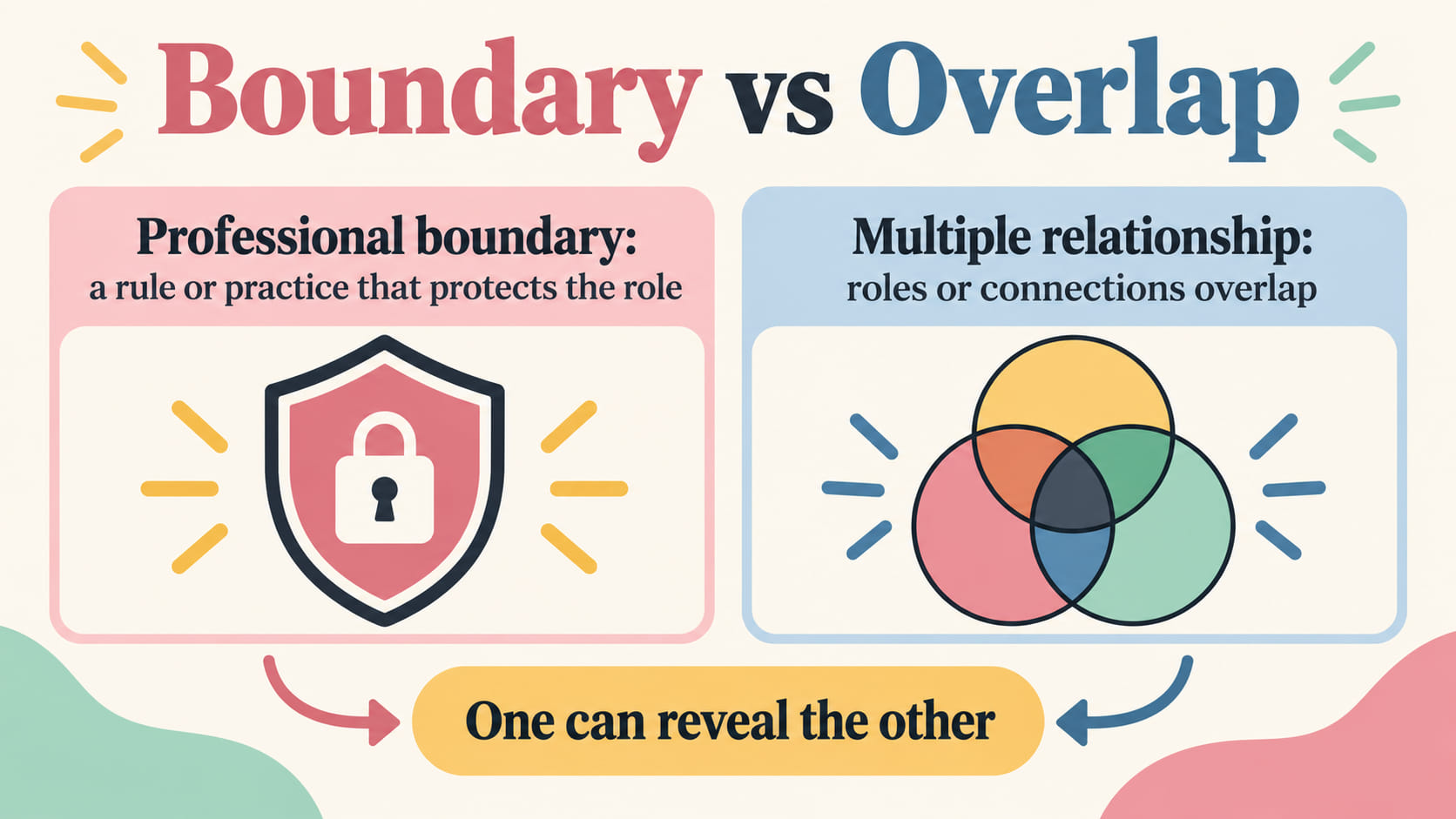
The difference in professional boundary vs multiple relationship RBT discussions is simple but important: a professional boundary is a rule or practice that protects a service role, while a multiple relationship describes an overlap between that role and another relationship or role. A boundary can prevent, limit, or manage an overlap; an overlap can reveal where a boundary needs clarification.
Table of Contents
- Professional boundary vs multiple relationship RBT: the short answer
- What a professional boundary does
- What a multiple relationship describes
- Compare the ideas
- Where boundaries protect RBT work
- Respond when an overlap appears
- Common mistakes
- Frequently asked questions
RBT professional boundaries, multiple relationships, privacy, access, communication, and supervision
Professional Boundary vs Multiple Relationship RBT: Know the Difference
A boundary protects the role; a multiple relationship describes an overlap that may require a closer risk review.
The difference in professional boundary vs multiple relationship RBT discussions is simple but important: a professional boundary is a rule or practice that protects a service role, while a multiple relationship describes an overlap between that role and another relationship or role. A boundary can prevent, limit, or manage an overlap; an overlap can reveal where a boundary needs clarification.
Neither phrase is a shortcut to a final ethics conclusion. The current RBT Ethics Code, employer policy, Handbook, supervision structure, and applicable law or professional guidance control a real situation. This page is a learning comparison for recognizing questions early.
Professional boundary vs multiple relationship RBT: the short answer
| Concept | What it describes | Useful question |
|---|---|---|
| Professional boundary | A limit or practice that protects role clarity, privacy, objectivity, access, and service quality. | What boundary keeps this service relationship safe and clear? |
| Multiple relationship | An overlap between the professional relationship and another relationship or role. | What other connection exists, and could it affect the role? |
| Risk review | An evaluation of power, privacy, access, objectivity, expectations, and possible harm. | Who should help decide the next step? |
What a professional boundary does
A professional boundary sets expectations around what the service role includes and what it does not include. It can cover approved communication channels, privacy, gifts, social media, transportation, physical contact, records, payment, personal favors, and contact outside scheduled services.
Boundaries are not meant to make the RBT cold or unhelpful. They make conduct predictable. A family should know where to ask a service question, who can change a schedule, how a concern is escalated, and how information is protected. The RBT should know when to refer a request to a supervisor instead of making a private exception.
A boundary can also protect the technician. When a request arrives through a personal account or a family asks for a favor, the RBT can refer to the approved process rather than negotiate alone. Clear rules reduce pressure and support consistent treatment of families.
What a multiple relationship describes
A multiple relationship exists as a description when the professional service role overlaps with another role or connection. The second connection might be social, community-based, financial, online, family-related, educational, or another employment relationship. The overlap may be obvious or develop gradually.
For example, an RBT and caregiver may attend the same community event. An RBT may be asked to babysit privately. A family may offer a valuable gift or business discount. A technician may discover that a client’s relative is a neighbor or a former acquaintance. These situations are not all identical, but each can raise a boundary question about privacy, power, expectations, or objectivity.
The phrase does not prove that harm occurred. It tells the team to pause, describe the roles, review policy, and decide whether a protective change or supervisor direction is needed.
Compare the ideas
Think of a boundary as the protective line and a multiple relationship as a possible crossing or pressure point. The boundary answers, “What keeps this role clear?” The multiple relationship question answers, “What else is happening around this role?” The two ideas work together.
For instance, an employer may have a boundary against using personal social-media accounts for service communication. A caregiver’s friend request reveals a possible multiple relationship. The policy provides the boundary; the overlap prompts the RBT to use the approved channel and ask whether any further step is needed.
Another example is a gift policy. The boundary explains what to do with gifts and who reviews exceptions. The caregiver’s offer is the event that activates the question. The RBT should not decide that a gift is harmless simply because the intention is generous.
Where boundaries protect RBT work
- Communication: use approved channels and do not move service details into personal messages for convenience.
- Privacy: do not confirm services, schedules, diagnoses, or records in public or to people without a legitimate role.
- Gifts and favors: pause and follow policy before accepting money, valuable items, discounts, childcare requests, or reciprocal help.
- Records: keep notes and data in approved systems and document objective facts when a concern must be escalated.
- Access: recognize that service access, information, scheduling, and feedback can create power.
- Scope: do not allow a personal role to authorize independent clinical decisions or changes to an assigned plan.
Respond when an overlap appears
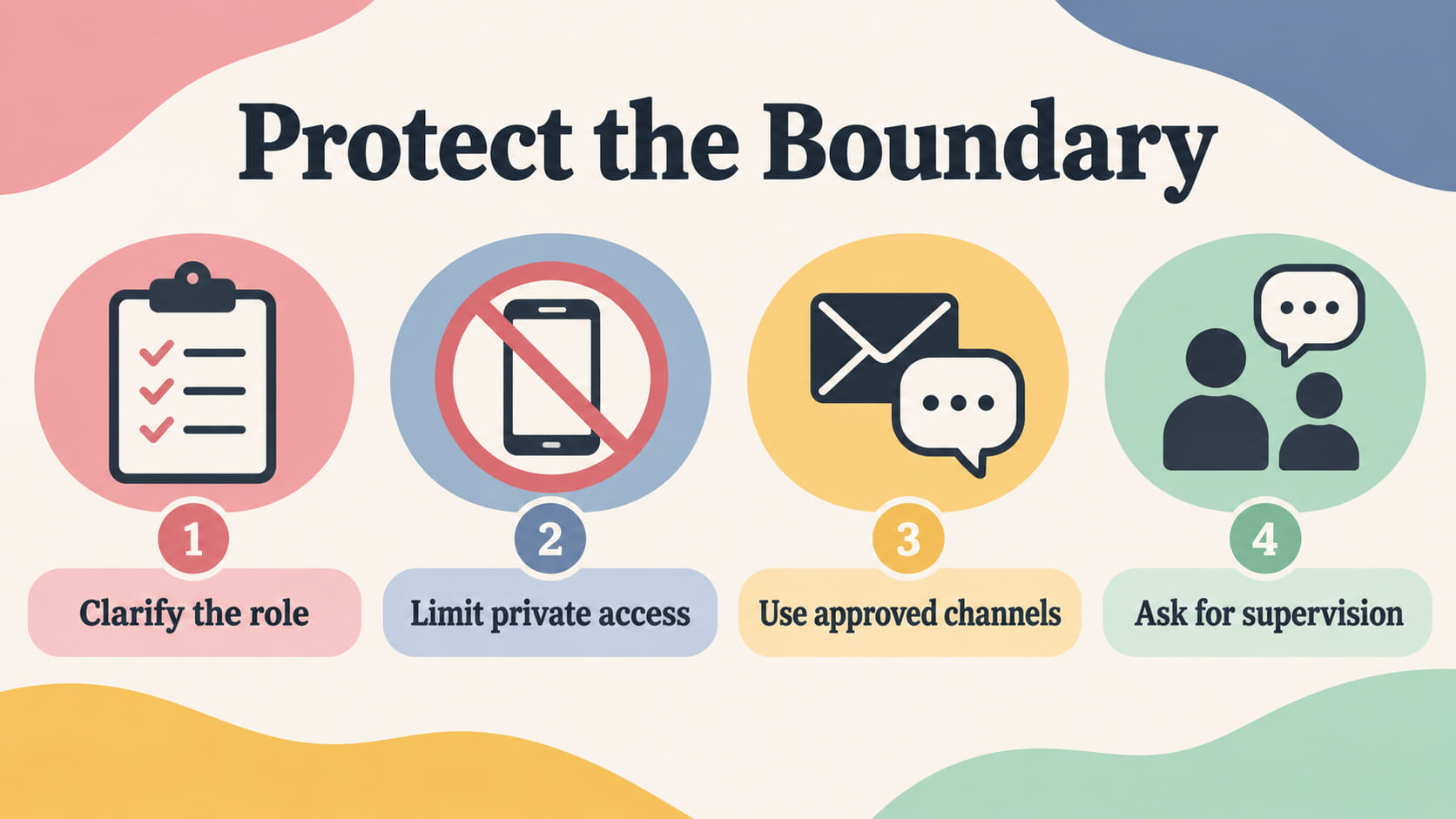
- Clarify the role: name the professional duty and the request or connection in neutral words.
- Limit private access: do not share records, personal contact details, or promises while the question is unresolved.
- Use approved channels: redirect the request to the organization’s communication or reporting process.
- Ask for supervision: bring the minimum necessary facts and follow the direction received.
Document only what is required, using observable facts. Record the request, the response, who was notified, and the direction received. Do not promise secrecy, gossip about the person involved, or create a private side record containing unnecessary client information.
Common mistakes
- Confusing the terms: a boundary is a protective practice; a multiple relationship is an overlapping connection.
- Using labels as verdicts: context, power, privacy, and possible harm still require review.
- Assuming good intent is enough: kind intentions do not remove unequal access or pressure.
- Making a secret exception: private arrangements can increase risk and reduce accountability.
- Waiting until harm is obvious: ask for guidance when the overlap first appears.
- Sharing too much: use the minimum necessary information through the proper channel.
Frequently asked questions
What is a professional boundary for an RBT?
It is a limit or practice that protects the service role, such as approved communication, confidentiality, record handling, gifts, access, scope, and supervision.
What is a multiple relationship?
It is an overlap between the professional service relationship and another relationship or role. The overlap should be reviewed for power, access, privacy, objectivity, expectations, and possible harm.
Can a boundary prevent a multiple relationship?
It can limit or prevent some overlaps, while other overlaps may be unavoidable. Use policy and supervision to decide how to protect the role and the person receiving services.
Who decides what to do?
Follow the current Ethics Code, employer policy, Handbook, and supervision process. An RBT should ask the appropriate supervisor or designated channel rather than make a complex exception alone.
Role reminder: This is educational information, not legal advice, ethics-board advice, or a substitute for the current Ethics Code, Handbook, employer policy, or supervisor direction. Consult the appropriate qualified channel when a boundary is unclear.
Official starting points: the BACB RBT Ethics Code, ethics resources, RBT Handbook, and supervision and training resources.
Ready to practice the RBT concepts you just reviewed?
Try an independent, original RBT practice resource with exam-style questions, scoring, and answer explanations.
References
- Behavior Analyst Certification Board. RBT Test Content Outline, 3rd edition.
- Behavior Analyst Certification Board. RBT Handbook.
- Behavior Analyst Certification Board. RBT Ethics Code.