

If you are studying prompt hierarchy ABA, do not memorize one universal ladder and stop there. A prompt hierarchy is an ordered plan for providing assistance, but the useful exam question is usually more specific: what type of prompt was used, how intrusive was it, when should it be delivered, and what does the written program say about fading it?
Table of Contents
- What does prompt hierarchy ABA mean?
- Separate prompt types from prompt order
- Least-to-most prompting
- Most-to-least and errorless teaching
- Prompt fading, stimulus fading, and time delay
- Map prompt hierarchy ABA to the RBT TCO
- Read a prompting scenario
- Record prompt levels and independence
- Common prompt hierarchy mistakes
- Frequently Asked Questions
- References
This guide explains prompt hierarchy ABA concepts for RBT exam study. It compares least-to-most and most-to-least prompting, separates stimulus prompts from response prompts, and connects prompt fading, errorless teaching, and time delay to the current RBT Test Content Outline, 3rd edition. The goal is a decision rule you can apply to a new scenario, not a list of labels to recite.
RBT Training is an independent educational resource. It is not affiliated with, operated by, or endorsed by the Behavior Analyst Certification Board (BACB). The examples and practice prompts below are newly written for independent study; they are not official, recalled, leaked, or BACB-endorsed questions. This article explains study concepts and does not authorize anyone to change a learner’s program. No study guide, practice score, or prompting example guarantees a passing result.
What does prompt hierarchy ABA mean?
Prompt hierarchy ABA refers to arranging assistance from less intrusive to more intrusive, or from more intrusive to less intrusive, so a learner can contact the correct response and move toward independence. A prompt is an added cue or form of help that increases the likelihood of a correct response. Independence is the outcome with no prompt delivered for that opportunity; it is not simply the lowest prompt on every hierarchy.
There is no single ladder that applies to every skill, person, setting, or teaching plan. One program may use a visual cue, verbal direction, model, gesture, partial physical prompt, and full physical prompt. Another may use a different sequence because a learner cannot use one topography reliably, because the target is unsafe to practice without stronger support, or because the written program specifies a particular teaching procedure. The order must be defined and implemented consistently within the program.
| Question | What to identify | Why it matters |
|---|---|---|
| What is the prompt? | The added cue or assistance. | Separates the prompt from the learner’s response. |
| How intrusive is it? | How much control or physical assistance it provides. | Helps place it in the program’s hierarchy. |
| When is it delivered? | Before the response, after a wait, or after an error. | Distinguishes procedures such as errorless teaching and least-to-most prompting. |
| What happens next? | Reinforcement, correction, data recording, or fading. | Shows whether the prompt is part of a complete teaching plan. |
For the RBT exam, look for the condition that controls the decision. “Use the least intrusive prompt that works” is not a replacement for reading the written hierarchy. The role-safe answer is usually to implement the assigned procedure accurately, record the learner’s response and prompt level as directed, and ask the supervisor when the plan is unclear.
Separate prompt types from prompt order
A prompt type describes the form of assistance. A hierarchy describes the sequence in which the program presents those forms. Mixing the two creates many avoidable exam errors.
| Prompt type | Original example | Study distinction |
|---|---|---|
| Visual or written | A picture schedule or written word cues the next step. | It may be less intrusive than a physical prompt, but the program decides its place. |
| Verbal | A spoken cue supplies part of the response or directs attention. | Do not assume a verbal prompt is always least intrusive; content and learner response matter. |
| Gestural | Pointing toward the relevant item or step. | The gesture must be defined clearly enough for consistent implementation. |
| Model | The implementer demonstrates the response. | This is a response or stimulus support depending on what the model controls in the program. |
| Physical | Partial or full guidance supports the movement. | Follow consent, safety, and the written procedure; do not improvise physical assistance. |
Many study resources list independence, visual, verbal, gestural, model, partial physical, and full physical in one order. Treat that list as an example, not a BACB-mandated universal sequence. The exam may instead give you a specific hierarchy and ask which prompt comes next, whether the prompt was faded, or whether the learner responded independently.
Least-to-most prompting
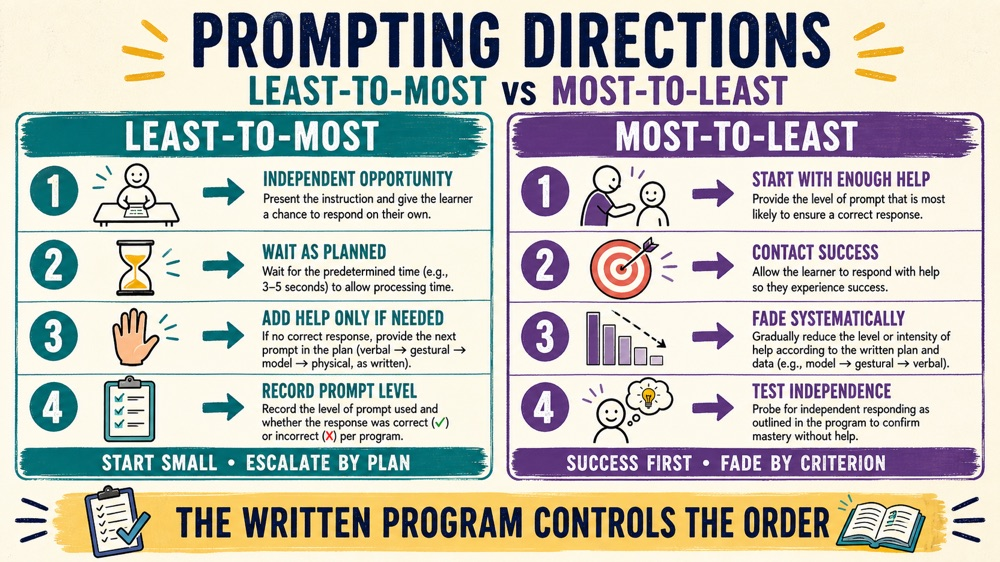
Least-to-most prompting begins with the smallest planned amount of assistance and increases help only when the learner does not respond correctly or needs additional support. A simplified study sequence might be: opportunity for independent response → visual or gestural cue → verbal or model prompt → partial physical prompt → full physical prompt. The exact sequence, wait time, and error rule must come from the program.
- Present the instruction or natural opportunity as written.
- Allow the defined response interval rather than prompting immediately by habit.
- If the response is absent or incorrect, deliver the next planned prompt.
- Reinforce the correct response according to the written contingency.
- Record the response and prompt level, then continue the planned progression.
This arrangement gives the learner an opportunity to respond independently before assistance increases. It can be useful when the learner already has some repertoire and the program is designed to test or build independent responding. It can also create errors or frustration when a new skill requires immediate support, when safety is relevant, or when the learner cannot benefit from the early prompt levels. That is why the hierarchy is a program decision, not an RBT improvisation.
Exam contrast: if the stem says the learner did not respond after the defined interval and the plan identifies the next prompt, choose the next prompt in the stated sequence. If the stem says the instructor immediately used full physical guidance before the learner had an opportunity to respond, ask whether the plan called for most-to-least or errorless teaching instead. The timing of the prompt is part of the procedure.
Most-to-least and errorless teaching
Most-to-least prompting begins with a level of assistance that is expected to produce a correct response, then systematically reduces the assistance as the learner demonstrates success. Errorless teaching is related to arranging prompts so errors are minimized, often by prompting before an incorrect response can occur. These are not synonyms for “always use full physical prompting.” The prompt level and fading plan must fit the target, learner, and written program.
| Procedure | Starting logic | What to watch |
|---|---|---|
| Least-to-most | Give an independent opportunity, then increase help as needed. | Do not skip the planned wait or jump between levels. |
| Most-to-least | Begin with enough help for success, then fade toward independence. | Record when a lower prompt becomes effective. |
| Errorless teaching | Arrange immediate or carefully timed assistance to prevent repeated errors. | Make sure the prompt is later faded and independent responding is tested. |
| Prompt fading | Reduce prompt intensity, delay, size, or other support dimension. | Do not call a prompt “faded” merely because the instructor spoke more quietly. |
Consider an original study example: a written program teaches a learner to select a target picture. During early teaching, the program calls for an immediate model, followed by a planned reduction in model size and then a brief delay before the model. The RBT follows those steps and records the learner’s response. The RBT does not replace the model with a verbal cue because it feels less intrusive, and does not remove the prompt because one trial looked easy.
The controlling clue in a scenario may be “new skill,” “prompt immediately,” “fade after two consecutive independent responses,” or “use the next least intrusive prompt after no response.” Circle that phrase before thinking about which hierarchy you personally prefer.
Prompt fading, stimulus fading, and time delay
Prompt fading reduces assistance so stimulus control can transfer to the natural instruction or relevant stimulus. The reduction can involve prompt intensity, physical distance, model size, verbal content, position, or delay. Stimulus fading changes a feature of the stimulus or cue itself; it is not identical to simply lowering physical assistance. Time delay changes the interval between the instruction and the prompt, usually from an immediate prompt toward a planned delay.
| Method | What changes | Scenario clue |
|---|---|---|
| Prompt fading | The amount or intrusiveness of assistance decreases. | Full physical becomes partial physical, then a gesture, as the plan specifies. |
| Stimulus fading | A feature of the relevant stimulus is gradually changed. | The size, position, intensity, or salience of a cue changes while the target relation is taught. |
| Time delay | The interval before the prompt is delivered changes. | The instructor waits longer after the instruction before providing the prompt. |
| Transfer trial | The natural cue is tested after a prompted response. | The prompt is removed or a new opportunity checks whether control transferred. |
Prompt dependency is a warning sign when a learner waits for a familiar prompt even after the natural instruction is available. The appropriate response is not for the RBT to invent a new fading schedule. Record the pattern, follow the current plan, and communicate the observation through the designated supervisor route. The data may support a clinical decision, but the RBT should not make that decision independently.
Map prompt hierarchy ABA to the RBT TCO
The academic anchor for this article is the RBT Test Content Outline, 3rd edition. It describes 43 tasks across six domains. The exam context used in this workflow includes 75 scored questions and 10 unscored pilot questions. Prompt hierarchy ABA is most directly connected to Domain C, Behavior Acquisition, especially the current C.7 task on selecting and implementing stimulus and response prompting procedures such as errorless, most-to-least, least-to-most, stimulus fading, and time delay.
| Current domain | Why it can appear in prompt questions | RBT study action |
|---|---|---|
| A. Data Collection and Graphing | Prompt level, independent responding, and correct/error outcomes may be recorded. | Identify what was observed and which measure the plan requires. |
| B. Behavior Assessment | Assessment or skill-strength information can influence assigned teaching decisions. | Implement the assigned procedure; do not redesign an assessment. |
| C. Behavior Acquisition | Prompting, fading, reinforcement, chaining, and generalization support skill development. | Match the prompt procedure and sequence to the written program. |
| D. Behavior Reduction | Prompting may support replacement behavior or a safety-related procedure. | Follow the reduction and safety plan; do not create a consequence. |
| E. Documentation and Reporting | Prompt levels, data irregularities, and variables affecting progress may need communication. | Use objective language and the chain of command. |
| F. Ethics | Physical assistance, dignity, competence, privacy, and supervision involve ethical boundaries. | Protect dignity and work within training and supervision. |
The six-domain map prevents a narrow definition from taking over the article. Prompting is a skill-acquisition concept, but a scenario can test data accuracy, objective reporting, or ethical boundaries at the same time. A strong explanation names both the prompting rule and the role-safe next action.
Read a prompting scenario
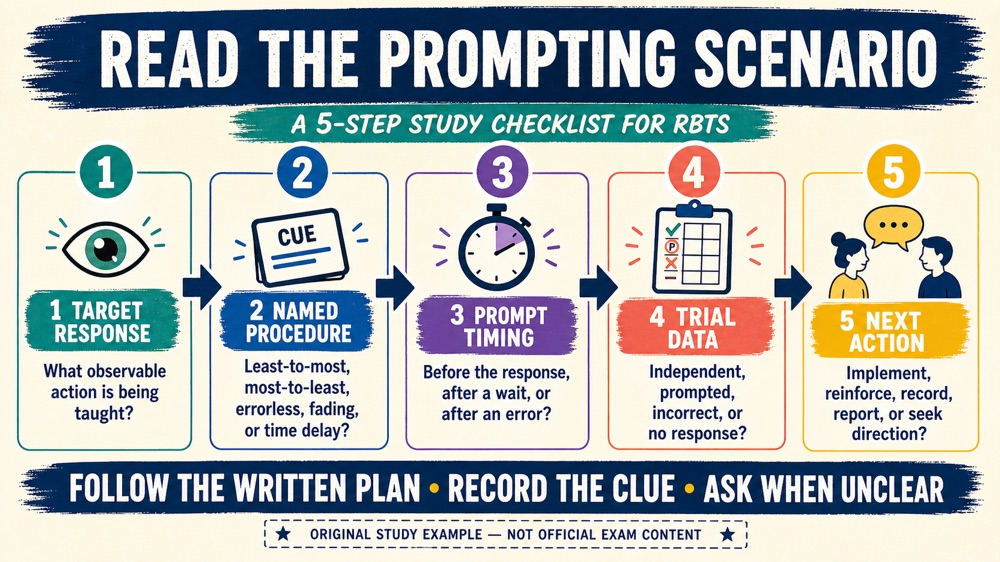
Use this five-question routine when a practice item describes a prompt hierarchy ABA procedure:
- What is the target response? State it in observable terms.
- What cue or instruction is present? Separate the natural stimulus from the added prompt.
- Which hierarchy or procedure is named? Look for least-to-most, most-to-least, errorless, stimulus fading, or time delay.
- What happened on the trial? Note independent, prompted, incorrect, or no response and the timing.
- What is the RBT’s next action? Implement, reinforce, record, report, or seek direction according to the plan.
Try this original scenario: a program says to present an instruction, wait four seconds, and then use a gestural prompt if there is no response. The learner does not respond during the four seconds. The best study answer is not “use the most helpful prompt.” It is to follow the next step specified by the hierarchy, deliver the gesture as written, record the outcome, and continue the reinforcement and fading procedure. If the program is silent about what happens next, the safe answer is to seek direction rather than inventing a level.
For a second scenario, the program uses most-to-least prompting for a new chain and says to fade from partial physical guidance to a model after a defined success criterion. The learner succeeds once. One success does not automatically authorize skipping the criterion. Look for the written rule controlling the fade.
Record prompt levels and independence
Prompting questions are easier when you treat each trial as data rather than as a vague judgment about whether the learner “needed help.” A useful record might include the instruction, target response, prompt level, response accuracy, latency or wait condition if required, consequence, and any unusual variable. Use the format named by the written program.
| Field | Example of objective wording | Why it helps |
|---|---|---|
| Instruction | “Place the red block in the bin.” | Identifies the opportunity. |
| Prompt level | “Gestural prompt delivered after 4 seconds.” | Shows the actual assistance and timing. |
| Response | “Block placed in bin within 3 seconds of gesture.” | Separates behavior from interpretation. |
| Consequence | “Programmed praise and access delivered.” | Connects the event to the written contingency. |
| Communication | “Two trials required a higher prompt than the current criterion.” | Flags a pattern without diagnosing or changing the plan. |
A note such as “the learner was lazy and needed lots of prompting” hides the prompt level, timing, and observable response. Replace it with facts another trained observer could check. If a prompt was delivered too early, a prompt level was unavailable, or the data sheet does not match the procedure, document the irregularity and use the designated communication route.
Common prompt hierarchy mistakes
- Memorizing one universal order: learn the hierarchy named by the program and the intrusiveness logic behind it.
- Confusing a prompt with a reinforcer: a prompt supports a response; a reinforcer is defined by its effect on future behavior.
- Prompting immediately by habit: check the procedure’s response interval and error rule.
- Fading without a criterion: use the written success rule, not one apparently easy trial.
- Calling all fading stimulus fading: identify whether assistance, the stimulus feature, or timing changed.
- Ignoring independent responses: record when the learner responds without the prompt.
- Changing the plan: report unclear or ineffective patterns instead of selecting a new hierarchy yourself.
- Using subjective notes: record the instruction, prompt, timing, response, and consequence objectively.
Bottom line: prompt hierarchy ABA is a decision system, not a universal staircase. Identify the prompt type, the order specified by the program, the timing of assistance, the fading method, the learner’s response, and the RBT’s role-safe next step. Then connect the decision to current TCO C.7 and the surrounding data, documentation, and ethics responsibilities.
Ready to practice the distinction?
Use independent RBT questions, underline the prompt timing and plan condition, and record the correction rule.
Try Free RBT Practice Questions →
Frequently Asked Questions
What is prompt hierarchy ABA?
It is an ordered plan for delivering levels of assistance during teaching. The order may move from least-to-most or most-to-least, and the specific levels depend on the written program.
Is there one correct prompt hierarchy for every learner?
No. Prompt types and order are program decisions. Study the hierarchy named in the scenario and do not treat a common example ladder as a universal requirement.
What is the difference between least-to-most and most-to-least prompting?
Least-to-most starts with a smaller amount of help and increases it when needed. Most-to-least starts with enough help for success and systematically fades assistance.
How is prompt fading different from stimulus fading?
Prompt fading reduces the assistance. Stimulus fading changes a feature of the relevant stimulus or cue. Time delay changes the interval before a prompt is delivered.
Can an RBT change the prompting hierarchy during a session?
An RBT should implement the written program and communicate observations through the designated supervisor route. Do not independently change the procedure because a different hierarchy seems easier.
References
- Behavior Analyst Certification Board. RBT Test Content Outline, 3rd edition.
- Behavior Analyst Certification Board. RBT Handbook, updated June 2026.
- Behavior Analyst Certification Board. RBT Ethics Code.
- Stimulus and response prompting study lesson. Reviewed for competitor research; not an endorsement.
- RBT prompting practice resource. Reviewed for competitor research; not an endorsement.
- Prompting hierarchy comparison guide. Reviewed for competitor research; not an endorsement.