
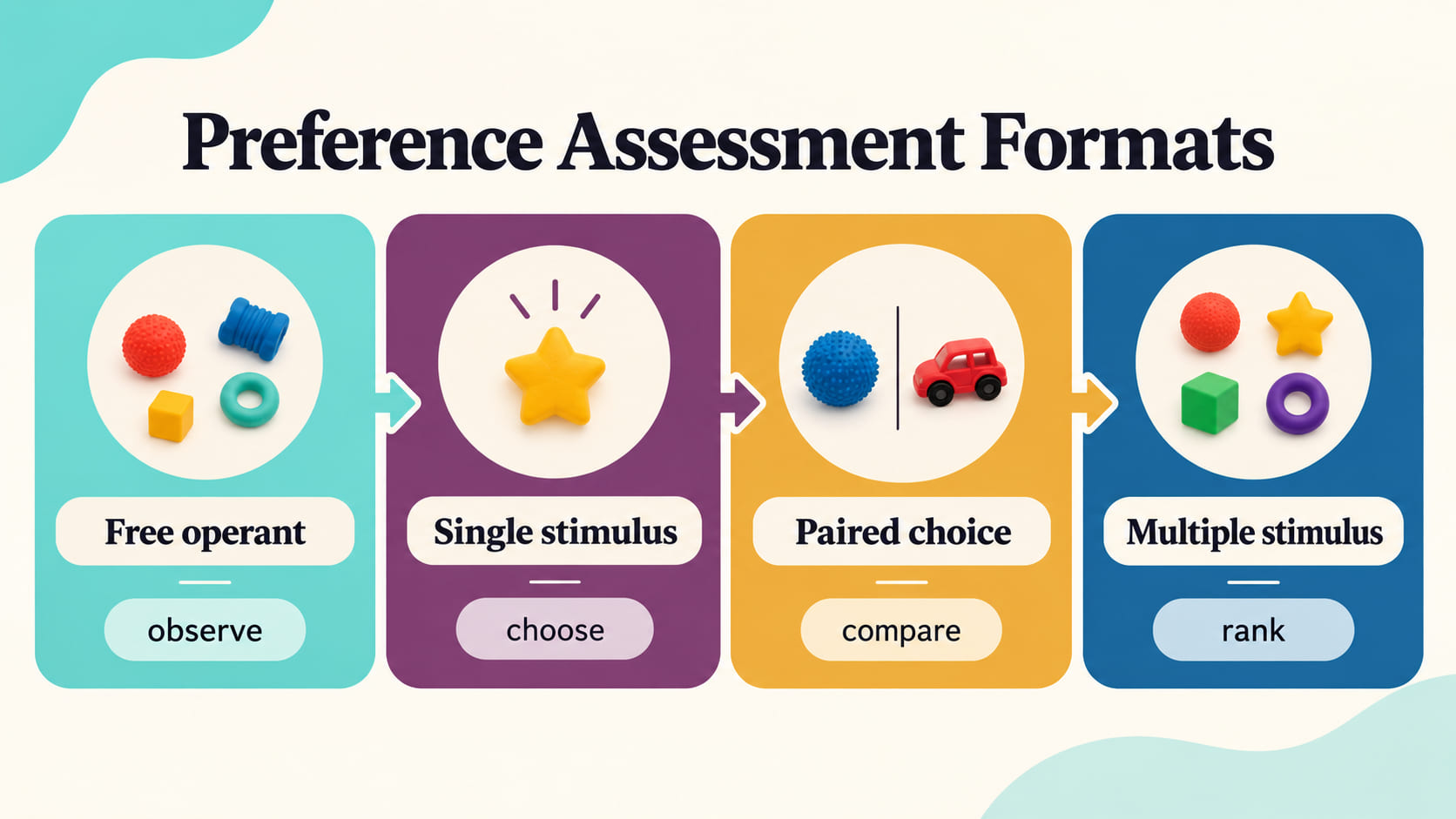
Different types of preference assessments ABA programs use provide structured ways to learn what a person approaches, selects, or engages with under defined conditions. Free-operant observation, single-stimulus presentation, paired-choice formats, and multiple-stimulus formats answer slightly different questions. The method, materials, timing, and data rules should come from the assigned plan and supervision.
Table of Contents
- Different types of preference assessments ABA: the short answer
- Free-operant observation
- Single-stimulus presentation
- Paired-choice assessment
- Multiple-stimulus formats
- What the data can and cannot tell you
- The RBT’s role
- Frequently asked questions
ABA preference assessments, choice formats, data, learner dignity, and RBT implementation
Different Types of Preference Assessments ABA: Formats and Data
Compare common formats and learn why the supervising professional chooses the materials, steps, and interpretation.
Different types of preference assessments in ABA provide structured ways to learn what a person approaches, selects, or engages with under defined conditions. Free-operant observation, single-stimulus presentation, paired-choice formats, and multiple-stimulus formats answer slightly different questions. The method, materials, timing, and data rules should come from the assigned plan and supervision.
A preference assessment is not a personality test and not a permanent ranking of everything a person likes. Preference can change with context, access, satiation, novelty, effort, communication, health, and the available choices. Use the results as information for planning, not as a label for the person.
Different types of preference assessments ABA: the short answer
Common formats differ mainly in how choices are presented:
| Format | Basic arrangement | Typical information |
|---|---|---|
| Free operant | Several items are available and approach or engagement is observed. | Relative engagement under open access. |
| Single stimulus | One item is presented at a time. | Approach, acceptance, or engagement with each item. |
| Paired choice | Two items are presented for a choice. | Comparative selection between pairs. |
| Multiple stimulus | A group of items is presented for selection, with a defined rotation. | A rank or order based on repeated selections. |
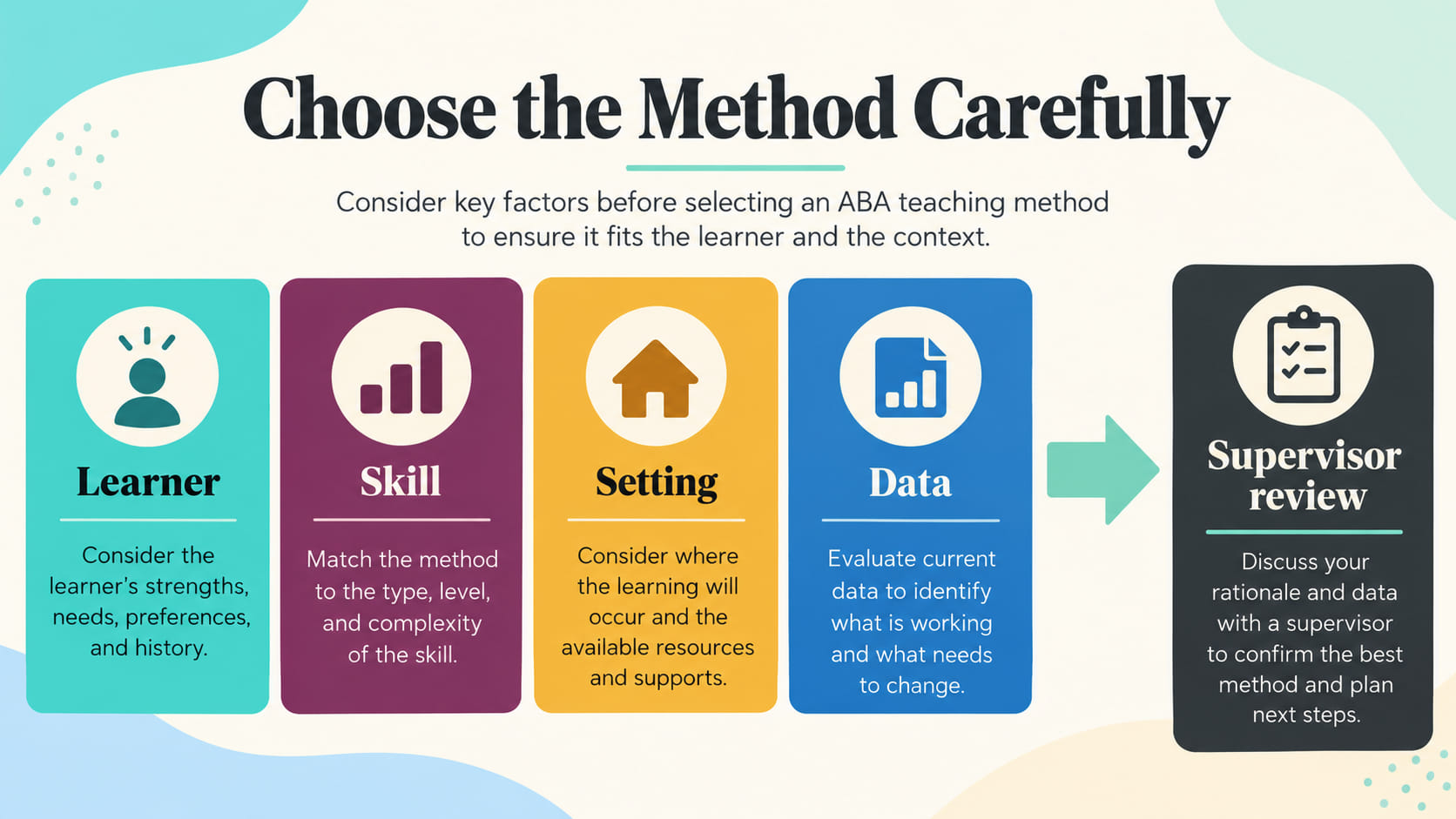
The table is an overview, not an instruction to select a format independently. The supervisor should consider the learner’s communication, motor skills, safety, attention, available time, and the question the team needs to answer.
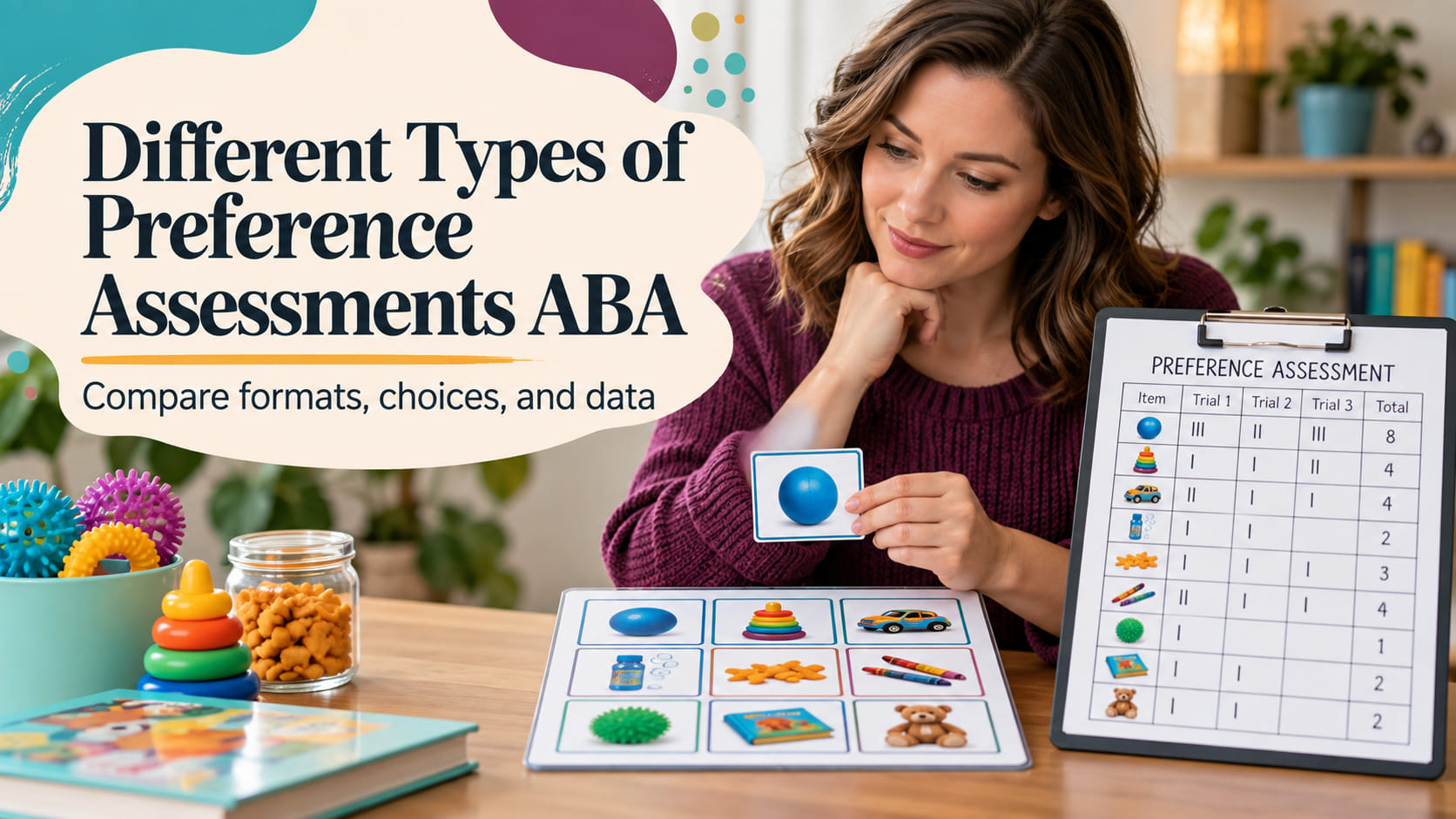
Free-operant observation
In a free-operant arrangement, several items or activities may be available and the observer records approach, engagement, duration, or another defined measure. The learner may move among options rather than choosing only one item from a forced display.
This format can show what the person approaches or engages with when more than one option is available. It may be useful when direct selection is difficult or when the team wants to observe natural engagement. It can also be affected by item location, novelty, access history, motor demands, and how the environment is arranged.
RBTs should follow the assigned instructions about placement, timing, prompting, safety, and measurement. Do not move an item closer, remove an option, or redirect engagement to create a preferred result unless the procedure says to do so.
Single-stimulus presentation
In a single-stimulus format, one item or activity is presented at a time, and the team records the defined response, such as approach, acceptance, interaction, or duration. Each option can be presented under similar conditions according to the plan.
This format can be easier when comparing two items at once would be confusing or when the learner needs a simple presentation. It does not directly show which of two available items would be chosen over the other, so the interpretation should stay within the question the assessment was designed to answer.
A lack of approach is not automatically a statement that the person dislikes the item. The item may be unfamiliar, inaccessible, poorly presented, associated with an earlier event, or simply not useful at that moment. Record the defined response and report relevant context.
Paired-choice assessment
In a paired-choice, or forced-choice, arrangement, two options are presented together and the learner selects or engages with one according to the defined procedure. Pairs are rotated so the team can compare selections across combinations.
Repeated choices can produce a relative ranking, but the result depends on the items, instructions, trial order, response definition, and opportunities provided. The procedure may specify what happens to the unselected item, how long the choice remains available, and whether prompts are used.
The RBT should not turn a paired-choice trial into a negotiation. Present the options as directed, respect the learner’s communication and refusal, record the response, and ask the supervisor when the learner cannot access the choice or the trial rule is unclear.
Multiple-stimulus formats
Multiple-stimulus arrangements present several options at once and use a defined selection and rotation process. Some formats replace a selected item before the next trial; others do not. The exact version matters because it changes the number of options and the opportunities for later selections.
These formats can produce a ranked order efficiently, but they may require scanning, pointing, reaching, or other response skills. If the learner cannot make the expected response, the supervisor may need to adapt the format or choose another method. Do not assume that a failed format means the learner has no preferences.
Choice presentation should also respect communication differences. A learner may select by looking, reaching, touching, using an AAC response, moving toward an option, or using another defined response. The assessment should not privilege one motor or communication style simply because it is easiest for the adult to record.
What the data can and cannot tell you
Data may include selection, approach, latency, engagement duration, refusal, order of choice, or the number of opportunities. Use the operational definitions and recording system in the assigned plan.
Preference results can guide a team in selecting items or activities to evaluate further, but preference is not identical to reinforcement. An item may be selected yet fail to increase a target response in a teaching arrangement. A less frequently selected item may still work in a particular context or for a specific response. The treatment team should evaluate effects through the assigned process.
The RBT’s role
An RBT may prepare materials, present choices, follow timing and safety steps, record the defined data, and report observations. Protect choice and dignity: do not force contact, tease a learner for refusing, or treat a refusal as defiance without following the actual plan.
Ask the supervisor before changing item order, adding a prompt, removing an option, interpreting a ranking, or using a result as a reinforcer. Report when an item is unavailable, contaminated, unsafe, inaccessible, too familiar, or associated with a change in the learner’s condition.
Frequently asked questions
What are the main types of preference assessments?
Common formats include free-operant observation, single-stimulus presentation, paired-choice comparison, and multiple-stimulus arrangements. The exact procedure and interpretation depend on the assigned plan.
Which preference assessment is best?
There is no universally best format. The supervising professional should match the method to the learner, response skills, setting, safety needs, available options, and question being asked.
Is a preference assessment a reinforcer assessment?
Not automatically. Preference data can help identify options to evaluate, but reinforcement is determined by the effect on future behavior under the relevant teaching conditions.
Can an RBT choose the assessment type?
Follow the assigned procedure and supervision. An RBT can report observations and implementation barriers, but should not independently select or redesign the assessment method.
Role reminder: This is educational information, not individualized clinical, credentialing, or treatment advice. RBTs should follow the assigned assessment procedure and ask a supervisor before changing materials, trial order, interpretation, or reinforcement use.
Official starting points: the BACB RBT Test Content Outline, RBT Handbook, supervision and training resources, and RBT Ethics Code.
Ready to practice the RBT concepts you just reviewed?
Try an independent, original RBT practice resource with exam-style questions, scoring, and answer explanations.
References
- Behavior Analyst Certification Board. RBT Test Content Outline, 3rd edition.
- Behavior Analyst Certification Board. RBT Handbook.
- Behavior Analyst Certification Board. RBT Ethics Code.