
The phrase seeking input RBT describes a practical professional skill: recognize when a question needs another person’s knowledge or authority, ask the right person, share observable facts, and confirm the next step.
Table of Contents
- What does seeking input RBT mean for an RBT?
- Notice when a question needs input
- Ask a focused question with useful context
- Act on guidance and close the loop
- Keep input-seeking within scope and privacy
- Common mistakes and a practical checklist
- Frequently Asked Questions
- Sources and further reading
RBT communication and supervision guide
Seeking Input RBT: Ask, Clarify, and Act on Guidance
Seeking input is a professional action: recognize uncertainty, share the facts, ask the right person, and follow approved guidance.
The phrase seeking input RBT describes a practical professional skill: recognize when a question needs another person’s knowledge or authority, ask the right person, share observable facts, and confirm the next step. It is not a sign that an RBT has failed. It is one way to protect accurate implementation, supervision, privacy, and safety.
An RBT can ask for clarification and then implement approved guidance. That does not authorize the RBT to diagnose, redesign a treatment plan, change a procedure, or provide clinical advice. The current written plan, organization policy, training, and responsible supervisor still control the work.
What does seeking input RBT mean for an RBT?
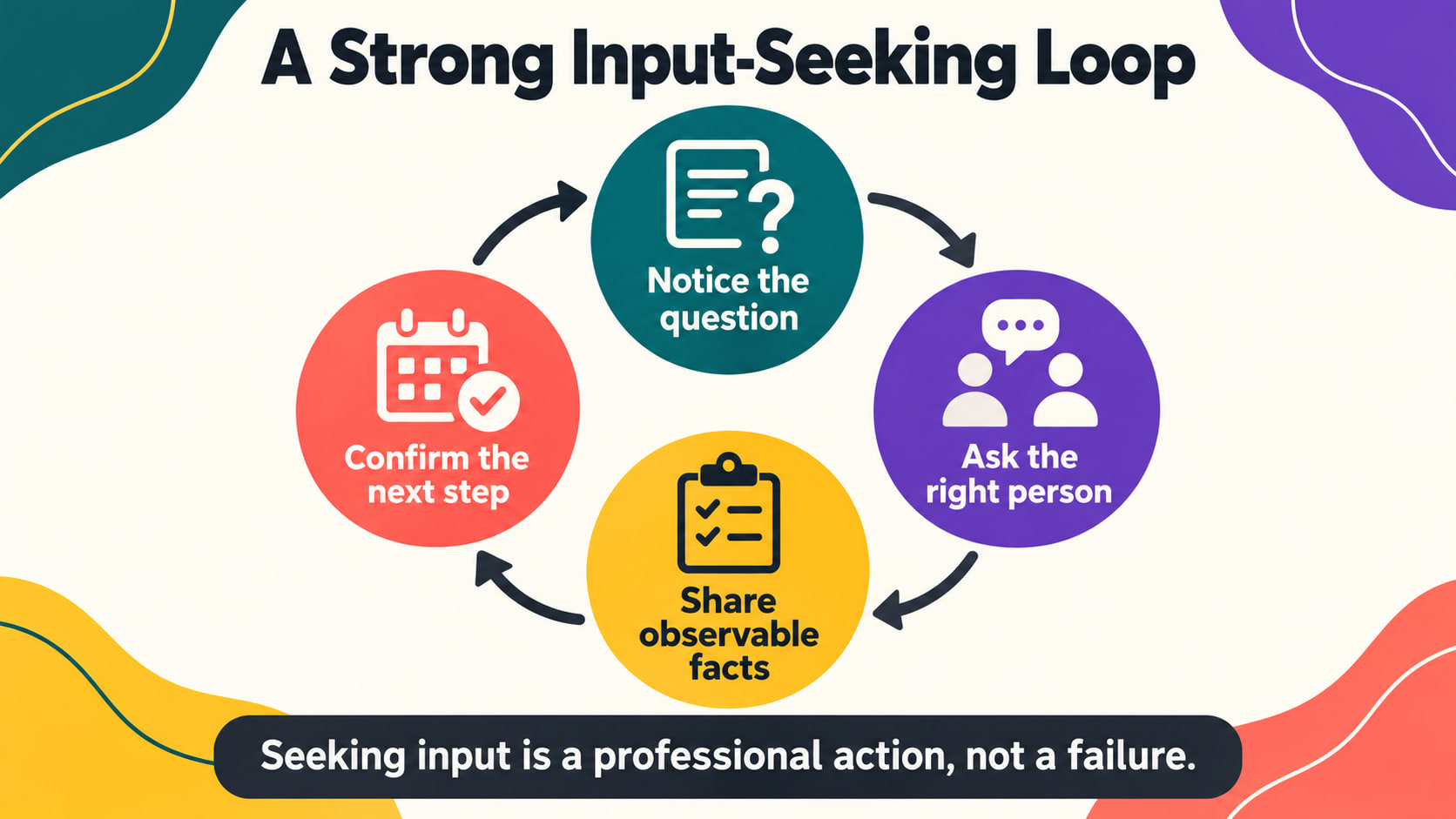
Seeking input means noticing an uncertainty or question and routing it to the person or process that can resolve it. A strong request usually contains four parts:
- The situation: what happened, when, and in which relevant context.
- The observation: the behavior, data, instruction, or document detail you can describe directly.
- The question: the exact point you need clarified.
- The boundary: what you have not changed and what decision belongs to the supervisor or team.
For example: “The current procedure says to record the response after the instruction, but today the instruction was interrupted before the response interval ended. I recorded what occurred and did not change the procedure. Should I mark this as a deviation, and where should I document the question?” That request is more useful than “What should I do?” because it gives the supervisor a clear decision to review.
Notice when a question needs input
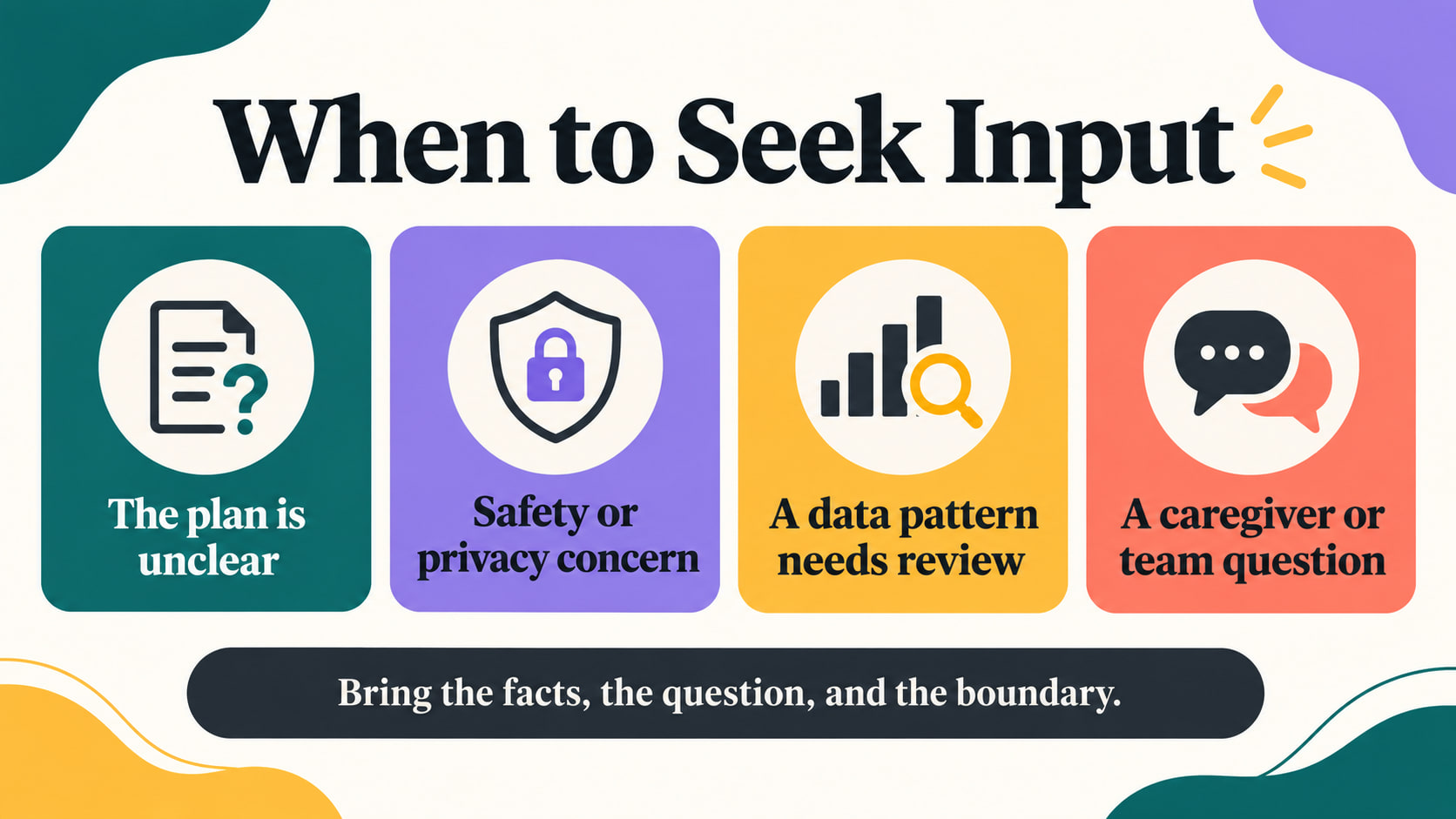
An RBT does not need to wait until a small uncertainty becomes a large error. Seek input when the plan is unclear, when two instructions appear to conflict, when a safety or privacy concern appears, when a data pattern needs clinical review, or when a caregiver or team member asks for a decision outside the RBT role.
There is a difference between ordinary problem-solving and a plan-level decision. An RBT can check the written procedure, organize the facts, and correct a simple documentation omission according to policy. A question about changing the target, reinforcement arrangement, prompt-fading criterion, crisis response, or interpretation of progress generally needs the responsible supervisor or another authorized professional.
Before asking, take a short pause. Identify what you already checked, what remains uncertain, and whether the issue is urgent. If there is an immediate safety concern, use the required escalation route rather than waiting to write a perfect message.
Ask a focused question with useful context
The right person depends on the question. A supervisor may handle clinical or program guidance. An employer or coordinator may handle scheduling, onboarding, or an administrative process. An official credentialing organization may control an application or examination requirement. When the route is unclear, ask the supervisor or organization which channel to use.
Keep the request concise but complete. A useful structure is:
- Context: “During the final transition in today’s session…”
- Facts: “The learner left the table twice after the instruction; the current procedure was followed until that point.”
- Question: “Should this be documented as a plan deviation, or is there a specific field for it?”
- Next step: “I will keep using the current procedure until you clarify the approved response.”
Ask one main question at a time when possible. If there are several related concerns, number them. This makes it easier for the supervisor to answer and easier for the RBT to record which guidance applies to which situation.
Do not fill gaps with confident language. “I am not sure which version controls” is more accurate than guessing. Seeking input is strongest when it makes uncertainty visible instead of hiding it behind a quick answer.
Act on guidance and close the loop
Receiving input is only the middle of the process. After the supervisor responds, restate the approved next step in your own words: “To confirm, I should continue the current procedure, record the deviation in the session note, and bring the pattern to supervision review.” If your summary is wrong, the other person can correct it before the next session.
Then follow the instruction through the approved channel and document what the policy requires. Do not turn informal advice into a permanent plan change. If the guidance conflicts with the written procedure or raises a new safety or ethics concern, pause and ask for clarification rather than silently choosing one version.
Closing the loop can also mean telling the person who raised the question what you can and cannot share. Protect client privacy, avoid promising a particular outcome, and use the minimum necessary information. The goal is a clear next step, not a dramatic or lengthy conversation.
Keep input-seeking within scope and privacy
Seeking input does not mean asking everyone for an opinion. Choose an authorized route and protect identifying information. Do not post client details in a public group, send them from a personal account, or discuss a case where people are not authorized to hear it.
Input also does not transfer decision authority. A colleague may offer a helpful observation, but an informal suggestion is not automatically a new treatment instruction. The RBT should follow the current approved plan and ask the responsible supervisor to resolve a plan-level question.
For credentialing, employment, legal, or testing questions, use current official or organizational sources. A study partner or online comment can help identify a question, but it cannot replace the controlling handbook, application instruction, policy, or supervisor.
Common mistakes and a practical checklist
- Waiting until the uncertainty becomes an incident. Ask when the question first affects safe or accurate implementation.
- Asking for an opinion without sharing facts. State the observable event, data, or document language first.
- Asking the wrong person. Route program decisions, administrative questions, and credentialing questions to the appropriate authority.
- Changing the plan after informal input. Confirm that guidance is authorized and document the approved next step.
- Leaving the loop open. Repeat the next step and record what the policy requires.
Before sending a request, ask yourself:
- What exactly happened?
- What did I observe or measure?
- What document or procedure did I check?
- What one decision or clarification do I need?
- Which approved channel protects privacy?
Frequently Asked Questions
Is seeking input a weakness for an RBT?
No. Recognizing uncertainty and asking through the correct supervision route can support accurate, ethical, and safe practice. The quality of the request matters: bring facts, a focused question, and a clear boundary.
What should an RBT include when asking a supervisor for input?
Include the relevant situation, observable facts or data, the current procedure or source checked, the exact question, and what you have not changed. Keep client-identifying information to the approved minimum.
Can an RBT change a plan after receiving input from a coworker?
Not simply because a coworker offered a suggestion. Plan changes and clinical decisions must follow the responsible professional’s authorized process. Continue the current approved procedure and ask for clarification when needed.
When should input-seeking be urgent?
Use the required escalation process for immediate safety risks, privacy concerns, suspected harm, medical concerns, or directions that conflict with safety or policy. Do not delay urgent reporting while trying to make the message perfect.
How can an RBT practice this skill?
After a session or study scenario, write one sentence describing the facts and one sentence stating the question. Practice identifying who has authority to answer and what you will do while waiting for guidance.
Sources and further reading
- BACB RBT Test Content Outline, 3rd edition
- BACB Supervision and Training resources
- BACB RBT Handbook
- BACB Ethics Codes and RBT Ethics Code resources
Explore RBT communication training, supervision learning, and role-safe practice resources for your next professional question.
Ready to practice the RBT concepts you just reviewed?
Try an independent, original RBT practice resource with exam-style questions, scoring, and answer explanations.
References
- Behavior Analyst Certification Board. RBT Test Content Outline, 3rd edition.
- Behavior Analyst Certification Board. RBT Handbook.
- Behavior Analyst Certification Board. RBT Ethics Code.