

The phrase collaboration RBT describes how an RBT works with the supervisor, caregivers, and other authorized team members to support consistent, respectful, and role-appropriate service.
Table of Contents
- What does collaboration RBT mean for an RBT?
- Understand roles before coordinating
- Communicate observations clearly
- Coordinate the next step
- Protect scope, privacy, and disagreement
- Common mistakes and a practical checklist
- Frequently Asked Questions
- Sources and further reading
RBT teamwork and supervision guide
Collaboration RBT: Work With the Team Within Your Role
Collaboration helps an RBT share observations, coordinate with authorized team members, and keep professional roles clear.
The phrase collaboration RBT describes how an RBT works with the supervisor, caregivers, and other authorized team members to support consistent, respectful, and role-appropriate service. Collaboration is more than being friendly or agreeing with every suggestion. It means sharing useful observations, listening to assigned roles, coordinating approved next steps, and making boundaries visible.
An RBT can contribute important information without becoming the person who independently diagnoses, designs treatment, changes a plan, or supervises another professional. The current written procedure, organization policy, training, and responsible supervisor continue to control implementation.
What does collaboration RBT mean for an RBT?
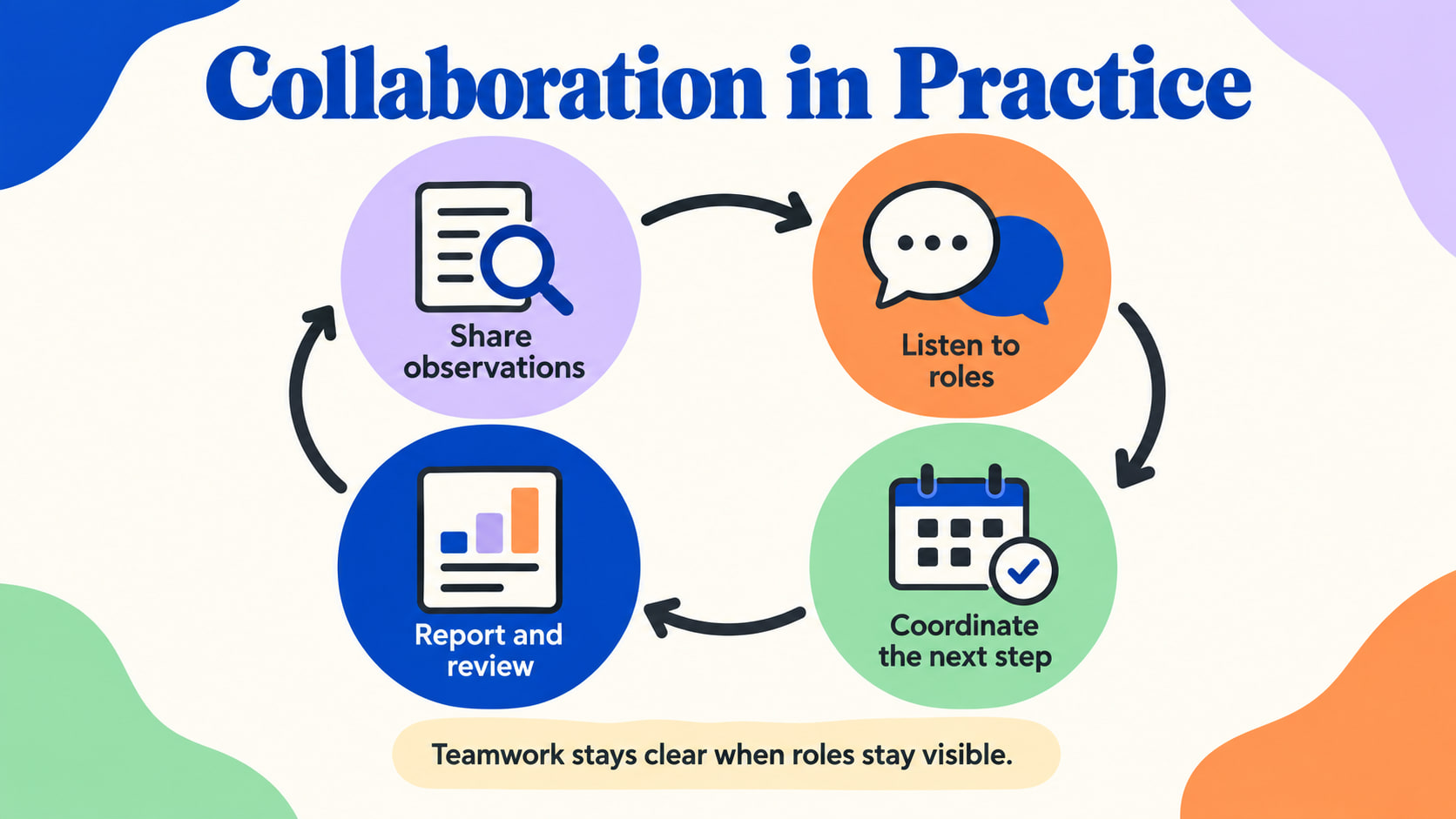
For an RBT, collaboration is a structured way to work with the people responsible for a learner’s service and support. A useful collaboration loop includes:
- Share observations: describe what happened, what was measured, and what question came up.
- Listen to roles: understand which person owns the clinical, administrative, caregiver, or credentialing decision.
- Coordinate the next step: agree on the approved action, channel, timing, or follow-up.
- Report and review: document what the procedure requires and bring unresolved patterns to supervision.
This approach helps the team act on information without asking the RBT to solve every issue independently.
Understand roles before coordinating
Collaboration works best when each person’s role is visible. A supervisor may be responsible for clinical interpretation, treatment design, plan changes, and supervision. A caregiver may share priorities, context, or concerns. An RBT may implement assigned procedures, record observable events, and report questions. An employer or coordinator may handle schedules, training records, or administrative processes.
Roles can overlap in conversation while remaining different in authority. For example, a caregiver can ask why a transition was difficult, an RBT can share what was observed, and the supervisor can decide whether the program requires review. The RBT can participate respectfully without answering a plan-level question outside the RBT role.
When a team member asks for an immediate change, identify whether the request is an observation, a preference, a safety concern, or an authorized instruction. If the answer is unclear, seek input through the approved route before changing the procedure.
Communicate observations clearly
Good collaboration depends on information that another person can understand and check. Separate observations from interpretations. “The learner left the table twice after the instruction” is an observation. “The learner was refusing because the task was too hard” is an interpretation that may require more evidence and supervisor review.
A concise update can use four questions:
- What happened?
- What was measured or documented?
- What support or clarification is needed?
- What is the next question for the responsible person?
Use the team’s approved communication and documentation channels. Avoid unnecessary details, emotional labels, and client-identifying information. If the topic is sensitive, confirm who is authorized to receive it before discussing the case.
Coordinate the next step
Coordination turns a conversation into a defined action. Instead of ending with “we will see what happens,” state who will do what and what remains with the supervisor or team. For example: “I will continue the current procedure, record the two transitions according to the data definition, and send the question through the approved supervision channel. The supervisor will review whether the pattern requires a program discussion.”
Repeat the instruction in your own words when the next step is important or complex. This is especially useful when several people are involved or when a question moved from a session observation to a plan-level concern.
Collaboration does not require every person to agree. A respectful disagreement can be reported as a specific difference in observation, source, or role. Ask which document or responsible professional controls the decision, and avoid turning a professional question into a personal argument.
When responsibility moves from one team member to another, make the handoff explicit. Name the last confirmed observation, the open question, the person expected to review it, and the time or event that will prompt a follow-up. This reduces the chance that everyone assumes someone else is handling the concern.
Protect scope, privacy, and disagreement
Collaboration is not a license to share everything with everyone. Use the minimum necessary information and approved channels. Do not discuss a client in a public group, send identifying information from a personal account, or invite unauthorized people into a case conversation.
It is also not a license to change a plan. A coworker may offer a thoughtful suggestion, but the RBT should not treat informal input as a new treatment instruction. Keep implementing the current approved procedure unless the authorized process provides a clear change.
If a collaboration request raises a safety, privacy, ethics, or scope concern, make that boundary explicit and use the escalation route. “I can share what I observed, but I need the supervisor to confirm the plan decision” is a useful professional response.
Common mistakes and a practical checklist
- Confusing teamwork with agreement. Collaboration allows respectful questions and different observations.
- Sharing conclusions instead of facts. Start with observable events and the data or document checked.
- Skipping the owner of the decision. Ask who is authorized to answer a program, administrative, or credentialing question.
- Changing the procedure to be helpful. Continue the approved plan and route the requested change.
- Leaving roles unclear. State your next action and what remains with the supervisor or team.
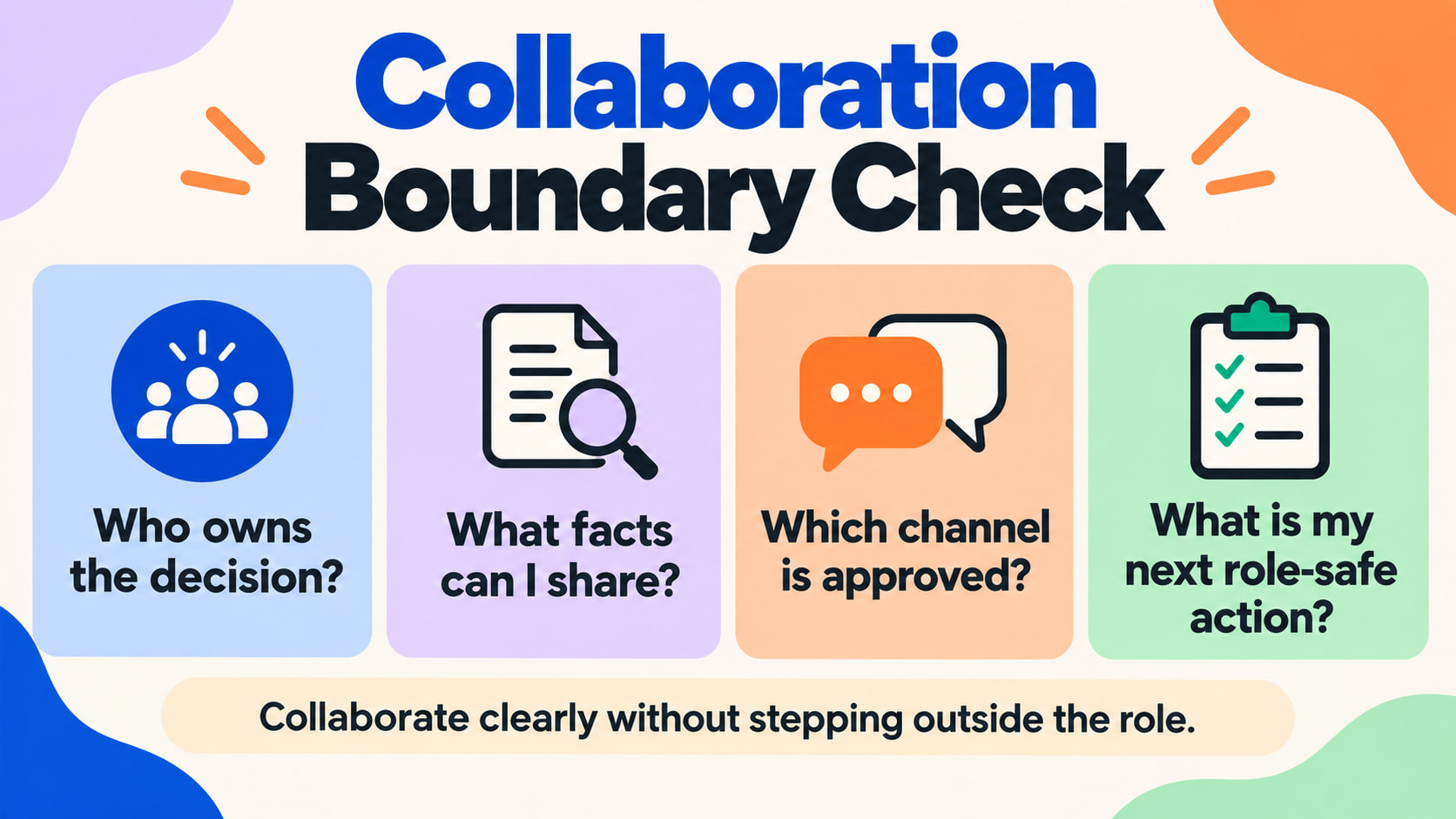
Before a team conversation, check:
- What did I directly observe or measure?
- What is the exact question?
- Who owns the decision?
- Which channel protects privacy?
- What role-safe action can I take now?
Frequently Asked Questions
Does collaboration mean an RBT can make decisions with the team?
An RBT can participate in communication and share observations, but collaboration does not transfer authority for diagnosis, treatment design, plan changes, or supervision. Follow the current assigned procedure and the authorized decision process.
What should an RBT contribute during a team meeting?
Bring objective observations, relevant data, questions about implementation, and any safety or privacy concern that should be routed. Avoid client-identifying details that are not necessary for the authorized discussion.
How should an RBT handle disagreement with a coworker?
Keep the discussion specific and respectful. Separate observations from interpretations, identify the current source or procedure, and ask the supervisor or responsible person to resolve a plan-level disagreement.
Can a caregiver’s request change an RBT’s procedure?
A caregiver’s concern is important information, but an RBT should not independently change the procedure in response. Listen, document or relay the concern through the approved process, and follow the supervisor’s direction.
What makes collaboration role-safe?
Role-safe collaboration keeps decision ownership visible, shares only authorized information, uses approved channels, describes observations accurately, and confirms the next step before a change is implemented.
Sources and further reading
- BACB RBT Test Content Outline, 3rd edition
- BACB Supervision and Training resources
- BACB RBT Handbook
- BACB Ethics Codes and RBT Ethics Code resources
Explore RBT communication training, supervision learning, and role-safe practice resources for your next team conversation.
Ready to practice the RBT concepts you just reviewed?
Try an independent, original RBT practice resource with exam-style questions, scoring, and answer explanations.
References
- Behavior Analyst Certification Board. RBT Test Content Outline, 3rd edition.
- Behavior Analyst Certification Board. RBT Handbook.
- Behavior Analyst Certification Board. RBT Ethics Code.