
The phrase interpersonal professional skills RBT points to the everyday communication behaviors that help an RBT work respectfully with supervisors, caregivers, learners, and authorized team members.
Table of Contents
- What are interpersonal professional skills RBT behaviors?
- Listen before reacting
- Clarify facts, questions, and next steps
- Respect roles while collaborating
- Repair a difficult conversation
- Practice and review the skill
- Frequently Asked Questions
- Sources and further reading
RBT communication and professional skills guide
Interpersonal Professional Skills RBT: Practice Respectful Teamwork
Build observable communication habits that help you listen, clarify, respect roles, repair conversations, and follow through.
The phrase interpersonal professional skills RBT points to the everyday communication behaviors that help an RBT work respectfully with supervisors, caregivers, learners, and authorized team members. These skills are observable: listening without rushing, asking a focused question, separating facts from assumptions, respecting decision ownership, and completing an agreed follow-up.
Strong interpersonal skill does not mean being agreeable at all times or accepting unsafe, disrespectful, or unethical conduct. It also does not authorize an RBT to diagnose, redesign treatment, change a plan, or supervise another person. Professional communication and role boundaries work together.
What are interpersonal professional skills RBT behaviors?
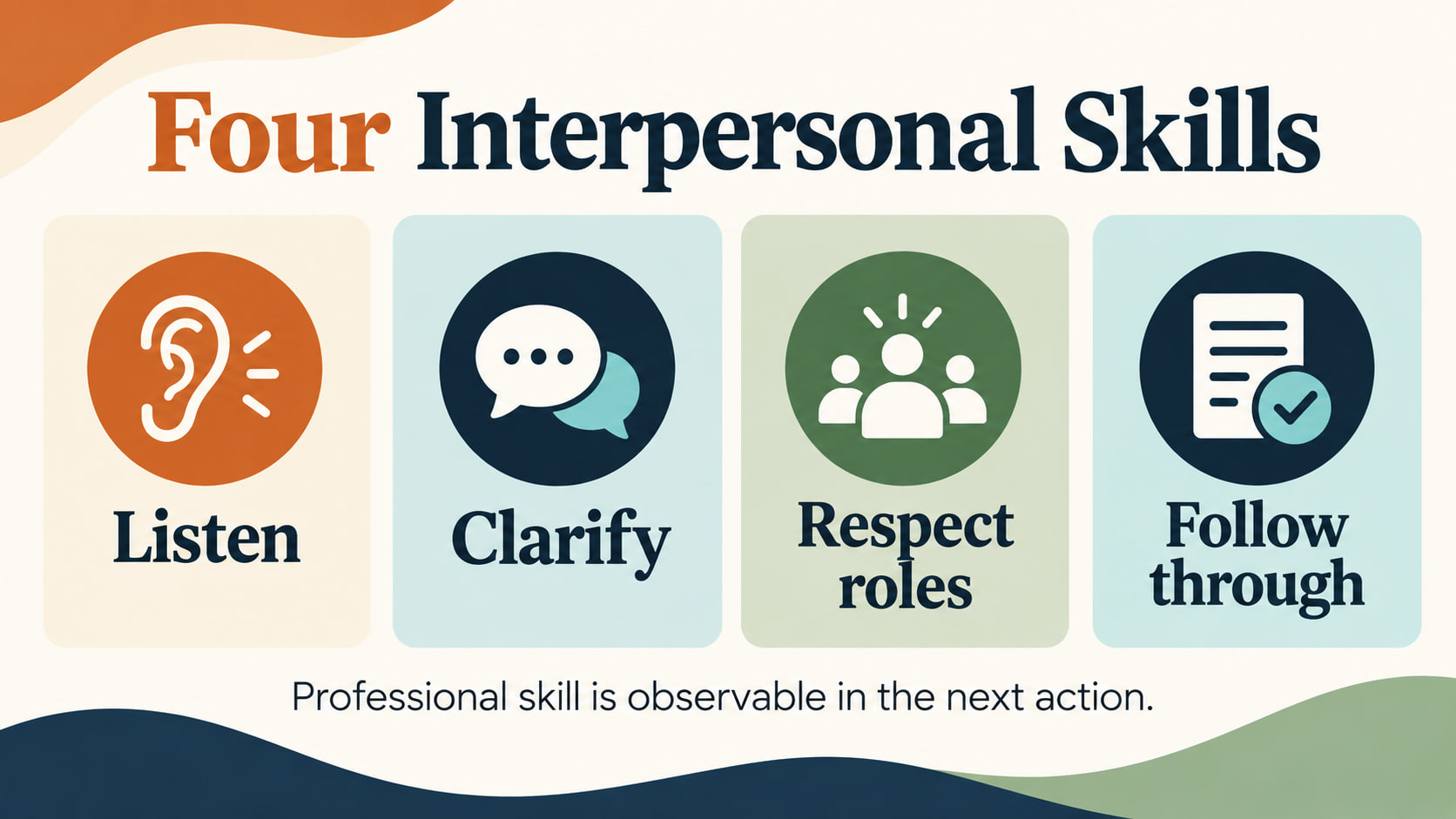
For an RBT, interpersonal professional skills can be organized into four practical behaviors:
- Listen: give attention to the concern and identify what the person is actually asking.
- Clarify: reflect observable facts and ask what remains uncertain.
- Respect roles: identify who owns a clinical, administrative, caregiver, or credentialing decision.
- Follow through: use the approved channel, document what is required, and confirm the next step.
A useful skill is not only a personality trait. It is something a supervisor or team member can observe, describe, and practice. That makes it easier to improve without turning a broad label such as “good communicator” into an unsupported judgment.
Listen before reacting
People often combine observations, feelings, interpretations, and requests in one message. An RBT can acknowledge the concern without treating each part as verified fact. For example, “The transition was hard today” may describe an observation, while “the routine is not working” is an interpretation that may need review.
Start with attention. Reduce distractions, allow the person to finish the main thought, and use a short reflection such as “I hear that the final transition was difficult.” Then identify the actual request: Is the person asking what was documented, reporting a safety issue, seeking a plan decision, or asking for an administrative update?
Listening does not require an immediate answer. If you need to check the plan or ask the supervisor, say so. A calm pause is more professional than a confident guess that later creates confusion.
Clarify facts, questions, and next steps
Clarification keeps a conversation from drifting into assumptions. Use observable language and one focused question at a time:
- “What did you observe immediately before and after the response?”
- “Are you asking for the session data, a description of the event, or a supervisor decision?”
- “Which part of the current procedure seems unclear?”
- “What would you like me to record or route through the approved channel?”
Then summarize the answer in your own words. “So the question is whether the event should be marked as a deviation; I will not change the procedure while that is reviewed” makes the boundary visible and gives the other person a chance to correct the summary.
Respect roles while collaborating
Collaboration is easier when decision ownership is clear. An RBT may implement assigned procedures, record observations, report concerns, and ask for supervision. The responsible supervisor may handle assessment, clinical interpretation, treatment design, plan changes, and supervision. Caregivers and other authorized team members may contribute context, priorities, or questions.
Role awareness is not a barrier to teamwork. It tells the team how to route information. If a caregiver asks for a program change, listen respectfully, document or relay the concern as required, and ask the supervisor for the approved response. If a coworker proposes a different procedure, check whether the suggestion is an authorized instruction or simply an idea for review.
Use the minimum necessary information and approved communication channels. Interpersonal skill includes protecting privacy, not only sounding polite.
Good collaboration also makes work predictable. Tell the team what you noticed, what you need from them, and what you will do while the question is reviewed. Predictable handoffs reduce repeated explanations and help the next person act on the same information.
Repair a difficult conversation
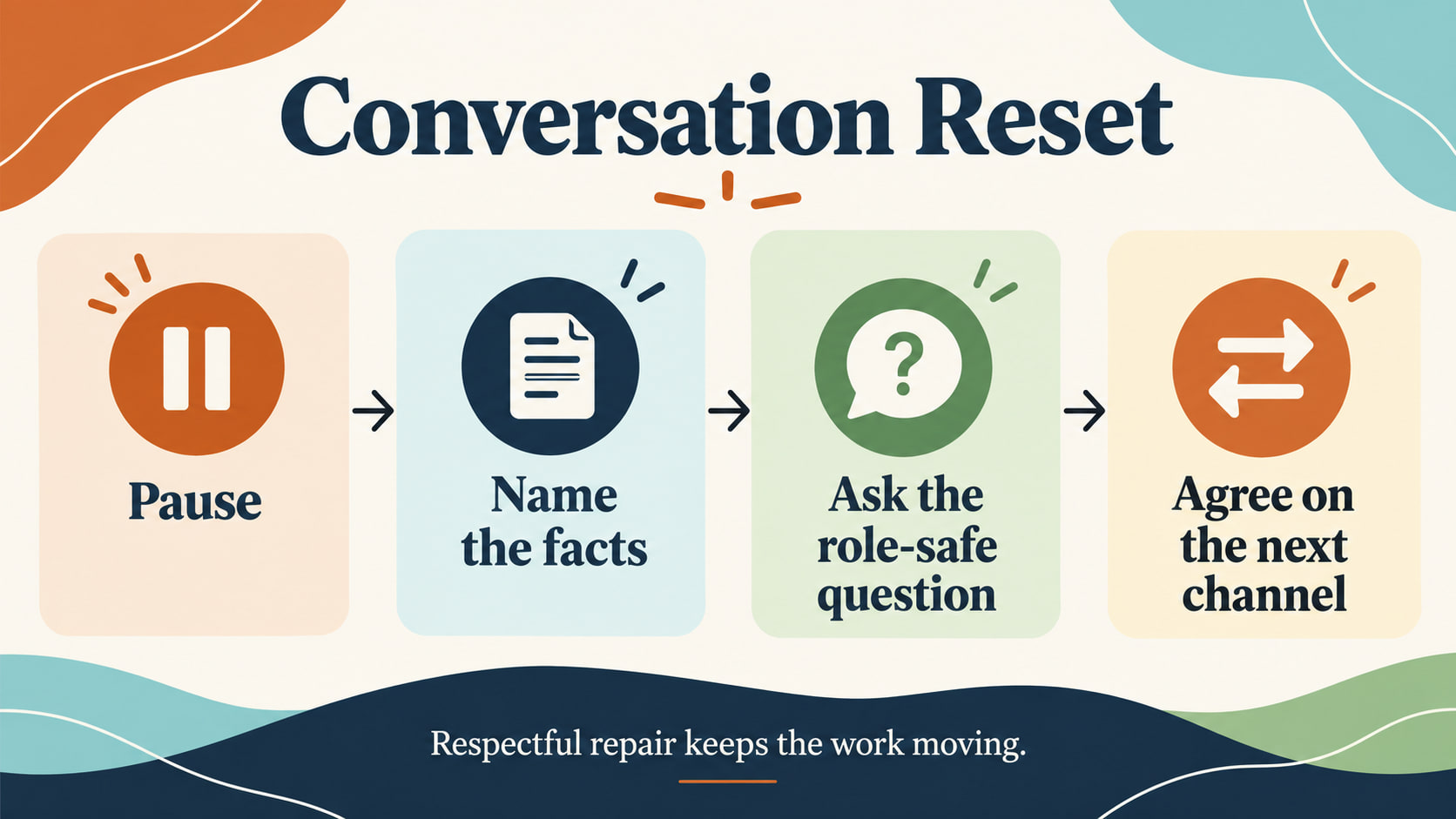
Even careful professionals can misunderstand one another. A repair conversation does not require proving who was right. It requires slowing down, naming what can be verified, and agreeing on a role-safe next step.
- Pause: lower the pace and avoid adding new assumptions.
- Name the facts: describe the words, instruction, observation, or record that created confusion.
- Ask the role-safe question: identify what needs clarification and who owns the decision.
- Agree on the next channel: state what will be documented, reviewed, or followed up.
If a conversation includes threats, harassment, discrimination, retaliation, unsafe directions, or a privacy concern, use the organization’s reporting or escalation process. Professional skill is not the same as tolerating harm.
Practice and review the skill
After a conversation or study scenario, review the next action rather than judging your personality. Ask:
- Did I listen for the actual question?
- Did I distinguish observation from interpretation?
- Did I identify who owns the decision?
- Did I use an approved channel and protect privacy?
- Did I state the follow-up clearly?
Bring one concrete example to supervision. Ask for feedback on a sentence, handoff, note, or question, then practice a revised version. A specific behavior such as “summarize the concern before responding” is easier to improve than a general goal such as “be more professional.”
Keep documentation objective and within policy. If you made a communication error, correct the record through the approved process and ask how to handle the next similar situation. Hiding a mistake makes teamwork harder; reporting it accurately gives the team something to review.
Frequently Asked Questions
What interpersonal skills should an RBT practice first?
Start with listening, objective reflection, focused clarification, role awareness, and follow-through. These behaviors support both everyday communication and supervision.
Does being professional mean agreeing with a supervisor or caregiver?
No. Professional communication can include a respectful question, a documented disagreement, or an escalation of a safety, privacy, or ethics concern. Agreement is not the same as collaboration.
Can interpersonal skill allow an RBT to give clinical advice?
No. Communication skill helps an RBT share observations and seek input, but it does not authorize diagnosis, treatment design, plan changes, or clinical advice outside the assigned role.
How can a supervisor give useful feedback on interpersonal skills?
Feedback is most useful when it names an observable behavior, explains the effect, and identifies what to practice next. A supervisor might review a handoff sentence or role-boundary response rather than using only a broad label.
How should an RBT handle an unsafe or disrespectful interaction?
Protect immediate safety, use the organization’s reporting or escalation process, and seek supervision. Do not treat politeness as a reason to tolerate abuse, discrimination, retaliation, or unsafe instructions.
Sources and further reading
- BACB RBT Test Content Outline, 3rd edition
- BACB Supervision and Training resources
- BACB RBT Handbook
- BACB Ethics Codes and RBT Ethics Code resources
Explore RBT communication training, supervision learning, and role-safe practice resources for your next professional conversation.
Ready to practice the RBT concepts you just reviewed?
Try an independent, original RBT practice resource with exam-style questions, scoring, and answer explanations.
References
- Behavior Analyst Certification Board. RBT Test Content Outline, 3rd edition.
- Behavior Analyst Certification Board. RBT Handbook.
- Behavior Analyst Certification Board. RBT Ethics Code.