
This cultural responsiveness RBT guide connects relevant information to concrete, respectful, and authorized support decisions.
Table of Contents
- What is cultural responsiveness RBT?
- Notice the context without guessing
- Ask what matters to the person and team
- Adapt approved support respectfully
- Check, document, and route decisions
- Practice a responsive support sequence
- Quick comparison
- Frequently Asked Questions
- Sources and further reading
RBT ethics, communication, and implementation guide
Cultural Responsiveness RBT: Notice, Adapt, Respect
Connect relevant information to respectful support while staying inside the written plan and RBT role.
The phrase cultural responsiveness RBT describes how an RBT can respond to relevant cultural, communication, family, identity, and preference information in a concrete and respectful way. Responsiveness is more than having good intentions. It means noticing the context, asking when information is missing, using the person’s stated cues or approved team guidance, and checking whether the support was implemented as intended.
Responsiveness is also not a license to improvise. An RBT can observe and communicate, implement assigned procedures, protect dignity and privacy, and seek direction. Plan changes, assessment, diagnosis, and other clinical decisions belong to the responsible professional or authorized process.
What is cultural responsiveness RBT?
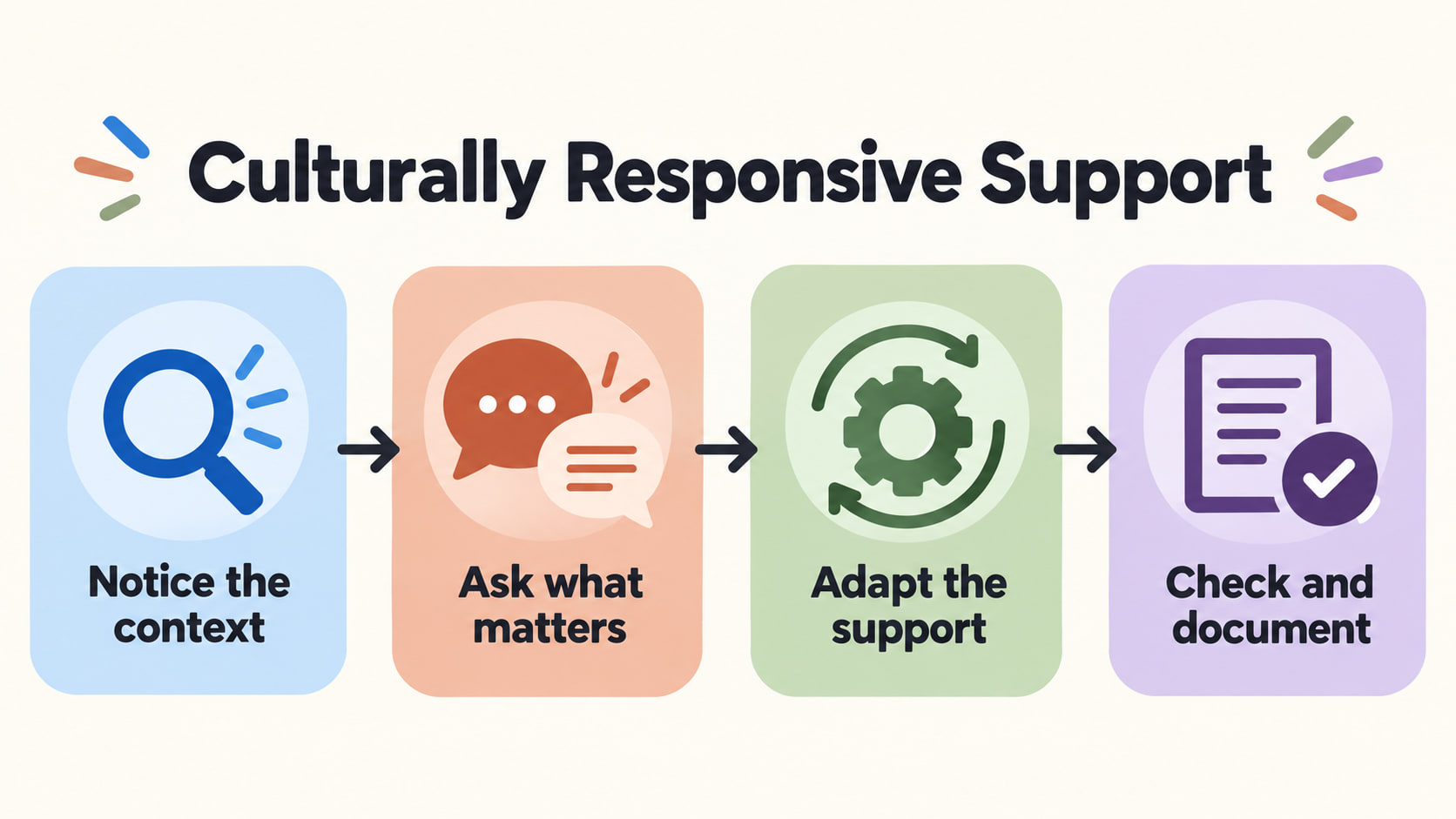
Cultural responsiveness for an RBT can be organized into four actions:
- Notice the context: identify what happened and what information may affect communication or participation.
- Ask what matters: use a relevant question instead of assuming a group rule or personal preference.
- Adapt the support: use an approved adjustment that preserves dignity, choice, safety, and the purpose of the program.
- Check and document: confirm understanding, record relevant information through the correct system, and route plan-level questions.
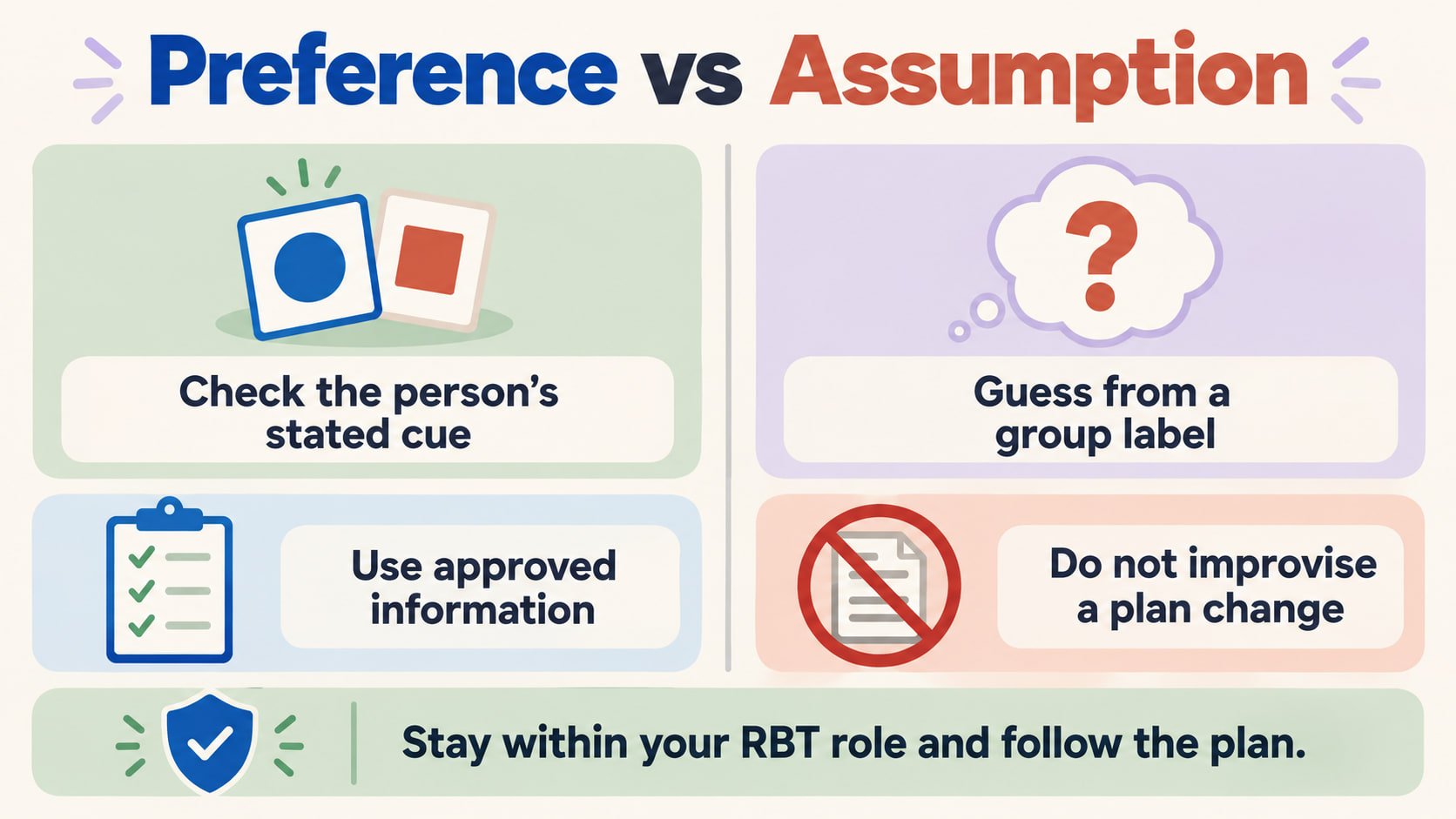
The target is person-specific support. A cultural label may alert a team that a question deserves attention, but it does not tell the team exactly what an individual wants, communicates, values, or needs. The person’s own stated preference, the current plan, and supervisor direction are more useful than a stereotype.
| Situation | Less responsive shortcut | More responsive action |
|---|---|---|
| A routine is unfamiliar | Assume what the routine means | Describe the event and ask what context is relevant |
| A communication preference is shared | Ignore it because the old script is easier | Use the approved preference and check the record |
| A request changes the program | Make the change immediately | Bring the request to the responsible supervisor |
| An adjustment seems ineffective | Blame the person or culture | Review implementation, data, context, and next direction |
Notice the context without guessing
Responsiveness begins with accurate observation. Write what was said or done, when it happened, who was involved in the professional interaction, and what support was available. Avoid turning a behavior into a motive or cultural explanation before the team has relevant information.
For example, “The learner refused because the family does not value school tasks” is an unsupported interpretation. A more useful record might be: “When the worksheet was presented, the learner pushed it away, pointed to the break card, and did not begin within the defined response interval.” The supervisor and team can then decide what additional context is relevant.
A context check can include:
- Was the instruction understood in the person’s preferred communication format?
- Was a relevant routine, language, person, material, or setting different today?
- Did the team use the person’s approved name, pronoun, communication system, or choice procedure?
- Is the information necessary for implementation, or is it merely interesting?
- Does the current plan say how the information should be recorded or used?
Noticing context does not require the RBT to conduct an independent assessment. It means identifying a question clearly enough for the appropriate person to review.
Ask what matters to the person and team
A useful question is relevant, respectful, and limited to the professional purpose. The RBT does not need to ask every person to explain their identity or background. A question should help the team communicate, implement the current procedure, protect dignity, or decide who needs to review a concern.
Examples include:
- “Is there a communication preference the current team should follow?”
- “Which term or name should I use in the session record?”
- “Would this choice format be easier to understand, or should I ask the supervisor first?”
- “Is this routine change something the supervisor should review before the next session?”
- “What part of the current support is most important to keep consistent at home and in session?”
Listen to the answer without treating it as a universal rule. One person’s preference may be personal, situational, or connected to a particular communication need. If the answer involves a change to the plan, the RBT communicates it through the approved channel and waits for the responsible direction.
Adapt approved support respectfully
Some adaptations are communication choices within an existing procedure. Examples might include using an approved name, providing a documented language support, presenting choices in a familiar format, or allowing the person to select between authorized materials. These adjustments should be visible in the current records or confirmed through supervision when the RBT is unsure.
Other requests may affect the target, reinforcement arrangement, prompt procedure, data system, assessment condition, safety response, or treatment schedule. Those requests can be culturally important and still require plan-level review. The responsive action is to bring the relevant context to the supervisor, not to decide that the request is either automatically approved or automatically unreasonable.
A role-safe sentence is: “I understand that this format matters to the family. I can use the approved option currently in the program. The requested change appears to affect the procedure, so I will ask the supervisor to review it before I alter the session.” This communicates respect and keeps decision ownership visible.
Check, document, and route decisions
Checking means asking whether the adjustment was understood and implemented, not demanding that the person prove it worked. If the team agrees on a wording or communication support, use it consistently and document the relevant information according to policy. If a misunderstanding occurs, repair it and tell the supervisor when the issue affects the plan or relationship.
Document the minimum necessary information. A note can state the observable communication preference and the action taken without recording unrelated family history or identity details. Use the approved system, protect access, and follow the organization’s confidentiality requirements.
When the adjustment appears to affect outcomes, do not announce a conclusion from one session. Share the data, implementation details, and unanswered question. The responsible professional can decide whether a program review, additional training, or another process is appropriate.
Practice a responsive support sequence
Use this four-part sequence in training or supervision:
- Describe: state the observable event without a stereotype or motive.
- Ask: identify the specific context or preference that needs clarification.
- Act within scope: use the approved support or pause for direction when the request is plan-level.
- Review: check the record, follow up through the proper channel, and note what question remains.
Practice with a neutral example: a caregiver asks that a visual use a different term. The RBT can say, “I hear that this wording is important. I will check the current materials and use the approved wording available today. Can we ask the supervisor to confirm whether the visual should be updated across the program?” This response is responsive without promising an immediate plan change.
After practice, ask whether the response preserved choice, dignity, privacy, safety, and decision ownership. Cultural responsiveness grows through repeated small checks, not through a single perfect sentence.
Quick comparison
| Prompt | Responsive check | Role boundary |
|---|---|---|
| What do I know? | Separate direct observation from interpretation | Do not turn a guess into a fact |
| What should I use? | Follow stated or approved communication information | Do not invent a preference |
| What needs to change? | Use the current authorized support or ask for review | Do not change the plan independently |
| What should I record? | Document relevant information and action | Do not include unnecessary private details |
Frequently Asked Questions
Is cultural responsiveness the same as cultural competence?
This article uses cultural responsiveness to describe concrete, person-specific actions. It does not claim that an RBT has complete knowledge or that one training event proves competence.
Can cultural responsiveness require a plan change?
Relevant information may lead the team to consider a plan review, but the RBT should not make the change independently. Bring the observation and request to the responsible supervisor or authorized process.
What if a caregiver asks for a support that seems unsafe?
Listen respectfully, state that you need to follow the current safety and supervision process, and route the request promptly. Do not promise to implement an unsafe or out-of-scope instruction.
How can an RBT avoid stereotypes?
Use person-specific information, ask only relevant questions, separate observations from assumptions, and check the current plan. Do not infer a preference from a group label, appearance, language, or family name.
Sources and further reading
- BACB RBT Test Content Outline, 3rd edition
- BACB Supervision and Training resources
- BACB RBT Handbook
- BACB Ethics Codes and RBT Ethics Code resources
Explore RBT ethics, communication, supervision learning, and role-safe practice resources for your next team discussion.
Ready to practice the RBT concepts you just reviewed?
Try an independent, original RBT practice resource with exam-style questions, scoring, and answer explanations.
References
- Behavior Analyst Certification Board. RBT Test Content Outline, 3rd edition.
- Behavior Analyst Certification Board. RBT Handbook.
- Behavior Analyst Certification Board. RBT Ethics Code.