
Instruction vs feedback RBT supervision is easier to understand when you separate explaining a task from responding to an observed performance.
Table of Contents
- Instruction vs feedback RBT supervision: the short answer
- What instruction does
- What feedback does
- Instruction versus feedback in a supervision example
- A practical practice loop
- Role boundaries and documentation
- When another practice attempt is needed
- Common mistakes
- Frequently asked questions
- References
RBT SUPERVISION GUIDE · PRACTICE SKILLS
Instruction vs Feedback RBT Supervision: Know the Difference
Separate task explanations from responses to observed performance, then use both within the current supervision plan.
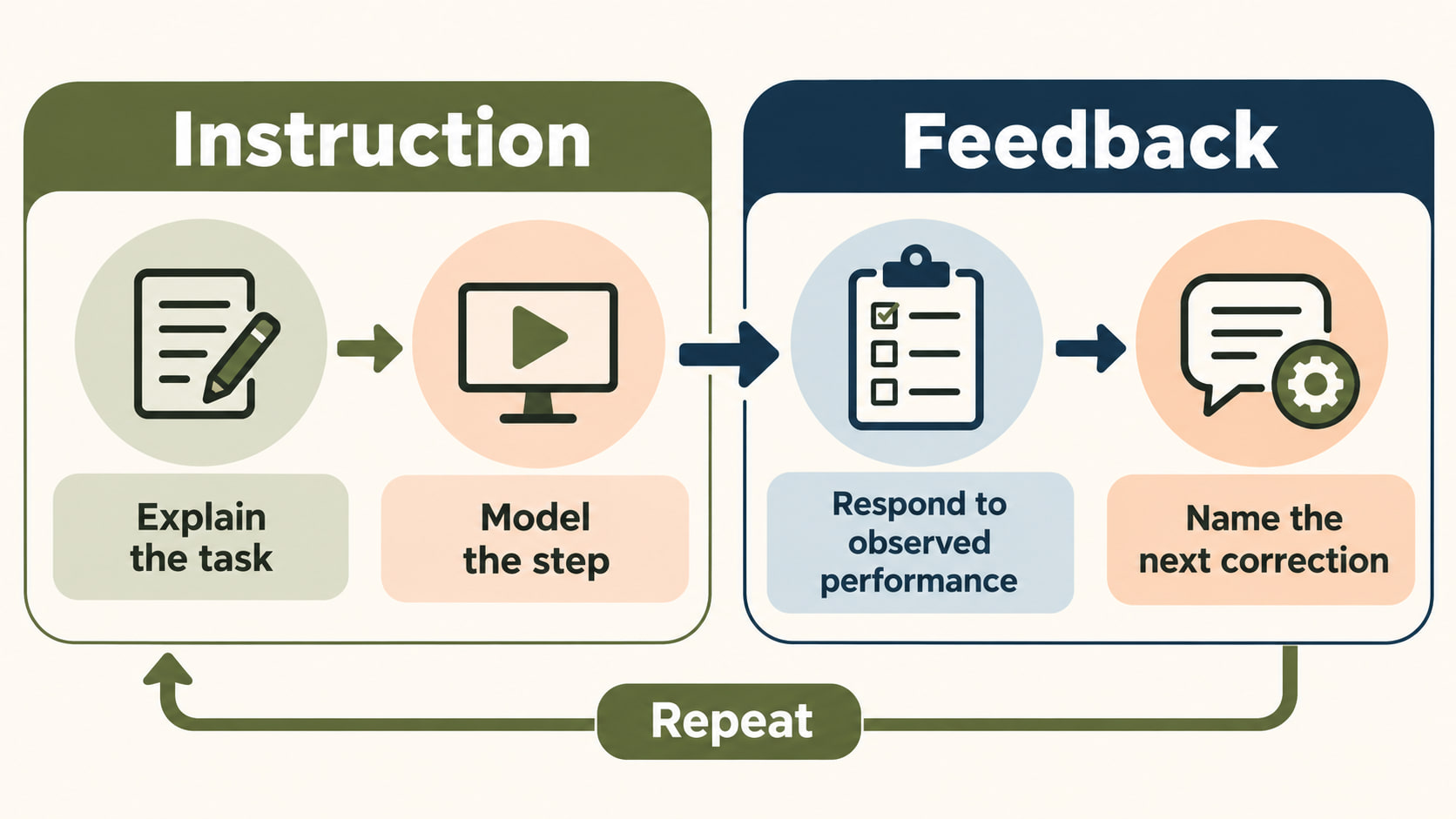
Instruction vs feedback RBT supervision becomes clearer when you ask whether the supervisor is explaining the task or responding to something the RBT just did. In plain-language study notes, instruction vs feedback rbt supervision is a comparison between explaining a task and responding to observed performance. Instruction gives a learner information, a demonstration, or a direction. Feedback evaluates an observed attempt and identifies a specific strength or correction. Both can support practice, but neither gives an RBT permission to change an authorized procedure.
The current written plan, training arrangement, safety requirements, and supervisor direction control implementation. This guide uses original examples to explain the distinction; it is not an official BACB answer key, individualized clinical advice, or a replacement for competency verification.
Instruction vs feedback RBT supervision: the short answer
Instruction usually comes before or during an attempt: it explains what the task requires, demonstrates a step, or states the response expected. Feedback usually follows an observed attempt: it describes what matched the procedure, what differed, and what the learner should practice next. A single supervision interaction may include both.
For example, “Record the duration from the defined start until the defined stop” is instruction. After watching a practice trial, “You identified the start correctly; next time apply the stop rule when the behavior ends” is feedback. The second statement depends on an observed performance.
What instruction does
Instruction builds a shared starting point. A supervisor may define the target response, explain the materials, demonstrate the data rule, describe the communication route, or identify the conditions under which the RBT should ask for help. Good instruction is specific enough that the learner can identify the next observable action.
Before practice, clarify:
- What task or response is being practiced?
- What written procedure, definition, or safety direction controls?
- What should the RBT record or report?
- What should happen if the procedure is unclear or the situation changes?

What feedback does
Feedback connects an observed attempt to the task standard. Useful feedback is timely, respectful, and tied to an observable step rather than a personality judgment. It may confirm an accurate action, identify a correction, or recommend another rehearsal under the same or a deliberately changed practice condition.
“Be more professional” is too broad to guide practice. “State the objective observation before offering an interpretation” gives the RBT a concrete behavior to repeat. If the feedback reveals that the written procedure is unclear, the next step is clarification from the responsible supervisor, not independent redesign.
Instruction versus feedback in a supervision example
Imagine a supervisor is teaching an RBT how to document a session variable. First, the supervisor explains which variable belongs in the record, models an objective description, and states where the entry goes. That is instruction. The RBT then practices with a fictional scenario. The supervisor observes that the entry names the event but omits its timing and gives a specific correction. That is feedback.
The RBT can revise the practice entry and try again. The RBT should not alter the client’s treatment plan, invent a new data field, or omit an unusual event simply because the practice feels difficult. If the assigned procedure does not answer the question, the RBT should document the uncertainty and ask for direction.
A practical practice loop
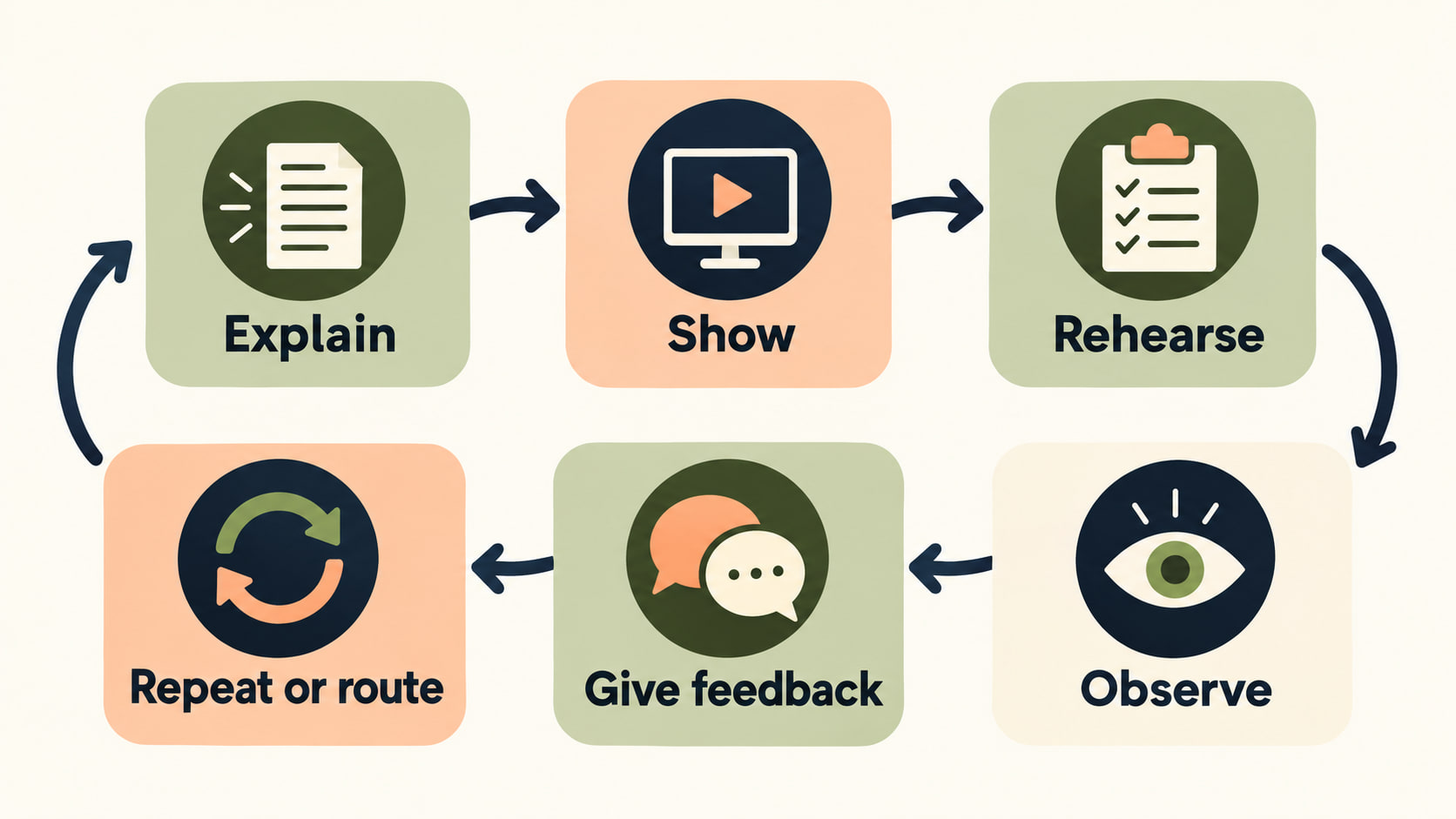
- Explain: identify the target, procedure, materials, and safety boundary.
- Show: demonstrate the relevant step or provide a model of the record.
- Rehearse: let the RBT practice with an appropriate scenario.
- Observe: note what happened without guessing at intent.
- Give feedback: name one strength and one specific next correction.
- Repeat or route: rehearse again when appropriate, or escalate an unresolved procedure question.
Role boundaries and documentation
Instruction and feedback are training activities, not a substitute for authorized supervision or competency assessment. The RBT should implement only assigned procedures, protect privacy and dignity, report safety concerns, and document according to the current system. A practice correction should not be silently transferred into client care if the supervisor has not authorized that change.
After supervision, record the task practiced, the direction received, the question that remains, and the agreed follow-up when the applicable process requires it. Keep the record objective and protect confidential information.
A useful way to test feedback is to ask whether another trained person could identify the next action from the sentence. “Your timing was off” does not identify the relevant start point, stop point, or recording rule. “Start the timer when the defined response begins, then record the duration when the response ends” is more actionable when it matches the current procedure. If the sentence does not match the written plan, pause and request clarification rather than treating a conversational correction as a new rule.
When another practice attempt is needed
More practice may be appropriate when the RBT cannot describe the target, misses the same step more than once, asks a reasonable question about an exception, or performs differently when the materials or setting change. The supervisor can decide whether to model the step again, change the practice example, observe another rehearsal, or use a formal competency process. The RBT should not decide that a single successful trial proves the skill is stable.
Feedback can also reveal a systems question. For example, an RBT may receive one instruction during a meeting and find that the written data sheet uses different labels. The correct response is to identify the mismatch, protect the record from guesswork, and ask which source controls. It is not to choose the label that seems easiest or silently edit the form.
For a concise follow-up note, describe the task, the practice condition, the observed result, the direction received, and the next step. A neutral note might say: “Practiced objective session-variable documentation with a fictional scenario. The first entry omitted timing. Supervisor modeled the timing field; RBT completed a second practice entry and will review the live form before the next assigned session.” Use the organization’s required system and omit unnecessary confidential details.
Common mistakes
- Calling a broad explanation feedback when no performance was observed.
- Giving feedback about personality instead of an observable task step.
- Treating one successful rehearsal as proof of stable competence.
- Changing a procedure because feedback exposed a gap.
- Failing to ask for clarification when instruction conflicts with the written plan.
Frequently asked questions
Can instruction and feedback happen in the same supervision meeting?
Yes. Instruction may establish the task, and feedback may follow an observed rehearsal. The roles remain different even when they occur close together.
Does feedback authorize an RBT to change a treatment plan?
No. An RBT should follow the authorized procedure and ask the responsible supervisor about any needed change.
Is this an official BACB definition or examination question?
No. This is independent educational content using an original explanation and scenario. Consult current official BACB materials for credential and examination decisions.
Ready to practice the RBT concepts you just reviewed?
Try an independent, original RBT practice resource with exam-style questions, scoring, and answer explanations.
References
- Behavior Analyst Certification Board. RBT Test Content Outline, 3rd edition.
- Behavior Analyst Certification Board. RBT Handbook.
- Behavior Analyst Certification Board. RBT Ethics Code.