
Supervision vs training RBT questions are easier to answer when you separate learning a skill from maintaining and reviewing implementation over time.
Table of Contents
- The short answer
- Supervision vs training RBT: the central difference
- What training is designed to do
- What supervision is designed to do
- Where training and supervision overlap
- Practical examples
- Questions to ask when support is unclear
- Role boundaries and follow-up
- Frequently asked questions
- References
RBT LEARNING GUIDE · SUPPORT IN PRACTICE
Supervision vs Training RBT: What Is the Difference?
Know when the goal is to teach a skill, observe implementation, provide feedback, or plan the next follow-up.
Supervision vs training RBT questions are common because the two activities can happen in the same meeting. A supervisor may teach a procedure, model a step, observe an RBT, provide feedback, and schedule another observation. The activities overlap, but their primary purposes are different: training builds or checks a skill, while supervision provides ongoing direction, observation, feedback, and accountability within the service arrangement.
The current BACB RBT Test Content Outline connects supervision with instruction, modeling, rehearsal, feedback, observation of service delivery, and timely direction. The exact responsibilities, frequency, documentation, and role of each person depend on the current requirements and written arrangement. This article is an educational comparison, not a replacement for those sources.
The short answer
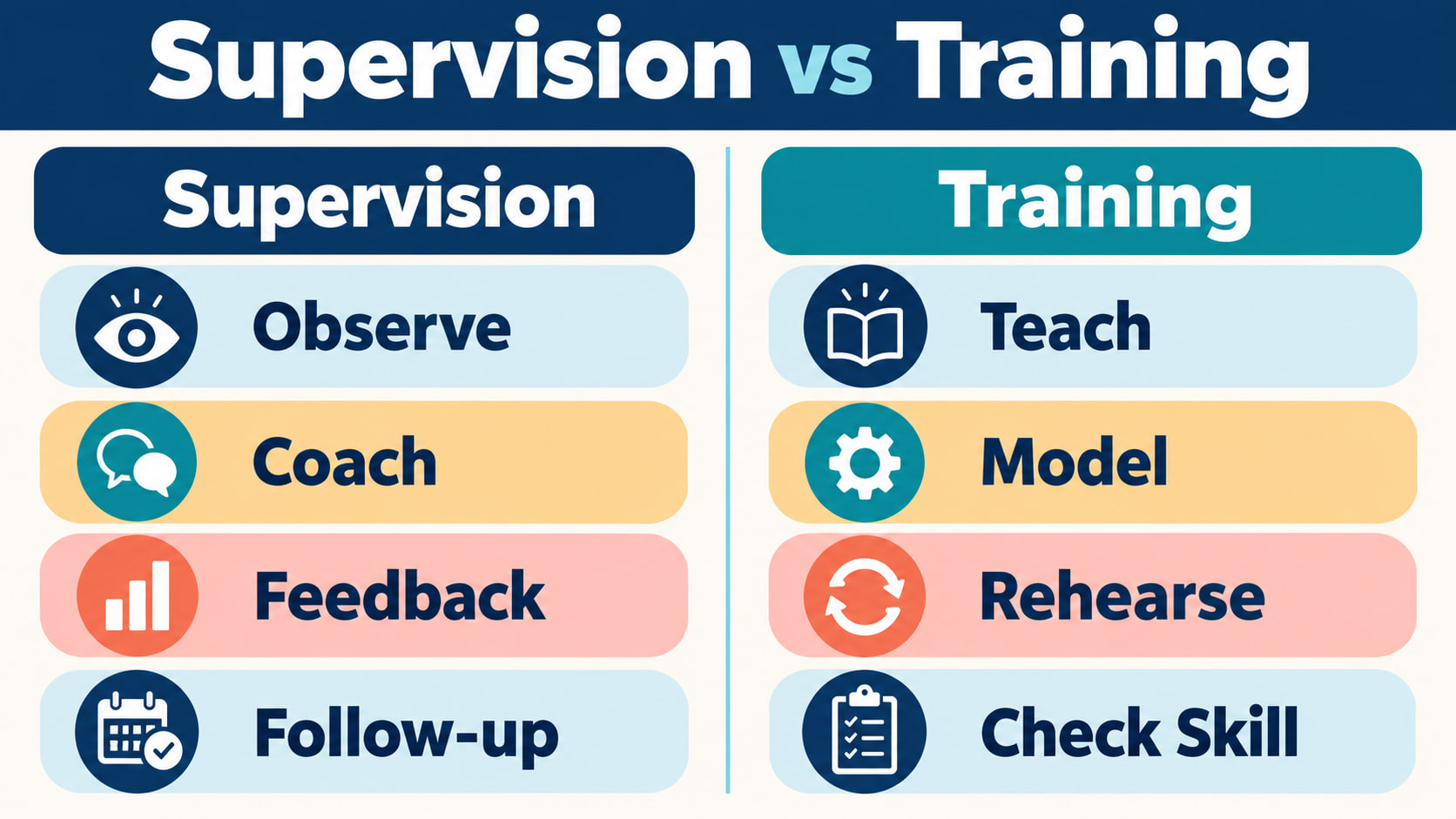
Training answers, “How do I learn or demonstrate this skill?” It may include instruction, modeling, rehearsal, guided practice, and a check of performance.
Supervision answers, “How am I implementing assigned services over time, and what direction do I need next?” It may include observation, review of documentation, feedback, problem-solving, communication, and follow-up.
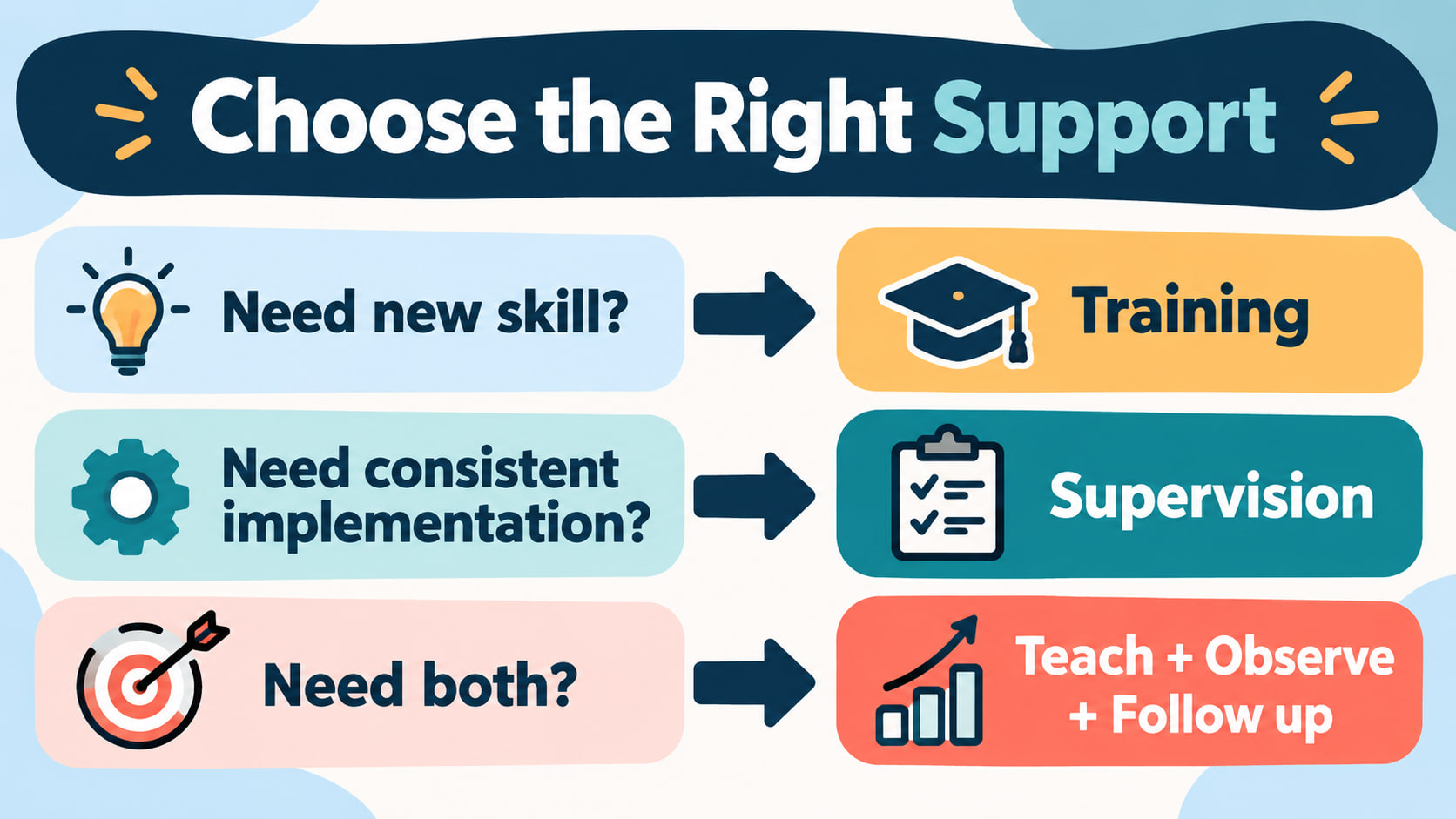
One event can contain both. A supervisor can train an RBT on a prompt procedure, then supervise the next session by observing whether the procedure is implemented as assigned.
Supervision vs training RBT: the central difference
The difference is best understood through the outcome. Training should leave the learner with a clearer, practiced skill and a way to show what they can do. Supervision should leave the service arrangement with clearer direction, observed implementation, useful feedback, and a plan for continued support.
Training is often more concentrated around a skill or procedure. Supervision is ongoing and connected to actual service delivery. Training can happen before an RBT implements a new procedure; supervision helps determine whether the assigned procedure is being implemented accurately and what to do when the situation changes.
What training is designed to do
A practical training sequence begins with a clear target. “Understand the program” is broad. “Record the defined response using the required code after each opportunity” is easier to teach and check. The trainer can explain the step, model it, invite rehearsal, and give specific feedback.
Training is useful when an RBT is new to a procedure, a written instruction has changed, a data system is unfamiliar, or an observed performance shows that a foundational skill needs practice. The trainer should define what successful implementation looks like and what happens if more practice is needed.
Training does not end simply because someone attended a meeting or watched a video. The responsible person should use the approved competence-check process for the setting. A practice example may be useful, but it may not replace observation of the actual assigned procedure when such observation is required.
What supervision is designed to do
Supervision creates continuity. It gives the RBT a route for asking questions, receiving direction, discussing objective observations, and identifying training needs. It also lets the supervisor observe whether assigned services are being implemented as written and whether the current direction remains clear.
Supervision can include a short check-in, direct observation, review of a permitted record, role-play, feedback, or a follow-up plan. The format is less important than whether it addresses the relevant service and creates usable next steps. A meeting with no observation, no question, and no follow-up may not answer the practical need that prompted the meeting.
Effective feedback is specific and respectful. It identifies the observed action, connects it to the written procedure, and states the next practice step. “Use the defined response interval before recording the category; let’s rehearse two trials” is more useful than “be more careful.”
Where training and supervision overlap
Both activities can include instruction, modeling, rehearsal, feedback, and documentation. The context changes the purpose. During training, rehearsal helps build the skill. During supervision, rehearsal may address a performance question that arose during service delivery and is followed by observation or another check.
Both should use objective language. Record what was taught, observed, practiced, or assigned for follow-up. Avoid turning a learning note into a personal label. “The RBT practiced the prompt sequence and needed a reminder to wait the defined interval” supports a next step; “the RBT is careless” does not.
Practical examples
- New data system: training explains the fields, models entry, and checks practice. Supervision later reviews whether entries are accurate during assigned service.
- Prompt timing question: training may rehearse the timing. Supervision observes implementation and provides feedback on whether the written procedure is followed.
- Unexpected response pattern: the RBT reports the objective pattern. The supervisor determines the appropriate clinical direction; the RBT does not independently redesign the plan.
- Procedure changed: training clarifies the new steps. Supervision checks implementation over time and provides a route for questions.
Questions to ask when support is unclear
- Is the immediate need to learn a new skill, or to review implementation of an assigned skill?
- What observable action will show that the skill or procedure is being performed correctly?
- Will the next step be instruction, modeling, rehearsal, direct observation, feedback, or another review?
- Where should the question or documentation be recorded?
- Who should receive an urgent concern if the usual supervisor is unavailable?
Role boundaries and follow-up
An RBT implements assigned services after demonstrating competence and under ongoing supervision. Training and supervision do not authorize an RBT to diagnose, change a treatment plan, alter measurement rules, select an unapproved intervention, or interpret a privacy or consent question independently.
If an instruction is unclear, state the specific step that is unclear and ask for direction. If a situation exceeds demonstrated competence or creates a safety concern, pause when safe to do so and use the approved escalation route. Document the objective facts and follow-up according to policy.
Frequently asked questions
Can supervision include training?
Yes. A supervision interaction may include instruction, modeling, rehearsal, and feedback. The record and follow-up should make clear whether the activity taught a new skill, reviewed implementation, or did both.
Does completing training mean I no longer need supervision?
No. Training and ongoing supervision serve different functions. Training may establish or refresh a skill, while supervision provides continuing direction and review within the service arrangement.
What if I need training but the meeting is called supervision?
Describe the skill or step you need to practice. Ask what the expected performance is, request modeling or rehearsal if appropriate, and confirm how the follow-up will be documented.
What if supervision feedback conflicts with the written procedure?
Pause and ask the responsible supervisor to clarify the conflict through the approved process. Do not privately choose a new procedure or change the plan on your own.
Source note: Review current BACB materials, your organization’s written arrangement, workplace policies, and supervisor direction for your setting. This article is educational and does not provide individualized legal, clinical, employment, or credentialing advice.
Ready to practice the RBT concepts you just reviewed?
Try an independent, original RBT practice resource with exam-style questions, scoring, and answer explanations.
References
- Behavior Analyst Certification Board. RBT Test Content Outline, 3rd edition.
- Behavior Analyst Certification Board. RBT Handbook.
- Behavior Analyst Certification Board. RBT Ethics Code.