
Collecting client information vs disclosing client information RBT work involves two different decisions: what is needed for the service and what may be shared with an authorized recipient.
Table of Contents
- The short answer
- Collecting client information vs disclosing client information RBT: the difference
- Collecting client information vs disclosing client information RBT: collect responsibly
- Collecting client information vs disclosing client information RBT: disclose responsibly
- Compare the two decisions
- A practical example
- Common mistakes
- Keep the RBT role clear
- Frequently asked questions
- References
RBT DOCUMENTATION GUIDE · INFORMATION FLOW
Collecting vs Disclosing Client Information RBT: Key Differences
Separate the decision to gather information from the decision to share it.
Collecting client information vs disclosing client information RBT work involves two different decisions: what is needed for the assigned service and what may be shared with an authorized recipient. Information collected for a legitimate purpose is not automatically shareable with everyone who asks.
RBT work may involve data sheets, session notes, schedules, photographs, family communication, supervision records, and other service information. Current BACB materials, authorization, applicable requirements, organizational policy, and supervisor direction control the details for a particular setting. This guide explains the distinction as a practical learning tool.
The short answer
Collecting asks: Do I need this information for the assigned service or required record? Is the purpose clear? Can I record it accurately and respectfully?
Disclosing asks: Is sharing authorized? Who is the correct recipient? What approved channel should be used? What is the minimum detail needed?
The first decision protects against unnecessary collection. The second protects against unnecessary access or disclosure. Good documentation and communication require both.
Collecting client information vs disclosing client information RBT: the difference
Collecting information happens when the RBT observes, records, asks, receives, or enters information for an approved service purpose. Disclosing happens when information moves to another person, team, system, or audience. The information may be accurate in both situations, but the decision rules are not identical.
A note may be appropriate in the official record but inappropriate in a personal text. A data point may be needed for supervision but unrelated to a scheduling request. A training story may be useful in a private approved meeting but not suitable for a public post, even after a name is removed.
Collecting client information vs disclosing client information RBT: collect responsibly
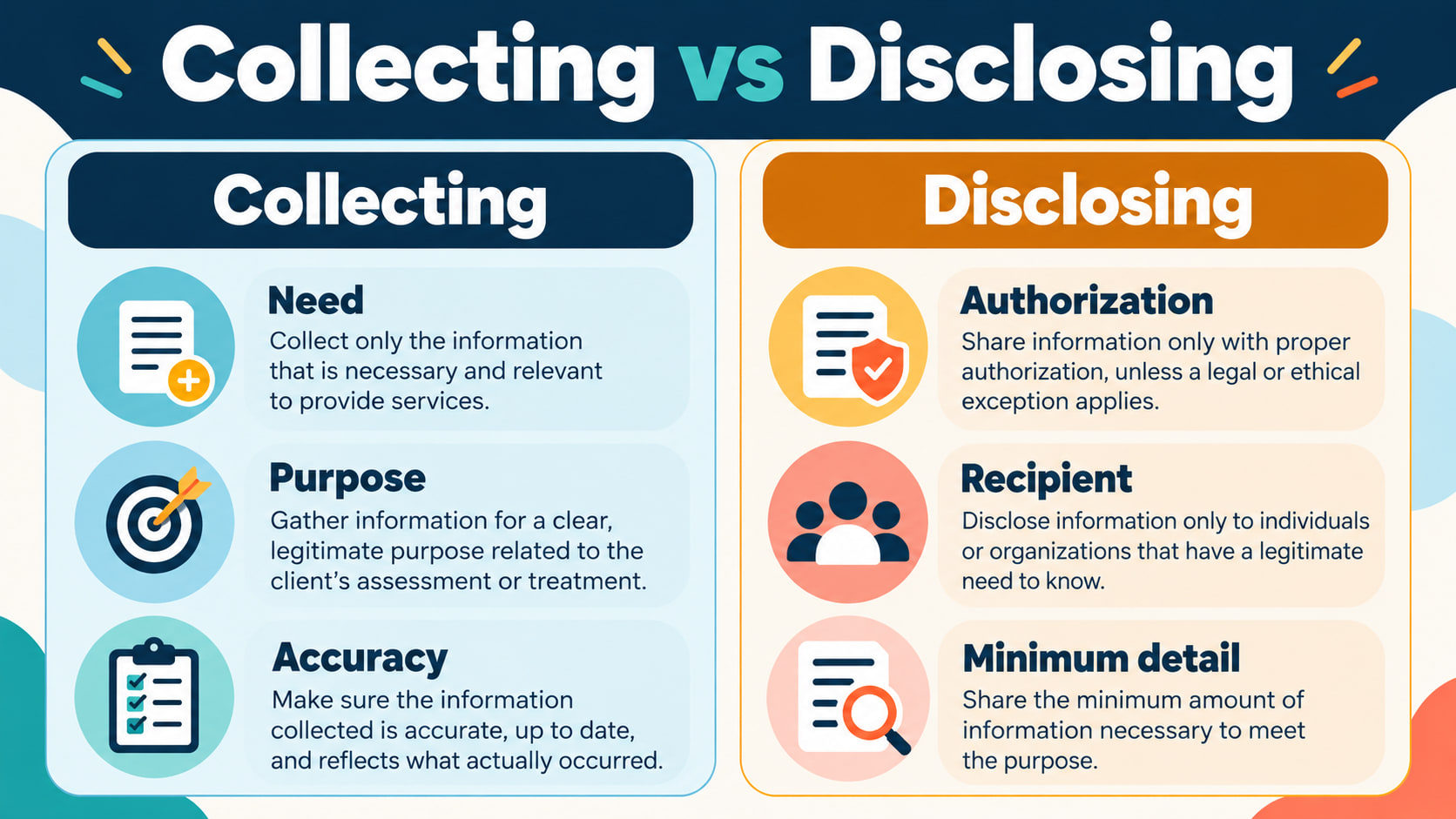
Begin with need and purpose. Identify the task, procedure, measurement, or required record. Collect only what is relevant, use objective language, and follow the organization’s definitions and templates. If a field is confusing, ask rather than inventing a category.
Accuracy matters. Record what actually occurred close to the time of service, distinguish observation from interpretation, and avoid unrelated family or personal details. More information is not automatically better documentation. Unnecessary detail can create privacy risk without improving service quality.
Use the approved system from the beginning. Do not make a private copy simply because it is convenient. If a device, form, or access problem prevents accurate collection, report the barrier through the designated route.
Collection also includes what is left out. If a detail is not needed for the assigned service, required record, or approved quality task, do not add it merely because it is interesting. Ask the supervisor when the purpose of a field is unclear, especially when the information is sensitive or could identify a family member.
Collecting client information vs disclosing client information RBT: disclose responsibly
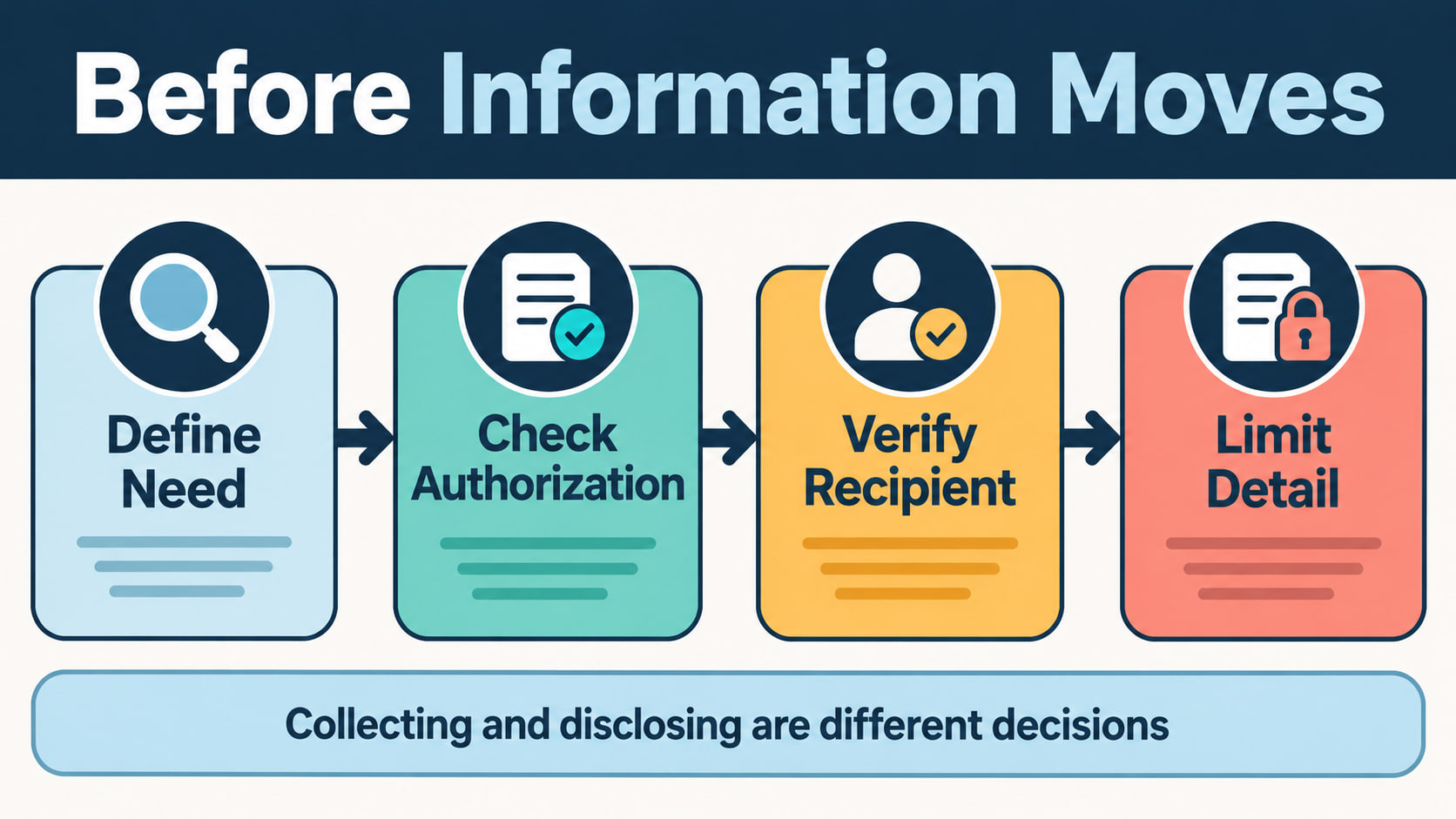
Before disclosing, check authorization, purpose, channel, recipient, and minimum detail. Verify an email address, phone number, account, meeting participant, or attachment. A familiar contact, urgent request, or helpful intention does not automatically establish permission.
Use the approved record system, secure upload, work email, designated platform, or meeting process. Do not place identifiable information in personal notes, private email, social-media drafts, or unapproved cloud folders. If the approved system is unavailable, ask what temporary process is authorized.
Minimum necessary does not mean vague. It means enough detail for the authorized task without unrelated information. De-identify examples when identity is not needed, but remember that schedule, location, age, school, behavior, and family details can identify someone in combination.
Before attaching a document, open it and check its contents. Remove unrelated pages only through an approved process, and do not alter the official record simply to make a message shorter. A secure link may be safer than a downloaded copy when the organization’s system provides one.
Compare the two decisions
- Need: collecting asks whether the information is needed; disclosing asks whether the recipient needs it.
- Purpose: collecting connects to service or documentation; disclosing connects to an authorized communication task.
- Accuracy: collecting requires objective, current entries; disclosing requires accurate, relevant details.
- Access: collecting uses approved systems; disclosing verifies the recipient and channel.
- Scope: collecting avoids unnecessary details; disclosing limits the amount shared.
A practical example
An RBT observes a response pattern and records the required data in the approved system. The supervisor later asks for a focused review. The RBT provides the relevant date, program step, and objective pattern through the approved channel. The RBT does not send a full screenshot containing unrelated client details to a group chat.
In this example, collecting required accurate data and disclosing a focused question are separate decisions. If the recipient, authorization, or channel is unclear, the RBT pauses and asks the responsible supervisor instead of improvising.
Common mistakes
- Collecting everything: extra information is recorded without a service purpose.
- Sharing by habit: a saved contact or familiar group receives information without verification.
- Assuming de-identification: a name is removed but indirect details remain identifying.
- Using personal tools: convenience creates an unofficial copy or channel.
- Skipping escalation: uncertainty is resolved privately instead of through the approved process.
If information goes to the wrong person, a record is exposed, or an unapproved device is used, stop further sharing and report the concern promptly. Do not quietly delete evidence or rewrite an official record to hide a mistake.
Reporting a concern is not assigning blame. State what happened, when, what information was involved, who received it if known, and what immediate action was taken. The responsible team can determine whether correction, notification, training, or another response is required.
Timely questions are part of accurate, respectful, and ethical RBT practice.
Pause before acting.
Keep the RBT role clear
An RBT implements assigned services after demonstrating competence and under ongoing supervision. The RBT can collect objective information, use approved systems, ask what may be shared, and escalate uncertainty. The RBT should not independently interpret a legal exception, change consent, alter a treatment plan, or create a new privacy rule.
Urgent danger, medical needs, safeguarding concerns, or emergencies may require emergency and organizational procedures in addition to supervision. Address immediate risk first, then document and seek appropriate follow-up.
Frequently asked questions
Does collecting information mean it can be shared?
No. Collection and disclosure have different purpose, authorization, recipient, channel, and minimum-detail questions.
Can I send the full record to make sure nothing is missing?
Use the approved system and share only the detail needed for the authorized task. Ask when the scope is unclear.
Is removing a name enough?
Not always. Indirect details may identify a person. Follow approved de-identification guidance.
What should I do if a request feels urgent?
Pause long enough to verify the purpose, recipient, channel, and authorization. Use the designated escalation route when unsure.
Source note: Review current BACB materials, organizational policy, applicable requirements, and supervisor direction for your setting. This article is educational and does not provide individualized legal, clinical, employment, or credentialing advice.
Ready to practice the RBT concepts you just reviewed?
Try an independent, original RBT practice resource with exam-style questions, scoring, and answer explanations.
References
- Behavior Analyst Certification Board. RBT Test Content Outline, 3rd edition.
- Behavior Analyst Certification Board. RBT Handbook.
- Behavior Analyst Certification Board. RBT Ethics Code.