
An RBT manual can organize study and work information, but it should be used with current policy, assigned procedures, approved sources, and supervision.
Table of Contents
- What an RBT manual can do
- RBT manual: the four-step use cycle
- Orient yourself to the structure
- Locate the relevant section
- Apply information carefully
- Review, update, and ask questions
- Use the manual with policy and supervision
- Common manual mistakes
- Frequently asked questions
- References
RBT STUDY GUIDE · USING RESOURCES WELL
RBT Manual: How to Use a Practical Study and Work Guide
Use a manual to orient, locate, apply, and review information without replacing current supervision or policy.
An RBT manual can organize study and work information, explain common terms, point to procedures, and help an RBT prepare questions. It should be used with current official materials, organizational policy, assigned procedures, the written service plan, and supervision. A manual is a support tool, not permission to improvise or replace a responsible supervisor.
Manuals vary by author, organization, publication date, and purpose. Before relying on a section, check whether it is current, whether it applies to your setting, and whether it matches the current procedure. If the sources conflict, pause and ask for direction rather than selecting the version that seems easiest.
A practical way to test a section is to write down four items before using it: the question you are trying to answer, the source and revision date, the part that is general education, and the part that requires confirmation. This short note prevents a broad explanation from being mistaken for a client-specific instruction. It also makes supervision more efficient because you can show exactly what you read and where uncertainty remains.
Keep study notes separate from protected service records. A manual may be useful at home, during approved training, or in a designated work area, but notes should not include unnecessary names, dates of birth, diagnoses, photographs, or other identifying details. If you need to discuss a real situation, use the organization’s approved communication and documentation process.
What an RBT manual can do
A good manual can provide orientation, definitions, study prompts, examples, checklists, and links to primary resources. It can help a new RBT understand where to look before asking a focused question. It can also support review after supervision by giving the learner a place to organize notes and identify a skill that needs practice.
A manual cannot observe service delivery, determine whether you are competent in a specific procedure, authorize a disclosure, change a treatment plan, or resolve a conflict between current instructions. Those decisions belong to the appropriate process and people.
RBT manual: the four-step use cycle
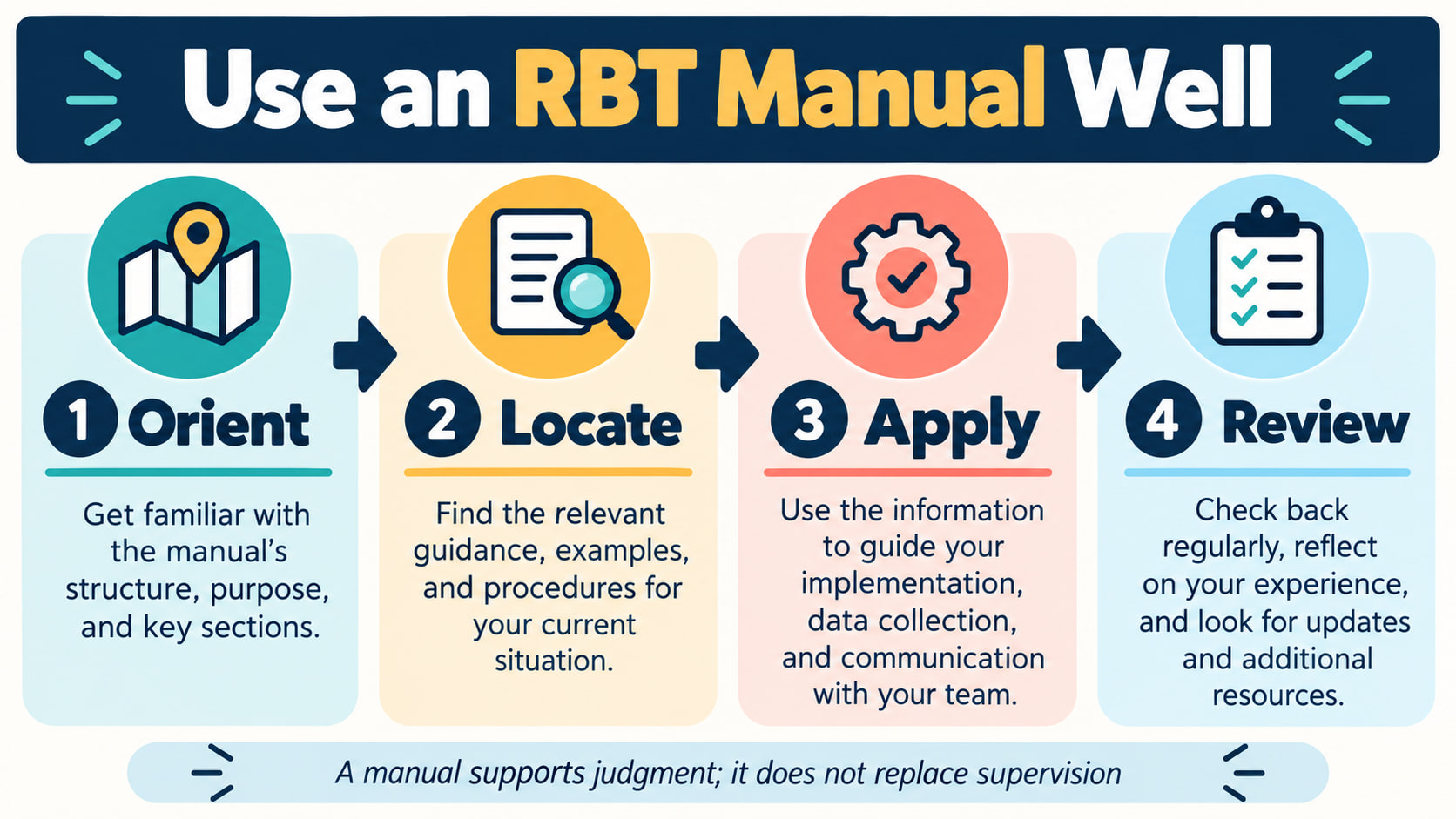
- Orient: learn the manual’s sections, source notes, and update information.
- Locate: find the relevant topic, definition, example, or procedure.
- Apply: compare it with the current assigned instruction before using it.
- Review: check back for updates, reflect on questions, and confirm direction.
Orient yourself to the structure
Start by identifying what the manual is designed to cover. Is it a general study resource, an employer orientation guide, a procedure reference, or a personal set of notes? Read the introduction, source list, revision date, and scope statement. A general study manual may explain a concept but not contain your organization’s current implementation instructions.
Also look for boundaries around examples. Some manuals simplify language to make a concept easier to remember, while real service work may require exact definitions, approved measurement systems, or additional safeguards. When a section feels unusually broad, treat that as a prompt to find the underlying source instead of filling in missing details yourself.
Create a simple map of sections. Mark where the manual discusses terminology, data collection, supervision, ethics, safety, documentation, and questions. Avoid highlighting everything. The purpose of orientation is to know where to look when a focused question arises.
Locate the relevant section
Use the table of contents, index, search function, or headings to find the narrowest relevant section. Start with the exact question: “What does this term mean?” “Which step does the written procedure require?” or “What should I ask my supervisor about this observation?” A narrow question makes it easier to compare sources.
Separate explanation from instruction. A manual may describe an example in general language, while the assigned program uses a specific operational definition, measurement rule, prompt sequence, or safety procedure. Treat the current assigned instruction as the source for implementation.
Apply information carefully
Before applying a manual’s suggestion, check the client’s current written plan, workplace policy, approved materials, and supervisor direction. Do not copy a generic example into a client record. Do not change a target, prompt, consequence, mastery rule, or data code because a manual presents another option.
Use a manual to prepare a question or rehearse a general skill. For example, a manual can help you understand why objective descriptions matter; supervision can then clarify how your organization expects a particular record to be completed. This keeps learning useful without turning a study resource into an unofficial clinical instruction.
Review, update, and ask questions
Set a review habit. Check whether official requirements or workplace procedures have changed. Compare the manual’s examples with recent supervision feedback. Record questions in the approved place, and bring the most important one to the responsible supervisor.
When a manual conflicts with a current instruction, do not hide the conflict. Note the title, section, and issue without copying unnecessary client details. Ask which source controls and whether the manual should be replaced, annotated, or removed from the work area.
Use the manual with policy and supervision
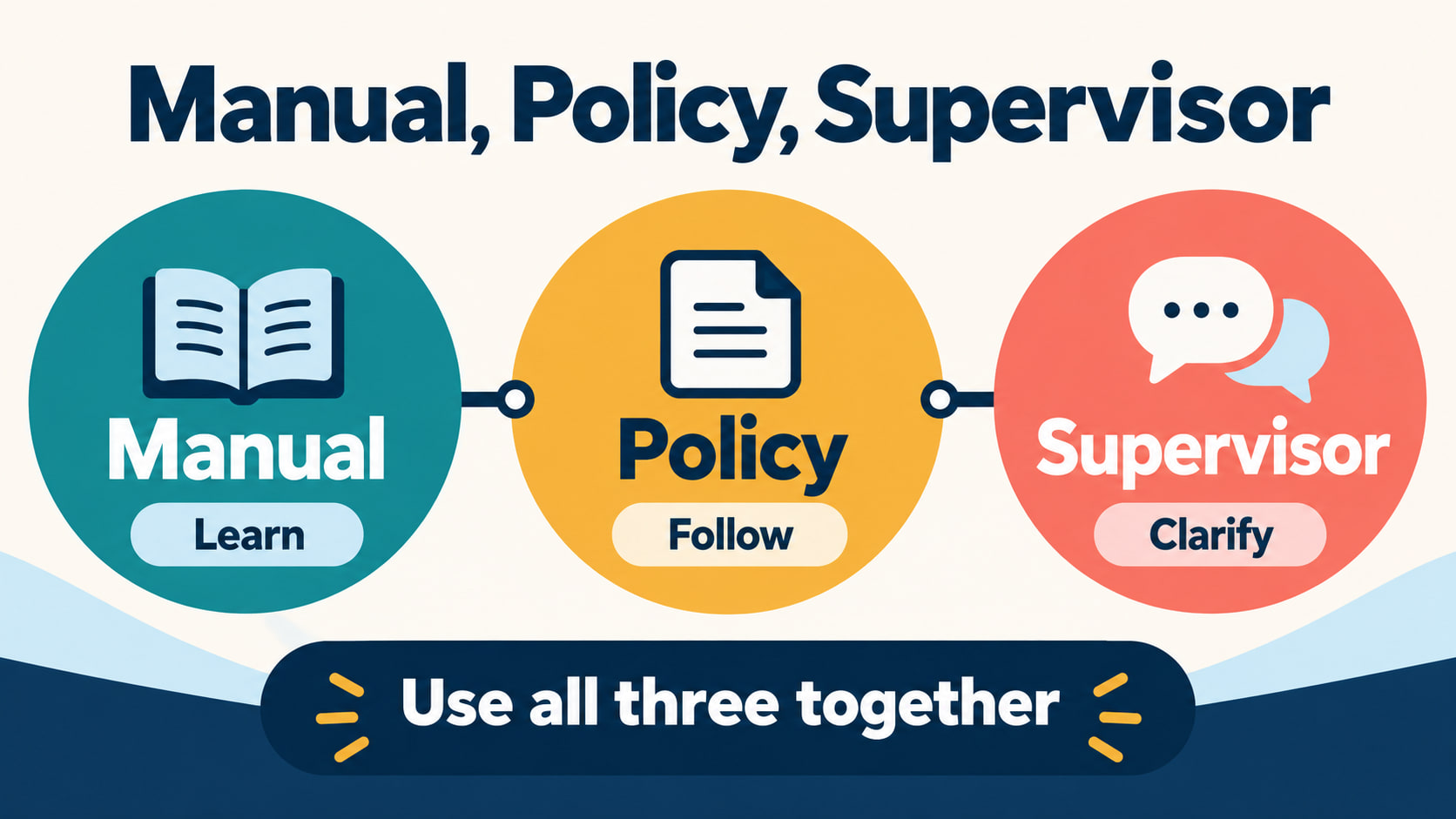
Think of three sources working together: the manual helps you learn, policy tells you what the organization requires, and the supervisor clarifies application in the current service context. No single source answers every question.
- Manual: orient, define, explain, and suggest questions.
- Policy: set the approved organizational process.
- Supervisor: clarify current implementation, competence, feedback, and escalation.
If the issue involves safety, privacy, consent, a medical concern, a data-integrity problem, or a task beyond demonstrated competence, use the designated escalation route. A manual should never delay urgent action or replace emergency procedures.
Common manual mistakes
- Assuming it is current: the publication date and source history are ignored.
- Using generic examples as client instructions: a study example is copied into practice.
- Reading without practicing: familiarity is mistaken for demonstrated competence.
- Ignoring conflicts: a mismatch with policy is handled privately.
- Using the manual as authority: the learner changes a plan or procedure independently.
Reading is valuable when it leads to a clearer question, safer implementation, better documentation, or a useful supervision conversation. It is not valuable when it encourages false certainty.
Frequently asked questions
Is an RBT manual the same as an official handbook?
Not necessarily. Check the publisher, date, purpose, and source. Use current official BACB and organizational materials for controlling requirements.
Can I use a manual to study for the RBT exam?
It may organize study, but compare it with the current official test content outline and approved resources. Reading alone does not prove competence or guarantee a result.
What if my manual and supervisor disagree?
Pause and ask the supervisor to clarify the current source of truth. Do not choose a procedure independently or change the plan.
How should I mark a useful section?
Note the topic, source, date, and question it helps answer. Avoid adding identifying client information to personal notes.
Source note: Review current BACB materials, organizational policy, the written service plan, and supervisor direction for your setting. This article is educational and does not provide individualized legal, clinical, employment, or credentialing advice.
Ready to practice the RBT concepts you just reviewed?
Try an independent, original RBT practice resource with exam-style questions, scoring, and answer explanations.
References
- Behavior Analyst Certification Board. RBT Test Content Outline, 3rd edition.
- Behavior Analyst Certification Board. RBT Handbook.
- Behavior Analyst Certification Board. RBT Ethics Code.