

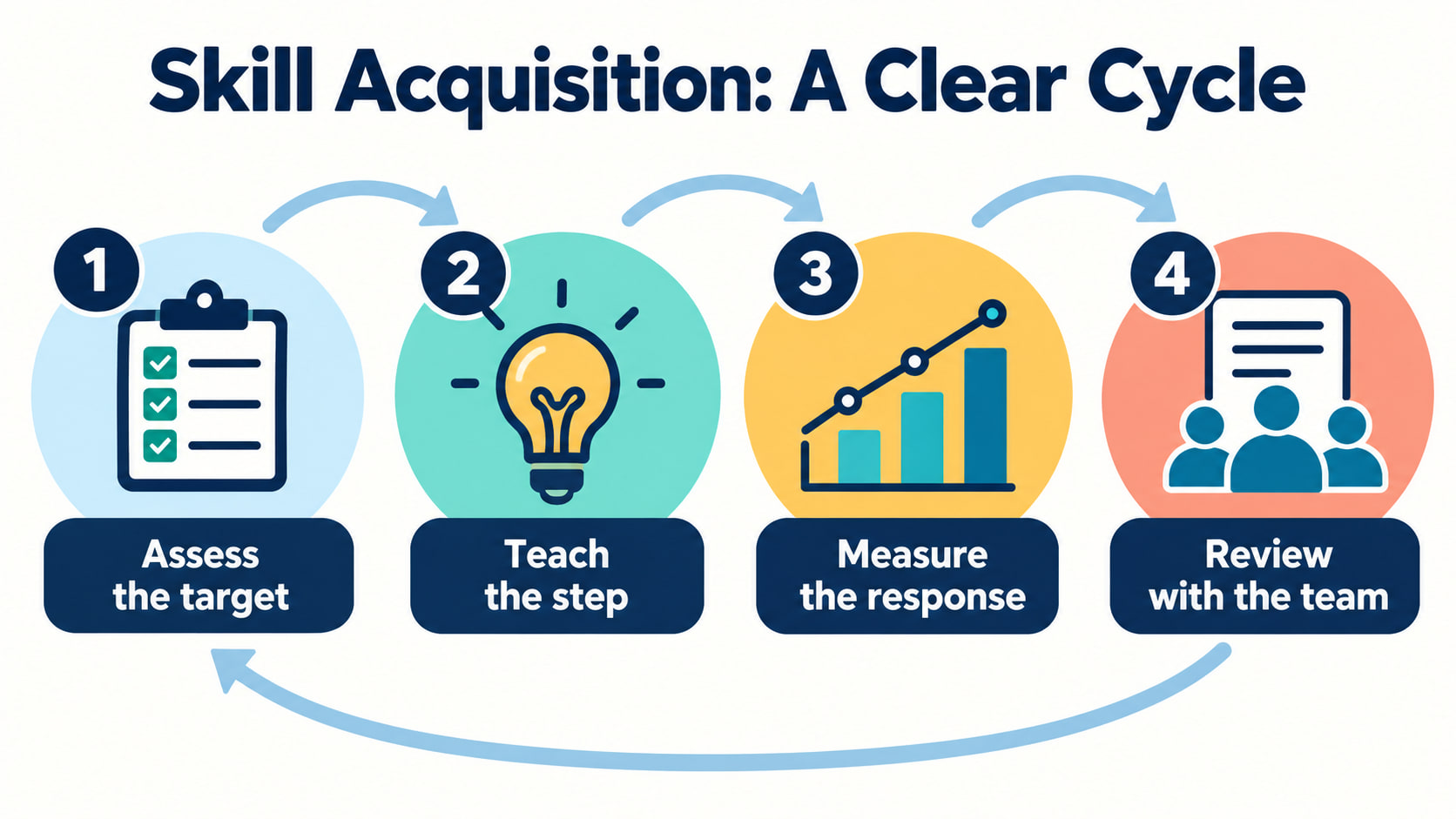
When behavior analytic services focus on skill acquisition, the team defines a meaningful target, teaches observable steps, measures responses, and reviews progress responsibly.
Table of Contents
- Behavior analytic services focus on skill acquisition: what it means
- When behavior analytic services focus on skill acquisition, start with a clear target
- Teach the assigned steps
- Measure the response
- How behavior analytic services focus on skill acquisition requires team review
- Support learning without taking over
- Common skill-acquisition mistakes
- Frequently asked questions
- References
ABA LEARNING · RBT ROLE CLARITY
Skill Acquisition in ABA: How RBTs Support Learning
Define a meaningful target, teach assigned steps, measure responses, and review progress without taking over clinical decision-making.
When behavior analytic services focus on skill acquisition, the team is helping a learner develop or strengthen an observable response that matters in the person’s life. The work begins with a meaningful target, a clear teaching procedure, measurement, and review. An RBT supports that process by implementing assigned procedures accurately and communicating what was observed.
Skill acquisition is not simply “teaching more.” The target, prompt sequence, materials, reinforcement arrangement, measurement system, mastery rule, and generalization plan should come through the appropriate clinical and organizational process. An RBT should ask for direction when an instruction is missing, conflicts with another source, or exceeds demonstrated competence.
This article explains the workflow in role-safe terms. Use the current written plan, employer policy, supervision, and approved materials for decisions in your setting.
Behavior analytic services focus on skill acquisition: what it means
Skill acquisition refers to teaching a learner a new response or helping an existing response become more reliable, independent, fluent, or useful across relevant situations. Examples may include communication, self-care, academic, social, community, or daily-living skills. The exact goal should be observable enough that the team can identify what counts as a response.
A meaningful target is connected to the learner’s needs and context, not chosen only because it is easy to count. The team may consider safety, independence, dignity, preferences, access, and opportunities to use the skill. An RBT does not independently decide which goals should be prioritized, but can share accurate observations about barriers, materials, and responses.
When behavior analytic services focus on skill acquisition, start with a clear target
Before a session, locate the target and read the current procedure. Look for the expected response, the opportunity or cue, the materials, the prompt instructions, the consequence or reinforcement procedure, and the measurement rule. If the description is vague, ask before improvising.
Clear targets help separate teaching from interpretation. “Requests a break using the taught response within the programmed opportunity” is more useful than “is cooperative.” The target should also state the conditions that matter, such as the activity, setting, person, or level of assistance.
Teach the assigned steps
Implement the written teaching procedure as trained. Present the opportunity, use the specified prompt or prompt hierarchy, allow the programmed response time, and deliver the stated consequence or reinforcement. Avoid adding a new prompt, changing the order, or removing a step because the session feels difficult.
Teaching should protect dignity and make the learner’s response visible. Use the approved materials and communication supports. If a learner shows distress, a safety concern, an unexpected response, or a repeated barrier, follow the current safety and escalation process. Do not treat a challenging moment as permission to redesign the program.
Measure the response
Record the measurement specified by the program. Depending on the target, that may involve frequency, duration, latency, percentage, task-analysis steps, prompt level, or another defined measure. Enter what occurred rather than what you hoped would occur.
One successful response does not automatically demonstrate mastery, fluency, generalization, or maintenance. Those conclusions require the team’s defined criteria and review. If data are missing or a response does not fit the available code, use the approved correction or escalation process instead of guessing.
How behavior analytic services focus on skill acquisition requires team review
Review means looking at the recorded information and relevant context through the authorized team process. An RBT can report observable patterns, materials that were unavailable, prompt use, questions, and barriers. The supervisor or responsible clinician determines whether the plan, teaching procedure, criteria, or priorities need review.
Bring a focused question: identify the target, describe what happened, state the data or observation, and ask what should happen next. For example, “The learner completed the first two steps independently but needed the programmed prompt on the third step across four opportunities. Should I continue the current procedure and record the prompt level?”
Support learning without taking over
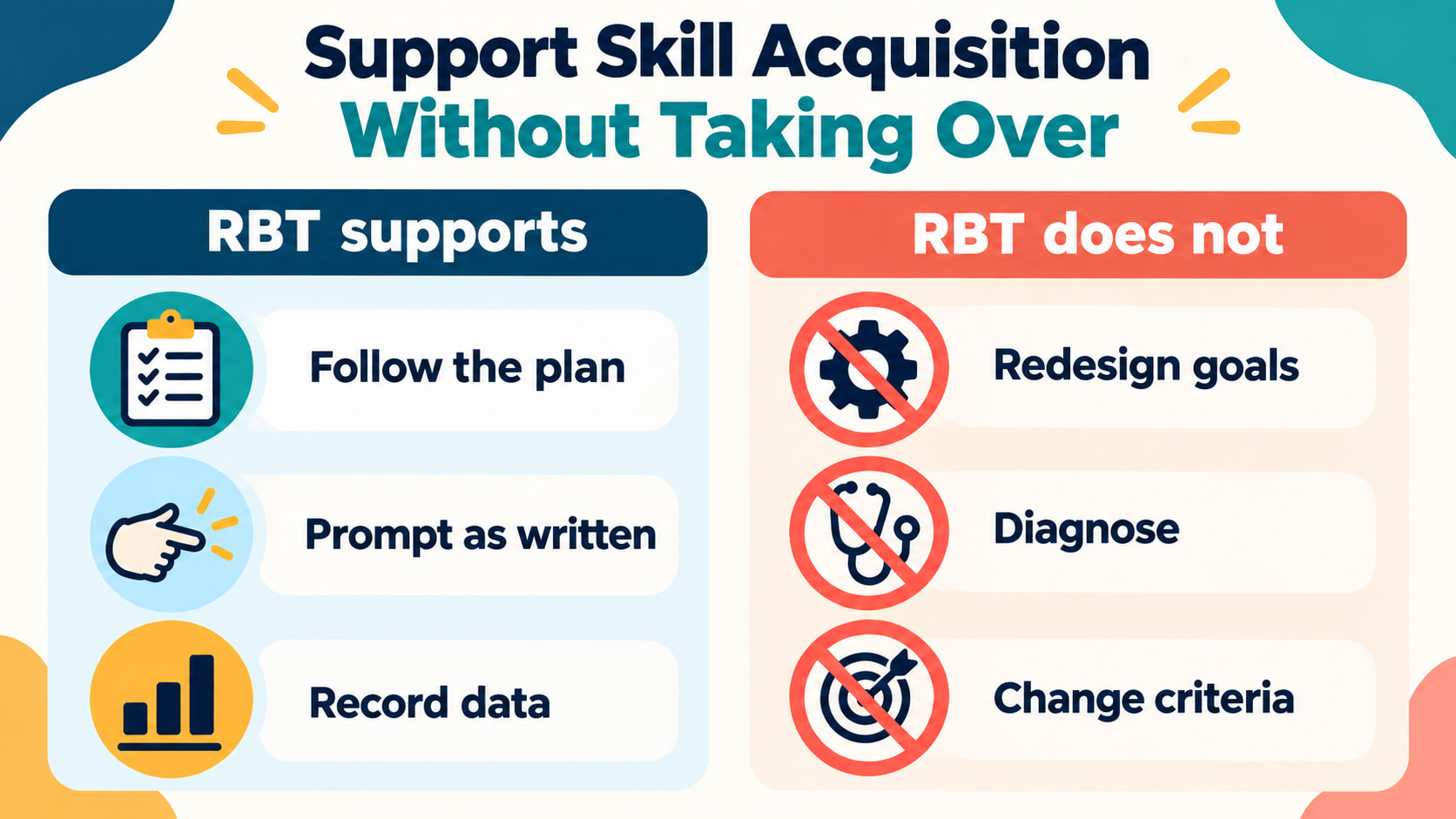
RBT support includes following the plan, using prompts as written, recording data, preparing materials, communicating observations, and seeking direction. It does not include independently redesigning goals, diagnosing, selecting a new intervention, changing mastery criteria, or deciding that a skill is mastered without the defined review.
Stay within competence. A textbook, course, personal experience, or successful trial may help you understand an idea, but it does not authorize a new procedure. If the current instruction does not address the situation, pause and route the question through supervision.
Common skill-acquisition mistakes
- Vague targets: labels such as “good behavior” replace observable responses.
- Unplanned prompting: a new prompt is added without instruction or documentation.
- Changing criteria: an RBT treats one successful response as mastery.
- Guessing data: a missing value is entered to make the record look complete.
- Ignoring context: materials, setting, fatigue, or access barriers are not reported.
- Taking over decisions: observations become an independent plan change.
Skill acquisition works best when implementation, measurement, and review stay connected. Accurate RBT work gives the team usable information without shifting decision ownership.
Generalization deserves deliberate attention. A response that occurs with one person, material, or setting may not appear in another context. The team decides which variations matter and how they should be taught or measured. An RBT can implement the programmed variations and report what was observed, but should not add new settings or criteria independently.
Prompting also requires precision. A prompt is not simply extra help; it is part of the written teaching procedure and may affect how independence is measured. Follow the specified prompt level, record it accurately, and ask when the learner’s response does not fit the procedure. Avoid removing support early just to make data look better, or adding support without recording it.
Reinforcement should be used as written and delivered consistently with the approved plan. Do not promise a learner a new reward, change access rules, or infer that a consequence is effective from one moment. Report what happened and ask the supervisor to review patterns when the programmed arrangement does not appear to fit the situation.
Small, accurate observations help the team decide what deserves a closer review.
Frequently asked questions
What is skill acquisition in ABA?
It is the planned teaching of a meaningful, observable response so it can become more reliable, independent, fluent, or useful in relevant situations.
What does an RBT do in skill acquisition?
An RBT implements assigned procedures, uses trained prompts, records data, protects dignity, and communicates observations and questions through supervision.
Can an RBT change a skill-acquisition goal?
Not independently. Route concerns and observations to the responsible supervisor or authorized process.
Does one correct response prove mastery?
No. Mastery, maintenance, and generalization depend on the defined criteria and team review.
Source note: Review current BACB materials, organizational policy, the written service plan, assigned teaching procedures, and supervisor direction for your setting. This article is educational and does not provide individualized legal, clinical, employment, or credentialing advice.
Ready to practice the RBT concepts you just reviewed?
Try an independent, original RBT practice resource with exam-style questions, scoring, and answer explanations.
References
- Behavior Analyst Certification Board. RBT Test Content Outline, 3rd edition.
- Behavior Analyst Certification Board. RBT Handbook.
- Behavior Analyst Certification Board. RBT Ethics Code.