
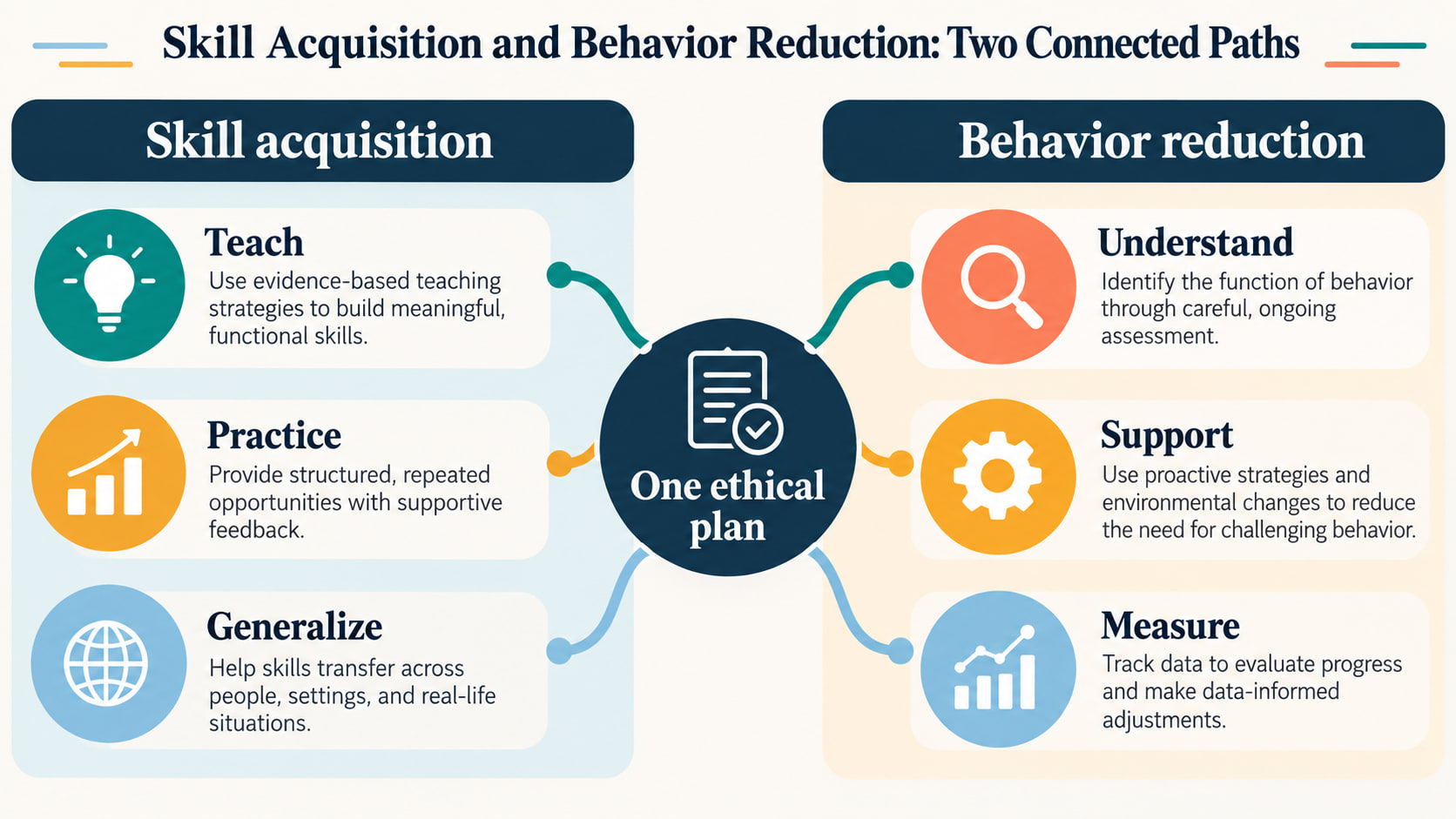
Skill acquisition and behavior reduction should be connected through one approved, ethical plan: teach useful alternatives, measure objectively, and ask before changing a procedure.
Table of Contents
- Skill acquisition and behavior reduction: how the two paths connect
- Start with the approved plan
- Skill acquisition: teach and generalize
- Behavior reduction: understand and support
- Use objective data for both paths
- Keep the RBT role clear
- Worked practice examples
- Frequently asked questions
- References
RBT DOMAIN CONCEPTS · PRACTICE GUIDE
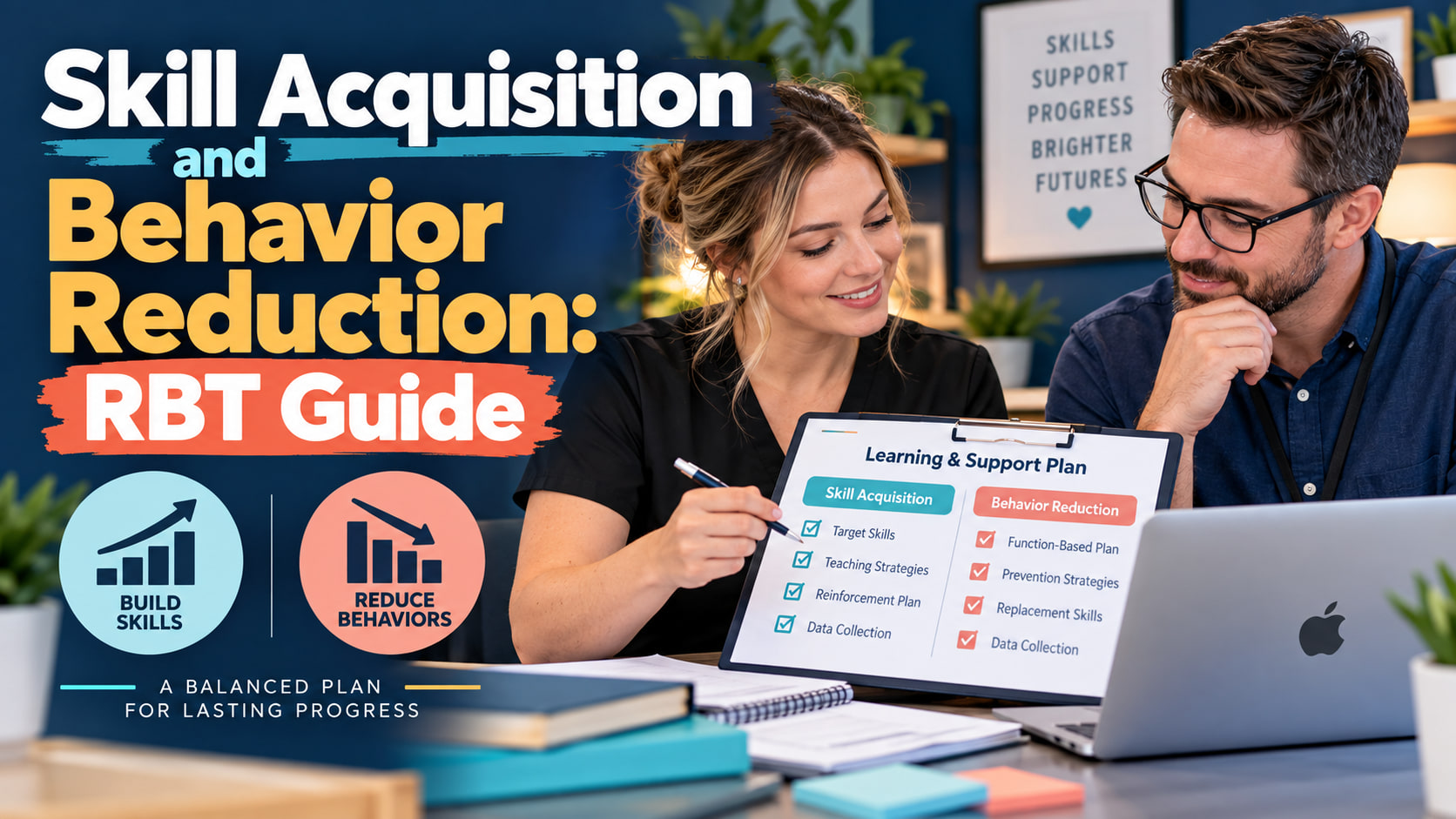
Skill Acquisition and Behavior Reduction: An RBT Guide
Teach useful alternatives, measure objectively, and keep plan changes within supervision.
Skill acquisition and behavior reduction should be connected through one approved, ethical plan. The first path builds communication, independence, participation, or another useful skill. The second path addresses behavior that interferes with learning, safety, access, or quality of life. A strong plan does not treat these as competing goals: it teaches an appropriate alternative while using safe, measurable support.
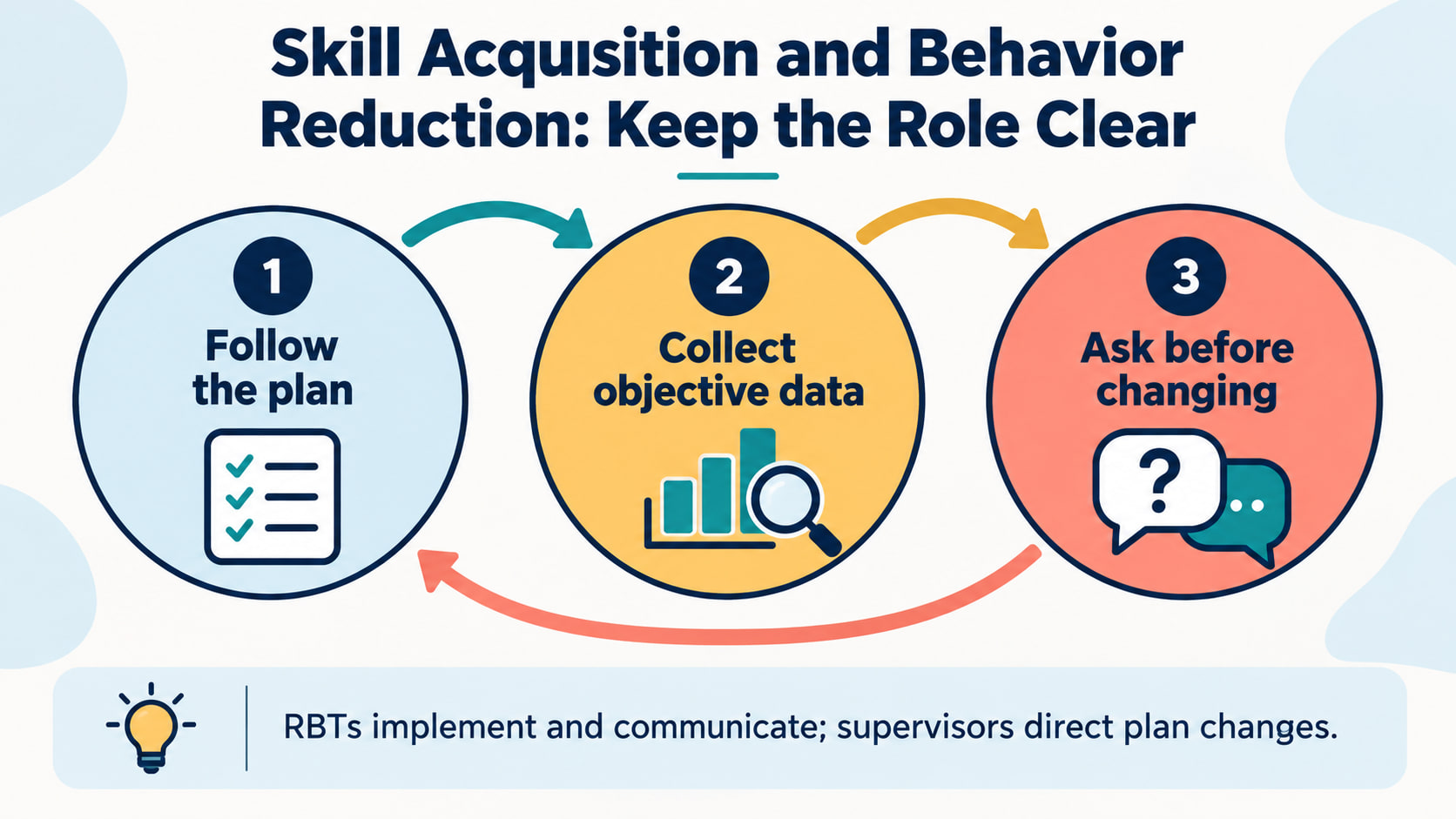
This guide explains the relationship for RBT learners and technicians. It does not replace the current BACB handbook, task list, supervisor direction, employer policy, consent process, or safety procedure. RBTs implement approved procedures, collect objective data, communicate observations, and ask before changing a plan.
Skill acquisition and behavior reduction: how the two paths connect
Behavior often communicates a need or produces access to something. A skill-acquisition target can give the person a more efficient, safe, and socially supported way to communicate or participate. For example, a communication response may replace dropping to the floor when a break is needed. The technician should not assume the function or invent the replacement; the supervisor and approved plan provide the direction.
The connection is practical. If a plan only says what not to do, the person may still lack a way to request help, wait, transition, tolerate a change, or access a preferred activity. If a plan only teaches a new skill while ignoring a safety risk, the learner may not get the support needed to practice. The team can monitor both the new response and the behavior of concern.
Respect matters in both paths. Reduction is not a reason to remove communication, choice, privacy, or dignity. Skill teaching is not a reason to force a response without considering assent, safety, or the approved procedure.
Start with the approved plan
Before a session, identify the current target, definition, materials, prompting guidance, reinforcement arrangement, data method, and safety instructions. Read the plan as a connected set of decisions. Do not combine an old goal, a coworker’s suggestion, and a social-media example into a new procedure.
Check the definitions. A skill should be observable enough to measure, and behavior reduction data should use the current operational definition rather than a label such as “bad behavior” or “not trying.” If the definition, prompt, consequence, or data field is unclear, ask the supervisor before proceeding.
Skill acquisition: teach and generalize
Skill teaching usually begins with a clear target and a reasonable learning opportunity. The technician follows the approved instruction, delivers prompts as directed, reinforces the relevant response, and records what happened. A prompt is not a license to improvise; timing, fading, error correction, and reinforcement should match the current plan.
Practice should not remain tied to one room, person, material, or exact script when the plan includes generalization. A learner may need opportunities with different materials, people, settings, or natural routines. The technician reports what changed and what was observed rather than deciding independently that mastery has generalized.
Use the learner’s communication and preferences as information. A useful skill is more than a correct response on a worksheet. The team may consider whether the person can use it in a meaningful routine, whether support can be faded, and whether the response remains safe and functional.
Behavior reduction: understand and support
Behavior reduction begins with an approved description and support plan. The technician observes context, behavior, and consequence as defined by the team and follows safety procedures. Avoid guessing a motive from appearance. Record what can be seen or heard and bring patterns or uncertainty to supervision.
Support may include antecedent strategies, prompting an alternative response, reinforcement, environmental adjustments, or a safety procedure. The correct choice depends on the plan and the situation. Never use punishment, restraint, withholding, or an unapproved consequence because it seems likely to stop behavior quickly.
When a behavior changes suddenly, becomes more dangerous, or no longer matches the plan, pause and escalate through the designated route. An RBT can communicate that the current procedure is difficult to implement or that a new pattern appeared. That observation is valuable; changing the plan independently is outside the role.
Use objective data for both paths
Data connects teaching and behavior support. For skill acquisition, the record may show opportunities, independent responses, prompt levels, accuracy, duration, or another approved measure. For behavior reduction, the record may show frequency, duration, latency, intensity using the approved definition, or contextual information. Use the method specified by the plan rather than choosing the measure that makes the session look best.
Write what occurred, not a conclusion. “The learner used the break card after a model and waited 30 seconds” is more useful than “the learner understood.” “The response occurred twice after the transition direction” is more useful than “the learner was manipulative.” Objective notes support better supervision and reduce bias.
Look for patterns without overclaiming. One session can provide information, but it does not prove mastery, treatment effectiveness, or generalization. Share the data through the approved system and let the authorized team interpret trends and decide whether a plan change is needed.
Keep the RBT role clear
RBTs are part of a team. They implement assigned procedures, communicate observations, maintain records, protect privacy, and request supervision. They do not independently diagnose, select goals, change mastery criteria, redesign treatment, or promise a family that a strategy will work.
When a caregiver asks for a new goal or a teacher reports a new concern, listen respectfully and route the information to the authorized supervisor. When a learner does not respond as expected, do not increase demands, remove reinforcement, or change prompts outside the plan. Ask what the current procedure requires and document the direction.
Role clarity protects the learner and the technician. It also makes feedback specific: the supervisor can review implementation fidelity, data quality, communication, and safety instead of trying to reconstruct an informal change.
Worked practice examples
- Requesting a break: The approved plan teaches a request and defines the break response. The technician prompts and reinforces as directed, records independence, and asks before changing the delay or prompt.
- Transition support: The plan includes a visual schedule and transition routine. If the learner drops to the floor, the technician follows the safety and prompting procedure, records the event, and does not invent a new consequence.
- New communication pattern: A learner begins pointing to a card not listed in the plan. The technician preserves the observation and brings it to supervision rather than adding the card permanently.
- Generalization: A response is independent in the clinic but not at home. The technician reports the setting difference so the team can decide how to plan the next opportunity.
Frequently asked questions
Is skill acquisition more important than behavior reduction?
They serve different purposes and may be connected in one plan. The team should consider safety, dignity, communication, meaningful participation, and the person’s goals rather than treating one category as automatically more important.
Can an RBT create a replacement behavior?
An RBT can implement an approved teaching target and communicate observations. Selecting or changing goals and procedures belongs to the authorized plan and supervision process.
What if the plan does not seem to work?
Continue the approved safety and data procedures, record objective observations, and contact the supervisor. Do not quietly change the plan or promise a new outcome.
Does one successful response prove mastery?
No. Mastery and generalization depend on the current definitions, criteria, data, and authorized review. One response is a data point, not proof of durable change.
Source note: Review the current BACB RBT Handbook, task list, ethics code, employer policy, and supervisor instructions. This article is educational and does not provide individualized legal, clinical, employment, or credentialing advice.
Ready to practice the RBT concepts you just reviewed?
Try an independent, original RBT practice resource with exam-style questions, scoring, and answer explanations.
References
- Behavior Analyst Certification Board. RBT Test Content Outline, 3rd edition.
- Behavior Analyst Certification Board. RBT Handbook.
- Behavior Analyst Certification Board. RBT Ethics Code.