
Least to most prompting hierarchy aba starts with an opportunity to respond, adds the least intrusive planned support, and uses data to guide review.
Table of Contents
- Least to most prompting hierarchy aba: what it means
- The prompting hierarchy
- Start with an opportunity to respond
- Add the planned level of support
- Record data and review progress
- Prompt fading and independence
- Keep the RBT role clear
- Practice examples
- Frequently asked questions
- References
ABA KNOWLEDGE · RBT IMPLEMENTATION
Least-to-Most Prompting Hierarchy ABA: An RBT Guide
Give an opportunity, add planned support, record what happened, and fade prompts as directed.
Least to most prompting hierarchy aba starts with an opportunity to respond, adds the least intrusive planned support, and uses data to guide review. The learner has a chance to respond independently before the technician adds help. If the response does not occur or is not accurate, the technician follows the next directed prompt level rather than guessing.
Prompting is not a universal ladder that can be copied into every program. The current plan, learner, skill, context, safety needs, and supervisor instructions determine the hierarchy. This guide explains the concept for RBT learners and technicians; it does not replace an approved teaching plan or authorize independent changes.
Least to most prompting hierarchy aba: what it means
Least-to-most prompting arranges support from less intrusive to more intrusive. The technician begins with the lowest planned level and increases help only as the plan directs. The purpose is to provide enough support for learning while preserving an opportunity for independent responding.
“Least intrusive” does not mean “always best” or “always safe.” A plan may require a different sequence for a particular response, medical concern, risk, communication need, or learner preference. Follow the current plan and ask the supervisor if a prompt level is unclear.
The hierarchy should also identify when to wait, how long to wait, what counts as a correct response, what to do after an error, how to reinforce, and how to record the prompt level. Without those details, the word “prompting” is too broad to guide consistent implementation.
The prompting hierarchy
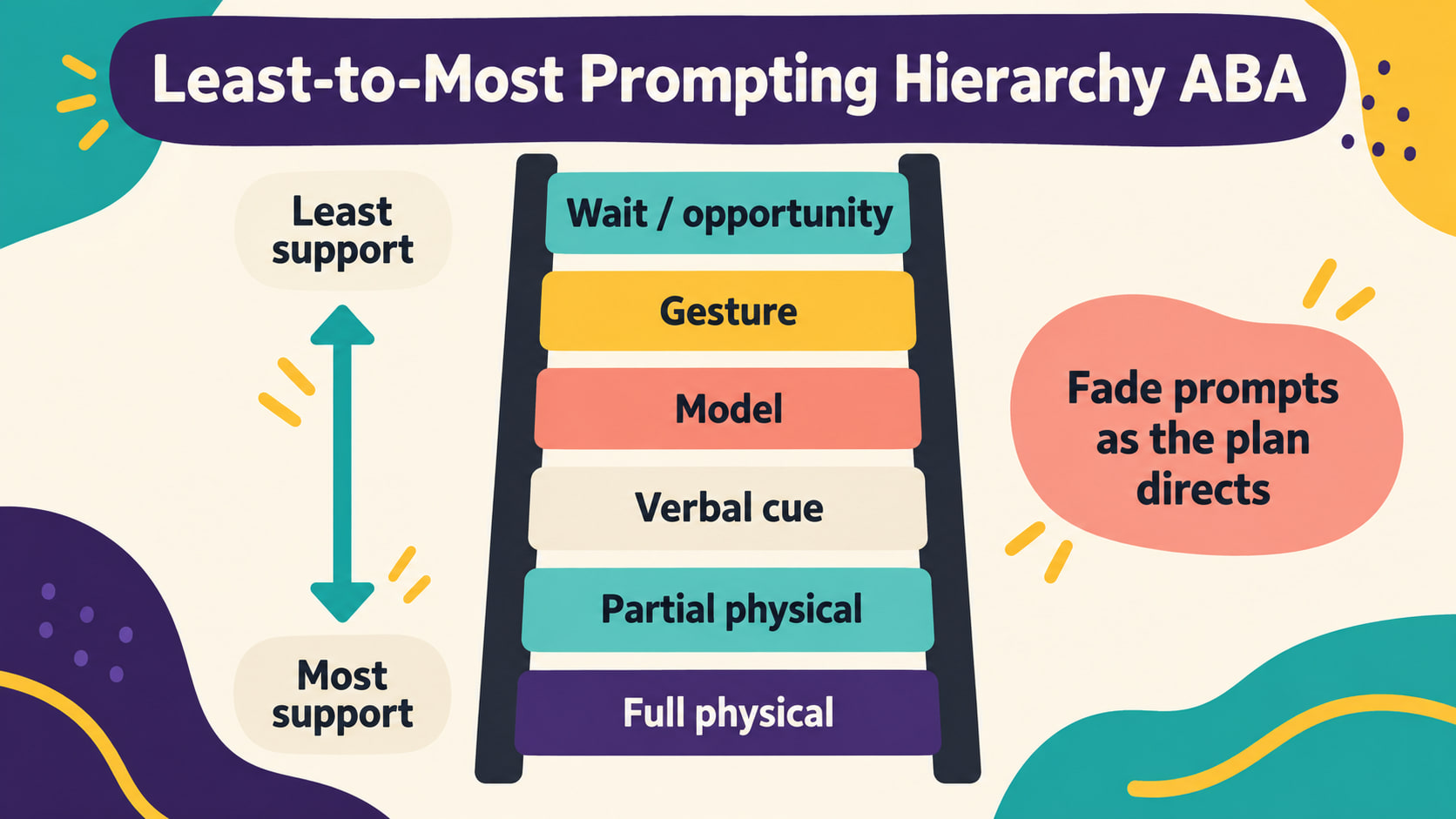
The exact levels vary by program. A common teaching illustration moves from a pause or opportunity through increasingly direct supports:
- Wait or opportunity: Present the instruction or natural cue and allow the planned response interval.
- Gesture: Use the approved visual or gestural cue if the plan includes it.
- Model: Demonstrate the relevant action when modeling is part of the program.
- Verbal cue: Provide the specified verbal support without adding extra language that changes the task.
- Partial physical: Use only the directed partial physical prompt and safety procedure.
- Full physical: Use full physical guidance only when the approved plan and trained procedure require it.
This list is an illustration, not a replacement for a learner’s program. A hierarchy may use different labels, omit levels, or define a different order. Never infer that a more intrusive prompt is permitted simply because it appears in an online chart.
Start with an opportunity to respond
The first step is often the easiest to overlook. Deliver the instruction, cue, or natural opportunity as written, then wait the planned interval. Moving immediately to a prompt may reduce the learner’s opportunity to respond independently and may make the data difficult to interpret.
Waiting does not mean ignoring safety or allowing an unsafe situation to continue. The plan and safety instructions control the response interval. If the learner shows distress, risk, or a need for immediate support, follow the authorized safety procedure and notify the supervisor as required.
Use consistent language and materials when the plan calls for them. Do not repeat an instruction several times because silence feels uncomfortable unless repetition is part of the program. Record what occurred, including whether the response was independent, prompted, incorrect, or absent according to the data definition.
Add the planned level of support
If the independent opportunity does not produce the target response, add the next planned prompt. Keep the prompt clear and brief. Extra explanations, hints, gestures, and emotional coaching can accidentally create an unplanned prompt level, so ask how the program defines each support.
After the learner responds, deliver the programmed consequence or reinforcement and record the prompt level. Do not treat a prompted response as independent just because the learner completed the last part of the action. Accurate data helps the team decide whether the skill is emerging, whether a prompt is becoming too strong, or whether the program needs review.
When an error occurs, follow the error-correction procedure. Some programs repeat the instruction, use a model, or provide a different planned consequence. Others use a specific correction sequence. The technician’s job is to implement the written procedure and communicate when it does not fit the situation.
Record data and review progress
Prompt-level data shows more than whether a response happened. It can show the amount of support required, whether the skill is becoming more independent, whether one setting differs from another, and whether the learner responds to a particular cue. Use the approved measurement system rather than a personal scale.
Write objective notes. “Completed after a model prompt” is more useful than “needed lots of help.” Include the relevant opportunity, prompt level, response, and other fields required by the program. Protect the record and use the approved system.
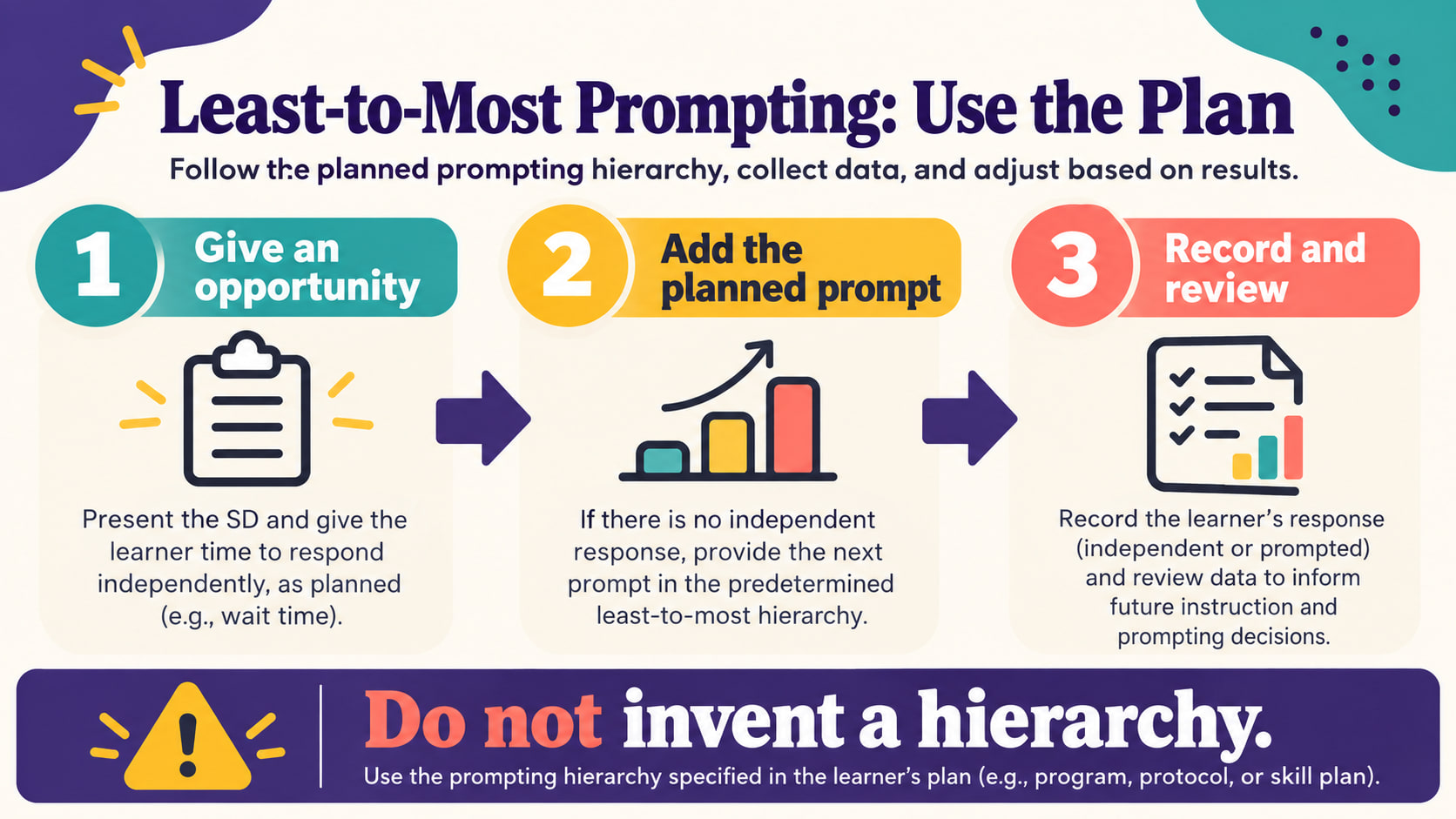
Review data with the supervisor. One independent response does not prove mastery, and one prompted response does not prove that a teaching plan failed. Look at the authorized criteria across opportunities and settings. The supervisor decides whether a target, prompt, reinforcement arrangement, or fading criterion should change.
Prompt fading and independence
Prompt fading reduces unnecessary help so the learner can use the skill with the natural cue. Fading might involve waiting longer, reducing a gesture, shortening a verbal cue, using less physical guidance, or changing another planned support. The method and timing belong to the program.
Do not fade because a session felt easy, and do not keep a prompt forever because it produced a quick response. Record the data and ask the supervisor to review the pattern. A prompt that is removed too quickly may lead to errors or frustration; a prompt that is not faded may become a dependency.
Keep the RBT role clear
RBTs implement the directed hierarchy, collect data, protect dignity and safety, and communicate observations. They do not invent a new hierarchy, change prompt criteria, select mastery goals, diagnose, or promise independence. When the plan is missing a level or a learner responds differently than expected, pause and ask through supervision.
Physical prompting requires particular care. Use only the approved procedure, training, consent, and safety guidance. If the learner resists, shows distress, or the action becomes unsafe, follow the emergency or escalation procedure and report accurately. Never use force as a shortcut to make a data point look complete.
Practice examples
- Sorting: The technician presents the item and waits the defined interval. If no response occurs, the technician uses the next prompt in the approved sequence and records it.
- Requesting: The learner reaches toward a preferred item but does not use the target communication response. The technician follows the planned cue and reinforcement procedure rather than inventing a new phrase.
- Transition: A visual cue is not enough during a difficult transition. The technician follows the next planned support and records the context for supervisor review.
- Generalization: A learner responds independently with one instructor but needs a model with another. The technician records the setting difference and does not declare mastery across people.
Frequently asked questions
Does least-to-most mean prompts should always be minimal?
It means the approved sequence begins with the planned lower level when appropriate. The current program and safety procedure determine the actual hierarchy and response.
Can an RBT choose the prompt level?
An RBT follows the prompt hierarchy and criteria in the approved plan. If a level is missing or does not fit, ask the supervisor rather than improvising.
Does a prompted response count as mastery?
Not automatically. Mastery depends on the current definition, independent-response criteria, data, and authorized review.
What if the learner refuses a prompt?
Follow the approved safety and assent-sensitive procedure, protect dignity, record objective facts, and contact the supervisor. Do not escalate physical support on your own.
Source note: Review the current BACB RBT Handbook, task list, ethics code, employer policy, and supervisor instructions. This article is educational and does not provide individualized legal, clinical, employment, or credentialing advice.
Ready to practice the RBT concepts you just reviewed?
Try an independent, original RBT practice resource with exam-style questions, scoring, and answer explanations.
References
- Behavior Analyst Certification Board. RBT Test Content Outline, 3rd edition.
- Behavior Analyst Certification Board. RBT Handbook.
- Behavior Analyst Certification Board. RBT Ethics Code.