
FCT ABA, or functional communication training, teaches a useful communication alternative within an approved plan rather than relying on guessing or punishment.
Table of Contents
- FCT ABA: what functional communication training means
- The functional communication path
- Identify the communication need
- Teach and prompt the request
- Honor the communication
- Record and review data
- Keep the role clear
- Frequently asked questions
- References
ABA KNOWLEDGE · COMMUNICATION SUPPORT
FCT ABA: Functional Communication Training
Teach a useful communication alternative within an approved plan and supervision process.
FCT ABA, or functional communication training, teaches a useful communication alternative within an approved plan rather than relying on guessing or punishment. The alternative might be a spoken request, sign, gesture, picture, device response, or another defined form of communication. The right target depends on the learner, context, access, safety, and authorized assessment.
This guide explains the concept for RBT learners and technicians. It does not authorize an RBT to independently identify function, select a target, change a plan, or promise that behavior will stop. Follow the current plan, supervisor direction, communication preferences, safety procedures, and privacy requirements.
FCT ABA: what functional communication training means
FCT connects a meaningful communication response with the outcome identified by the approved plan. If a learner can request a break, help, attention, or an item through the taught response, the team can reinforce that communication and collect data on whether it becomes more efficient and useful.
“Functional” does not mean that a technician should guess the reason for behavior from one observation. The communication target should come from the authorized assessment and treatment process. Ask the supervisor what the response means, what prompt is allowed, and what consequence follows.
Communication is broader than speech. A learner may use a sign, picture, device, body movement, written word, or another accessible response. Respect the approved system and do not replace a person’s effective communication with a form that is convenient for adults.
The functional communication path
A clear FCT program connects four actions:
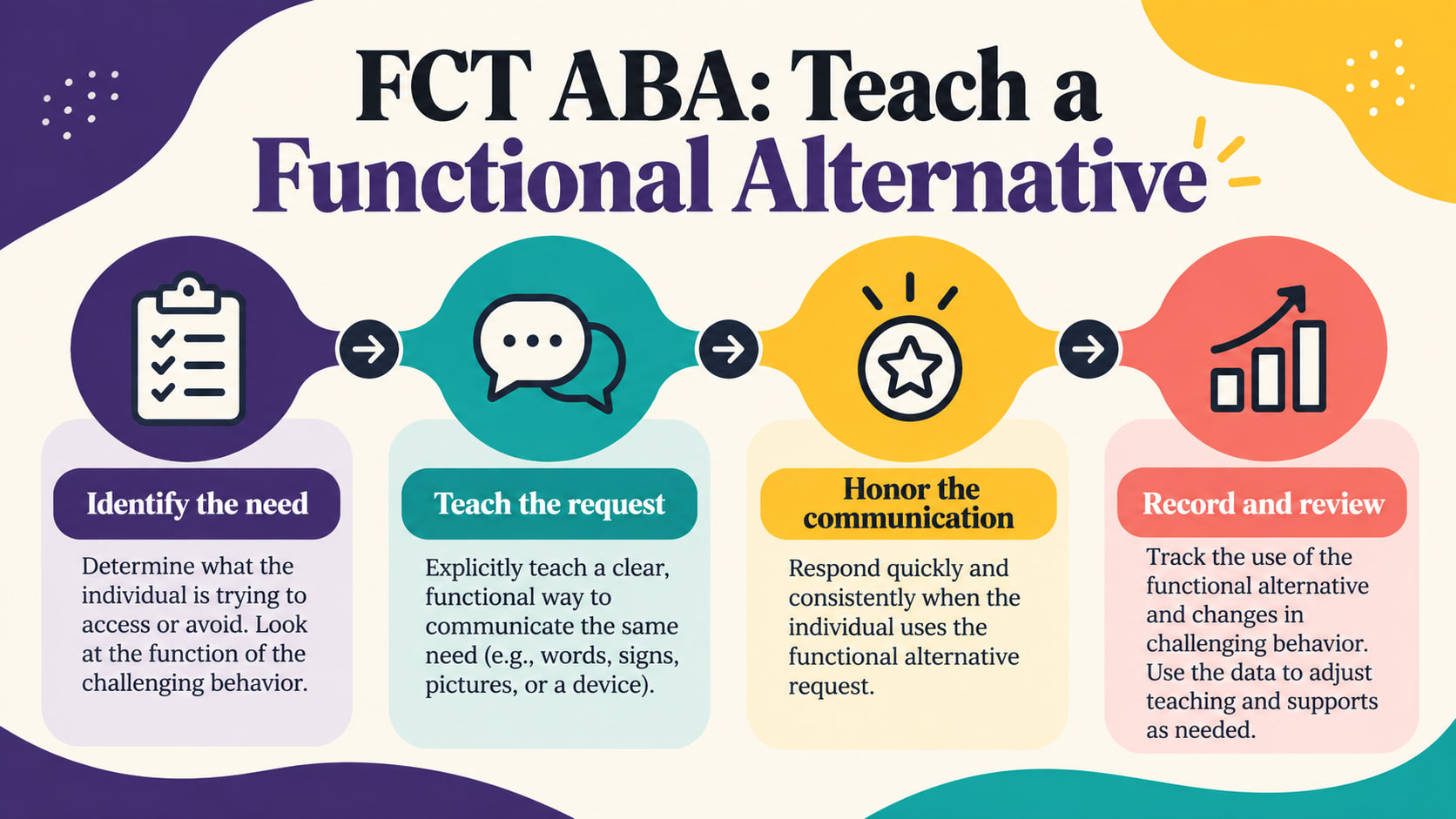
- Identify the need: Follow the plan’s definition and context rather than guessing a function.
- Teach the request: Present the communication opportunity and use the planned prompt.
- Honor the communication: Deliver the approved consequence when the response occurs.
- Record and review: Track independence, prompts, context, and outcomes for supervision.
The path should be safe and realistic. A response that is too difficult, unavailable when needed, or ignored after it occurs may not become a reliable alternative. Bring implementation barriers to the supervisor instead of quietly changing the response.
Identify the communication need
The plan may identify a need for help, a break, attention, access, information, or another outcome. Learn the exact definition and the situations in which the target is taught. Do not assume that a behavior has the same meaning in every setting or at every time.
Observe relevant context objectively. A transition, difficult task, unavailable item, social interaction, or delay may be part of the programmed opportunity. Record what occurred and ask how the team wants the context documented.
Protect dignity while collecting information. Do not discuss a learner’s communication or behavior in public, and do not use identifying details in personal study notes or unapproved tools.
Teach and prompt the request
Use the prompt, model, visual, gesture, verbal cue, or physical support specified by the plan. Give the learner an appropriate opportunity to respond, then add the planned support. Do not invent a new prompt hierarchy or repeat a demand until the learner gives an adult-preferred answer.
Prompt fading supports independence when it is part of the program. Follow the timing and criterion directed by the supervisor. A prompted request and an independent request should be recorded as the system requires.
Practice the communication in meaningful routines and settings when the plan includes generalization. Do not assume that a response learned at a table will automatically appear during a transition, at home, or with another person.
Honor the communication
When the target communication occurs, follow the programmed consequence. The response should have a meaningful connection to the outcome identified by the plan. Do not promise an unlimited or immediate outcome if the plan specifies a delay, schedule, safety condition, or alternative response.
Honor communication without removing boundaries or safety. A request can be acknowledged even when the exact outcome is delayed or unavailable, if the plan teaches that response. Ask the supervisor how to respond when a request conflicts with safety, timing, consent, or another person’s rights.
Do not reinforce only the communication form that is easiest for adults. The learner’s access, motor needs, language, culture, and preferences matter. Report when the response is difficult, unreliable, or no longer meaningful.
Record and review data
Record opportunities, independent and prompted requests, response type, latency, consequence, and other required fields. Use objective descriptions. “Used the break card after a model prompt” is more useful than “asked appropriately.”
Review patterns with the supervisor. One successful request does not prove generalization or mastery, and one missed request does not prove that FCT failed. Changes in setting, materials, prompt timing, motivation, communication access, or staff behavior may affect the data.
If the current communication no longer works, do not remove it or invent a replacement. Preserve the observation, protect the learner’s access to communication, and ask the authorized team to review the target and plan.
Generalization deserves explicit attention. A learner may request a break with a familiar technician but not with a new staff member, or may use a device in a quiet room but not during a noisy transition. Record the difference without labeling the learner as unwilling. The team can decide whether the next step is more practice, a different prompt, a new setting, or a plan review.
FCT also depends on consistent team behavior. If one person honors the communication and another ignores it, the learner receives mixed information. Share the current procedure through approved training and supervision, and ask for clarification when staff responses appear inconsistent.
When communication is difficult to interpret, slow down and preserve the person’s dignity. Offer the approved access, check the current prompt, and contact the supervisor rather than turning a misunderstood response into a compliance problem.
Keep the role clear
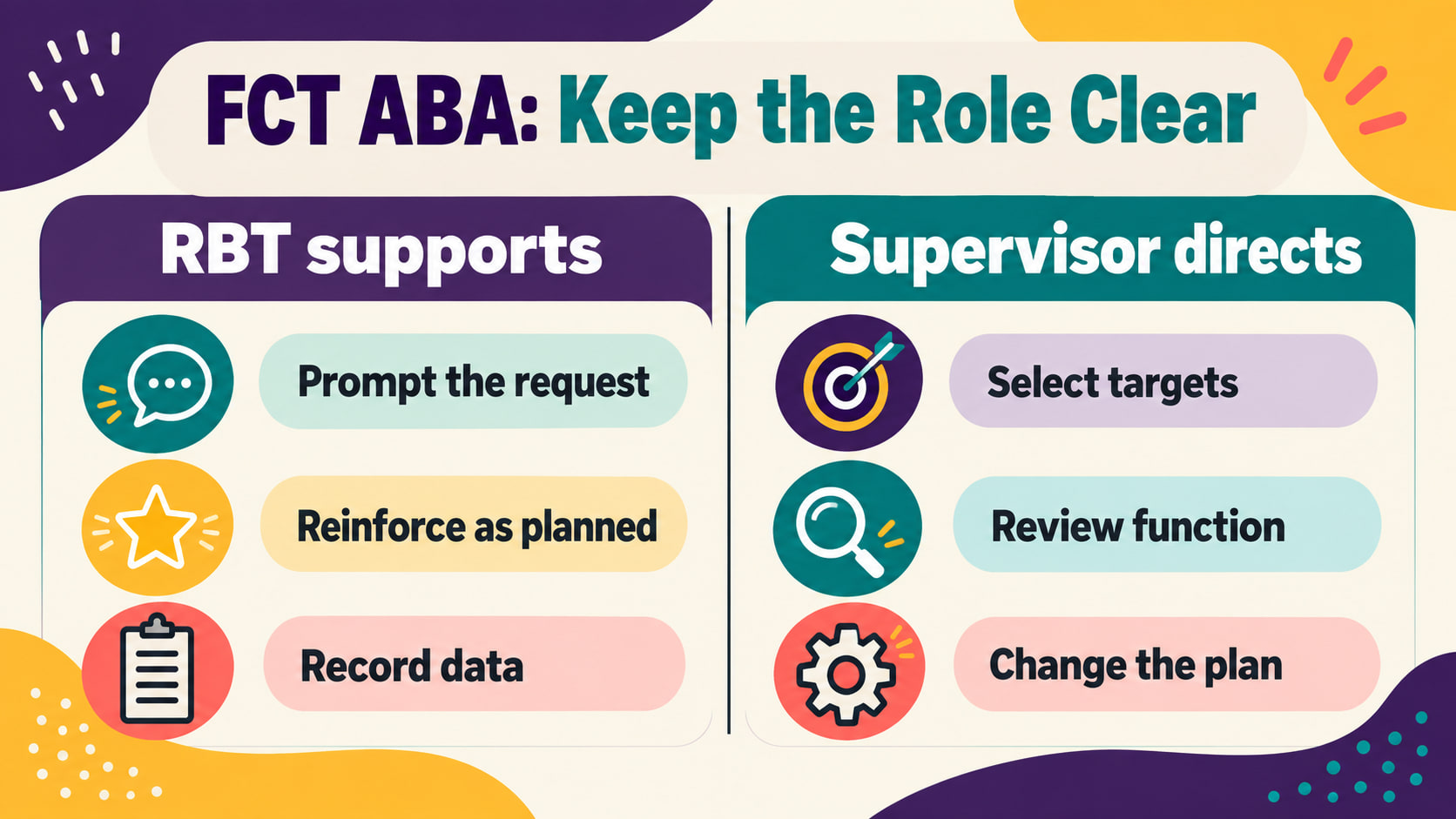
An RBT supports the plan by prompting, reinforcing, recording, protecting privacy, and communicating. The supervisor or authorized team selects targets, reviews function, determines criteria, and changes the plan. The role boundary is part of ethical communication support.
- RBT supports: prompt the request, reinforce as planned, record data, and report barriers.
- Supervisor directs: select targets, review function, approve procedures, and change the plan.
Frequently asked questions
Does FCT ABA mean using a picture card?
It can, but FCT may use speech, sign, gestures, devices, writing, pictures, or another defined response. The plan should match the learner and context.
Can an RBT choose the communication response?
An RBT implements the approved target and communicates observations. Target selection and plan changes belong to the authorized team.
Does FCT guarantee behavior reduction?
No. Communication training may support a useful alternative, but outcomes depend on the learner, plan, context, implementation, and review.
What if the communication request is not honored immediately?
Follow the current plan and safety procedure, acknowledge the response as directed, record facts, and ask the supervisor how to handle the situation.
Source note: Review the current BACB RBT Handbook, task list, ethics code, employer policy, and supervisor guidance. This article is educational and does not provide individualized legal, clinical, employment, or credentialing advice.
Ready to practice the RBT concepts you just reviewed?
Try an independent, original RBT practice resource with exam-style questions, scoring, and answer explanations.
References
- Behavior Analyst Certification Board. RBT Test Content Outline, 3rd edition.
- Behavior Analyst Certification Board. RBT Handbook.
- Behavior Analyst Certification Board. RBT Ethics Code.