
ABA measurement systems turn observable behavior into organized information that a team can review, but the measure must match the behavior and the current program.
Table of Contents
- ABA measurement systems: what they do
- ABA measurement systems begin with an operational definition
- Common ABA measurement systems
- Choosing the measure in a program
- Record data consistently
- Review data without overclaiming
- RBT role boundaries
- Frequently asked questions about ABA measurement systems
- References
ABA KNOWLEDGE · DATA COLLECTION
ABA Measurement Systems: How RBTs Record Behavior
Match the measure to the behavior, record observable facts, and review patterns with supervision.
ABA measurement systems turn observable behavior into organized information that a team can review, but the measure must match the behavior and the current program. A count, duration, latency, interval score, or percentage can answer a different question. The number is only useful when everyone knows what was observed, when it was observed, and how it was recorded.
This guide explains common measures for RBT learners and behavior technicians. It does not authorize an RBT to select a target, rewrite an operational definition, change a data system, or interpret a pattern without supervision. Follow the current plan, protect privacy, and ask for clarification when the procedure is unclear.
ABA measurement systems: what they do
Measurement describes a response in a way that can be counted, timed, or compared. Instead of writing “had a bad session,” a technician may record that the learner engaged in a defined response three times during a 30-minute observation, or that the response lasted a total of four minutes. The selected measure should make the target more observable, not add a judgment.
Good measurement supports decisions, but it does not explain everything by itself. A frequency number does not prove a function, a percentage does not prove mastery in every setting, and a decrease does not automatically prove that a particular intervention caused the change. The team combines data with context, program details, supervision, and other relevant information.
Ask four questions before recording: What is the exact target? When does observation start and stop? What counts as one response? Which field or system should contain the data? These questions prevent well-intended but inconsistent notes.
ABA measurement systems begin with an operational definition
An operational definition describes the response so that a trained observer can identify it and distinguish it from similar events. It should use observable terms, clear boundaries, and examples or nonexamples when the program provides them. “Disrespectful” or “tantrum” may be labels that need a more specific definition before data can be collected.
For example, a program might define “leaves area” as moving both feet outside the marked boundary during a designated activity, excluding transitions authorized by the schedule. The exact definition in the current plan controls. Do not replace it with a shorter phrase because it seems easier to remember.
Definitions should also account for the setting and response form. A communication response may be spoken, signed, gestured, written, or device-based. If the program counts all of these as the same target, record them as directed. If it distinguishes them, preserve the distinction.
Common ABA measurement systems
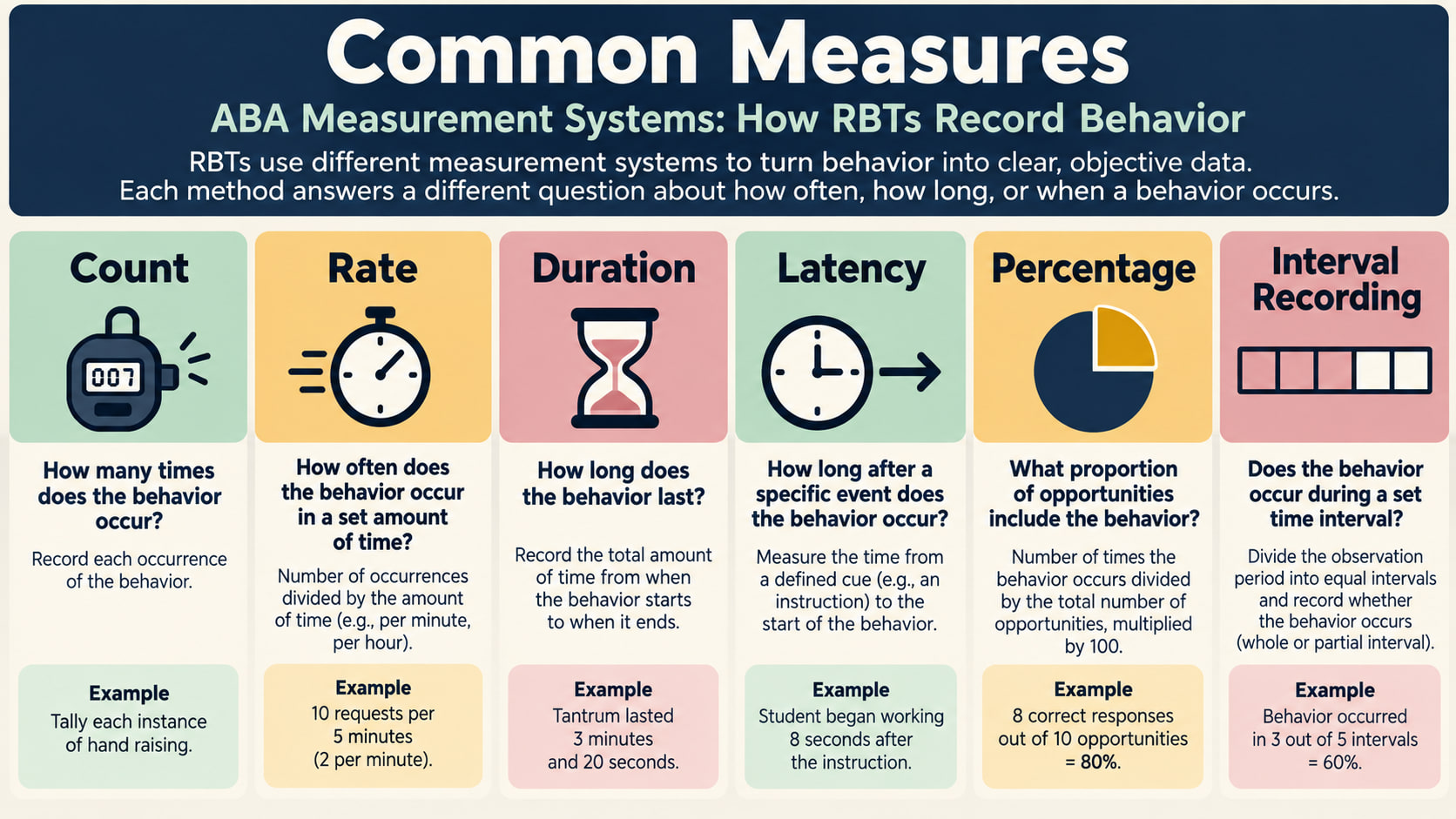
The following measures are common examples. The active program may use different definitions, fields, or combinations:
- Count or frequency: The number of times a defined response occurs during an observation. Count is useful when responses have a clear beginning and end and can be observed reliably.
- Rate: The number of responses relative to a unit of time, such as responses per hour. Rate can help compare observations of different lengths, but the time window must be recorded accurately.
- Duration: How long a response lasts, either for each episode or across a session. Duration may be useful for responses where the amount of time matters more than the number of episodes.
- Latency: The time between a specified cue or event and the start of the target response. The program should identify the start cue and the response clearly.
- Interresponse time: The time between the end of one response and the beginning of the next. This measure can describe spacing when the time between events matters.
- Percentage: A proportion expressed out of a defined total, such as correct responses divided by opportunities. Record the numerator, denominator, and opportunity definition when required.
- Interval recording: The observation period is divided into intervals and the technician records whether the target occurred according to the specified rule, such as partial-interval or whole-interval recording. Follow the exact interval rule because different rules answer different questions.
- Permanent product: The technician measures a lasting outcome produced by the response, such as completed items or written work, when the product reliably reflects the target and the program permits this method.
These measures are not interchangeable. A percentage of intervals is not the same as a percentage of opportunities, and a count across a 10-minute observation is not directly comparable with a count across a two-hour observation. When comparing data, confirm that the measure, observation length, denominator, and conditions match.
Choosing the measure in a program
The supervisor or authorized team selects the measurement system based on the target, purpose, feasibility, and decision to be made. A brief response may be measured by count; a response that can continue may require duration; a learning target may use opportunities and percentage; a delay before responding may require latency.
Feasibility matters, but convenience alone should not decide the measure. If a technician cannot safely watch, prompt, and record every event at the same time, report the barrier. The team may change the materials, assign another observer, use a different approved field, or revise the procedure through supervision.
Never quietly substitute “easy to record” for “meaningful to the program.” If the plan says whole-interval recording and the technician records count, the resulting numbers answer a different question. Pause and obtain direction when a form, app, or written plan appears inconsistent.
Record data consistently
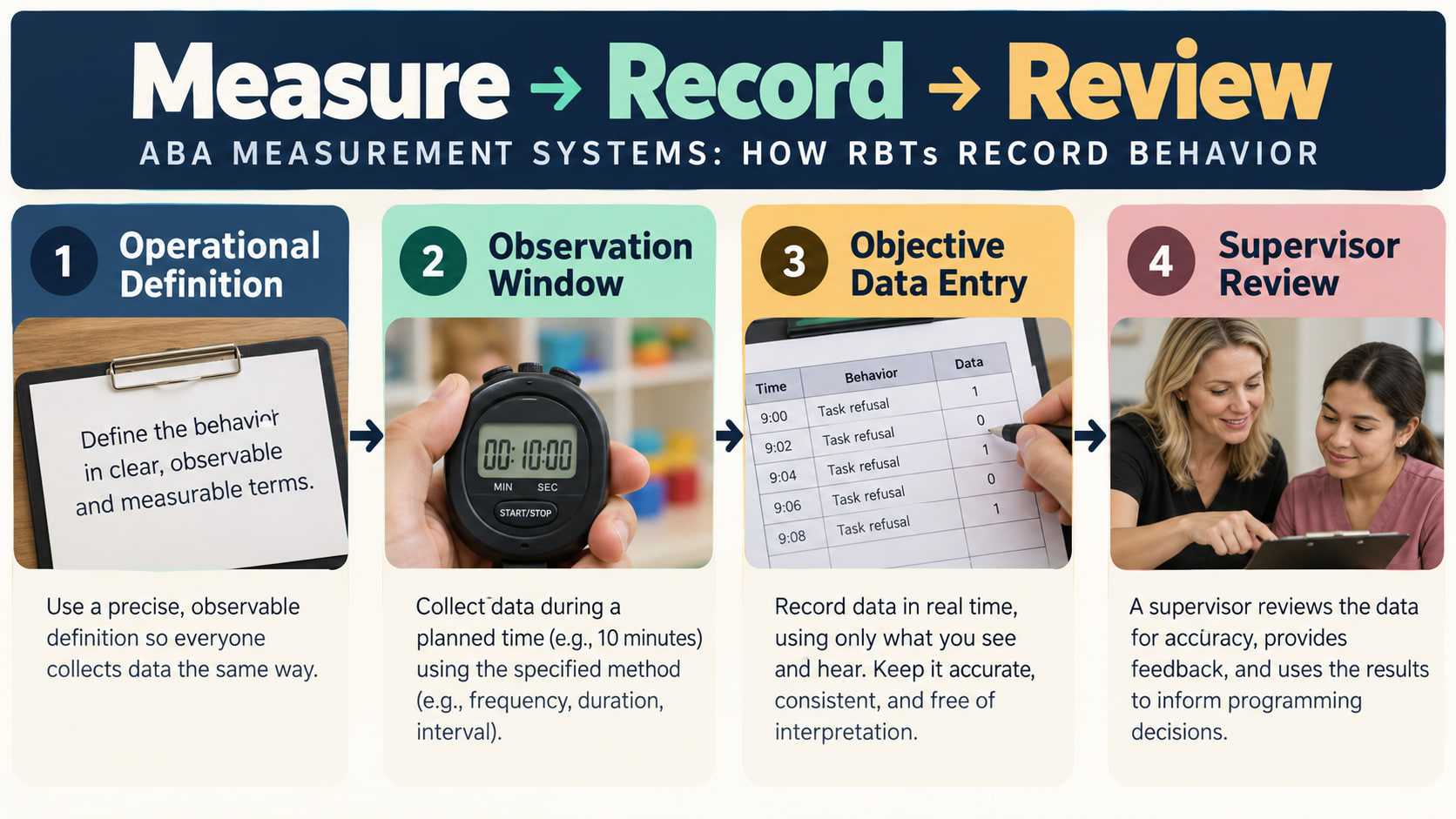
Prepare the approved data sheet, timer, device, or other tool before the observation begins. Confirm the learner, date, setting, target, observer, and session boundaries according to the privacy and documentation process. Use the same operational definition and response rule throughout the observation unless the program directs otherwise.
Record as close to the event as practical. If a delay or interruption prevents immediate entry, follow the program’s correction procedure and do not guess from memory. Correct errors transparently rather than deleting a record or changing a number to make the session look cleaner.
Objective notes can add context without replacing the data. “Two instances occurred after the transition cue; the visual schedule was unavailable” is different from “the learner was anxious.” Describe what was observed and reserve interpretation for the authorized review process.
Protect information during and after collection. Use approved systems, avoid personal screenshots, do not include identifying details in study notes, and follow the employer’s retention and access rules.
Review data without overclaiming
Look for patterns with the supervisor: changes across sessions, settings, materials, people, prompt levels, opportunities, and response forms. A single point can be informative, but it rarely answers a broad question by itself. Confirm that the measure was implemented as written before treating a change as a meaningful trend.
Data quality questions are part of review. Ask whether the observation was long enough, whether the definition was clear, whether opportunities were comparable, and whether staff recorded consistently. If observers disagree, preserve the original records and follow the program’s reliability or supervision procedure.
An RBT can report that a target seems to be occurring more often, taking longer, or requiring more prompts. The supervisor decides whether the plan, target, measurement system, or teaching conditions should change. Do not alter the program because a number feels surprising.
RBT role boundaries
An RBT implements the defined measurement procedure, records observable data, protects confidentiality, and communicates barriers. The supervisor or authorized team defines the target, selects the measure, determines criteria, interprets the pattern, and approves changes.
- Before collection: confirm the target definition, measure, observation window, tool, and correction procedure.
- During collection: follow the same rule, record facts promptly, and note relevant context without adding labels.
- After collection: secure the record, report uncertainty, and bring patterns or implementation barriers to supervision.
Frequently asked questions about ABA measurement systems
Which ABA measurement system is best?
There is no universal best measure. The current program should select a measure that matches the target and the decision the team needs to make.
Is frequency the same as rate?
No. Frequency is a count; rate relates the count to a unit of time. An observation length must be considered when comparing rates.
Can an RBT change the data method if it is inconvenient?
No. Record the approved measure and report the barrier. The supervisor or authorized team can review and change the procedure.
Does a data number explain why behavior happened?
No. Measurement describes what occurred under defined conditions. Function and plan decisions require the authorized assessment and supervision process.
Source note: Review the current BACB RBT Handbook, task list, ethics code, employer policy, and supervisor guidance. This article is educational and does not provide individualized legal, clinical, employment, or credentialing advice.
Ready to practice the RBT concepts you just reviewed?
Try an independent, original RBT practice resource with exam-style questions, scoring, and answer explanations.
References
- Behavior Analyst Certification Board. RBT Test Content Outline, 3rd edition.
- Behavior Analyst Certification Board. RBT Handbook.
- Behavior Analyst Certification Board. RBT Ethics Code.