
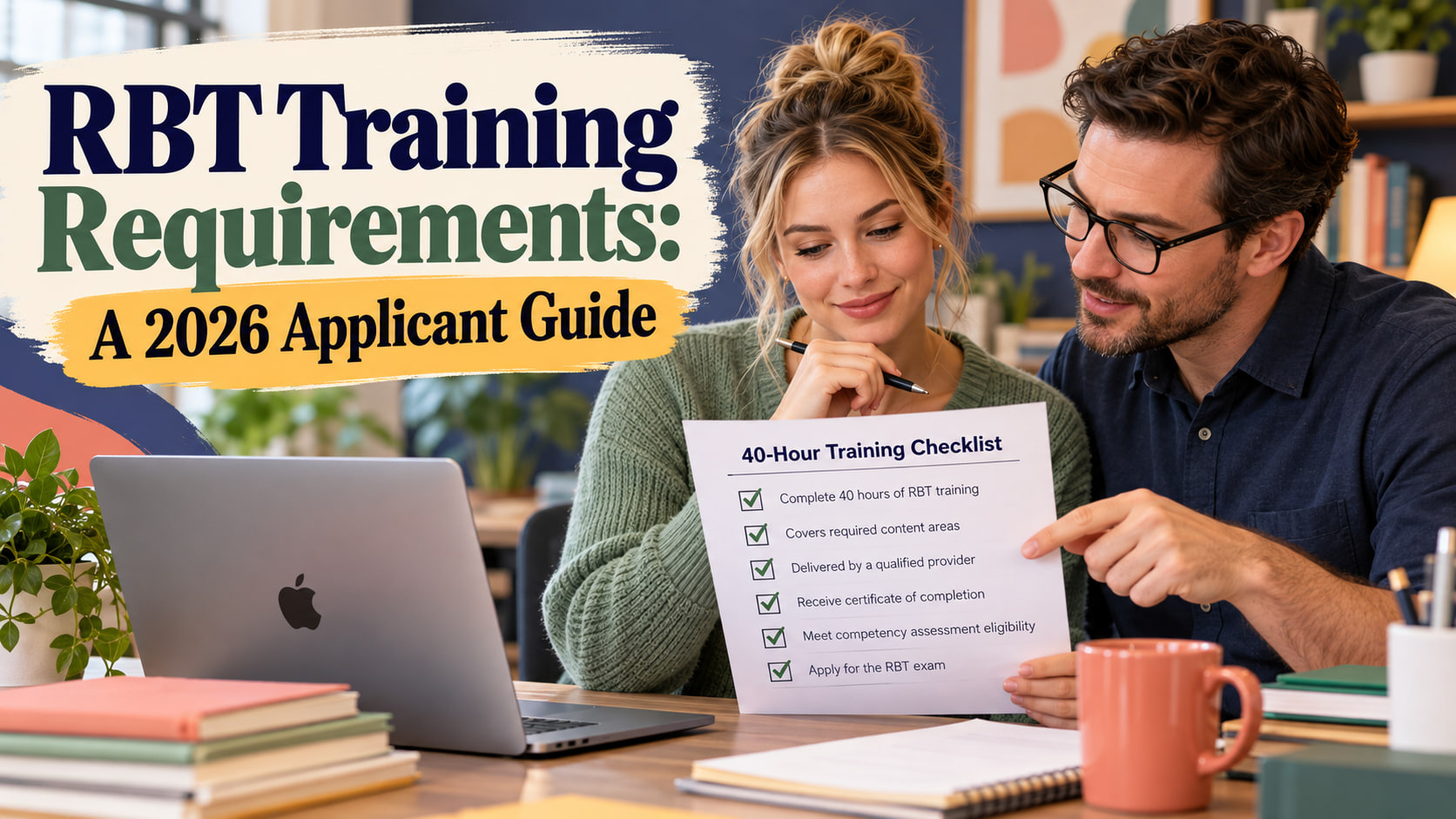
RBT training requirements in 2026 should be checked against the current BACB Handbook and transition guidance because the eligibility and examination process has changed.
Table of Contents
- RBT training requirements: why the 2026 process matters
- The training requirement
- Initial competency assessment
- Application and examination
- Verify a provider’s claims
- Keep records and plan ahead
- What training does not authorize
- Frequently asked questions about RBT training requirements
- References
RBT PATH · REQUIREMENTS GUIDE
RBT Training Requirements: A 2026 Applicant Guide
Separate training, competency assessment, application approval, examination, and certification.
RBT training requirements in 2026 should be checked against the current BACB Handbook and transition guidance because the eligibility and examination process has changed. A course, competency assessment, application, exam appointment, and certification are connected steps, but they are not the same thing.
This guide explains the pathway for prospective applicants. It does not replace the current BACB portal, handbook, or official transition documents. Before paying a provider or submitting an application, verify the version, effective date, eligibility route, documentation, fees, and deadlines that apply to you.
RBT training requirements: why the 2026 process matters
The BACB’s RBT resources identify 2026 requirements changes, a 2026 RBT Handbook, and a 2026 40-hour training curriculum outline. That means an older article or saved checklist may omit a current step, use an outdated competency process, or describe an examination that is no longer the current version.
Use the official resource’s effective date and update date as part of your checklist. When a provider says “BACB approved,” ask exactly what that means: a course may be designed to meet a curriculum requirement, while the BACB still controls application review, eligibility, examination, and certification decisions.
Do not confuse a transition document with a personal approval. Read the guidance, compare it with your situation, and contact the BACB through the official channel when a requirement is unclear.
The training requirement
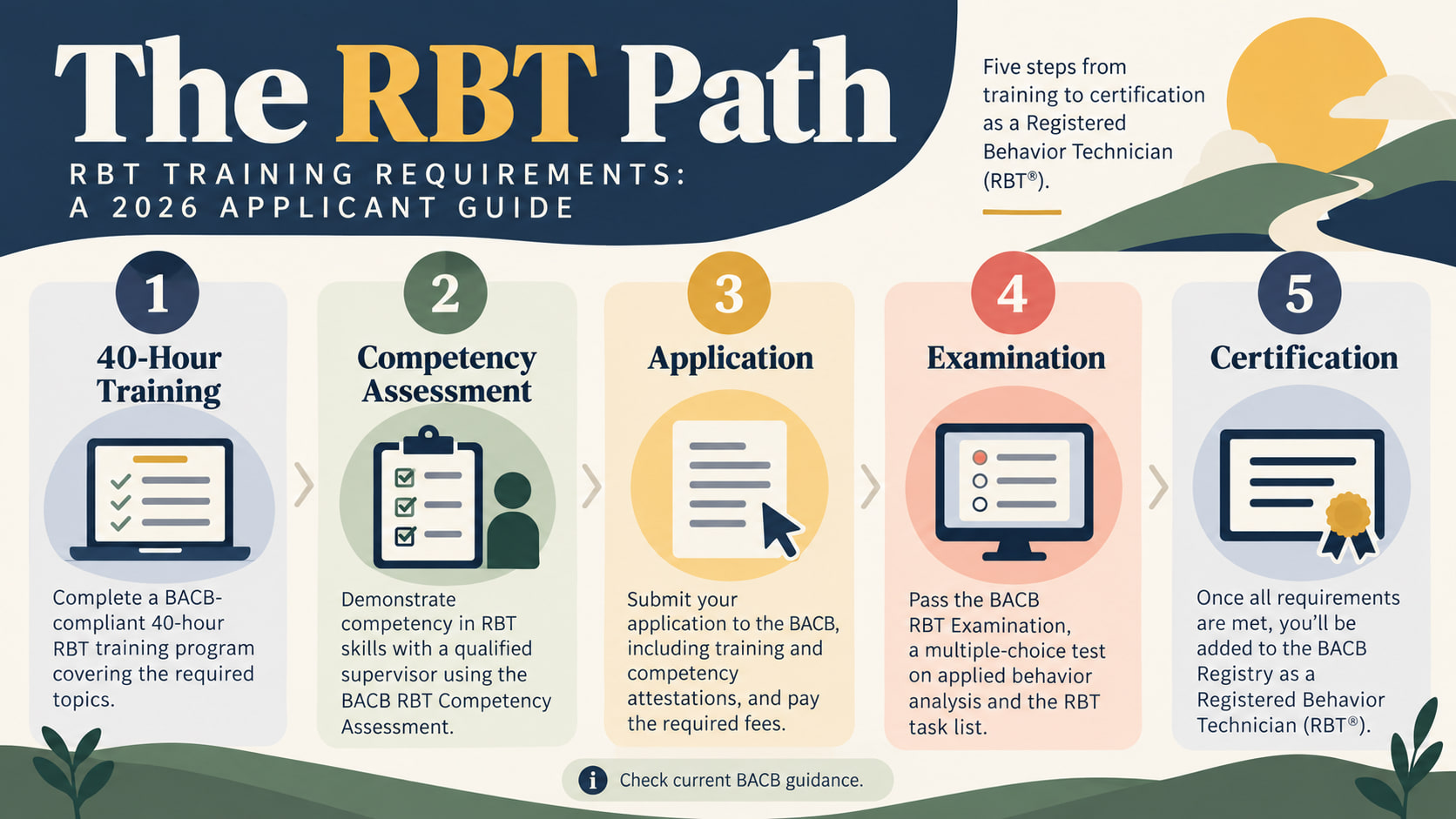
The current BACB materials describe a 40-hour training curriculum for new RBT applicants. The curriculum outline specifies the content framework and provider expectations; it does not mean that every short course, video playlist, or certificate automatically meets the current route.
Before enrolling, check:
- the course identifies the current RBT curriculum and effective version;
- the provider explains how hours, activities, quizzes, and completion are documented;
- the training covers the required content rather than only exam vocabulary;
- the completion record names the learner, provider, dates, and other information the current process requires;
- the provider clearly separates its certificate from BACB certification.
Training should build practical understanding of measurement, assessment concepts, skill acquisition, behavior reduction, documentation, ethics, and supervision. A course is preparation, not permission to practice independently or change a client’s plan.
Initial competency assessment
After or alongside the applicable training route, the applicant may need an initial competency assessment under the current BACB process. The current RBT resource page identifies an Initial Competency Assessment Packet with requirements effective January 1, 2026. Use the current packet and authorized assessor instructions rather than relying on a screenshot or an old form.
The assessment is not simply another course completion certificate. It evaluates whether the applicant can demonstrate defined skills through the approved process. Ask who may conduct it, which version of the packet applies, how results are documented, and what happens if a skill needs additional practice.
Keep personal information and assessment records secure. Do not upload private client information to public study tools, and do not ask for leaked assessment prompts or answer keys. Practice should use legitimate training scenarios and supervisor guidance.
Application and examination
Course completion and competency assessment do not automatically create certification. The applicant still follows the current BACB application process, pays the applicable official fee, submits required documentation, waits for review, and schedules the examination through the instructions provided after approval.
Read the current RBT Handbook for eligibility, application timing, examination authorization, retake timing, accommodations, and maintenance requirements. A training provider can help organize documents, but the BACB portal and handbook control the official process.
Budget separately for application and exam fees, training, background checks, travel, technology, and a possible retake. Ask an employer whether it covers any item and whether reimbursement has conditions.
Verify a provider’s claims
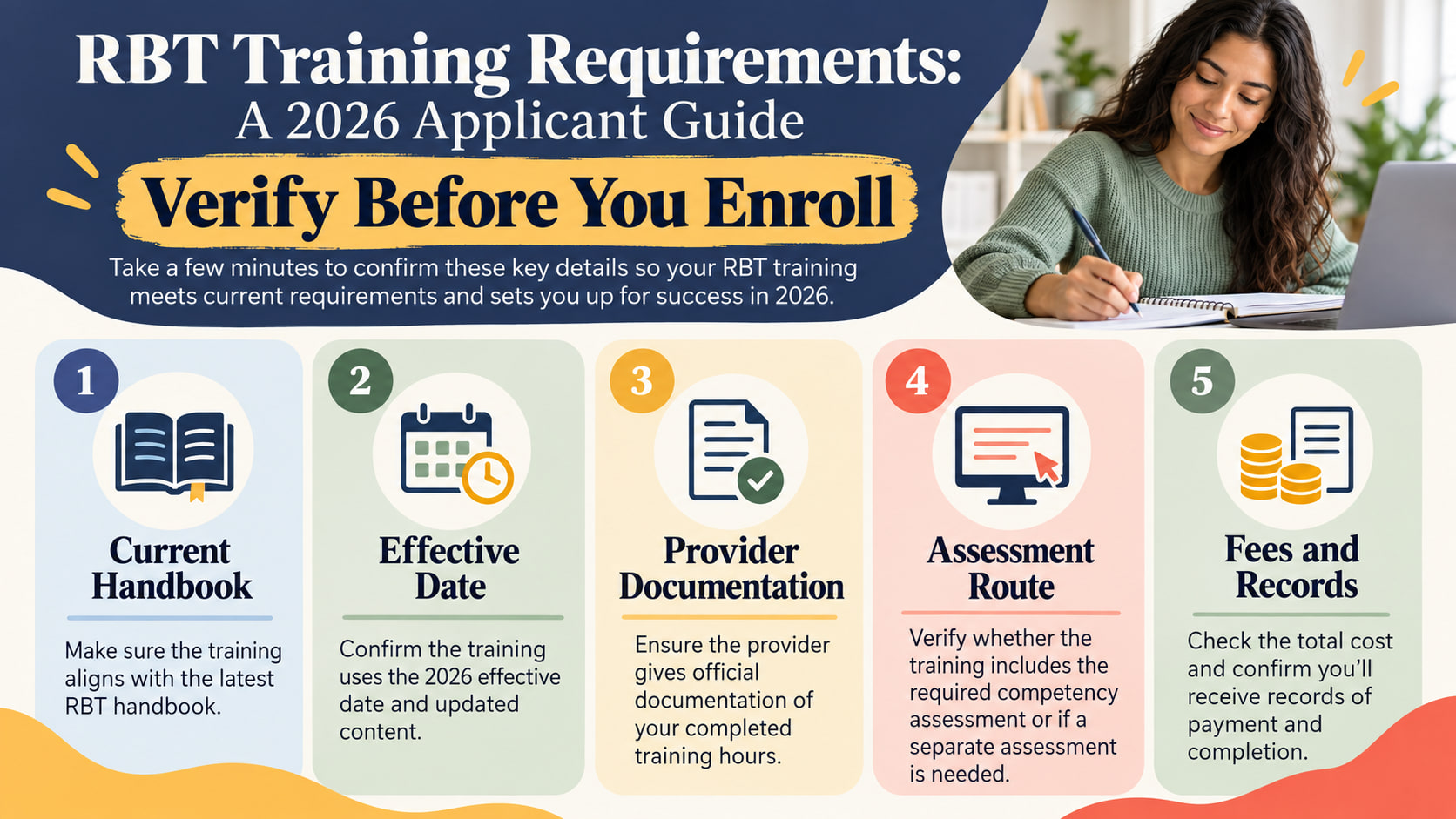
Use a simple verification sequence before paying:
- Open the current BACB RBT page and Handbook yourself.
- Compare the provider’s course title, version, hours, dates, and completion record with the official requirements.
- Ask which organization reviews the application and who conducts the competency assessment.
- Request itemized pricing and written refund, transfer, and support terms.
- Save the official links, provider answers, receipts, and completion documents.
Be cautious with phrases such as “guaranteed pass,” “instant certification,” “official exam questions,” or “no supervision needed.” Those claims conflict with the distinction between training, certification, examination security, and supervised practice.
Keep records and plan ahead
Make a personal folder with the current handbook version, training agreement, completion certificate, competency assessment record, application confirmation, fee receipts, examination authorization, and relevant correspondence. Use secure storage and limit access to private documents.
Track dates rather than assuming the process is open-ended. A course may have an expiration or transfer policy; an application may have a time window; an examination authorization may have a deadline. The official source and your portal account provide the dates that control your case.
At each handoff, compare the document you received with the step it is meant to support. A course certificate should identify the training completed; an assessment record should identify the competency process; an application confirmation should come from the official portal. If a document uses vague language, has no dates, or promises certification without application review, ask the provider and BACB for clarification before moving on.
If your name, address, identity document, employer, supervisor, or eligibility circumstances change, check the current reporting and application instructions. Do not let an old saved PDF make the decision for you.
What training does not authorize
Training does not authorize an RBT to diagnose, select a client’s goals, conduct an independent functional assessment, redesign a treatment plan, or work without the required supervision. An RBT implements assigned services under the direction and close supervision required by the current BACB framework and employer process.
During training, practice objective observation, data recording, communication, privacy, boundaries, and asking for clarification. If a real workplace asks you to act outside your training or supervision, pause and use the appropriate supervisor or compliance route.
Frequently asked questions about RBT training requirements
Is a 40-hour course the same as RBT certification?
No. Training is one part of the pathway. The current process also involves eligibility, documentation, competency assessment, application review, examination, and other applicable requirements.
Can an old training course still be used?
Do not assume so. Compare the course and its documentation with the current BACB Handbook, transition guidance, and curriculum requirements that apply when you apply.
Does a provider’s certificate guarantee approval?
No. The BACB controls certification decisions. A provider’s certificate documents its course or assessment; it does not replace BACB review.
Where should applicants verify current requirements?
Start with the current BACB RBT page, Handbook, transition guidance, official curriculum materials, and your BACB portal. Use the official contact route for case-specific questions.
Source note: Review the current BACB RBT Handbook, RBT page, 2026 curriculum outline, transition guidance, ethics code, employer policy, and supervisor guidance. This article is educational and does not provide individualized legal, clinical, employment, or credentialing advice.
Ready to practice the RBT concepts you just reviewed?
Try an independent, original RBT practice resource with exam-style questions, scoring, and answer explanations.
References
- Behavior Analyst Certification Board. RBT Test Content Outline, 3rd edition.
- Behavior Analyst Certification Board. RBT Handbook.
- Behavior Analyst Certification Board. RBT Ethics Code.