
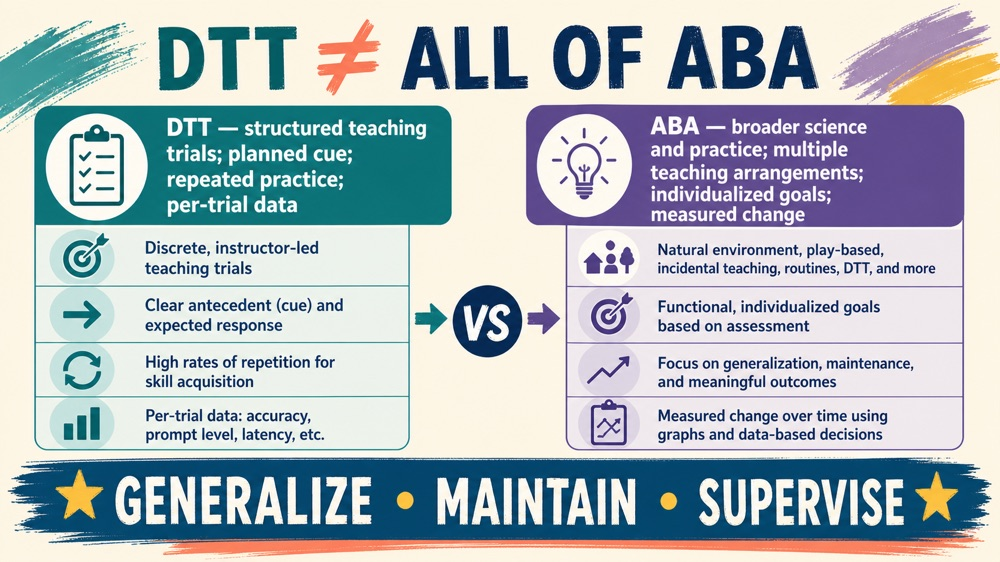
Discrete trial training ABA is a search phrase that often hides three different questions: What is DTT? How does one teaching trial work? And what should an RBT recognize or implement under a written program? DTT is a structured teaching method within applied behavior analysis, not a synonym for all ABA and not a universal script that every learner receives in the same way.
Table of Contents
- What discrete trial training ABA means for an RBT
- The DTT trial loop: cue, response, consequence, pause
- What happens before the trial
- Prompting, reinforcement, and error correction
- Collect data within the DTT program
- DTT and NET are not the same format
- Generalization and maintenance after DTT
- Connect DTT to the six current RBT domains
- Original RBT scenarios for DTT reasoning
- Common discrete trial training ABA mistakes
- Frequently Asked Questions
- References
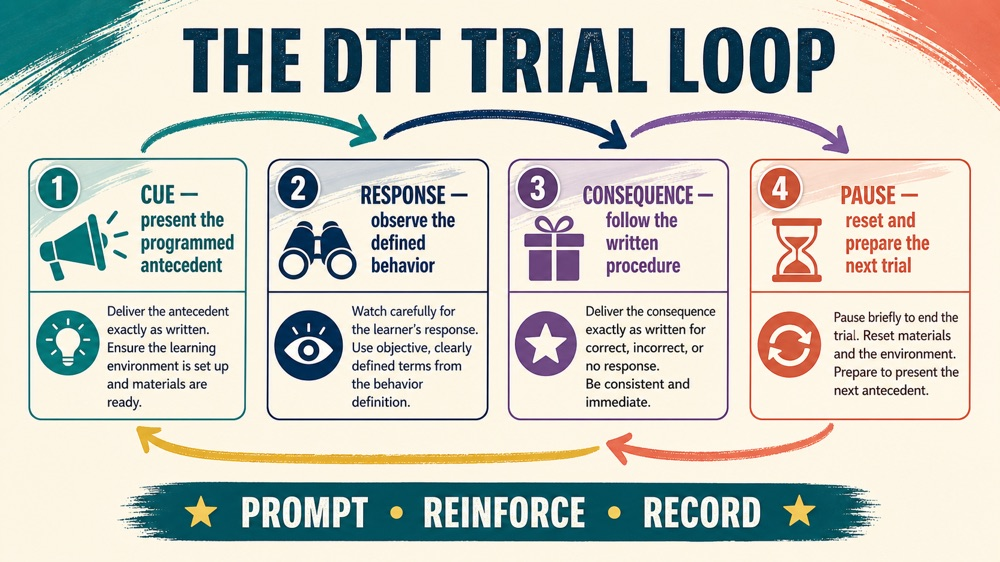
A generic DTT cycle can be described as a clear antecedent or cue, a learner response, a programmed consequence, and a brief inter-trial interval. The exact prompt hierarchy, error-correction procedure, reinforcement schedule, mastery criterion, data system, and pacing must come from the individualized program and supervision structure. The current RBT Test Content Outline, 3rd edition, describes 43 tasks across six domains; the current exam context includes 75 scored questions and 10 unscored pilot questions.
RBT Training is an independent educational resource. It is not affiliated with, operated by, or endorsed by the Behavior Analyst Certification Board (BACB). The examples below are newly written for independent study. They are not official, current, retired, recalled, leaked, or BACB-endorsed questions. This article is an educational overview, not individualized treatment advice, and no DTT description or practice score can guarantee a clinical or examination outcome.
What discrete trial training ABA means for an RBT
Discrete trial training is a structured teaching procedure that breaks a target skill into teachable learning opportunities. A practitioner arranges a clear stimulus or instruction, allows or helps the learner to respond, delivers the programmed consequence, and pauses or resets before the next opportunity. Repeated trials create frequent practice and per-trial data, but the method is only one possible component of a broader ABA program.
| Term | Meaning | Boundary to remember |
|---|---|---|
| ABA | A broad science and practice of applying behavior principles to socially important behavior and measuring change. | ABA includes multiple teaching and intervention arrangements, not only DTT. |
| DTT | A structured teaching method using bounded learning trials and programmed consequences. | DTT is within ABA; it is not the whole field. |
| Trial | A single teaching opportunity with a beginning, response opportunity, consequence, and transition. | The exact components depend on the written program. |
| RBT implementation | Carrying out an assigned procedure, recording data, and communicating observations under supervision. | An RBT does not independently design or change a clinical program. |
Some public pages describe DTT as cue, response, consequence, and pause; others divide the cycle into more steps by listing preparation, prompts, correction, or data. These descriptions can be compatible because they use different levels of detail. The important exam and practice question is not “Which internet diagram is the one true sequence?” It is “What does this program specify, what occurred, and what should the RBT do next?”
The DTT trial loop: cue, response, consequence, pause
Use the four-part loop as a study scaffold:
| Part | What it means | What to check |
|---|---|---|
| Antecedent or cue | The instruction, stimulus, or arranged event that signals the response opportunity. | Is it clear, presented as written, and appropriate for the target? |
| Response | The learner’s observable behavior after the cue, with or without the prescribed prompt. | Does the response meet the operational definition and scoring rule? |
| Consequence | The programmed event that follows the response, such as reinforcement, correction, or another plan-defined outcome. | Does it match the response and written procedure? |
| Inter-trial interval | A brief transition or pause before the next learning opportunity. | Is the next trial ready without rushing or adding unplanned demands? |
The loop is not a promise that every trial is identical. A learner may respond independently, need a prompt, make an error, pause, or show a safety concern. The plan may specify different consequences, prompt levels, or data codes for those events. The RBT’s responsibility is to recognize the relevant branch and implement it accurately, not to improvise a new branch because a generic diagram looks simpler.
What happens before the trial
Good DTT begins before the first instruction. Preparation supports procedural integrity, learner dignity, and reliable data:
- Read the current program: identify the target, materials, cue, prompt procedure, consequence, error correction, data code, and mastery or transition rule.
- Prepare materials: place stimuli and data sheets where they can be used consistently; remove irrelevant distractions when the plan calls for it.
- Check motivation and assent: follow the program’s reinforcement and choice procedures and notice communication that signals discomfort, refusal, or a need for support.
- Confirm the measurement: know whether the response is scored as independent, prompted, incorrect, no response, latency, or another plan-defined code.
- Ask before acting: if a target, prompt level, consequence, or safety step is unclear, contact the supervisor rather than inventing a procedure.
Preparation is not merely an efficiency step. If the data sheet is missing, the RBT may be tempted to reconstruct trials from memory. If the stimuli are inconsistent, a learner’s discrimination may be affected. If a plan is unclear, the technician may accidentally change the teaching arrangement. A short pre-session check protects both learning and documentation.
Prompting, reinforcement, and error correction
Prompting and reinforcement play different roles in a DTT trial. A prompt is assistance arranged to increase the likelihood of the correct response. Reinforcement is a consequence that increases future behavior under the relevant conditions. The same event should not be labeled by timing alone without considering the written program and the observed effect.
| Concept | Question | Common confusion |
|---|---|---|
| Prompt | What assistance was delivered to evoke the correct response? | Calling every helpful event reinforcement. |
| Prompt fading | How is assistance systematically reduced? | Removing prompts without following the stated fading plan. |
| Reinforcement | What consequence followed, and is future behavior increasing under the conditions? | Calling a preferred item a reinforcer without evidence of behavior change. |
| Error correction | What does the program say to do after an incorrect response or no response? | Using a favorite online script when the individualized plan says something else. |
Many DTT programs use a prompt hierarchy, immediate reinforcement for a correct response, and a defined correction sequence. The exact sequence may differ by goal and learner. An RBT should follow the written instruction, record the outcome, and bring repeated errors or unclear criteria to supervision. “Prompt until correct” is not a sufficient description if the program also specifies prompt level, transfer trial, delay, data code, or reinforcement condition.
For example: the cue is “match red,” the learner reaches toward blue, and the program says to use a model prompt followed by a transfer trial. The correct study answer is not simply “give the reward” or “repeat the instruction louder.” Identify the assigned correction, deliver it as written, score the response according to the program, and communicate if the learner is not responding to the prescribed support.
Collect data within the DTT program
DTT creates repeated, bounded opportunities, which can make per-trial data useful. But the data system still comes from the program. Common codes may distinguish independent correct, prompted correct, incorrect, no response, or other plan-defined outcomes. Do not change the code because a different one seems easier to calculate.
| Data question | What to identify | Why it matters |
|---|---|---|
| What is the target? | The operational definition and response criteria. | Prevents scoring a similar but non-target response. |
| What is the unit? | Trial, opportunity, latency, duration, percentage, or another specified measure. | Prevents a count from being mislabeled as a rate or percentage. |
| What counts as independent? | The program’s prompt boundary and response window. | Supports accurate mastery decisions. |
| What happens after a pattern? | The reporting or supervision rule for repeated errors, refusal, or safety concerns. | Keeps the RBT from changing the program independently. |
For another example: a learner completes 8 of 10 opportunities independently, 1 with a prompt, and 1 incorrectly. If the plan defines independent accuracy as correct without a prompt, the independent score is 80%, not 90%. A practice explanation should name the scoring rule and not count every correct-looking response as independent.
DTT and NET are not the same format
Natural environment teaching (NET) and DTT can both use antecedents, responses, consequences, prompting, reinforcement, and data. The difference is the arrangement and context of teaching opportunities. DTT typically arranges more bounded, adult-led trials around a defined target. NET embeds learning in naturally occurring activities, motivations, materials, or routines. A program may use one, the other, or a blend.
| Feature | Structured DTT example | Naturalistic teaching example |
|---|---|---|
| Opportunity | The instructor presents a planned cue with selected stimuli. | A communication opportunity arises during play or a routine. |
| Response target | A narrowly defined response is scored per trial. | The target is practiced within a broader activity. |
| Consequence | The program specifies the consequence after the response. | The natural activity or programmed consequence follows within the plan. |
| Data | Often recorded per opportunity or trial. | Recorded using the system specified for the activity. |
DTT is not automatically better because it produces many trials, and NET is not automatically better because it feels more natural. The appropriate arrangement depends on the target, learner, program, context, and clinical decision. An RBT implements the assigned arrangement and shares observations; the RBT does not switch formats simply to make a session easier.
Generalization and maintenance after DTT
A learner can perform a response during a highly structured trial without yet using it with different people, materials, instructions, or settings. Generalization programming deliberately changes relevant features while preserving the target. Maintenance checks whether the skill continues over time or when teaching support changes.
- Across people: practice with the staff or caregivers identified by the program.
- Across materials: vary exemplars without changing the response definition accidentally.
- Across settings: move from the teaching area to relevant routines when the plan calls for it.
- Across instructions: use varied but equivalent cues only when written into the program.
- Across time: check performance after a delay or reduced teaching density as specified.
Do not assume that generalization happens automatically because the learner reached a mastery criterion in one arrangement. Record the conditions under which performance occurred and report when a skill does not transfer. That observation can be clinically valuable without authorizing the RBT to rewrite the target or reinforcement plan.
Connect DTT to the six current RBT domains
DTT is most directly associated with Behavior Acquisition, but an RBT question can test several connected domains:
| Domain | DTT connection | Study question |
|---|---|---|
| A. Data Collection and Graphing | Score trial outcomes and summarize the specified measure. | What response, unit, and data code are required? |
| B. Behavior Assessment | Implement assigned assessment or preference procedures before selecting teaching conditions. | What is observed, and what conclusion requires supervision? |
| C. Behavior Acquisition | Use prompting, fading, shaping, chaining, reinforcement, maintenance, and generalization as written. | Which teaching step and consequence match the program? |
| D. Behavior Reduction | Follow any plan-defined response to problem behavior, safety issue, or replacement-skill goal. | What does the written plan direct, and what must be reported? |
| E. Documentation and Reporting | Record trials, prompts, errors, context, and communication objectively. | Could another professional verify the note? |
| F. Ethics | Protect dignity, assent, privacy, competence, supervision, and data integrity. | Is the action respectful, authorized, and within role? |
The current outline contains 43 tasks across these six domains. Use the map to study DTT as a connected implementation skill rather than memorizing a single four-word sequence.
Original RBT scenarios for DTT reasoning
Use this five-step method for original practice prompts:
- Identify the target: what observable response is the program teaching?
- Locate the trial component: cue, response, consequence, pause, prompt, correction, or data.
- Mark the controlling detail: independent versus prompted, correct versus incorrect, plan says, or safety issue.
- Choose the plan-based action: implement, record, communicate, or pause for guidance.
- Explain the distractor: state which boundary it violates or ignores.
A scenario should not require guessing a hidden diagnosis or inventing an unprovided treatment plan. If the stem does not tell you the prompt level or correction procedure, the safe question may be whether to check the written plan or contact the supervisor. That is not avoiding the concept; it is recognizing the role boundary.
Common discrete trial training ABA mistakes
- Calling DTT all of ABA: DTT is one structured teaching method within a broader field.
- Memorizing a universal script: the generic trial loop is a scaffold; prompts, correction, reinforcement, and mastery follow the program.
- Confusing prompt and reinforcement: assistance that evokes a response is not the same as a consequence that changes future behavior.
- Counting prompted responses as independent: use the program’s scoring rule.
- Skipping the inter-trial transition: pacing, materials, and learner readiness affect procedural integrity.
- Ignoring generalization: performance at a teaching table does not prove transfer across people, materials, or settings.
- Changing the plan mid-session: document the concern and ask for supervision.
- Making a treatment promise: DTT descriptions do not guarantee a particular learner or exam outcome.
Bottom line: Learn discrete trial training ABA as a structured teaching method with a clear trial loop and individualized implementation rules. Connect the cue, response, consequence, pause, prompting, data, generalization, documentation, and ethics to the current RBT TCO. Then practice recognizing the controlling clue and choosing the plan-based, supervised action rather than copying an internet script.
Ready to practice the trial loop?
Use original current-domain practice questions to identify the cue, response, consequence, data rule, and role-safe next step.
Try Free RBT Practice Questions →
Frequently Asked Questions
What is discrete trial training ABA?
Discrete trial training is a structured teaching method within applied behavior analysis. A generic trial includes a cue or antecedent, a learner response, a programmed consequence, and a brief transition before the next opportunity.
Is DTT the same as ABA?
No. DTT is one teaching method within ABA. ABA is broader and can include naturalistic teaching, chaining, shaping, prompting, behavior-reduction procedures, and other evidence-based arrangements.
What does an RBT do during DTT?
An RBT implements the assigned procedure, presents materials and cues as written, uses the prescribed prompts and consequences, records data, protects dignity and privacy, and communicates uncertainty or patterns to the supervisor.
What are the main parts of a DTT trial?
A useful study scaffold is cue or antecedent, response, consequence, and inter-trial interval. A specific program may add preparation, prompt levels, error correction, transfer trials, data codes, or other steps.
Does DTT automatically generalize skills?
No. Generalization and maintenance should be planned and measured across relevant people, materials, settings, instructions, or time. Follow the written program and report observations.
Can DTT guarantee an RBT exam or treatment result?
No. A DTT method, practice question, or study article cannot guarantee a clinical outcome, certification, or passing result.
References
- Behavior Analyst Certification Board. RBT Test Content Outline, 3rd edition.
- Behavior Analyst Certification Board. RBT Test Content Outline, 3rd-edition PDF.
- Behavior Analyst Certification Board. RBT Handbook.
- Indiana University Bloomington, Indiana Resource Center for Autism. Discrete Trial Teaching: What is it?.
- Children’s Hospital of Philadelphia. Discrete Trial Training.
- National Professional Development Center on Autism Spectrum Disorders. Discrete Trial Training evidence-based practice brief.
- LaMarca et al. Teaching Receptive Discriminations to Children with Autism. Reviewed for research context.