
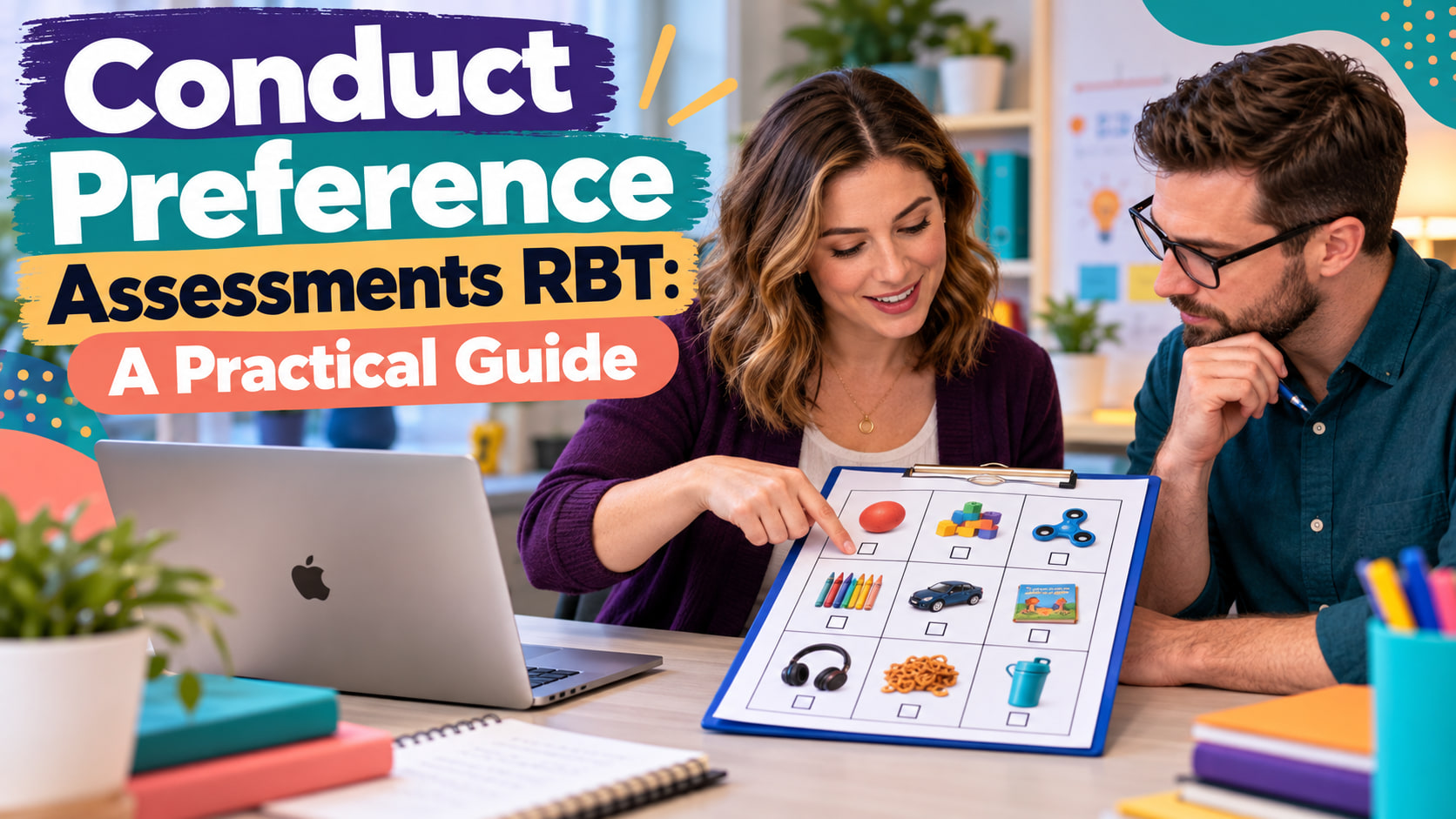
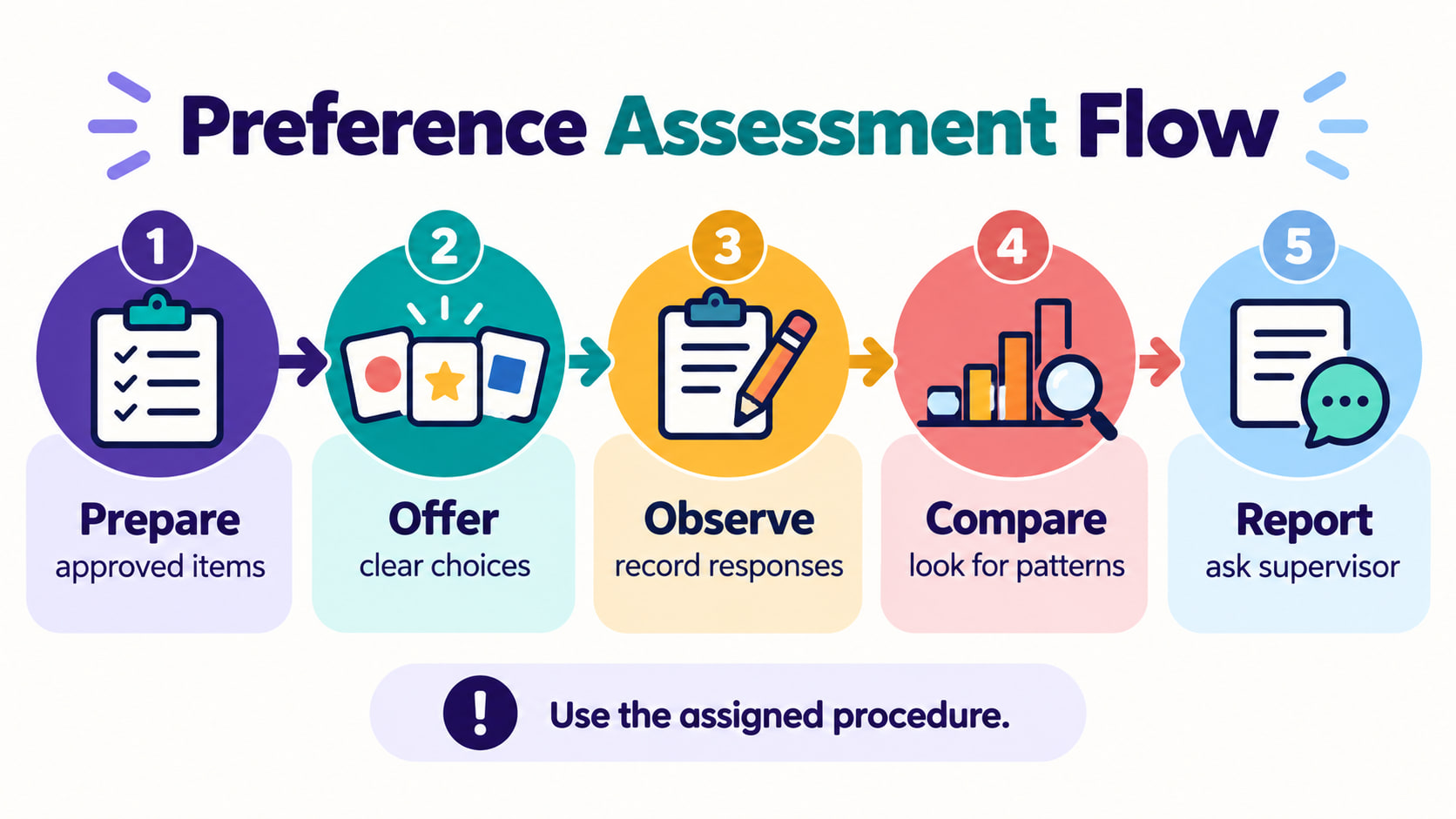
To conduct preference assessments RBT professionals follow the assigned procedure, prepare approved choices, observe responses, record objective information, and report patterns to the supervisor.
Table of Contents
- How to conduct preference assessments RBT teams use
- Prepare the assessment
- Offer choices consistently
- Observe and record responses
- Compare patterns carefully
- Report and protect information
- Common mistakes to avoid
- Frequently asked questions
- References
RBT KNOWLEDGE · PREFERENCE ASSESSMENT
Conduct Preference Assessments RBT: A Practical Guide
A clear framework for preparing choices, observing responses, recording information, and reporting patterns.
To conduct preference assessments RBT professionals follow the assigned procedure, prepare approved choices, observe responses, record objective information, and report patterns to the supervisor. The process helps a service team learn what a person may select or approach under particular conditions. It does not make a preferred item a guaranteed reinforcer in every situation.
Procedures vary. A supervisor or qualified professional determines which assessment is appropriate, how it is arranged, what safety considerations apply, and how results should inform programming. This guide explains the decision structure for learning purposes; it does not replace the current plan, training, supervision, or setting-specific instructions.
How to conduct preference assessments RBT teams use
A preference assessment creates a structured opportunity to observe choices. The team may present one item, a small array, or a sequence of options according to an assigned protocol. The important point is not simply asking “What do you like?” It is arranging the approved opportunity, defining what counts as a response, and recording what happened.
Preference is also contextual. An item selected at one time may not be selected later. Hunger, fatigue, novelty, access, competing activities, social context, and the way choices are presented can affect responding. That is why an RBT reports observations rather than declaring that an item will always function the same way.
Prepare the assessment
Start by reviewing the assigned instructions with the supervisor or responsible trainer. Confirm the purpose, materials, number of choices, response definition, recording method, session location, timing, and safety or accessibility requirements. Ask what to do if an item is unavailable, damaged, refused, or associated with a concern.
Prepare only approved items and materials. Check that choices are safe, usable, and presented in a way the person can access. Keep the environment uncluttered enough to see the response. If food, equipment, mobility, allergies, or other risks are involved, follow the current plan and ask before making an adjustment.
Offer choices consistently
Consistency makes the observation more interpretable. Use the assigned wording, distance, order, access time, and prompt level. If the protocol requires rotating positions, rotate them as instructed. Do not make one item more attractive by adding extra attention, describing it enthusiastically, or allowing longer access unless the procedure says to do so.
Choice means the person has a meaningful opportunity to respond. Avoid treating a reach, glance, touch, vocalization, or approach as a choice unless the assigned procedure defines it that way. If the response is unclear, record the uncertainty according to the system and ask how it should be handled.
Do not force a selection. A refusal, no response, or movement away may be meaningful information. Follow the protocol for ending a trial or re-presenting an option. If a person shows distress or a safety issue, follow the urgent procedure rather than continuing for the sake of completing a data sheet.
Observe and record responses
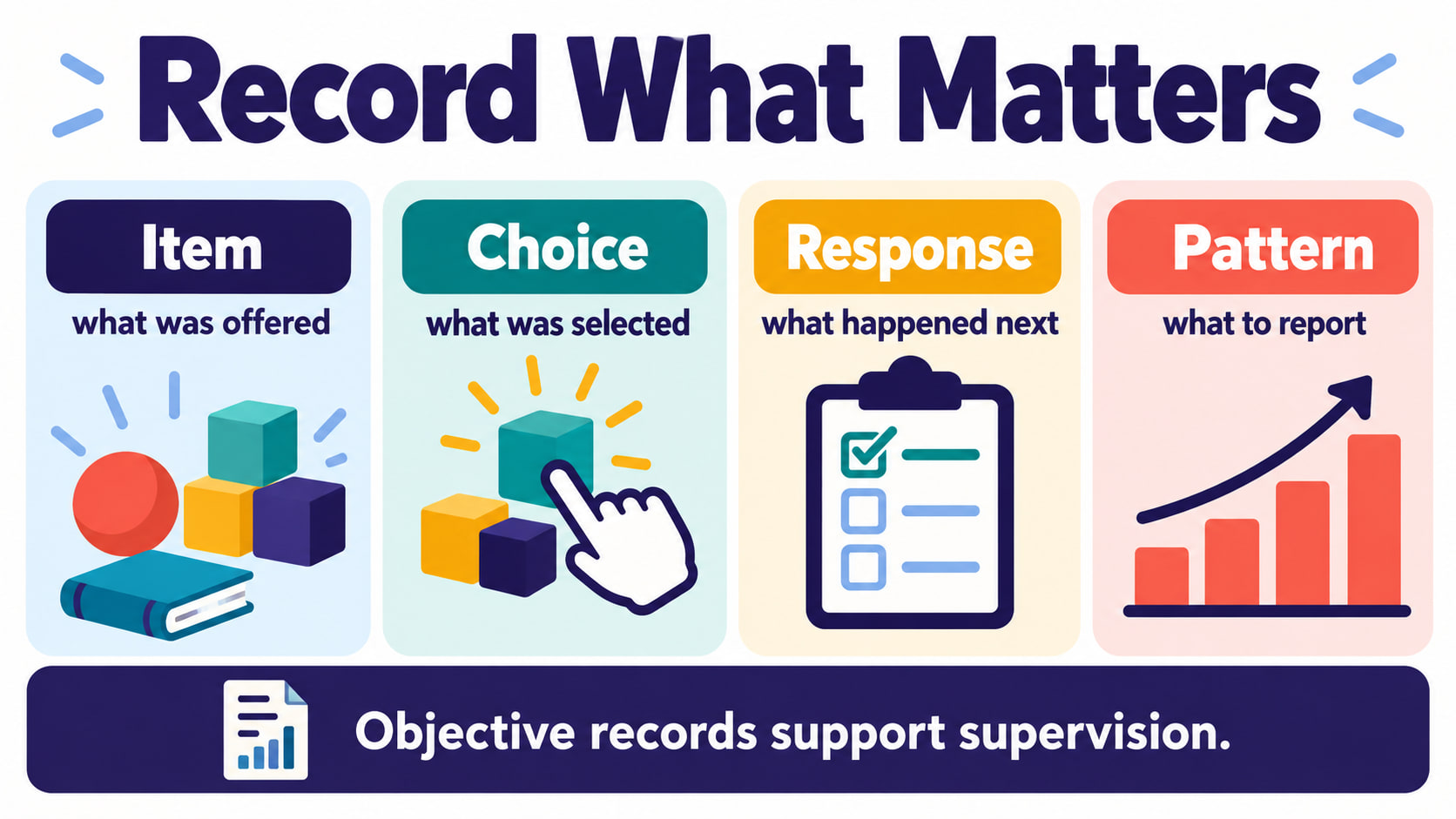
Good recording describes what occurred without adding an unsupported explanation. Depending on the assigned system, note which item was selected, how quickly a response occurred, whether the item was approached or rejected, what happened after access, and any required trial information. Use the exact fields in the form or system.
Separate “selected the blue block” from “wanted attention.” The first is an observable description; the second may be a hypothesis that requires more information. Objective notes make it easier for a supervisor to interpret the result and identify whether the procedure should be repeated or changed.
Record promptly. Relying on memory can blur the order of choices or combine two responses. Check the case identifier, date, time, and required session fields before saving. If you make an error, use the approved correction process rather than hiding it or creating an untracked replacement record.
Compare patterns carefully
A result is more useful when the team can see a pattern across the assigned trials or sessions. Compare the recorded responses using the method provided by the supervisor. Do not calculate a new score, rank items, or change the number of trials just because a pattern looks interesting.
Ask what the data support and what they do not support. A high selection rate may show repeated choice under those conditions; it does not prove the item will maintain behavior, work as reinforcement, or be preferred in another context. Report unusual variability, missing trials, equipment problems, or changes in access because those details may affect interpretation.
Report and protect information
Share the result through the approved record and supervision route. A concise report can state the procedure used, the response definition, the observed pattern, any deviations, and the question that needs direction. Avoid turning a preliminary observation into a recommendation that you are not authorized to make.
Protect the person’s information. Do not photograph a choice board with identifying details, post a data sheet in a group, or use a distinctive case story as a public example. Use approved systems and fictional examples for training. If information is sent to the wrong place or a record is lost, follow the setting’s incident and escalation process promptly.
Common mistakes to avoid
- Changing the protocol: adding prompts or extra access without checking the assigned procedure.
- Over-interpreting a choice: treating one selection as proof of a stable preference or reinforcer.
- Recording guesses: writing an interpretation instead of the observable response.
- Forcing participation: ignoring refusal, distress, or safety instructions to finish a trial.
- Skipping context: omitting unavailable items, unusual events, or deviations that affect the observation.
- Sharing casually: moving a private record into personal messaging, social media, or an unapproved training file.
The most reliable habit is to pause at each stage: prepare the approved materials, offer them consistently, observe the defined response, record what happened, and report the pattern with its limits. When the next step is unclear, ask the supervisor instead of inventing a new procedure.
Frequently asked questions
Can an RBT choose any preference assessment?
No. The responsible supervisor or qualified professional directs the assessment selection and procedure. The RBT follows the assigned instructions and asks when the plan is unclear.
Does choosing an item prove it is a reinforcer?
No. Selection indicates a preference under the observed conditions. Reinforcement effects require the assigned plan, further observation, and appropriate interpretation.
What should be recorded?
Record the fields required by the assigned system, such as the item offered, response, trial information, access, and relevant deviations. Describe observable events rather than guessing motivation.
What if the person refuses?
Follow the current protocol and safety guidance. Record the response as required, do not force a choice, and report the concern or uncertainty to the supervisor.
Source note: Review current BACB materials, the assigned plan, organizational policy, approved systems, and supervisor direction for your setting. This article is educational and does not provide individualized legal, clinical, employment, or credentialing advice.
Ready to practice the RBT concepts you just reviewed?
Try an independent, original RBT practice resource with exam-style questions, scoring, and answer explanations.
References
- Behavior Analyst Certification Board. RBT Test Content Outline, 3rd edition.
- Behavior Analyst Certification Board. RBT Handbook.
- Behavior Analyst Certification Board. RBT Ethics Code.