
Behavior data collection methods become clearer when you define the event, match the method to the question, record at the required moment, and report unusual or missing data.
Table of Contents
- How to use behavior data collection methods
- Count and frequency
- Duration and latency
- Interval methods
- Protect data quality
- Report patterns and concerns
- Common collection mistakes
- Frequently asked questions
- References
RBT KNOWLEDGE · DATA COLLECTION
Behavior Data Collection Methods: RBT Guide
How to match a measurement question to an assigned method and record information consistently.
Behavior data collection methods become clearer when you define the event, match the method to the question, record at the required moment, and report unusual or missing data. In an RBT role, the assigned operational definition and measurement system are the starting point. The supervisor or qualified professional directs selection and changes for a client-specific plan.
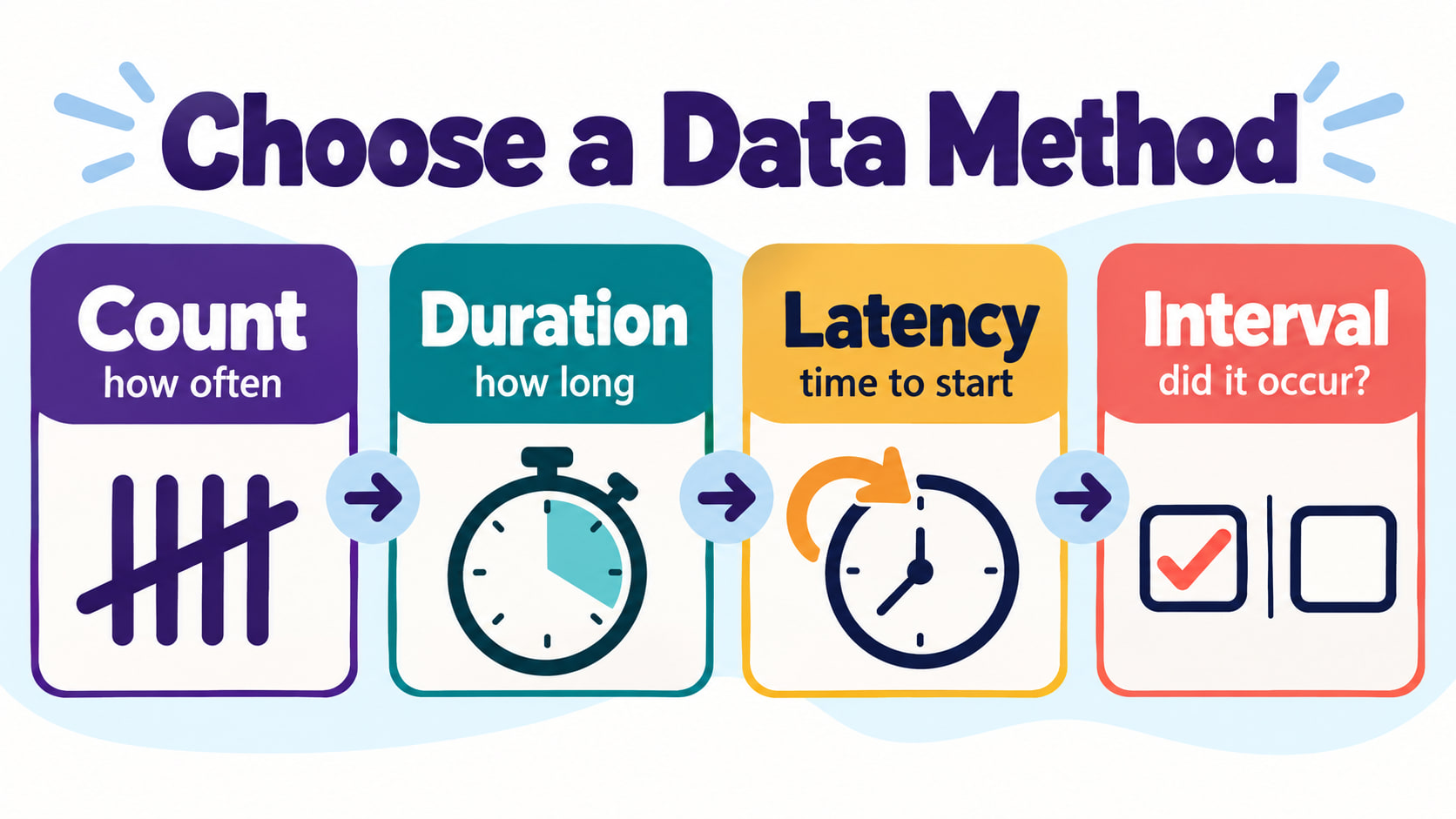
Different methods answer different questions. Counting events does not answer how long one event lasted. Measuring latency does not answer how often a response occurred. Interval recording can summarize whether an event appeared during time segments, but it does not mean the same thing as a direct count. The method must fit the question and the definition.
How to use behavior data collection methods
Before recording, ask what the team needs to know. Is the target about how often a response occurs, how long it lasts, how quickly it begins, or whether it appears during a defined interval? Check the assigned plan for the behavior definition, start and stop rules, recording window, materials, and required fields.
A good operational definition makes the method usable. “Leaves the area” is not enough if different observers would disagree about the area, the distance, or when the event starts. The assigned definition should specify what counts and what does not. If the definition or method is unclear, ask before collecting data rather than creating a private rule.
Count and frequency
Count records how many times a defined response occurs. Frequency is often useful when opportunities and observation time are comparable. If session lengths differ, the team may need a rate or another summary according to the assigned system. Do not silently compare raw counts from very different observation windows.
Counting requires a clear response boundary. Decide whether repeated movements are one event or several according to the operational definition. Use the approved tally, counter, or electronic field, and record at the time required. If two responses overlap or the event is ambiguous, follow the instruction for uncertain observations and report the issue.
Duration and latency
Duration measures how long a defined event lasts. It requires a clear start and stop. Latency measures the time between a specified cue or instruction and the beginning of the response. These methods both use time, but they answer different questions. A long duration is not a long latency, and a quick start does not show how long the response continued.
Use the timer or system specified by the plan. Avoid estimating after the fact when precise timing is required. If an interruption, device problem, or competing event affects the timing, document it as directed. Do not change start or stop rules because a trial feels difficult to time.
Interval methods
Interval methods divide an observation into defined periods and record whether a response occurred according to the assigned rule. Depending on the system, the record may ask whether behavior occurred at any point, throughout an interval, or at a particular moment. These distinctions affect how the data should be understood.
Keep the interval length, observation window, and recording prompt consistent. A missed timer signal or a late entry can create a gap that should be reported rather than filled with a guess. The supervisor determines how to handle missing segments, unusual conditions, or a change in the environment.
Protect data quality
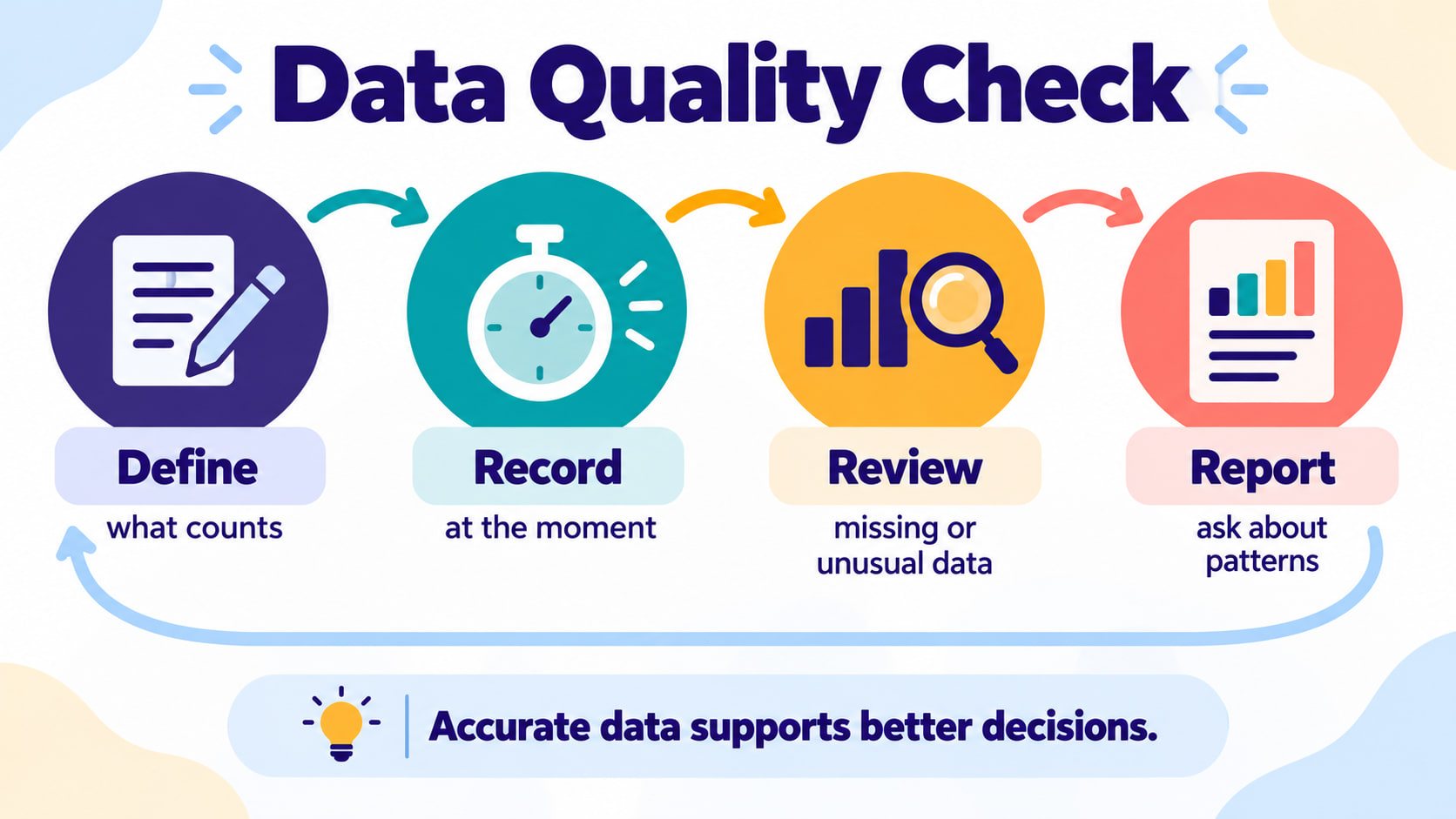
Data quality begins before the session. Review the definition, check the recording tool, confirm the case and date, and understand the observation period. During the session, record at the required moment and avoid adding interpretations to the raw record. Afterward, check for missing fields, impossible values, wrong identifiers, and deviations that need follow-up.
Objective recording does not mean pretending that conditions were perfect. Note interruptions, unavailable materials, unusual events, or changes made under direction. A transparent record gives the supervisor better information than a neat sheet that hides uncertainty.
Report patterns and concerns
An RBT records and communicates; the RBT does not independently redesign the measurement system. Report repeated missing data, unclear definitions, equipment problems, changes in session length, or a pattern that seems inconsistent with the procedure. State what was observed and what question needs direction.
Protect privacy when sharing data. Use approved systems, accounts, and recipients. Do not photograph a data sheet for a personal message, post a graph with identifying details, or use a distinctive case in a public example. If information is sent to the wrong place, follow the organization’s incident and escalation route.
Common collection mistakes
- Using the wrong method: counting is recorded when the question is about duration or latency.
- Changing the definition: the observer adds a personal rule instead of asking for clarification.
- Comparing unlike windows: raw counts are compared even though observation times differ.
- Filling gaps from memory: missing entries are guessed rather than reported.
- Adding interpretation: a data field records what the observer thinks instead of what occurred.
- Changing the plan independently: a difficult method is replaced without supervisor direction.
A reliable habit is simple: define what counts, choose the assigned method, record at the required moment, review the entry, and report what needs attention. This process supports supervision and makes the data more useful without asking the RBT to make decisions outside the role.
Frequently asked questions
Which behavior data collection method is best?
There is no universal best method. The assigned supervisor or qualified professional matches the method to the operational definition, question, setting, and plan.
Are frequency and duration the same?
No. Frequency concerns how many defined events occur, while duration concerns how long an event lasts. Follow the exact system assigned for the target.
What if I miss an observation or timer signal?
Follow the correction or missing-data procedure and report the issue. Do not fill the gap with an estimate unless the assigned protocol explicitly permits it.
Can an RBT change the measurement method?
Do not change a client-specific method independently. Ask the supervisor about unclear definitions, feasibility problems, or repeated data-quality concerns.
Source note: Review current BACB materials, the assigned plan, organizational policy, approved systems, and supervisor direction for your setting. This article is educational and does not provide individualized legal, clinical, employment, or credentialing advice.
Ready to practice the RBT concepts you just reviewed?
Try an independent, original RBT practice resource with exam-style questions, scoring, and answer explanations.
References
- Behavior Analyst Certification Board. RBT Test Content Outline, 3rd edition.
- Behavior Analyst Certification Board. RBT Handbook.
- Behavior Analyst Certification Board. RBT Ethics Code.