
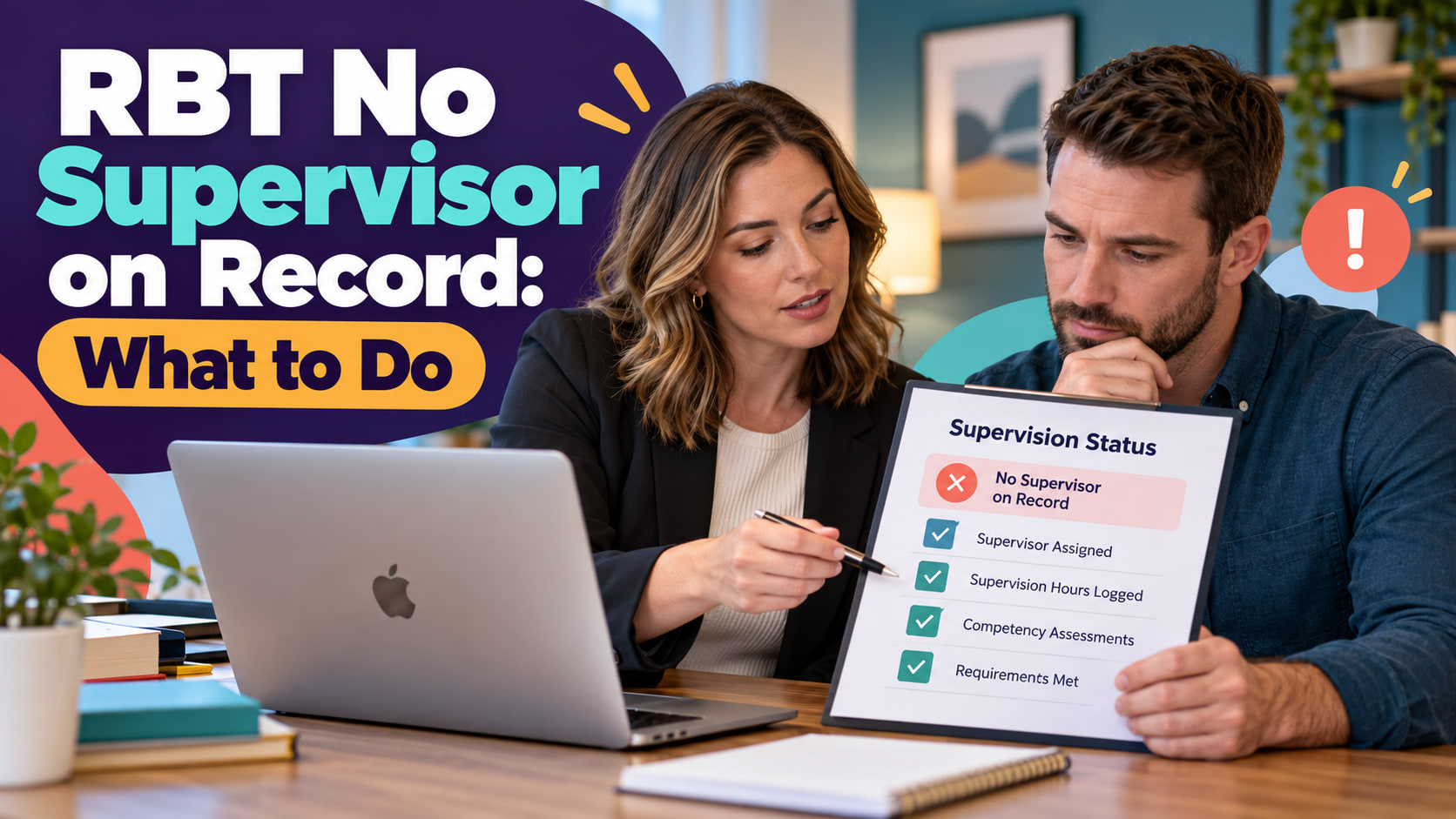
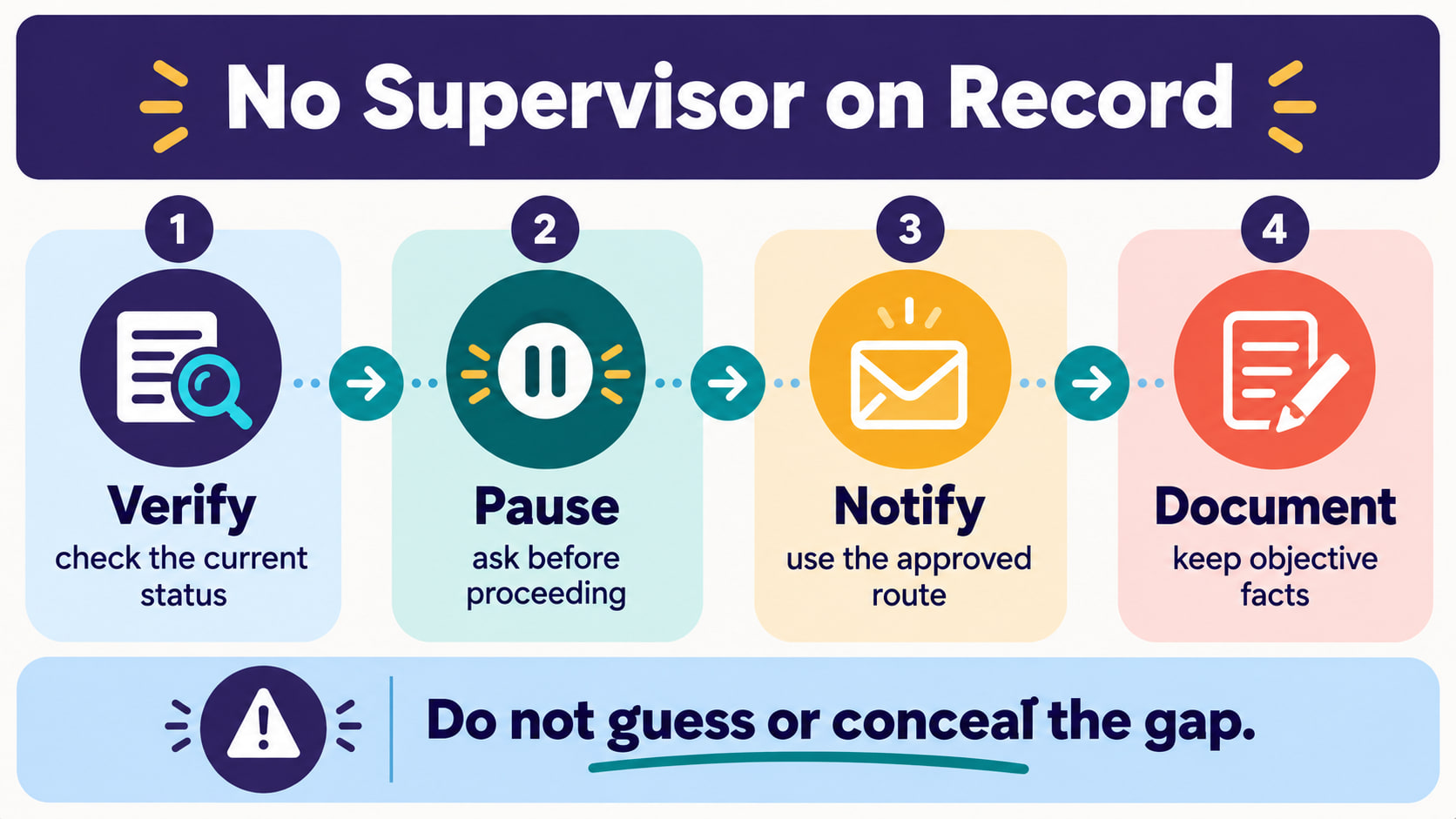
RBT no supervisor on record situations call for verifying the current status, pausing before working outside the approved route, notifying the responsible contact, and documenting objective facts.
Table of Contents
- What an RBT no supervisor on record notice means
- Verify the current status
- Pause before proceeding
- Notify through the approved route
- Document objective facts
- Ask a focused follow-up question
- Common mistakes to avoid
- Frequently asked questions
- References
RBT SUPERVISION · STATUS CHECK
RBT No Supervisor on Record: What to Do
A practical sequence for verifying status, pausing safely, notifying the right contact, and documenting facts.
RBT no supervisor on record situations call for verifying the current status, pausing before working outside the approved route, notifying the responsible contact, and documenting objective facts. A blank field, missing name, or system delay does not by itself explain what happened. It is a signal to check the current process.
This article is general education. Current official materials, employer systems, the service setting, and the responsible organization determine the applicable steps. Do not treat a general checklist as an individualized credentialing, employment, clinical, or legal decision.
What an RBT no supervisor on record notice means
A missing supervisor record can have several explanations: an assignment has not been entered, a record is still processing, a role changed, an account is displaying incomplete information, or the wrong system or identifier was used. The right first action is verification, not assumption.
Separate the administrative question from the work question. You may need to know who is responsible for supervision, whether an assignment is active, and which activities are approved while the status is checked. Those questions may have different answers. Keep following known safety, privacy, and workplace procedures while seeking direction.
Verify the current status
Check the system, record, or communication channel the organization identifies as authoritative. Confirm the account, case, date, and status rather than relying on a screenshot or a message from an unknown source. Look for a recent update, pending assignment, contact name, or instruction about what to do when the field is blank.
Use a small verification note: what system you checked, when you checked it, what the screen or record showed, and what information was missing. Do not change the record simply to make the status look complete. If you find a mismatch, preserve the facts and use the correction or escalation process.
Pause before proceeding
Pause activities that require supervisor direction when you cannot confirm who is responsible or which procedure applies. This does not mean abandoning a person or ignoring an urgent safety issue. Follow the setting’s immediate safety route, then ask the responsible contact how to proceed with routine work.
Do not invent a supervisor, backdate an assignment, use someone else’s name, or assume that a previous supervisor remains responsible. Do not independently modify a behavior plan, create a new clinical procedure, or represent that supervision occurred when it did not. A temporary pause protects the record while the organization resolves the status.
Notify through the approved route
Use the organization’s designated supervisor, administrator, compliance, credentialing, or support contact. A workplace may have a different route from a certification system. Ask which route applies and whether the notification should be made by you, your employer, or another responsible person.
Keep the message concise and privacy-aware. State that the record does not show a supervisor, identify the system and time checked, explain what activity is waiting for direction, and ask for the next approved step. Do not include unnecessary client details in a general administrative request.
Document objective facts
Record the status check and response in the approved place. Include dates, times, channels, names or roles when necessary for the authorized recipient, and the instruction received. Keep the tone factual: “The supervision field was blank at 9:10 a.m.; I contacted the designated coordinator and was told to pause routine work pending confirmation.”
Protect confidentiality while documenting. Store the note in an approved account or system, limit the audience, and follow retention or correction instructions. If you sent information to the wrong person or cannot access the record, report that through the incident route rather than creating multiple untracked copies.
Ask a focused follow-up question
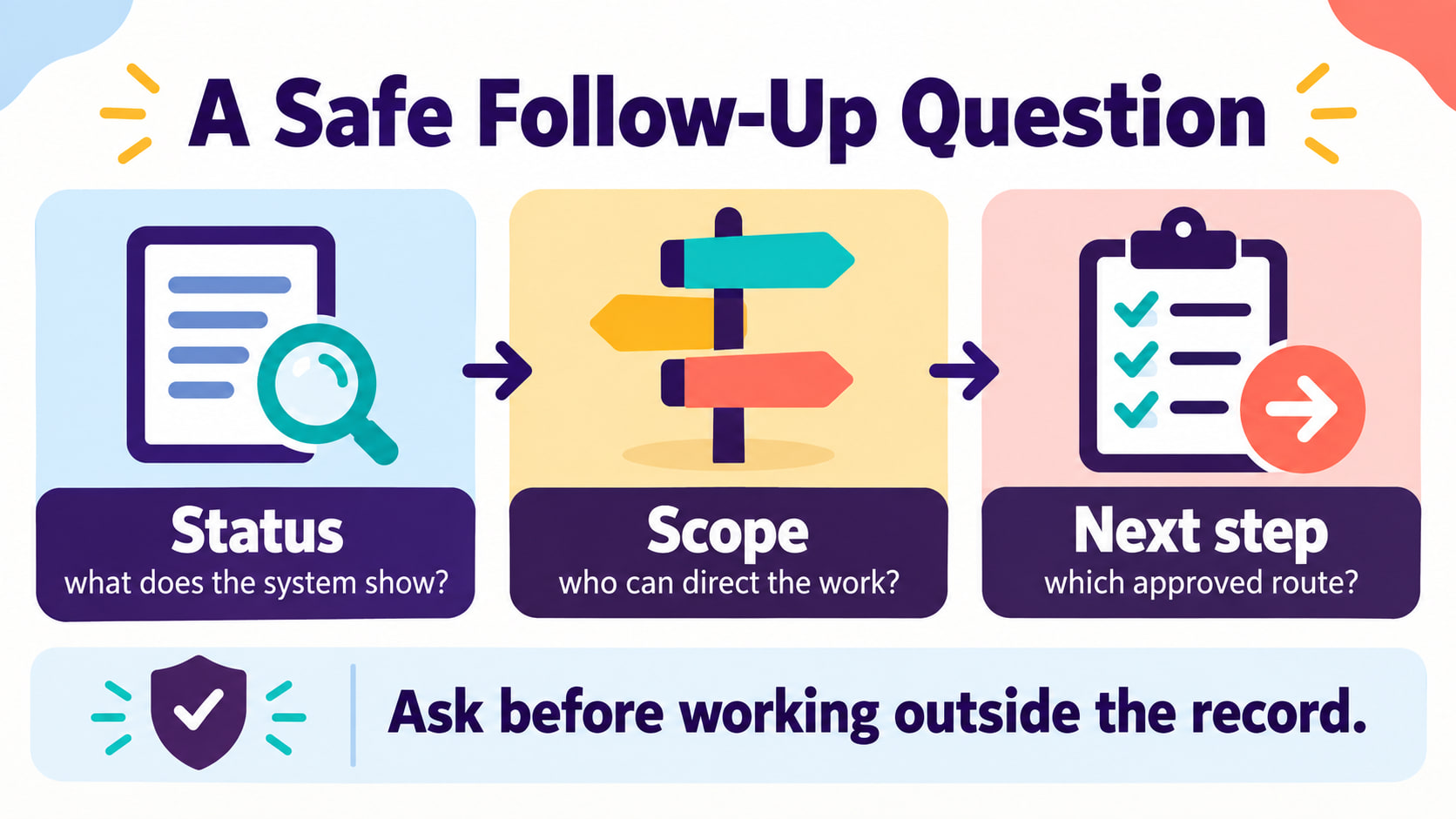
A useful question includes status, scope, and next step. Ask: “What does the current system show?” “Who is authorized to direct this work?” and “Which approved route should I use while the record is corrected?” This avoids turning uncertainty into a broad argument about what you think should be true.
Keep working within confirmed instructions. If the response is unclear, ask for written direction or a named contact. If there is an immediate safety concern, use the urgent process rather than waiting for a routine reply. The aim is a clear handoff, not a private workaround.
Common mistakes to avoid
- Assuming the blank field is harmless: a missing record needs verification.
- Continuing without direction: routine work outside a confirmed route can create a larger problem.
- Backdating or editing: never make the system appear complete without an authorized correction.
- Using a personal channel: administrative urgency does not remove privacy or security requirements.
- Over-sharing: include only the information the recipient needs.
- Hiding the gap: an honest status check is safer than an unsupported claim that supervision occurred.
A missing supervisor record is a status problem to route, not a puzzle to solve alone. Verify the source, pause where direction is required, notify the right contact, document facts, and follow the organization’s next instruction. That sequence protects the learner, the service team, the record, and the person receiving services.
Frequently asked questions
Does no supervisor on record automatically mean an RBT cannot work?
Not necessarily. The correct response depends on the current system, organization, role, and applicable requirements. Verify the status and ask the responsible contact before making a decision.
Should I add a supervisor’s name myself?
No. Use the authorized assignment or correction process. Do not backdate, guess, or use another person’s name without direction.
Who should I contact?
Use the designated supervisor, administrator, credentialing contact, compliance route, or system support specified by your organization. Ask which route applies to the issue.
What should I document?
Document the system checked, date and time, status shown, contact or route used, direction received, and unresolved question. Keep the record objective and privacy-aware.
Source note: Review current BACB materials, organization policy, approved systems, applicable requirements, and supervisor or administrator direction for your setting. This article is educational and does not provide individualized legal, clinical, employment, or credentialing advice.
Ready to practice the RBT concepts you just reviewed?
Try an independent, original RBT practice resource with exam-style questions, scoring, and answer explanations.
References
- Behavior Analyst Certification Board. RBT Test Content Outline, 3rd edition.
- Behavior Analyst Certification Board. RBT Handbook.
- Behavior Analyst Certification Board. RBT Ethics Code.