

This RBT professional development in service checklist helps organize a training need, learning goal, activity record, evidence, and next review without treating one checklist as a universal certification rule.
Table of Contents
- What the RBT professional development in service checklist is for
- Choose a real learning need
- Set a useful learning goal
- Plan and complete the activity
- Build the training record
- Review learning and next steps
- Common documentation mistakes
- Frequently asked questions
- References
RBT PROFESSIONAL DEVELOPMENT · TRAINING RECORDS
RBT Professional Development In Service Checklist
A simple workflow for choosing a need, completing learning, saving evidence, and planning the next review.
This RBT professional development in service checklist helps organize a training need, learning goal, activity record, evidence, and next review without treating one checklist as a universal certification rule. Professional development can be useful when it responds to the actual work an RBT performs, clarifies a skill, and creates a record that the responsible organization can understand.
Before counting an activity toward any credential, employer program, or recertification requirement, check current official materials and organizational instructions. A completed slide deck, attendance record, or certificate may show participation, but it does not automatically establish that a specific requirement has been met.
What the RBT professional development in service checklist is for
A checklist turns a broad intention such as “I need more training” into a traceable process. It can help an RBT and supervisor agree on the topic, the reason for the activity, the expected learning, the provider or source, and the evidence to retain. It also creates a point for reviewing whether the learning should change practice, prompt another consultation, or lead to a new goal.
Keep the checklist proportionate. It should support learning, not create a second clinical record or collect unnecessary client information. Use approved systems and follow privacy, retention, and employer policies for any documentation.
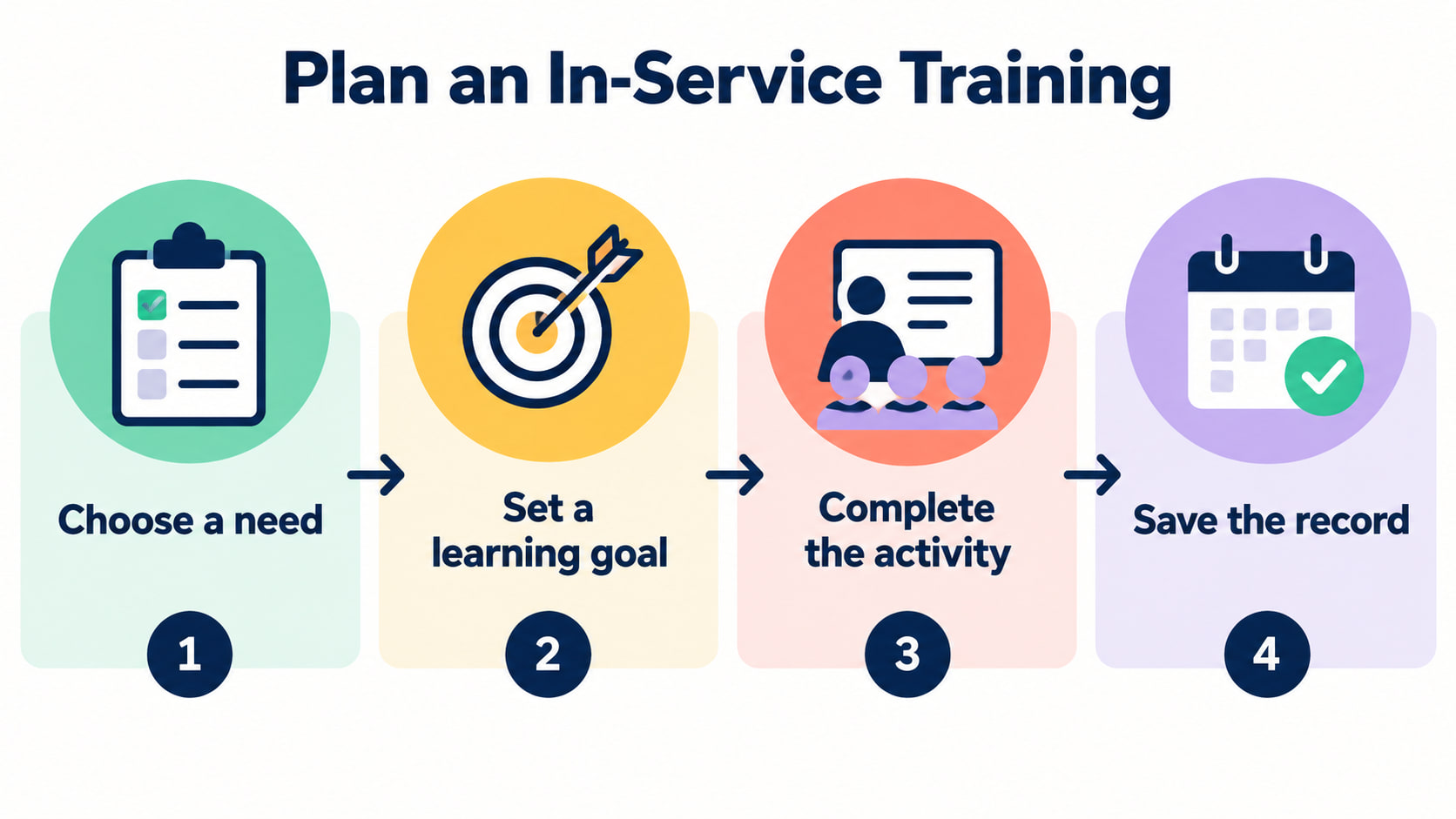
Choose a real learning need
Start with a specific need connected to the RBT’s role. The need might come from a supervisor’s feedback, a new procedure, a recurring documentation question, a change in the service setting, or a skill the RBT wants to understand more clearly. Avoid choosing a topic only because its title sounds impressive or because someone says it will definitely count for credit.
Write the need in observable terms. “I need to understand how to record a prompting change according to our current plan” is more useful than “I need advanced ABA knowledge.” The first statement points toward a learning activity and a later review. If client information is relevant, use a de-identified description and the smallest amount of detail needed.
- What task, concept, or process needs clarification?
- What prompted the need?
- Who can confirm the scope of the question?
- What current policy, plan, or official material should be checked?
Set a useful learning goal
A learning goal should describe what the RBT will be able to explain, identify, practice, or locate after the activity. Use one or two verbs that can be checked. For example: “After the session, I can identify the approved data fields used for this procedure and explain when to ask the supervisor for clarification.”
Do not promise an outcome that the activity cannot support. A short in-service may introduce a concept or rehearse a process; it may not independently establish clinical competence. The supervisor or responsible organization determines whether additional observation, feedback, assessment, or authorization is needed.
Plan and complete the activity
Record the activity type, date, estimated duration, provider or presenter, learning materials, and delivery method. The activity might be a staff training, a guided discussion, an approved course, a reading review, a demonstration, or a supervised practice opportunity. Use the organization’s terminology and confirm whether a particular format is permitted.
During the activity, capture learning evidence rather than copying large blocks of content. Evidence could be a short reflection, completed knowledge check, practice result, supervisor feedback, or list of questions resolved. Do not include confidential client details in a personal file or distribute training materials in a way that violates copyright or policy.
If the activity reveals uncertainty, record the question and the follow-up route. A good training record can show that the RBT recognized a limit and sought appropriate guidance; it does not need to pretend that every issue was solved in one session.
Build the training record
A useful record usually answers five questions: What was the topic? When did it happen? Who provided or approved it? What evidence shows participation or learning? What should be reviewed next? Use the format required by the employer, supervisor, or credentialing process if one exists.
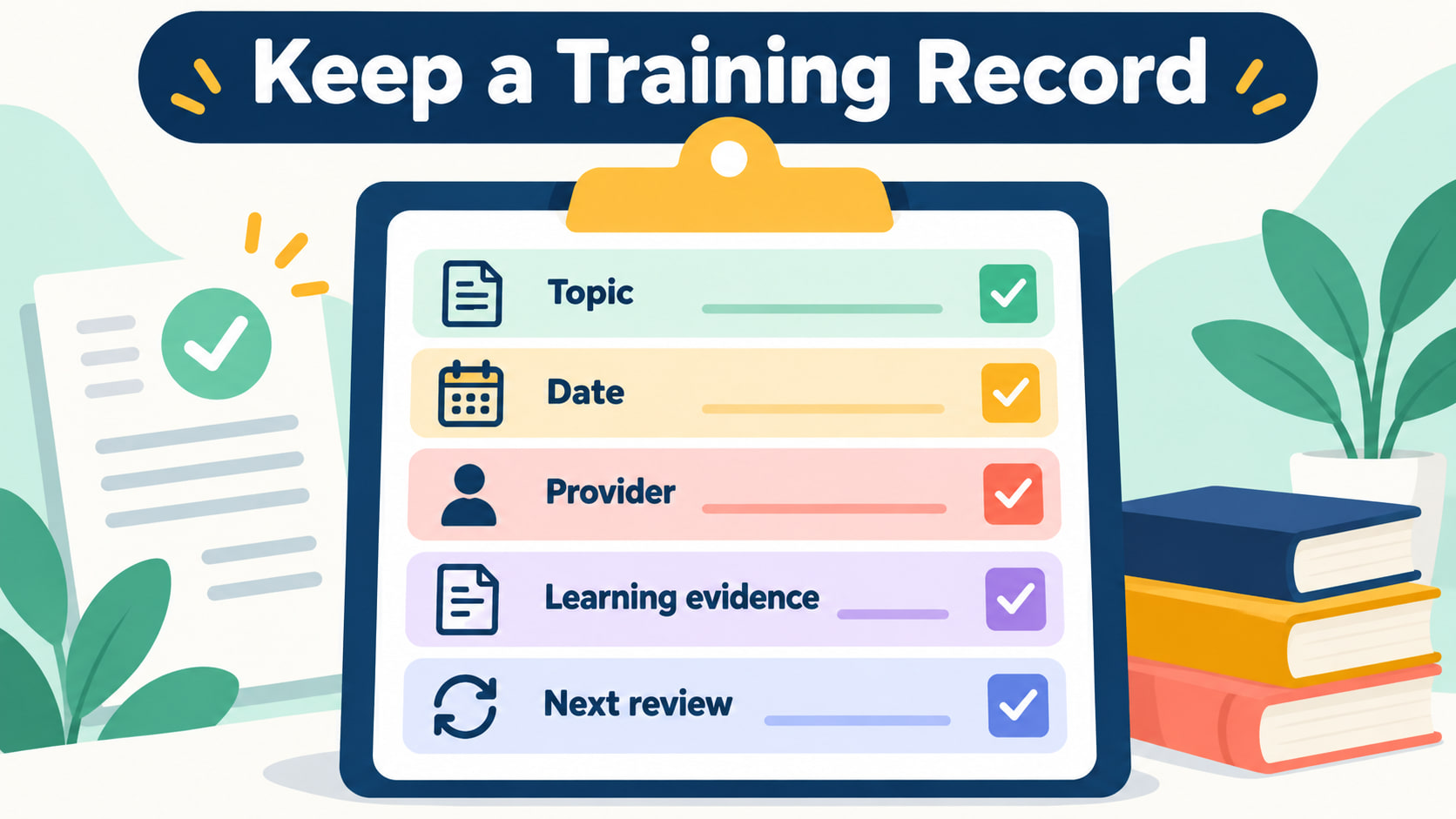
Keep the record factual and easy to verify. Separate attendance from competence, and separate a general learning activity from any client-specific supervision note. If a certificate has an expiration date or provider identifier, retain the relevant details according to policy. If no certificate exists, ask what alternative evidence the responsible organization accepts instead of inventing a format.
Review learning and next steps
Close the loop with a short review. Can the RBT explain the key idea? Can the RBT locate the current procedure? Does the supervisor need to observe a skill or correct a misunderstanding? Is another activity needed? These questions convert participation into a plan for responsible application.
Set a next-review date when the topic is likely to change, when a new procedure is being introduced, or when the supervisor has identified a continuing need. A review date is not a promise that a requirement will remain unchanged. It is a reminder to check current information again.
Common documentation mistakes
- Vague topic: the record says “RBT training” without identifying the learning need.
- Unclear source: the provider, material, or approving person cannot be identified.
- Participation equals competence: attendance is described as proof that a skill is mastered.
- Missing evidence: there is no reflection, check, feedback, or other permitted indication of learning.
- Excessive private detail: a personal record includes client information that does not belong there.
- No follow-up: a question or uncertainty is recorded but no route or review is assigned.
A strong record is specific, proportionate, and connected to the RBT’s role. It supports communication with a supervisor and makes it easier to check whether an activity actually addressed the original need.
Frequently asked questions
Does every in-service training count toward RBT recertification?
Not automatically. Check current official requirements and the responsible organization’s rules for eligible activities, providers, evidence, and deadlines.
What if my employer has no checklist?
Ask the supervisor or administrator what record format and retention process they use. A simple topic-date-provider-evidence-next-review structure can organize the conversation, but it does not replace an official form.
Is a certificate enough?
A certificate can document participation, but it may not establish competence or satisfy every program’s requirements. Keep any required evidence and confirm what the receiving organization accepts.
Should client information appear in the training record?
Only when an approved process requires it and only to the minimum necessary extent. Prefer de-identified examples and authorized systems, and follow privacy and retention policy.
Source note: Review current BACB materials, current organizational policy, approved systems, and supervisor or administrator direction for your situation. This article is educational and does not provide individualized legal, clinical, employment, or credentialing advice.
Ready to practice the RBT concepts you just reviewed?
Try an independent, original RBT practice resource with exam-style questions, scoring, and answer explanations.
References
- Behavior Analyst Certification Board. RBT Test Content Outline, 3rd edition.
- Behavior Analyst Certification Board. RBT Handbook.
- Behavior Analyst Certification Board. RBT Ethics Code.