

RBT 12 PDUs 2026 planning starts with the transition rule, the two-year cycle, and the approved path used to earn and document professional development.
Table of Contents
- What the RBT 12 PDUs 2026 rule says
- Check your certification cycle
- Compare the three PDU paths
- Understand In-Service training
- Understand ACE events
- Consider university coursework
- Build a documentation plan
- Frequently asked questions
- References
RBT 2026 · PROFESSIONAL DEVELOPMENT
RBT 12 PDUs 2026: Requirements Check
How to understand the transition, compare approved paths, and keep the right evidence.
RBT 12 PDUs 2026 planning starts with the transition rule, the two-year cycle, and the approved path used to earn and document professional development. BACB materials describe a new professional-development requirement for RBTs who become certified or recertify in 2026, but the exact timing for an individual depends on that person’s certification history and current account information.
Use this article as a planning guide, not as a substitute for the current RBT Handbook, BACB forms, or the organization responsible for your record. Before counting an activity, verify the current requirement, the provider or organization, the content, the documentation form, and the deadline shown for your own cycle.
What the RBT 12 PDUs 2026 rule says
The BACB’s current public materials state that, after becoming newly certified or recertified in 2026, RBTs are required to earn 12 professional development units during each two-year recertification cycle. The requirement is part of the 2026 transition and should be read together with the current Handbook and the professional-development guidance.
That wording matters. It does not mean that every RBT should use the same date, that all older activities can be moved into a new cycle, or that a person can calculate eligibility from a search result alone. Open the current account and official instructions for the cycle that applies to you.
Check your certification cycle
Start with the event that triggers your applicable cycle: becoming certified or recertifying in 2026. Record the date shown in your authorized account or official correspondence, then identify the two-year period that the current materials associate with that event. If your status, timing, or account display is unclear, ask BACB or the responsible administrator rather than guessing.
- Confirm whether you became certified or recertified in 2026.
- Locate the current recertification cycle and its end date.
- Check how PDUs appear in your account and when uploads or forms are due.
- Keep a running total, but do not treat a personal spreadsheet as the official record.
Do not assume that completing 12 hours in a calendar year settles the issue. The requirement is tied to a recertification cycle, and the activity must also meet the applicable content and documentation rules.
Compare the three PDU paths
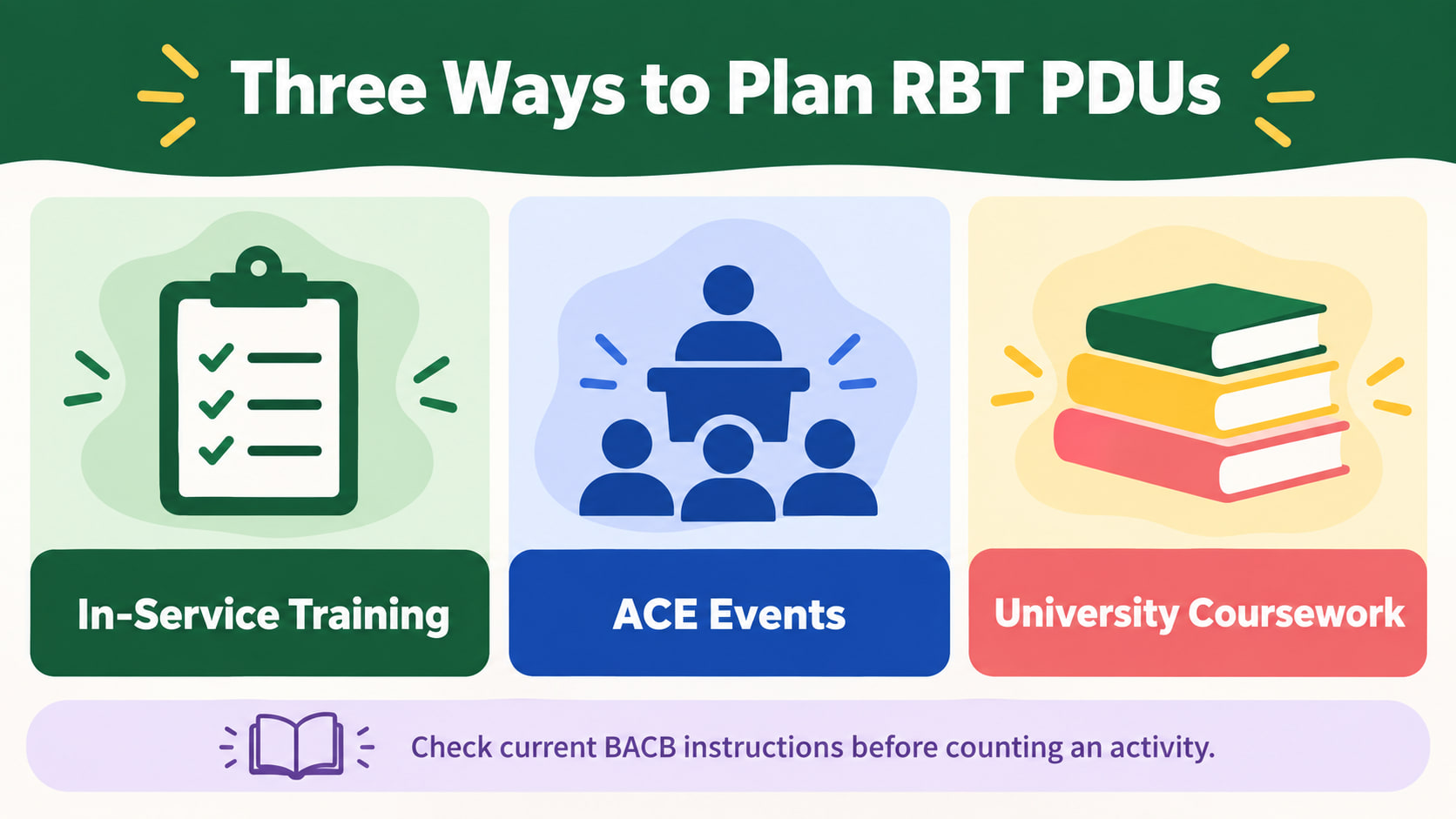
Current BACB materials describe more than one way RBTs may earn professional development. The main planning categories are organization-provided In-Service training, professional-development events from authorized ACE Providers, and qualifying university behavior-analytic coursework. Each path has its own provider, content, and documentation considerations.
The choice is practical. An employer may offer structured In-Service events. An RBT whose organization does not offer enough suitable training may look for an ACE event. A person already enrolled in relevant coursework may need to verify how the coursework is documented. The route is not interchangeable simply because all three involve learning.
Understand In-Service training
In-Service professional development is training provided by an organization where the RBT works. Current guidance describes structured activities intended to deliver knowledge, skills, or competencies related to approved RBT content. Examples can include ethics, communication, working with supervisors, or other appropriate professional-development topics.
Not every staff meeting qualifies. The current In-Service requirements distinguish professional development from client- or program-specific training, routine company policy review, a supervision meeting about one client’s programming, a 40-hour RBT course, or other activities listed as non-qualifying. Review the current requirements before assigning a PDU value.
Organizations should use the current BACB In-Service Event form and retain the required information. An RBT should ask the organization who completes the form, what evidence is kept, and how the event is recorded in the account or local process.
Understand ACE events
ACE events are professional-development events offered by authorized ACE Providers. They may be available outside company time and can include online events, webinars, or conferences designed for RBT professional development. Check the provider’s current authorization and the event’s RBT-specific requirements before registering.
Use the current ACE Event form and follow the provider’s instructions. Participation may require attendance for the entire event and active learning activities. Keep the completed documentation and upload or submit it through the authorized route. A marketing page or attendance email alone may not be the complete record.
Consider university coursework
University behavior-analytic coursework is another category described in the Handbook. The relevant question is not simply whether a class has “ABA” in its title. Verify the course, institution, documentation, and current account process against the official requirements. Ask the institution for the records needed to support the activity.
If a course is part of a larger program, do not assume that every assignment or hour is separately countable. Keep the syllabus, dates, completion evidence, and any required transcript or form according to the current process. When unsure, ask before relying on the course to complete the cycle.
Build a documentation plan
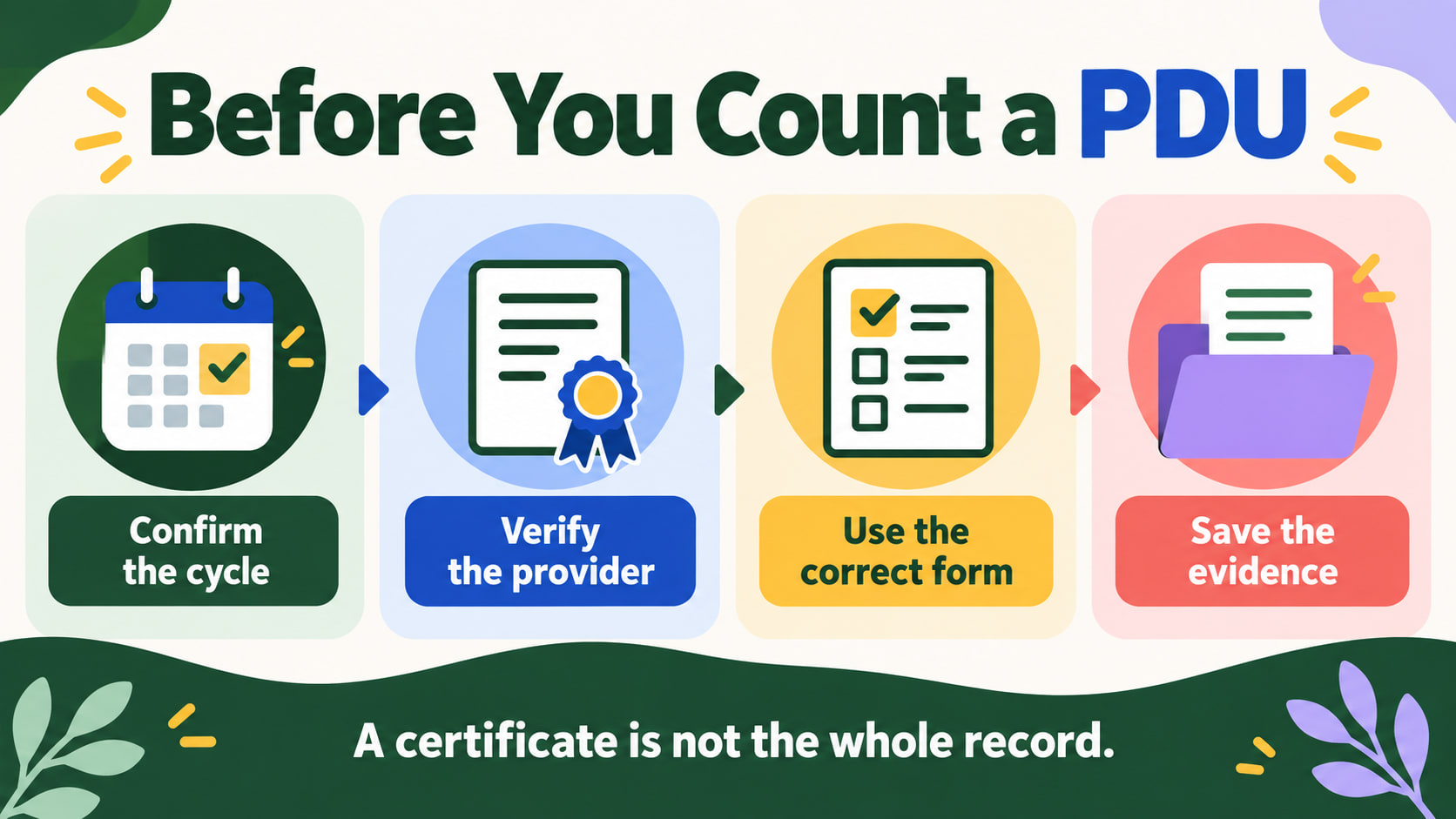
Before counting a PDU, use a four-part check: confirm the cycle, verify the provider or organization, use the correct form, and save the evidence. Record the topic, date, duration or value shown by the official form, provider, learning evidence, and next action. Keep the official document unchanged unless the instructions explicitly allow a field to be completed.
Separate participation from competence. A form can document an event, while supervision or another approved process may be needed to apply or assess a skill. Also protect confidential information: do not place client details in a personal PDU spreadsheet when the official process does not require them.
Review your running total with enough time to correct a missing form, clarify an ineligible activity, or choose another path. Waiting until the end of the cycle makes it harder to reconstruct what happened and whether the provider or content met the current rules.
Frequently asked questions
Do all RBTs need 12 PDUs immediately?
The current transition language connects the 12-PDU requirement to becoming certified or recertifying in 2026 and to each two-year cycle. Check your own certification history, account, and current BACB instructions.
Can company training count?
Some organization-provided In-Service training may qualify when it meets the current content, structure, provider, and documentation requirements. A general staff meeting or client-specific training is not automatically an eligible PDU.
Can I use an ACE webinar?
Potentially, if it is an eligible RBT professional-development event from an authorized ACE Provider and you complete the required participation and documentation steps. Verify the current provider and event details first.
Is a certificate enough?
Not necessarily. Keep the correct BACB form and any required evidence, then follow the current account or submission process. A certificate alone does not decide eligibility.
Source note: Review the current BACB RBT Handbook, the RBT Professional Development: In-Service and ACE Events guidance, current In-Service requirements, current ACE Provider materials, and administrator direction for your situation. This article is educational and does not provide individualized legal, clinical, employment, or credentialing advice.
Ready to practice the RBT concepts you just reviewed?
Try an independent, original RBT practice resource with exam-style questions, scoring, and answer explanations.
References
- Behavior Analyst Certification Board. RBT Test Content Outline, 3rd edition.
- Behavior Analyst Certification Board. RBT Handbook.
- Behavior Analyst Certification Board. RBT Ethics Code.