

RBT university coursework PDUs require more than an ABA course title: confirm the current requirement, course details, evidence, and BACB account process before counting the activity.
Table of Contents
- What RBT university coursework PDUs means
- Confirm the course before counting it
- Check current rules and timing
- Keep transcript and completion evidence
- Follow the account process
- Three common coursework scenarios
- Documentation mistakes to avoid
- Frequently asked questions
- References
RBT PROFESSIONAL DEVELOPMENT · COURSEWORK
RBT University Coursework PDUs: Documentation Guide
How to verify a course, keep evidence, and follow the current account process.
RBT university coursework PDUs require more than an ABA course title: confirm the current requirement, course details, evidence, and BACB account process before counting the activity. The current professional-development materials identify university behavior-analytic coursework as one possible pathway, but they do not turn every class, credit, or transcript into an automatically accepted PDU.
Use the current RBT Handbook and account instructions for the certification cycle that applies to you. This guide organizes the review; it does not decide whether a particular course satisfies an individual record or recertification requirement.
What RBT university coursework PDUs means
University coursework refers to eligible learning completed through an institution of higher education. The relevant question is not simply whether the course title contains behavior analysis. Review the course’s content, level, provider, dates, completion status, and the documentation the current process requires.
Coursework is different from an informal webinar, a staff meeting, a client-specific training, or a personal reading list. It is also different from assuming that every hour in a degree program can be counted separately. Keep the official description and ask the responsible source how the course should be recorded.
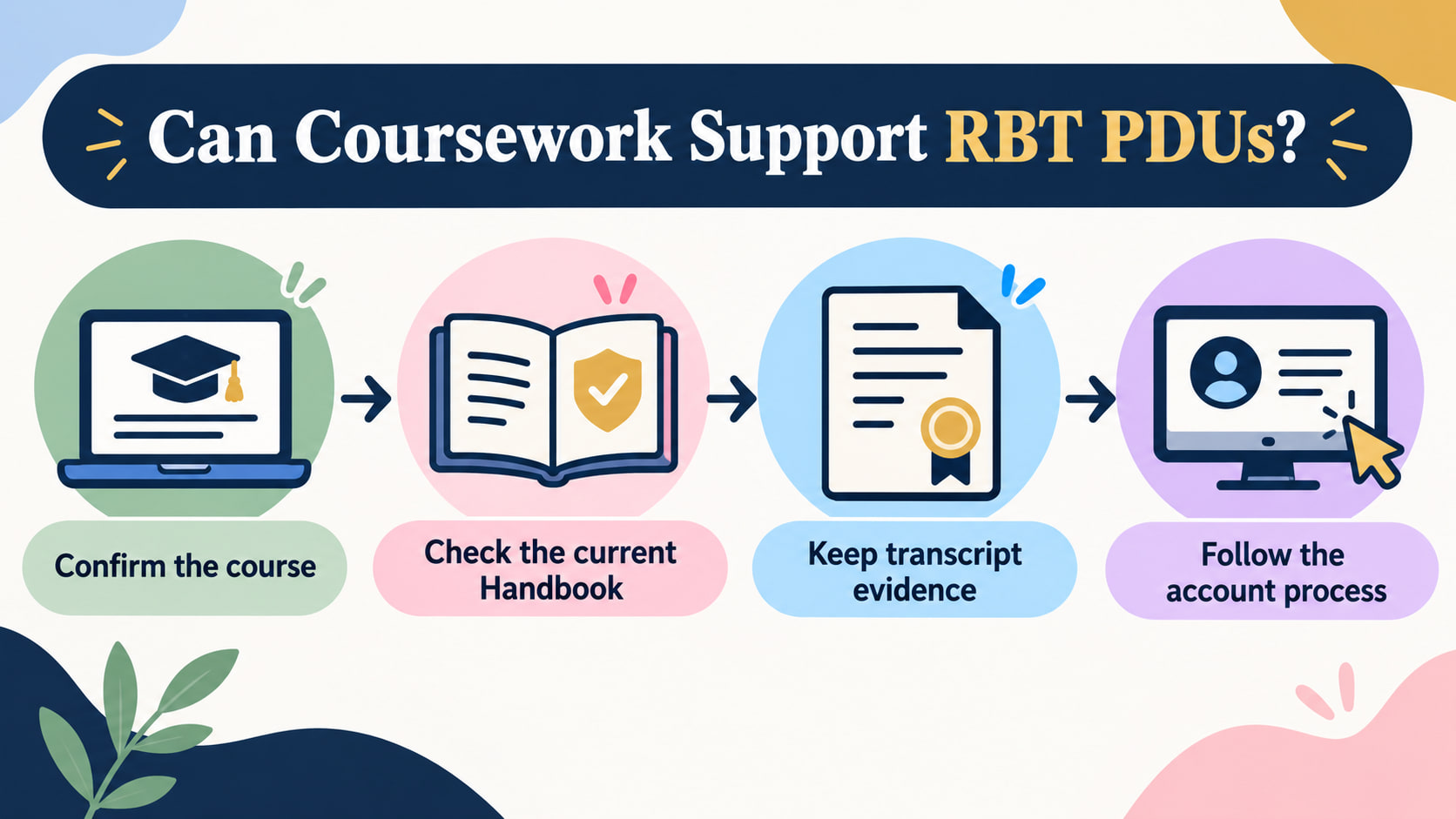
Confirm the course before counting it
Begin with the course record. Write down the exact title, institution, department, term or completion date, credit or unit information, and whether the course was successfully completed. If the institution uses a course number, include it. This avoids relying on a shortened title that could describe several different classes.
- Content: Does the course connect to behavior-analytic knowledge or skills relevant to the current professional-development rules?
- Institution: Can the school and course be verified through an official record?
- Completion: Is there evidence that the learner completed the course rather than only registered?
- Timing: Does the course fall within the current recertification cycle?
- Documentation: What form, transcript, or account entry is required?
Do not count a course because another RBT says it worked for them. Their certification cycle, course, or documentation may be different. Treat another person’s experience as a question to investigate, not as proof of eligibility.
Check current rules and timing
Professional-development rules can change during a transition. Read the current Handbook and the current professional-development page, then compare those instructions with the dates in your account. A course completed before the applicable cycle may not be treated the same way as a course completed during it.
Keep a small timeline: enrollment or course start, completion, evidence received, account action, and any follow-up requested. If the account shows a different date or status, stop and ask the responsible support route rather than editing a document to make the timeline look simpler.
Also check whether the current instructions distinguish a course from a professional-development event. Similar subject matter does not mean the same provider, form, or submission path. Use the category that the official instructions identify.
Keep transcript and completion evidence
A transcript or official completion record can show what was taken and when, but keep the exact evidence the current process requests. Depending on the instructions, that may include a transcript, course description, completion statement, or another approved record. Do not add unsupported PDU totals to a personal spreadsheet and treat them as official.
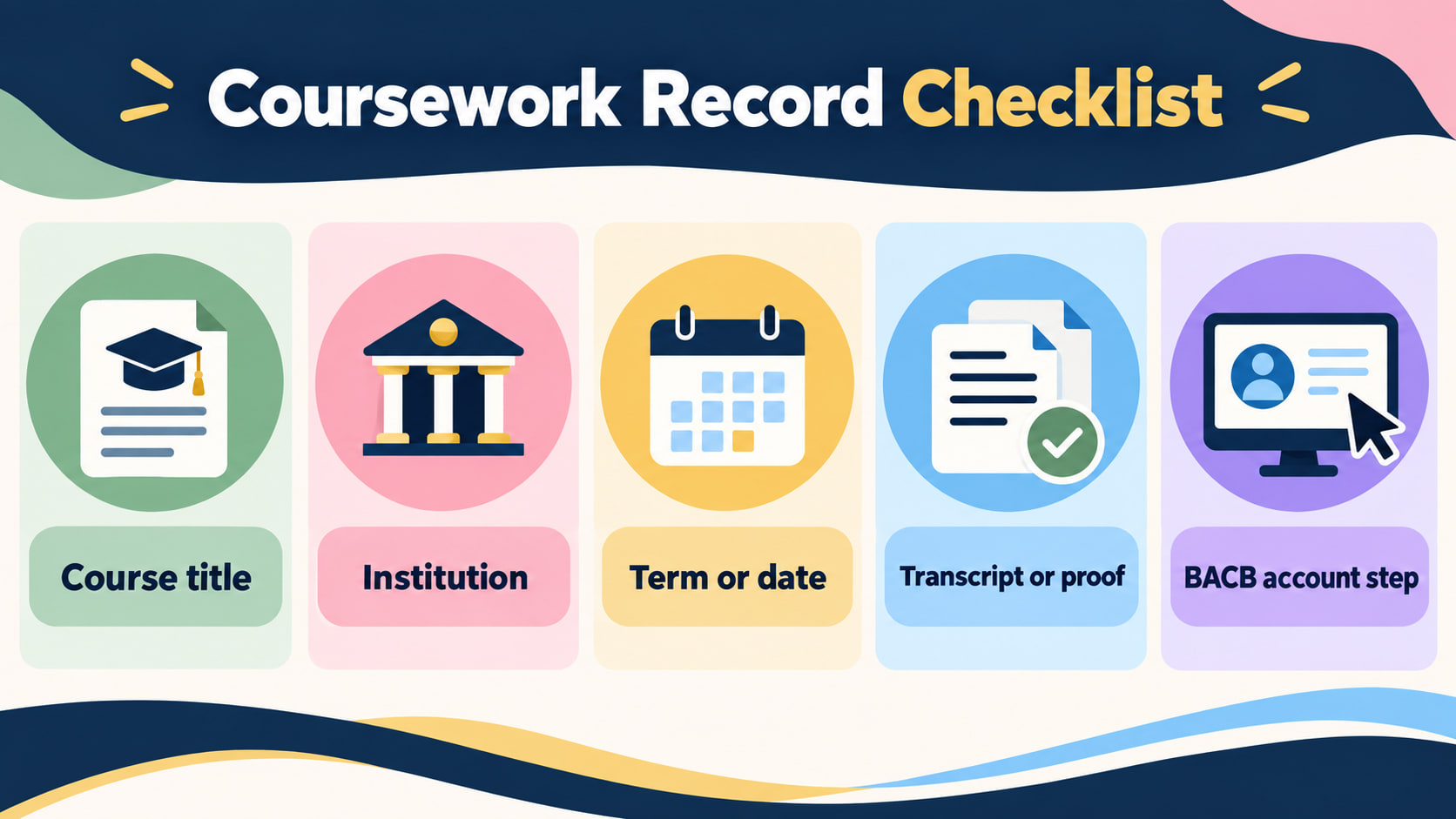
Store records securely and limit private information to what is needed. A transcript may contain more personal education history than the account process requires. Use an authorized channel, follow retention instructions, and keep the original document unchanged unless the instructions tell you to complete a field.
Follow the account process
After confirming the course and evidence, follow the current BACB account instructions for entering or uploading professional development. Read the field labels carefully. A course title, institution, date, and evidence may need to match exactly across the account and supporting document.
Check the status after submission and save the confirmation or requested correction. Pending, returned, or incomplete does not mean final approval. If the account asks for additional documentation, provide it through the approved route and keep a factual record of the response.
If you cannot determine the correct category or value, ask before counting the course toward a deadline. A short question to the appropriate administrator is safer than discovering at recertification that a record was incomplete.
Three common coursework scenarios
A completed university course: An RBT finishes a behavior-analytic course and receives a transcript. The next step is to compare the course and dates with current rules and determine what additional documentation is required.
A course in progress: An RBT registers for a class but has not completed it. Registration alone is not completion evidence. Wait for the official result or follow the current instructions for unfinished coursework.
A related but different class: An RBT takes a general education or workplace course that sounds useful. Use the current criteria to decide whether it belongs in the professional-development category; usefulness alone does not determine eligibility.
Documentation mistakes to avoid
- Using the course nickname: the account and transcript do not match.
- Counting enrollment: registration is treated as completed learning.
- Ignoring the cycle: the course date is outside the applicable period.
- Assuming every credit counts: the PDU value is invented or copied from another program.
- Uploading the wrong record: a screenshot or unofficial note replaces the requested evidence.
- Skipping status review: a returned or incomplete entry is left unresolved.
The reliable sequence is confirm the course, check the current rules, preserve official evidence, follow the account process, and review the status. That sequence supports a clean record without promising an outcome the article cannot determine.
Frequently asked questions
Does every university ABA course count as an RBT PDU?
No. Verify the current requirements, course details, timing, and documentation before counting it.
Is a transcript enough?
A transcript may be important evidence, but the current process may require additional information or a specific account step. Follow the current instructions.
Can coursework from a prior cycle be reused?
Do not assume it can. Compare the course date with your current cycle and ask the responsible source if the timing is unclear.
What if my course title is not obviously behavior analytic?
Review the official course description and current criteria. Do not rely on the title alone or claim eligibility before the responsible process confirms it.
Source note: Review the current BACB RBT Handbook, current professional-development guidance, current RBT recertification instructions, and administrator direction for your situation. This article is educational and does not provide individualized legal, clinical, employment, or credentialing advice.
Ready to practice the RBT concepts you just reviewed?
Try an independent, original RBT practice resource with exam-style questions, scoring, and answer explanations.
References
- Behavior Analyst Certification Board. RBT Test Content Outline, 3rd edition.
- Behavior Analyst Certification Board. RBT Handbook.
- Behavior Analyst Certification Board. RBT Ethics Code.