

RBT concepts become easier to study when each term is defined, illustrated with an example, connected to data and the plan, and reviewed with a supervisor.
Table of Contents
- What RBT concepts means
- Measurement and data collection
- Antecedents and consequences
- Reinforcement and behavior change
- Behavior reduction concepts
- Build a concept study card
- Stay within the RBT role
- Frequently asked questions
- References
RBT KNOWLEDGE · STUDY CONCEPTS
RBT Concepts: Core Map for Study
A practical way to define terms, connect them to data and plans, and ask better supervision questions.
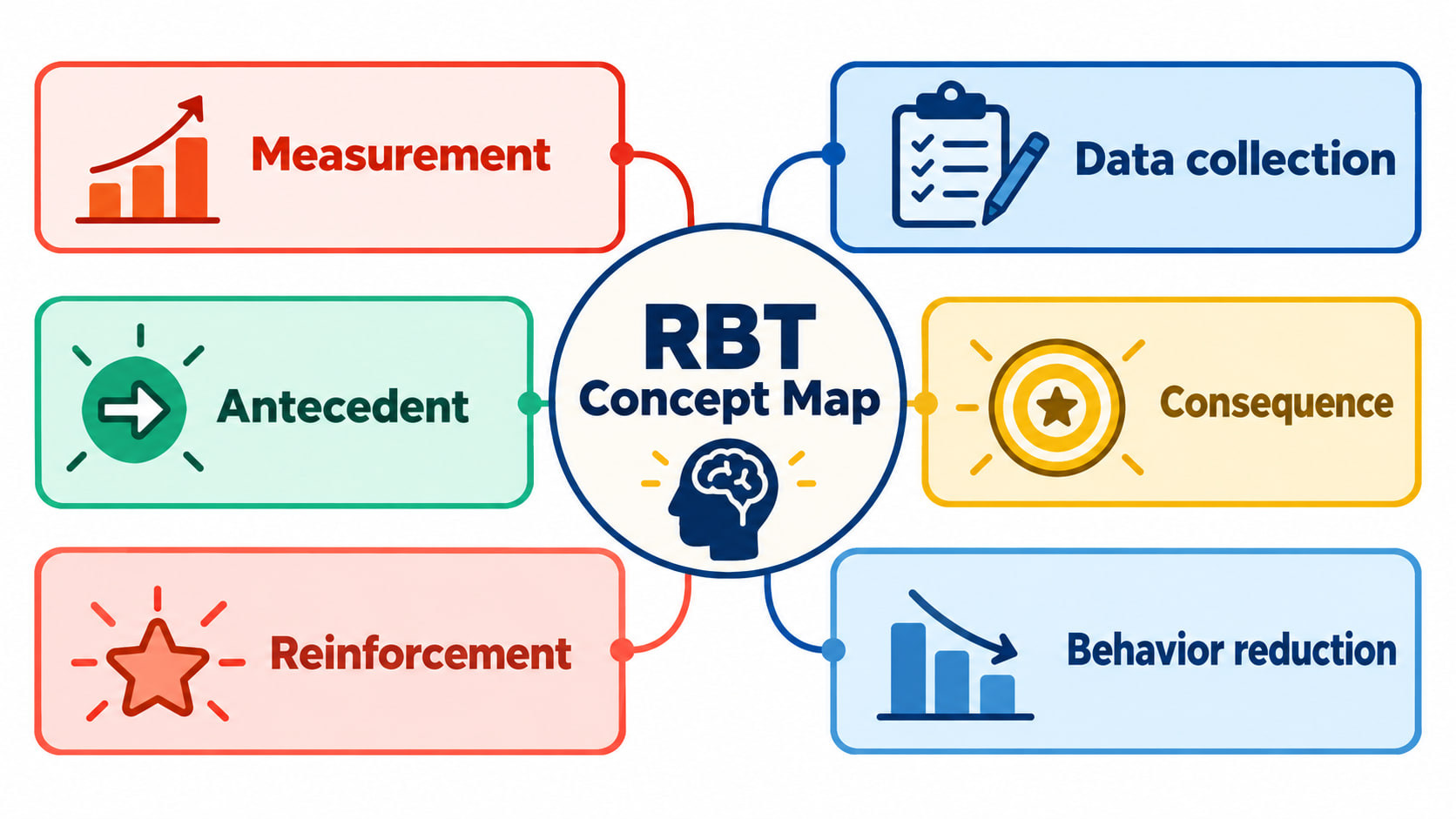
RBT concepts become easier to study when each term is defined, illustrated with an example, connected to data and the plan, and reviewed with a supervisor. A concept map can show how measurement, data collection, antecedents, consequences, reinforcement, and behavior reduction relate to daily implementation.
This is a study framework, not a replacement for the current RBT content outline, a client’s written plan, or supervisor direction. A broad definition may be useful for learning but does not authorize an RBT to change treatment or make an independent clinical decision.
What RBT concepts means
“RBT concepts” is a broad search phrase. It can refer to terms from the RBT training curriculum, an exam study outline, workplace communication, or a question about a specific procedure. Start by naming the exact term and the setting in which it appears.
For each concept, ask five questions: What does the term mean here? What is an observable example? What data would show what happened? Which part of the plan or instruction controls the action? What should be taken to the supervisor for clarification?
Measurement and data collection
Measurement gives a team a consistent way to describe behavior or performance. An RBT may encounter measures such as frequency, duration, latency, rate, interval recording, or permanent-product measures, depending on the current plan and training. The correct measure is the one the authorized plan or supervisor specifies.
Data collection is the action of recording what the plan asks the RBT to record. Study the definition, the recording rule, the start and stop points, and the examples and nonexamples. If two people would record the same event differently, the rule needs clarification before the data are treated as comparable.
Do not choose a new measurement method because it seems easier. Ask the supervisor when the written plan, device, or client context does not make the recording rule clear.
Antecedents and consequences
An antecedent is an event or condition that occurs before a behavior; a consequence follows the behavior. The words describe position in a sequence, not whether an event is good, bad, intentional, or guaranteed to cause a response.
Use an objective example. “The instruction was presented, the learner pushed the materials away, and the planned response followed” is easier to analyze than “the learner was being difficult.” The RBT’s job is to implement the assigned procedure and record observable events, not to invent a new explanation from one observation.
When studying ABC terms, connect the sequence to the plan. A consequence can be part of a programmed procedure, but an RBT should not add, remove, or rearrange consequences independently.
Reinforcement and behavior change
Reinforcement is defined by its effect on future behavior: a consequence increases the likelihood that a behavior will occur again under relevant conditions. The label is not determined by whether an item looks enjoyable to an observer. A planned reinforcer and a preference are related but not identical concepts.
Study the behavior, the consequence, the timing, and the data that would show a change. If the plan specifies a reinforcer, schedule, prompt, or exchange system, implement it as trained and record the result. Bring changes in motivation, access, safety, or effectiveness to the supervisor.
Behavior reduction concepts
Behavior reduction procedures are designed to reduce behavior according to an authorized plan while protecting dignity and safety. Concepts may include antecedent strategies, differential reinforcement, extinction, prompting, crisis procedures, or replacement skills. The exact procedure and limits come from training, the client plan, and supervision.
Do not treat a term as a permission slip. Knowing the definition of extinction, for example, does not authorize an RBT to decide that extinction should be used or to change a programmed procedure. When a situation does not match the plan, pause safely and seek direction through the designated route.
Build a concept study card
A useful study card has five fields: the term, a plain-language definition, an original example, the data connection, and the question to ask a supervisor. Keep examples de-identified and do not copy client information into a public study set.
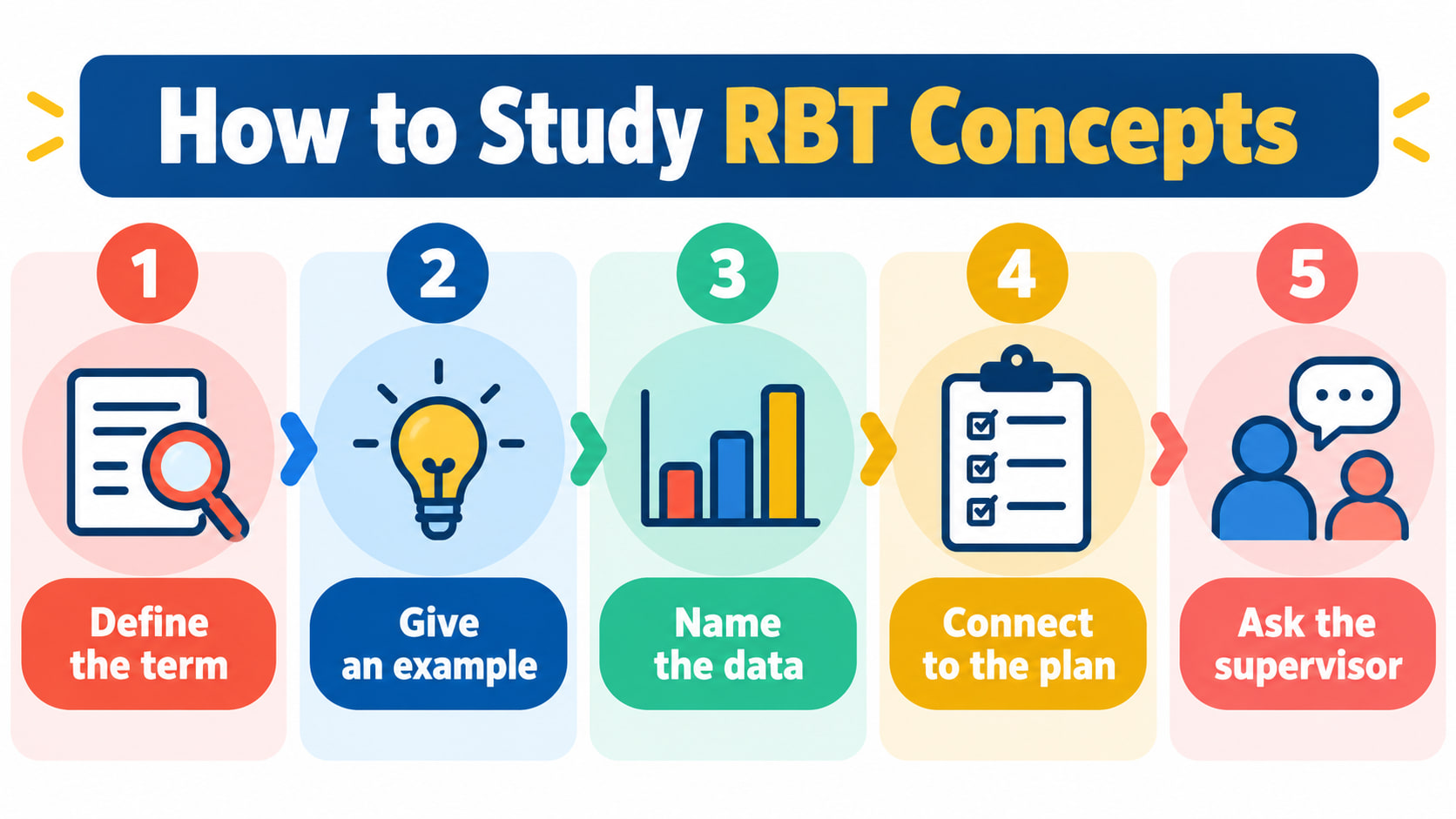
- Define: write the term in accurate, simple language.
- Example: create a new, observable scenario.
- Data: identify what would be counted or recorded.
- Plan: connect the concept to the instruction or written procedure.
- Supervisor: write one boundary or application question.
Then explain the concept aloud without claiming more than the source supports. A supervisor can correct a definition, distinguish similar terms, and show how the current plan applies.
Stay within the RBT role
Concept knowledge supports accurate implementation and communication. It does not turn an RBT into an independent assessor, treatment designer, diagnostician, or policy interpreter. Follow the current plan, protect client dignity and privacy, document objectively, and ask for direction when a procedure is unclear or a safety concern appears.
When a study term conflicts with a current instruction, use the current authorized source and bring the conflict to the supervisor. Online summaries can omit context, use outdated language, or combine terms from different training systems.
Frequently asked questions
Which RBT concepts should I study first?
Start with the current content outline and the concepts that appear in your training or supervision. Measurement, data, ABC sequences, reinforcement, skill acquisition, behavior reduction, ethics, and supervision are useful organizing areas.
Can I use one definition for every client?
The general concept may be stable, but the example, measurement rule, and procedure depend on the current plan and setting. Ask when context changes.
Do RBT concepts tell me what intervention to use?
No. Concepts support understanding and implementation. The authorized plan and supervisor determine the procedure, and an RBT should not make independent treatment changes.
How do I know whether my study card is accurate?
Compare it with current official materials and review it with a supervisor. Check the definition, example, data rule, and role boundary separately.
Source note: Review the current BACB RBT content outline, RBT Handbook, ethics materials, client plan, and supervisor direction for your situation. This article is educational and does not provide individualized legal, clinical, employment, or credentialing advice.
Ready to practice the RBT concepts you just reviewed?
Try an independent, original RBT practice resource with exam-style questions, scoring, and answer explanations.
References
- Behavior Analyst Certification Board. RBT Test Content Outline, 3rd edition.
- Behavior Analyst Certification Board. RBT Handbook.
- Behavior Analyst Certification Board. RBT Ethics Code.