
ABA data collection practice is most useful when it teaches you how to choose the right measurement for the behavior and the question. A strong RBT study session does not ask only, “What is frequency?” It asks whether the response is discrete or extended, whether the question requests a count or a time-based unit, which recording rule fits the plan, and what a technician should do when the instructions are unclear.
Table of Contents
- What ABA data collection practice should test
- Place Domain A in the current RBT scope
- Choose a measurement from the requested unit
- Compare continuous and discontinuous recording
- Prepare the operational definition and data sheet
- ABA data collection practice questions: original mini set
- Check graphs and data integrity
- Separate ABC recording from interpretation
- Turn errors into a retest plan
- Frequently Asked Questions
- References
The current RBT Test Content Outline, 3rd edition, describes 43 tasks across six domains. Data Collection and Graphing is Domain A, but accurate recording supports assessment, acquisition, reduction, documentation, and ethics. The current examination context includes 75 scored questions and 10 unscored pilot questions. Use the current BACB TCO and Handbook for official scope and process facts.
RBT Training is an independent educational resource. It is not affiliated with, operated by, or endorsed by the Behavior Analyst Certification Board (BACB). The practice prompts and explanations below are newly written for independent study. They are not official, current, retired, recalled, leaked, or BACB-endorsed questions. No practice score or data-collection checklist can guarantee certification or a passing result.
What ABA data collection practice should test
Data-collection practice should test a chain of decisions, not just isolated definitions. Before answering, identify the target response, the unit requested, the observation rule, and the plan boundary. If one of those pieces is missing, the correct study action may be to ask the supervisor or check the written protocol rather than make a clinical assumption.
| Decision step | Question to ask | Common error |
|---|---|---|
| Define | What observable event starts and ends the response? | Using a label such as “noncompliant” without observable criteria. |
| Unit | Does the prompt request count, time, interval status, or a product? | Answering frequency when the question asks for rate or latency. |
| Method | Does the plan call for continuous, discontinuous, trial-by-trial, or permanent-product recording? | Choosing the most familiar method instead of the assigned one. |
| Rule | When do you start, stop, score, or reset the measure? | Changing a timing rule halfway through a session. |
| Integrity | Can another trained observer understand what was recorded? | Filling gaps from memory or silently correcting data. |
| Communication | What should be documented or reported when equipment or protocol fails? | Inventing a replacement procedure without authorization. |
The search results for this topic range from 13-question quizzes to large practice hubs and software tutorials. Use a short set as a diagnostic, but read the explanation for the controlling clue. A score without a correction reason does not show whether the error came from measurement knowledge, reading, calculation, or plan fidelity.
Place Domain A in the current RBT scope
The current TCO organizes 43 tasks into six domains. Domain A is Data Collection and Graphing, with tasks A.1–A.8 in the practical study map used here. The other domains still matter because data is collected while assessment, teaching, behavior-reduction, documentation, and ethical procedures are occurring.
| Current scope fact | Practice implication | Do not infer |
|---|---|---|
| 43 tasks across six domains | Use A-domain practice deeply, then mix it with scenarios from the other domains. | A data quiz alone represents the whole certification exam. |
| 75 scored questions | Study measurement decisions broadly instead of memorizing one quiz’s item count. | A provider’s 75-question set is the official scored form. |
| 10 unscored pilot questions | Understand the 85-question exam context when planning later timed practice. | You can identify which items are unscored. |
| Current TCO and Handbook | Use them for official scope, application, scheduling, and test-day rules. | A commercial practice page can replace official instructions. |
For a study card, write “A.1–A.8 study family” rather than claiming that a third-party list is an official task-by-task question distribution. The current Handbook controls process details; the TCO controls the content-outline boundary.
Choose a measurement from the requested unit
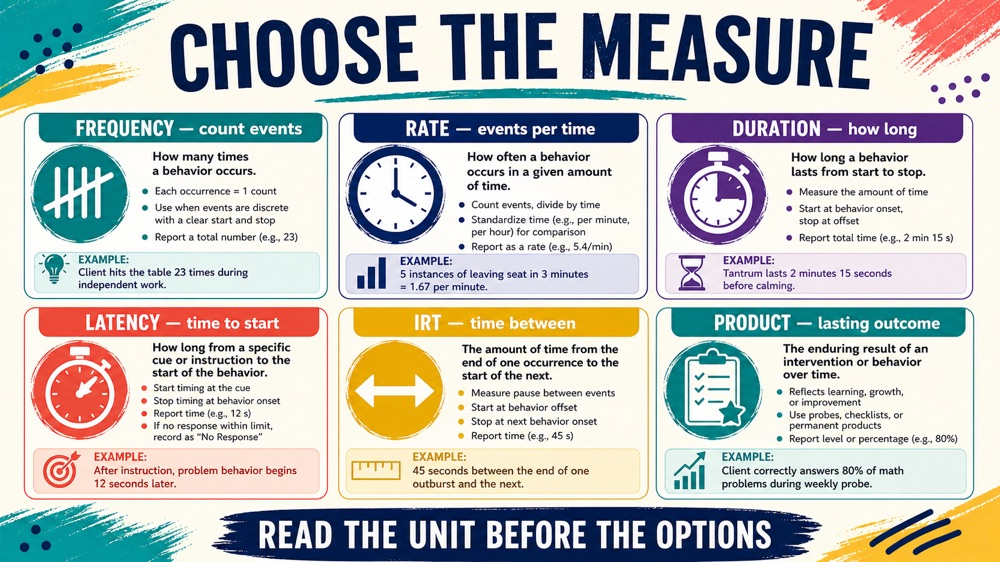
The fastest way to reduce confusion is to identify the unit before looking at answer choices. Use this decision table as a study guide:
| Measure | What it records | Clue in the stem | Mini example |
|---|---|---|---|
| Frequency | Number of occurrences. | “How many times?” with no time denominator. | 7 hand raises during the observation. |
| Rate | Occurrences relative to a specified time unit. | “Per minute,” “per hour,” or another denominator. | 12 responses in 30 minutes = 24 per hour. |
| Duration | How long a response lasts. | “How long did it continue?” | Vocalization lasted 18 seconds. |
| Latency | Time from an instruction or event to response onset. | “How long until it started?” | 12 seconds from the instruction to the first response. |
| Interresponse time | Time between the end or occurrence of one response and the next occurrence, as defined by the plan. | “How much time between responses?” | 40 seconds between one hand raise and the next. |
| Permanent product | A lasting outcome produced by the behavior. | The product can be inspected after the behavior. | Count completed problems left on a worksheet. |
For example: a learner begins a puzzle 45 seconds after the instruction and works for 6 minutes. The 45 seconds is latency; the 6 minutes is duration. If the learner completes four puzzles in an hour, the count is frequency and the standardized hourly expression is rate. The numbers do not decide the measure; the requested unit does.
Compare continuous and discontinuous recording
Continuous measurement records each occurrence or the full timing feature specified by the plan. Discontinuous methods sample behavior across intervals or at a defined moment. In practice, the method must match the behavior, observation conditions, and written instructions—not the method a learner remembers most easily.
| Method | Scoring rule | Typical study warning |
|---|---|---|
| Partial-interval | Score the interval if the behavior occurs at any point during it. | It can make occurrence look higher because a brief response can mark the whole interval. |
| Whole-interval | Score the interval only if the behavior occurs for the entire interval. | It can miss brief or incomplete responding because the full interval is required. |
| Momentary time sampling | Score behavior as it appears at the specified moment. | A momentary sample is not the same as observing the entire interval. |
| Trial-by-trial | Record the assigned response for each teaching opportunity. | Do not turn a trial score into a free-operant count without a plan. |
| ABC recording | Record the observed antecedent, behavior, and consequence using the assigned format. | Describe what happened; do not add an unsupported function statement. |
When a question asks which method is likely to overestimate occurrence, partial-interval recording is often the intended contrast because any response during the interval produces a “yes.” Read the exact definitions and plan rules, however. A practice explanation should teach the scoring rule, not reward memorized labels.
Prepare the operational definition and data sheet
Accurate data starts before the first observation. Review the written definition and the data sheet or approved collection system. Confirm the behavior is observable, the start and stop rules are clear, and the recording unit matches the plan.
- Read the definition: mark examples, nonexamples, onset, offset, and any exclusion rule.
- Check the instrument: confirm the timer, interval settings, trial fields, or product-count space is ready.
- Preview the session: identify when the observation begins and what events reset a count or timer.
- Record in real time: do not rely on memory when the plan calls for direct measurement.
- Flag uncertainty: document equipment or protocol problems and follow the supervisor’s established route.
For another example: if “loud vocalization” has no clear start or stop rule, the best practice answer is not to choose a timer length independently. Pause or clarify according to the protocol, notify the supervisor, and document the issue as required. An RBT can collect and report data under a plan; an RBT should not independently rewrite the operational definition or treatment procedure.
ABA data collection practice questions: original mini set
Work each item before reading the explanation. These are original study prompts, not official or recalled questions. Write the controlling clue and the nearest distractor in your correction log.
Question 1: frequency or rate?
Prompt: A learner engages in 9 target responses during a 30-minute observation. The question asks how many responses occurred. Which value fits?
Answer and explanation: 9 is the frequency because the question asks for the number of events. If it asked for rate per hour, the standardized value would be 18 per hour. The clue is the requested unit.
Question 2: duration or latency?
Prompt: The instructor says, “Begin,” at 10:00:00. The learner starts at 10:00:14 and stops at 10:02:04. Which value represents latency?
Answer and explanation: 14 seconds is latency because it is the delay from the instruction to response onset. The time from 10:00:14 to 10:02:04 describes duration, if the behavior being timed is the defined response.
Question 3: partial or whole interval?
Prompt: A technician scores “yes” when hand flapping occurs at any point during a 10-second interval. Which method is described?
Answer and explanation: Partial-interval recording. “At any point” is the controlling phrase. Whole-interval recording would require the behavior to occur throughout the entire interval.
Question 4: momentary time sampling?
Prompt: The timer signals at the end of each interval, and the technician checks whether the learner is on task at that exact moment. Which method is the best match?
Answer and explanation: Momentary time sampling. The observation is tied to a specified moment rather than the behavior across the entire interval.
Question 5: permanent product?
Prompt: After instruction ends, the technician counts the number of completed worksheet items using the approved scoring rule. Which feature makes this permanent-product recording?
Answer and explanation: The completed worksheet is a lasting outcome that can be inspected after the response occurs. The technician still follows the assigned product definition and does not infer performance from a product that the plan does not validate.
Question 6: objective ABC note?
Prompt: A caregiver presents a transition instruction, the learner drops to the floor for 20 seconds, and the caregiver repeats the instruction. What should an objective record contain?
Answer and explanation: Record the observed antecedent, defined behavior, and consequence in the assigned ABC format, including the measurable 20-second duration if required. Do not write that the learner “wanted attention” unless the supervisor’s assessment data and plan support that interpretation.
Question 7: data-system problem?
Prompt: The interval timer stops halfway through a session and the written protocol does not state what to do next. What is the safest study answer?
Answer and explanation: Follow the established protocol if one exists, notify the supervisor promptly, use an approved backup only if authorized, and document the equipment issue. Do not silently estimate missed intervals or invent a new scoring rule.
Question 8: graphing?
Prompt: A line graph displays session dates along the horizontal axis and measured values along the vertical axis. What is the graph helping you inspect?
Answer and explanation: It helps display change in the measured value over time. The RBT may enter and report data according to the plan; interpreting why the trend changed or modifying treatment belongs within the assigned supervision and clinical process.
Check graphs and data integrity
After collection, inspect the record before treating a number as meaningful. A simple data-integrity check catches many avoidable errors:
| Check | Question | Action when it fails |
|---|---|---|
| Completeness | Are all required sessions, trials, intervals, or products represented? | Mark the missing portion; do not fill it from memory. |
| Unit consistency | Are values recorded in the same unit the plan requires? | Flag the mismatch and ask how it should be corrected. |
| Definition fidelity | Did the observed event meet the written onset and offset rules? | Review the definition with the supervisor if examples are unclear. |
| Time stamp | Can the record be tied to the correct session and observation period? | Correct through the approved record process, preserving transparency. |
| Graph entry | Do the plotted values match the source record? | Recheck transcription and report discrepancies. |
Interobserver agreement and other reliability checks may appear in practice resources, but do not confuse a reliability calculation with proof that a behavior definition is clinically correct. Reliability asks whether observers agree under the stated procedure; the plan and supervisor establish the broader clinical context.
Separate ABC recording from interpretation
ABC data is often included in an ABA data collection practice set because it combines observation and documentation. The RBT task is to record what was observed using the assigned format: the relevant antecedent, the defined behavior, and the consequence. A function hypothesis or treatment change is a separate interpretive step.
| Record this | Be cautious about adding |
|---|---|
| “Instruction to put the tablet away was delivered.” | “The learner was being manipulative.” |
| “Learner pushed the tablet 20 cm away.” | “The learner wanted to escape.” |
| “Caregiver removed the tablet and repeated the instruction.” | “Removal reinforced the behavior,” unless that conclusion is part of the assigned analysis. |
Objective wording protects data quality and client dignity. When a practice question asks for the best note, choose the observable description and the plan-based reporting action rather than a mental-state label.
Turn errors into a retest plan
Use the practice score only as a starting signal. After each mini set, sort errors into a specific category:
- Unit error: confused count, rate, time, or interval status.
- Rule error: forgot the “any point,” “entire interval,” or “exact moment” rule.
- Definition error: used an unobservable label or missed onset/offset criteria.
- Procedure error: chose a method or data-sheet action outside the written plan.
- Integrity error: estimated, backfilled, or silently changed a record.
- Role error: moved from recording into independent interpretation or treatment change.
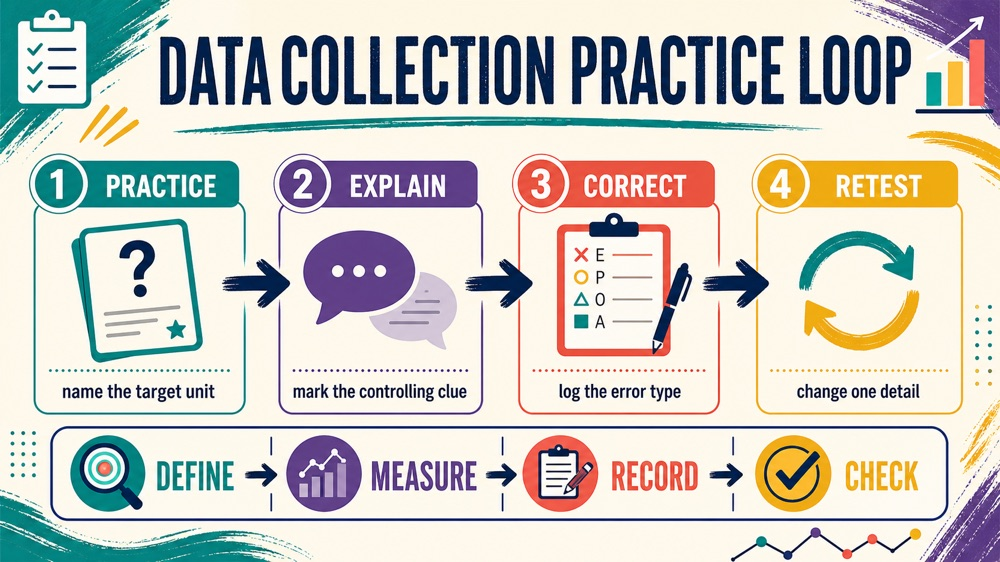
For each error, write one changed scenario. If you missed latency versus duration, keep the behavior the same but change whether the question asks when it starts or how long it continues. If you missed partial versus whole interval, keep the interval length the same but change “at any point” to “throughout.” Retest after a delay and explain the clue aloud.
Bottom line: Effective ABA data collection practice for an RBT is a decision routine: define the response, identify the unit, follow the assigned recording rule, check the record, and report uncertainty through supervision. Use original questions and correction explanations to build transfer, while using the current BACB TCO and Handbook for official scope and process.
Ready to test the measurement decision?
Use original RBT practice questions, record the controlling clue, and turn each data-collection error into a targeted retest.
See the Three RBT Mock Exams →
Frequently Asked Questions
What does ABA data collection practice cover?
It can cover operational definitions, frequency, rate, duration, latency, interresponse time, permanent product, interval methods, ABC recording, graphing, and data integrity. RBT practice should also include plan fidelity and role boundaries.
What is the difference between frequency and rate?
Frequency is the number of occurrences. Rate expresses occurrences relative to a time unit, such as per minute or per hour. Use the unit requested in the scenario.
How do I choose between duration and latency?
Duration measures how long the response lasts. Latency measures the delay from an instruction or event to response onset. Mark “until it stops” versus “before it starts” as the contrast.
Which interval method scores behavior at any point?
Partial-interval recording scores the interval when the behavior occurs at any point. Whole-interval recording requires behavior throughout the interval, while momentary time sampling checks a specified moment.
Can an RBT change a data-collection method when the timer fails?
Follow the written protocol and established supervision route. Notify the supervisor, use an approved backup only when authorized, and document the equipment or protocol problem instead of silently estimating data.
Are these ABA data collection practice questions official?
No. The prompts in this article are newly written independent study materials. They are not official, current, recalled, leaked, retired, or BACB-endorsed questions.
References
- Behavior Analyst Certification Board. RBT Test Content Outline, 3rd edition.
- Behavior Analyst Certification Board. RBT Test Content Outline, 3rd-edition PDF.
- Behavior Analyst Certification Board. RBT Handbook.
- Behavior Analyst Certification Board. Examination Information.
- Independent RBT practice-question hub. Reviewed for competitor research; not an endorsement.
- Independent data-collection quiz. Reviewed for competitor research; not an endorsement.
- Independent ABA data-collection guide. Reviewed for competitor research; not an endorsement.