

Skill acquisition ABA describes the systematic teaching of a new response or performance. For an RBT learner, the important question is not only which procedure has a familiar name. It is how the target is defined, which teaching step the written plan assigns, what prompt or reinforcement arrangement is in place, what data are recorded, and when a concern should be brought to the supervisor.
Table of Contents
- What skill acquisition ABA means—and what it does not
- Place skill acquisition in the current RBT scope
- Read the skill-acquisition plan before acting
- Match prompts and reinforcement to the plan
- Compare shaping, task analysis, and chaining
- Use DTT and naturalistic teaching with purpose
- Plan for fading, maintenance, and generalization
- Skill acquisition ABA scenarios for study
- Separate implementation from program design
- Frequently Asked Questions
- References
The current RBT Test Content Outline, 3rd edition, describes 43 tasks across six domains. Behavior Acquisition is the central domain for skill-acquisition study, but data collection, assessment, behavior reduction, documentation, and ethics shape how teaching is implemented. The current examination context includes 75 scored questions and 10 unscored pilot questions. Use the current BACB TCO and Handbook for official scope and process facts.
RBT Training is an independent educational resource. It is not affiliated with, operated by, or endorsed by the Behavior Analyst Certification Board (BACB). The examples and study prompts in this article are newly written for independent study. They are not official, current, retired, recalled, leaked, or BACB-endorsed questions. No skill-acquisition procedure, practice score, or study schedule can guarantee certification or a passing result.
What skill acquisition ABA means—and what it does not
In ABA, skill acquisition refers to teaching a learner to perform a new functional response or a more complex performance. Targets may involve communication, social interaction, self-care, academic work, motor routines, or self-management. The teaching arrangement is individualized: the same label, such as “requesting,” can require different materials, prompts, reinforcement, response definitions, and generalization checks for different learners.
A skill-acquisition program is not a generic list of activities. It is a plan with measurable targets, a teaching procedure, a data system, decision rules, and a review process. The person who designs or changes that plan may have a different role from the RBT who implements the assigned steps and reports what occurs.
| Part of the system | Question it answers | Study clue |
|---|---|---|
| Target | What exactly should the learner do? | Use observable, measurable response language. |
| Antecedent | What instruction, stimulus, or context starts the opportunity? | Identify the cue and the relevant materials. |
| Prompt | What support helps evoke the response? | Follow the assigned hierarchy or prompt rule. |
| Consequence | What follows the response? | Deliver the planned consequence as written and record the outcome. |
| Data | How will independent, prompted, incorrect, or absent responding be measured? | Use the plan’s unit and scoring rule. |
| Generalization | Does the skill occur with new people, materials, settings, or cues? | Do not assume practice in one context transfers automatically. |
Search results for skill acquisition ABA often promise real-world independence and list procedures such as prompting, shaping, reinforcement, chaining, and discrete-trial teaching. Those concepts are useful, but a study article should keep the plan boundary visible. A procedure name does not authorize an RBT to invent a target, change the reinforcement schedule, or decide that a learner has mastered a skill.
Place skill acquisition in the current RBT scope
The current RBT Test Content Outline, 3rd edition, organizes 43 tasks across six domains. For this article, Behavior Acquisition is the primary study family and the practical task range is C.1–C.11. The connected domain map matters because acquisition decisions depend on accurate data, assessment information, reduction plans, documentation, and ethics.
| Domain | How it connects to acquisition study | Controlling question |
|---|---|---|
| A. Data Collection and Graphing | Measures independent, prompted, incorrect, fluent, or generalized responding. | What was observed and in what unit? |
| B. Behavior Assessment | Informs preference, skill, and descriptive-observation procedures assigned by the plan. | What procedure was assigned, and what did the data show? |
| C. Behavior Acquisition | Includes teaching arrangements, prompting, reinforcement, shaping, chaining, and transfer. | Which teaching step matches the written plan? |
| D. Behavior Reduction | May include replacement-skill teaching and plan-based responses to interfering behavior. | What safer or functional response is being taught? |
| E. Documentation and Reporting | Records implementation, response patterns, barriers, and supervisor communication. | Could another professional verify what happened? |
| F. Ethics | Protects dignity, assent-related communication, privacy, competence, and supervision. | Is the action authorized, respectful, and role-safe? |
The exam context includes 75 scored questions and 10 unscored pilot questions, but a provider’s practice set is not the official examination. Use the current TCO and Handbook to orient scope and process, then use independent scenarios to rehearse plan-based reasoning.
Read the skill-acquisition plan before acting
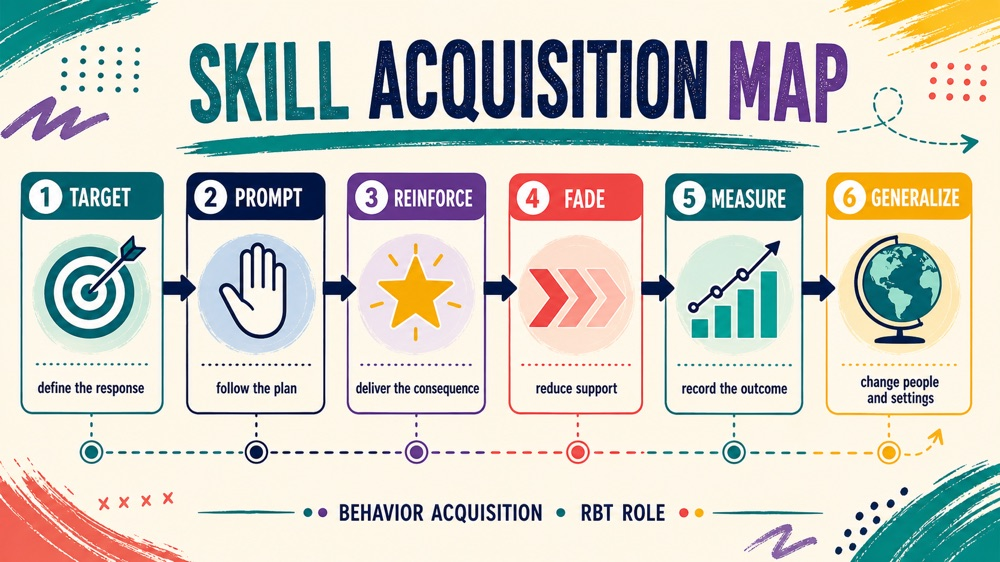
Before implementing a teaching opportunity, identify the target, materials, antecedent, prompt rule, consequence, data method, and mastery or correction rule. This is a better first move than choosing a favorite procedure from memory.
- Target: What response counts, and what is a nonexample?
- Opportunity: What cue or context starts the trial or routine?
- Prompt: Which prompt is delivered, when, and how is it faded?
- Consequence: What is delivered after the assigned response, and under what contingency?
- Correction: What does the plan say to do after an error, no response, or problem behavior?
- Data: What is recorded—independent, prompted, incorrect, latency, duration, step level, or another measure?
- Report: What concern should be documented or brought to the supervisor?
For example: a plan may teach a learner to request a break using a card. The RBT does not decide independently that a spoken request should replace the card because it seems more advanced. The RBT presents the assigned opportunity, follows the written prompt and reinforcement steps, records the response, and asks the supervisor about a possible program change.
Match prompts and reinforcement to the plan
Prompting and reinforcement solve different teaching problems. A prompt is an antecedent support that helps evoke the target response. Reinforcement is a consequence that follows a response and, when effective under the stated conditions, increases future responding. A prompt is not reinforcement simply because it helps a learner succeed, and praise is not automatically a reinforcer unless the response pattern supports that conclusion.
| Concept | What it does | Study boundary |
|---|---|---|
| Prompt | Increases the chance that the target response will occur now. | Use the assigned type, timing, and hierarchy. |
| Prompt fading | Systematically reduces support so the learner responds under more natural conditions. | Follow the fading rule; do not remove support abruptly without a plan. |
| Reinforcement | Follows a response and may increase future responding. | Deliver the planned consequence and record whether the response changes. |
| Error correction | Provides the plan-based response after an incorrect or absent response. | Do not improvise a correction sequence from a different program. |
| Transfer of stimulus control | Moves control from a prompt to the natural or instructional stimulus. | Look for the plan’s transfer procedure and data criterion. |
When comparing least-to-most and most-to-least prompting, do not memorize one hierarchy as universally correct. The appropriate arrangement depends on the written plan, learner response, error history, and supervisor direction. In a practice question, the controlling phrase is often “according to the plan” or “after the learner responds independently.”
Compare shaping, task analysis, and chaining
These procedures are related but not interchangeable. Identify what is changing: the form of one response, the analysis of a complex routine, or the sequence of several responses.
| Procedure | Primary teaching problem | Example of the study distinction |
|---|---|---|
| Shaping | The target response is not yet in the learner’s repertoire or needs to become closer to a final form. | Reinforce successive approximations toward a clearer vocal request according to the plan. |
| Task analysis | A complex routine needs to be described as teachable component steps. | Break handwashing into observable steps with clear start and finish rules. |
| Chaining | Several component responses must be linked into a fluent sequence. | Teach the steps of a routine using forward, backward, or total-task procedures specified by the plan. |
| Modeling | The learner benefits from observing the response or sequence. | Demonstrate the assigned action, then provide the planned opportunity to respond. |
For another example: if a learner can complete steps one, two, and four of a four-step routine but not step three, the question may be about task analysis, prompting, or chaining depending on the plan. Do not select backward chaining merely because the routine has steps. Look for whether the teaching procedure starts with the first link, final link, or whole task.
Use DTT and naturalistic teaching with purpose
Discrete trial teaching and naturalistic teaching are instructional arrangements, not synonyms for all ABA. DTT can create repeated, clearly defined opportunities with an antecedent, learner response, consequence, and pause or reset. Naturalistic teaching embeds opportunities in a relevant activity, motivation, routine, or environment. Both require a clear target, prompting plan, reinforcement arrangement, and data procedure.
| Question | Structured trial emphasis | Naturalistic opportunity emphasis |
|---|---|---|
| Where does it begin? | An arranged instruction or stimulus. | A routine, activity, material, or learner-initiated context. |
| What is measured? | Trial response, prompt level, correction, or accuracy. | Response in a natural context, opportunity, independence, or generalization. |
| What can go wrong? | Repeating trials without checking transfer or learner engagement. | Calling any incidental interaction a teaching opportunity without a defined target or plan. |
| What does the RBT do? | Implement the assigned trial sequence and record it. | Arrange or respond to opportunities as the plan specifies and record the outcome. |
The goal is not to choose the most “natural” or most “structured” method in the abstract. The goal is to implement the authorized teaching arrangement with fidelity and check whether the learner responds under the intended conditions.
Plan for fading, maintenance, and generalization
A skill is not fully useful just because it occurs once with one adult, material, prompt, and room. Acquisition practice should therefore include three separate questions:
- Fading: Can the learner respond with less prompt support while the natural cue remains effective?
- Maintenance: Does the learner continue to perform the skill after teaching intensity or reinforcement conditions change according to the plan?
- Generalization: Does the learner perform with new people, materials, settings, examples, or relevant cues?
For example: a learner requests help from one technician using one card at a table. A generalization check may involve a new adult, room, or routine if the plan specifies it. The RBT records the performance under the assigned conditions; the RBT does not announce that the skill has generalized merely because the learner succeeded in the original teaching context.
Do not treat a prompt-free trial as the only evidence of mastery. Review the plan’s criterion, data pattern, prompt level, and transfer conditions. A practice question that asks what to do when a learner succeeds only after a full prompt may be testing prompt-level recording, not mastery.
Skill acquisition ABA scenarios for study
Use the scenarios below to practice finding the controlling clue. They are original independent-study prompts, not official exam items.
Scenario 1: prompt or reinforcement?
A technician points to a picture card, the learner hands over the card, and the technician delivers the planned break. The point is a prompt; the planned break that follows the response is the consequence. The correction question is whether the plan records the response as prompted or independent.
Scenario 2: shaping or chaining?
A learner produces a partial approximation of a target sound, and the plan reinforces closer approximations over time. That is shaping. If the learner must complete “open drawer, take cup, pour water” as linked component responses, the teaching problem is a chain and should be analyzed as a sequence.
Scenario 3: plan fidelity
The learner does not respond after the assigned prompt. The practice answer is not automatically “add a physical prompt.” Read the error-correction and prompt hierarchy in the plan, implement it as written, record the outcome, and ask the supervisor if the procedure is unclear or ineffective.
Scenario 4: generalization
The learner requests a break with the classroom technician but not with a caregiver during a home routine. Do not label the skill absent or generalized from one observation. Check the assigned generalization conditions, collect the specified data, and report the pattern.
Scenario 5: acquisition versus reduction
A replacement request is taught so the learner can access help instead of engaging in a problem behavior. The request is a skill-acquisition target, even though it may support a behavior-reduction plan. Identify the target being taught and follow the relevant procedure rather than treating every question as a reduction procedure.
Separate implementation from program design
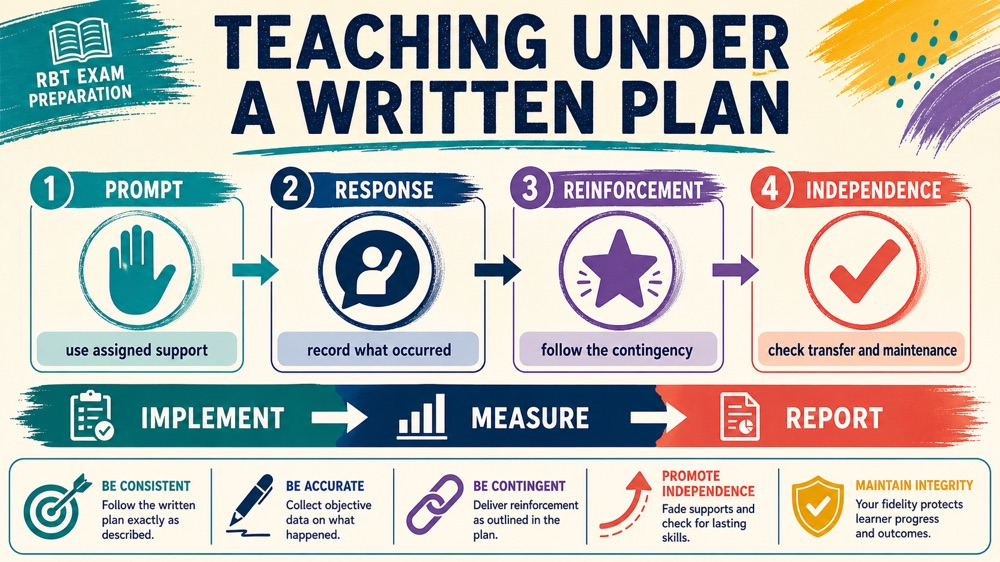
One of the most important RBT study boundaries is the difference between implementing an assigned program and designing or changing a program. An RBT may be expected to prepare materials, present instructions, deliver assigned prompts and consequences, collect data, document observations, and communicate concerns. The RBT should not independently create a treatment goal, change the mastery criterion, choose a new reinforcement schedule, or reinterpret a learner’s behavior outside the supervision structure.
| Study situation | Role-safe next action |
|---|---|
| The prompt level in the written plan is unclear. | Pause as the protocol allows, seek supervisor clarification, and document the issue. |
| The learner’s performance changes sharply. | Collect the assigned data, describe the observable pattern, and report it through the established route. |
| A caregiver asks for a new target. | Listen respectfully, document or communicate the request, and do not promise a program change. |
| A procedure appears ineffective or causes concern. | Follow safety and supervision procedures; do not improvise a replacement intervention. |
| A data sheet does not match the current routine. | Use the approved record process and ask the supervisor rather than silently editing the program. |
Use a correction log after practice: procedure, controlling clue, chosen answer, nearest distractor, role boundary, and next changed scenario. This makes skill-acquisition ABA study active and keeps a high practice percentage from hiding a plan-fidelity error.
Bottom line: Study skill acquisition ABA by connecting the target, teaching arrangement, prompt, reinforcement, data, fading, and generalization conditions. For the RBT role, the best answer is usually the plan-based, observable, supervision-safe action—not an improvised program change. Use the current BACB TCO and Handbook for official boundaries, and use independent scenarios to build transferable reasoning.
Ready to practice behavior acquisition?
Use current-domain practice questions to identify the teaching clue, follow the written plan, and turn each correction into a focused review action.
Try Free RBT Practice Questions →
Frequently Asked Questions
What is skill acquisition ABA?
Skill acquisition ABA is the systematic teaching of a new functional response or performance using an individualized target, teaching arrangement, prompting, reinforcement, data, and review process. An RBT implements assigned procedures under supervision.
What procedures are common in skill acquisition?
Study resources commonly discuss prompting, prompt fading, reinforcement, shaping, task analysis, chaining, discrete trial teaching, naturalistic teaching, discrimination, maintenance, and generalization. The written plan determines which procedure and parameters apply.
What is the difference between shaping and chaining?
Shaping reinforces successive approximations toward one response form. Chaining links component responses into a sequence, often after a task analysis. They solve different teaching problems.
Can an RBT design a skill-acquisition program?
An RBT typically implements assigned procedures, collects data, documents observations, and communicates concerns within supervision. Program design or changes should follow the current role, supervision structure, and written authorization.
How do prompting and reinforcement differ?
A prompt is an antecedent support that helps evoke a response. Reinforcement is a consequence that follows a response and may increase future responding when effective under the stated conditions.
Are these skill acquisition ABA examples official exam questions?
No. The examples are newly written independent-study prompts. They are not official, current, recalled, leaked, retired, or BACB-endorsed questions.
References
- Behavior Analyst Certification Board. RBT Test Content Outline, 3rd edition.
- Behavior Analyst Certification Board. RBT Test Content Outline, 3rd-edition PDF.
- Behavior Analyst Certification Board. RBT Handbook.
- American Speech-Language-Hearing Association. Applied Behavior Analysis and Communication Services. Reviewed for procedure terminology; not an endorsement.
- Cividini-Motta, C., Livingston, C., and Efaw, H. Systematic Review of Differential Reinforcement in Skill Acquisition. Reviewed for research context.
- Independent RBT skill-acquisition study guide. Reviewed for competitor research; not an endorsement.
- Independent RBT behavior-acquisition guide. Reviewed for competitor research; not an endorsement.