

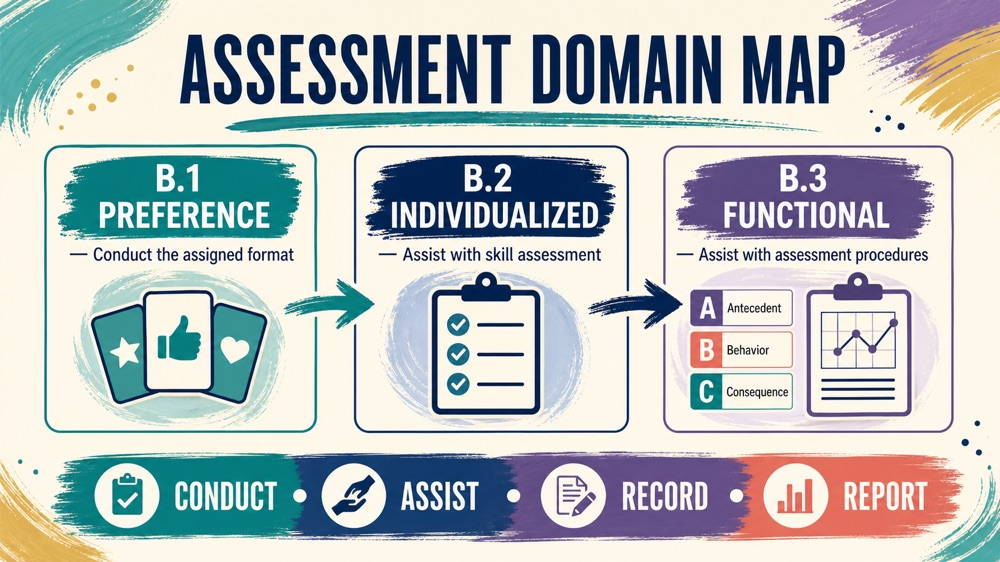
A strong RBT assessment study guide should do more than list preference assessments and functional assessment vocabulary. It should show what the scenario says, which assessment procedure is assigned, what data the RBT collects, and where the RBT’s role stops. The current RBT Test Content Outline, 3rd edition, places Behavior Assessment in three task areas: conduct preference assessments, assist with individualized assessment procedures, and assist with functional assessment procedures.
Table of Contents
- What an RBT assessment study guide should teach
- Use the current B.1–B.3 map
- Conduct preference assessments
- Assist with individualized assessment procedures
- Assist with functional assessment
- Read assessment scenarios by role
- Original assessment decisions
- Build an assessment correction log
- Avoid common assessment-study mistakes
- Frequently Asked Questions
- References
That verb pattern matters. An RBT may conduct an assigned preference assessment, but does not independently diagnose a function, select a treatment, or change a client’s assessment plan. An RBT may assist with individualized skill assessment and functional assessment procedures by implementing assigned steps, recording observations, and reporting accurately under supervision.
The current TCO describes 43 tasks across six domains. The written exam context includes 75 scored questions and 10 unscored pilot questions. The original examples in this guide are independent study content. They are not official, recalled, leaked, or BACB-endorsed questions, and a study guide cannot guarantee certification or a passing result. RBT Training is not affiliated with the BACB.
What an RBT assessment study guide should teach
Assessment questions often look simple because the answer choices contain familiar terms. The real decision is usually hidden in the verb and the evidence:
| Question layer | Ask yourself | Evidence of understanding |
|---|---|---|
| Purpose | What information is being collected? | You distinguish preference information, skill performance, and behavior-function information. |
| Procedure | Which assigned format or protocol is stated? | You follow the described sequence rather than choosing a favorite method. |
| Measurement | What is observed, counted, timed, or recorded? | You write data that another person could verify. |
| Role | Should the RBT conduct, assist, record, report, or ask? | You do not independently diagnose, select treatment, or rewrite the plan. |
| Next step | What happens when the procedure is unclear? | You pause safely and seek direction through the supervision route. |
For example, “identify a reinforcer” can be a misleading shortcut. A preference assessment identifies items or activities selected under an assessment procedure. A reinforcer is demonstrated when a consequence increases a target behavior under the relevant arrangement. The RBT should not promise that the most-selected item will function as a reinforcer in every situation.
Use a study page that makes these distinctions visible. A long glossary without the role boundary can produce a confident but unsafe answer.
Use the current B.1–B.3 map
Search results still contain “B1 to B3” pages based on the former Task List labels. Use them only as a historical crosswalk. For current study, organize the assessment domain around these three task verbs:
| Current task | Plain-language focus | RBT evidence |
|---|---|---|
| B.1 Conduct preference assessments | Implement the assigned procedure to identify relative preference. | Materials, presentation order, choice, timing, removal or return rule, and accurate recording. |
| B.2 Assist with individualized assessment procedures | Support assessment of skill strengths, deficits, or needs under an assigned protocol. | Correct setup, neutral delivery, response recording, and communication of unclear or unusual results. |
| B.3 Assist with functional assessment procedures | Collect or support information about behavior and context according to the assigned procedure. | Operationally defined behavior, antecedent and consequence facts, data integrity, safety, and escalation. |
The current map does not mean every page that says “B1–B3” is useless. It means you should check the edition and rewrite the study note in the current language. Do not silently mix an older scope statement, older domain name, or older exam percentage into a 3rd-edition article.
Conduct preference assessments
A preference assessment is a structured way to learn what a learner chooses or approaches under specified conditions. It is not a free-form question such as “What does the client like?” The procedure controls the materials, array, opportunity, response definition, timing, and recording.
| Format family | What the RBT may need to implement | Study distinction |
|---|---|---|
| Free-operant observation | Make available assigned items or activities and record selection or engagement according to the protocol. | Choice and engagement occur over an observation period rather than one forced pair per trial. |
| Single-stimulus | Present one item at a time and record the defined approach, acceptance, or engagement response. | Do not treat acceptance of one item as a rank comparison unless the protocol creates one. |
| Paired-stimulus | Present two options in the assigned order, record the selection, and rotate pairs as written. | Each choice is between two options; the final hierarchy depends on the full procedure. |
| Multiple-stimulus with replacement | Present an array, record the selection, and return the item according to the written rule. | The selected item remains available for later arrays. |
| Multiple-stimulus without replacement | Present an array, record the selection, remove the chosen item, and follow the next-array rule. | The array changes because the selected item is not returned in that procedure. |
Do not substitute the method from memory. If the procedure sheet says multiple-stimulus without replacement and a selected item is returned, the problem is procedure fidelity, not a small formatting choice. Record the discrepancy and ask for clarification before continuing.
Also separate preference from reinforcer assessment. A preference assessment provides information about choice or selection. A reinforcer assessment tests whether a consequence changes future responding under an arranged contingency. In many RBT situations, the technician implements the assigned procedure and reports the data; the supervising behavior analyst interprets the result and makes treatment decisions.
Assist with individualized assessment procedures
Individualized assessment procedures sample a learner’s current skills, strengths, deficits, or support needs. The procedure may involve task materials, prompts, scoring rules, a curriculum, or a structured probe. The RBT’s job is to implement the assigned steps consistently and record what happens.
- Prepare: check the materials, target definition, order, response window, prompt rule, and scoring field.
- Deliver: use the instruction and interaction specified by the protocol.
- Record: distinguish independent, prompted, incorrect, no-response, and other defined outcomes.
- Protect validity: avoid extra teaching, coaching, praise, or correction when the protocol calls for a probe.
- Report: communicate missing materials, unusual behavior, unclear scoring, or deviations to the supervisor.
A probe is not automatically a teaching trial. If a learner misses an item during an assessment, do not provide an unassigned prompt and then score the response as independent. Follow the scoring rule and ask whether a separate teaching opportunity is authorized.
For example, if a protocol asks whether a learner can identify three pictures independently, the RBT should present the materials, deliver the stated instruction, wait the stated interval, and record the defined response. “The learner seemed to know it” is not a score.
Assist with functional assessment
Functional assessment procedures examine relationships between behavior and environmental events. The RBT may collect descriptive data, implement assigned observation conditions, or support other steps in a written protocol. The RBT should not independently announce the function of behavior or select a behavior-reduction intervention from a study guide.
| Assessment support | What to record | Role boundary |
|---|---|---|
| Descriptive observation | Operationally defined behavior, antecedent, context, consequence, duration or other assigned measure. | Describe patterns without claiming that the pattern proves a function. |
| ABC recording | What occurred immediately before and after the target response, using observable language. | Do not replace events with “wanted attention” or “was avoiding work.” |
| Assigned analysis condition | Implement the exact condition, safety steps, materials, and data rule specified by the qualified supervisor. | Do not alter conditions or continue when safety or authorization is unclear. |
| Communication | Report data, deviations, risks, and questions through the established route. | Interpretation and treatment decisions remain with the responsible professional. |
“The behavior happened after a demand” is a descriptive fact. “The behavior is maintained by escape” is an interpretation that requires appropriate assessment evidence. An RBT assessment study guide should make that distinction explicit because many distractors turn a single observation into a conclusion.
Read assessment scenarios by role
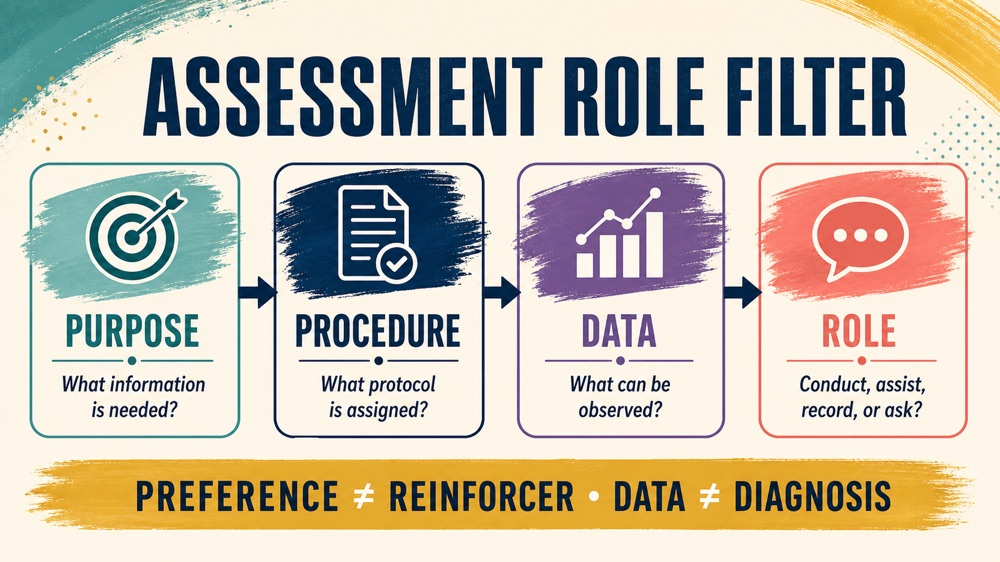
Use this five-question filter:
- What assessment purpose is named: preference, skill, or functional?
- What exact procedure or condition is already assigned?
- What is observable and recordable in the stem?
- Does the verb ask the RBT to conduct, assist, record, report, or interpret?
- What should happen if the protocol, materials, or safety direction is missing?
Eliminate answers that choose a new assessment, alter the item array, teach during a probe, diagnose function from one ABC event, or change the plan without supervision. The best answer usually preserves standardization and data quality.
Original assessment decisions
The following prompts are newly written for independent study. They are not official, recalled, leaked, or BACB-endorsed questions:
- Preference format: The procedure says “multiple-stimulus without replacement,” but the selected item is placed back into the array. What should the RBT do? Pause, record the deviation, and ask for direction; do not silently continue with a different format.
- Preference versus reinforcer: A learner chooses a toy first. What can you conclude? The toy was selected under that preference procedure. You cannot conclude from that choice alone that it will increase a target response as a reinforcer.
- Skill probe: The learner gives an incorrect response and the RBT provides a prompt even though the probe says “no prompts.” What should the correction identify? The prompt changes the assessment condition and affects the score; record according to the rule and notify the supervisor.
- ABC data: A note says, “The client wanted attention and acted out.” What is missing? Observable antecedent, topography, consequence, and the assigned measurement; the inferred motive should not replace data.
- Functional assessment safety: A study partner asks you to add an unassigned condition to see whether the behavior occurs. What is the role-safe response? Do not create or alter an assessment condition. Follow the written direction and contact the qualified supervisor.
- Unexpected result: The data pattern is different from last week. What should the RBT do? Check data integrity and procedure fidelity, report the observation, and avoid independently changing the program.
Change one fact in each scenario and solve again. For example, return the selected item in the first scenario only when the protocol says “with replacement.” The answer changes because the procedure changes, not because the RBT has chosen a preferred method.
Build an assessment correction log
Use a correction log that captures both the technical concept and the role boundary:
| Field | Write | Example |
|---|---|---|
| Assessment purpose | Preference, skill, or functional. | Preference: compare selections under an assigned array. |
| Procedure clue | The exact format, timing, or condition. | Selected item is removed after each choice. |
| Observable evidence | What was seen, heard, counted, or timed. | Reached for the blue card within five seconds. |
| Role verb | Conduct, assist, record, report, or ask. | Implement and record; do not interpret function. |
| Nearest contrast | The tempting wrong concept. | Preference information is not proof of reinforcement. |
| Supervisor question | What remains unclear? | What is the approved action if an item is missing? |
Review low-confidence correct answers as well as misses. If you chose the right option because it “sounded clinical,” you need the decision rule. Then create a changed-fact item and answer without the key.
Avoid common assessment-study mistakes
- Mixing editions: check the 3rd-edition TCO and label B1–B3 material as a crosswalk when needed.
- Calling preference a reinforcer: keep selection and behavior change conceptually separate.
- Teaching during a probe: follow the scoring and prompt rules of the assessment procedure.
- Writing inferred functions as facts: record observable ABC events and report patterns.
- Changing an assessment condition: ask the supervisor before altering materials, arrays, timing, or contingencies.
- Ignoring data integrity: record deviations and unexpected outcomes instead of cleaning them out.
- Using a study guide as clinical authorization: independent notes cannot replace a client-specific written plan or supervision.
Bottom line: a useful RBT assessment study guide maps current B.1–B.3 tasks to observable actions and role-safe decisions. Learn the procedure, record what happened, separate preference from reinforcer evidence, and ask before you interpret or change anything.
Ready to practice assessment decisions?
Use original RBT practice questions to review preference, individualized, and functional-assessment boundaries.
Try Free RBT Practice Questions →
Frequently Asked Questions
What does an RBT assessment study guide cover?
A current guide should cover B.1 preference assessments, B.2 individualized assessment procedures, and B.3 functional assessment procedures, with concepts, examples, data rules, and role boundaries.
Can an RBT independently diagnose the function of behavior?
No. An RBT may collect and report assigned assessment data under supervision, but should not independently diagnose function, choose treatment, or change a plan.
Is a preference assessment the same as a reinforcer assessment?
No. A preference assessment identifies choices or relative preference under specified conditions. A reinforcer assessment examines whether a consequence increases behavior under an arranged contingency.
What should I do if an assessment procedure is unclear?
Pause when appropriate, preserve safety and data integrity, document the uncertainty, and ask the responsible supervisor or qualified assessor for direction.
Are the scenarios in this study guide official RBT questions?
No. They are newly written for independent study and are not official, recalled, leaked, or BACB-endorsed questions.
References
- Behavior Analyst Certification Board. RBT Test Content Outline, 3rd edition.
- Behavior Analyst Certification Board. RBT Test Content Outline, 3rd-edition PDF.
- Behavior Analyst Certification Board. RBT Handbook.
- Independent Area B assessment study guide. Reviewed for competitor research; not an endorsement.
- Independent behavior-assessment guide. Reviewed for competitor research; not an endorsement.
- Independent assessment task guide. Reviewed for competitor research; not an endorsement.