
People search for RBT practice when they need different things: a quick diagnostic quiz, topic-by-topic questions, an untimed study set, or a full exam-style simulation. Choosing the wrong format can waste study time. A short quiz is useful for locating a gap, while a timed set is useful for pacing; neither replaces an explanation-based review.
Table of Contents
- What RBT practice should help you do
- Choose an RBT practice format
- Map RBT practice to the current TCO
- How to use RBT practice answers well
- Original RBT practice decisions
- Build an RBT practice correction log
- Use a seven-day RBT practice routine
- Avoid common RBT practice mistakes
- Frequently Asked Questions
- References
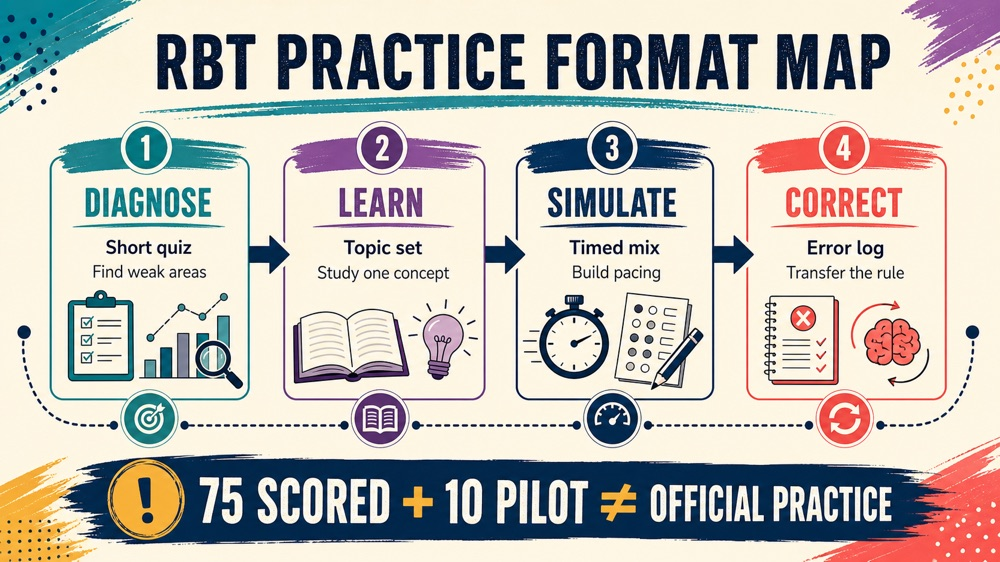
The current BACB RBT Test Content Outline, 3rd edition, defines 43 tasks across six domains. The current written-exam context includes 75 scored questions and 10 unscored pilot questions. A third-party practice resource may present 10, 20, 75, 85, or another number of questions. Its count, timer, score, and explanations remain independent study features.
RBT Training is an independent educational resource. It is not affiliated with or endorsed by the Behavior Analyst Certification Board (BACB), Pearson VUE, or any competitor named in the research. The examples in this guide are newly written for independent study. They are not official, recalled, leaked, or BACB-endorsed questions, and no practice result or study plan can guarantee certification or a passing result.
What RBT practice should help you do
Good RBT practice is not a contest to collect answer letters. It should make you perform four connected actions:
- Read the evidence: identify the observable event, timeline, measurement, procedure, or communication in the stem.
- Match the concept: choose the rule that fits the evidence rather than the term that sounds most advanced.
- Respect the role: distinguish what an RBT implements, records, reports, or asks a supervisor to clarify.
- Explain the contrast: state why the nearest distractor is wrong and what fact would make it correct.
| Practice that looks busy | Practice that builds transfer |
|---|---|
| Repeats familiar questions until the score feels comfortable. | Changes one fact and checks whether the decision changes. |
| Reviews only the letter or bolded answer. | Writes the evidence, decision rule, and nearest contrast. |
| Uses a provider’s pass threshold as if it were official. | Uses scores as a diagnostic signal and returns to current official sources. |
| Chases the largest question bank. | Prioritizes the domain and task pattern behind the errors. |
For example, if a question describes a response continuing for 25 seconds, do not choose frequency simply because “25” is present. Ask whether the stem wants duration, count, latency, rate, or another measurement. The number is not the concept. The question’s timeline and requested unit are the evidence.
Use an independent practice resource as a learning instrument. The value is in the reasoning loop: attempt, explain, correct, transfer, and retest. A score without that loop can hide memorization, lucky guesses, or repeated exposure to the same item.
Choose an RBT practice format
Search results for RBT practice commonly offer four formats. Each has a different job:
| Format | Best use | What to record |
|---|---|---|
| Short diagnostic quiz | Find a first weak area without fatigue. | Domain, task pattern, confidence, and time per item. |
| Topic or domain set | Learn one concept family, such as measurement or prompting. | Definition, example, nearest contrast, and procedure cue. |
| Untimed study mode | Practice reading the stem and reviewing explanations immediately. | Why the correct answer fits and why each close distractor fails. |
| Timed mixed simulation | Build pacing and attention across all six domains. | Score, pacing checkpoints, skipped or guessed items, and error groups. |
Start with a short diagnostic if you do not know where to begin. Move to a domain set when the errors cluster. Use study mode to repair the concept. Use a timed mixed set only after you can explain the rules without relying on instant feedback. Then repeat the cycle with new scenarios rather than simply retaking the same page.
Do not confuse the official exam context with a provider’s interface. The current BACB materials describe 75 scored questions and 10 unscored pilot questions. A resource may choose an 85-question presented-item simulation because it wants to mirror the total context, or a 75-question set because it wants to focus on the scored length. Both can be legitimate study formats when they are labeled honestly; neither provides official questions.
Map RBT practice to the current TCO
A practice schedule should cover the current six-domain outline, not only the topics that appear most often in a competitor’s menu. Use the domain as a coverage check and the task as the study target.
| Domain | Current task range | Practice question to ask |
|---|---|---|
| A. Data Collection and Graphing | A.1–A.8 | What is observable, which measurement fits, and what does the graph or summary show? |
| B. Behavior Assessment | B.1–B.3 | Which assigned assessment procedure applies, and what should the RBT record or report? |
| C. Behavior Acquisition | C.1–C.11 | Which reinforcement, prompting, teaching, chaining, maintenance, or generalization step fits? |
| D. Behavior Reduction | D.1–D.7 | What does the written plan require, and what should happen when a safety or fidelity issue is unclear? |
| E. Documentation and Reporting | E.1–E.4 | How can the note or communication stay objective, accurate, timely, and useful? |
| F. Ethics | F.1–F.10 | What protects competence, dignity, privacy, supervision, and professional boundaries? |
Make a six-domain grid with three columns: attempted, explained, and transferred. A domain is not finished because you answered one question correctly. Mark “explained” only when you can write the rule. Mark “transferred” only after you solve a changed-fact item without the answer key.
Keep former labels visible only as a crosswalk when you encounter older study material. The current edition controls the terminology used for current study. Do not silently combine old percentages, old domain names, and current exam claims in one note.
How to use RBT practice answers well
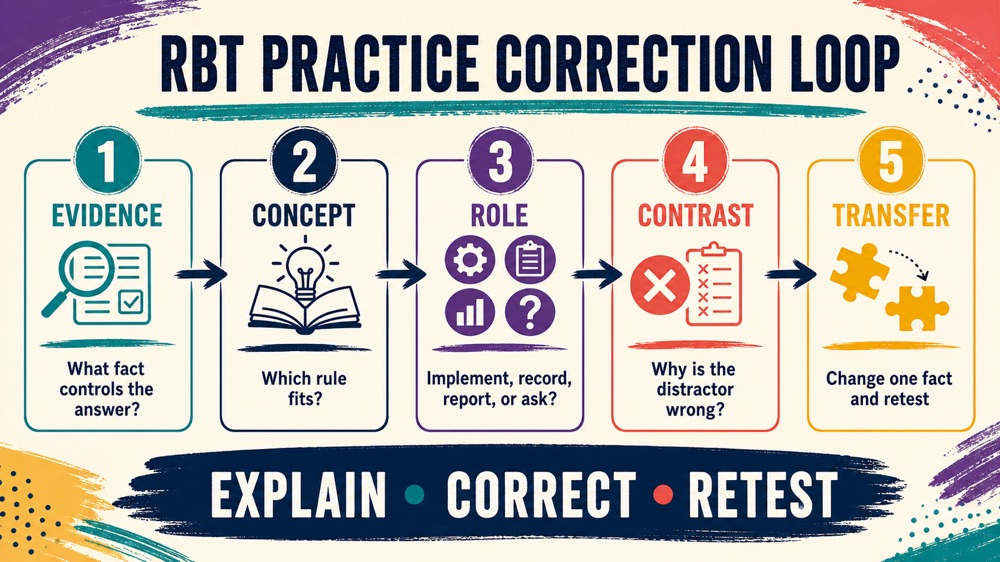
An answer explanation should do more than announce the correct option. For every missed or low-confidence item, write a five-line correction:
- Evidence: What exact fact in the stem controlled the answer?
- Concept: What measurement, teaching, assessment, reduction, documentation, or ethics rule applies?
- Role: What is the RBT expected to implement, record, report, or ask?
- Contrast: Why is the closest distractor not supported?
- Transfer: What one changed fact would change the answer?
Suppose the plan says a prompt is delivered only after a five-second wait. If the learner responds independently at four seconds, the correction is not “choose the reinforcement answer.” The key facts are the wait interval, the independent response, and the programmed consequence. A distractor that adds a prompt before five seconds changes the procedure. A distractor that says “the learner cannot perform the skill” makes an unsupported inference.
Use the same standard for explanations you did not write. If an explanation uses a label but never identifies the observable fact, flag it for verification. If it calls a practice question “real,” “official,” or “guaranteed,” treat that as a credibility problem rather than as evidence of quality.
Original RBT practice decisions
These newly written examples are for independent study. They are not official, recalled, leaked, or BACB-endorsed questions.
- Measurement: A client engages in three episodes of crying. The supervisor asks for the time from the instruction to the start of each episode. Which measurement feature matters? Latency: the interval between the relevant event and the response onset.
- Data quality: The RBT missed two trials while answering a phone call. What is the best correction? Record the deviation according to the procedure, protect data integrity, and report it rather than inventing values.
- Assessment: A written preference protocol specifies multiple-stimulus without replacement. The selected item is returned by habit. What should the correction identify? The return changes the assigned procedure and may affect later choices; follow the written rule and report the deviation.
- Acquisition: A learner needs a model prompt on the first trial, then responds independently on the next trial. What should the record distinguish? Prompted versus independent responding, using the plan’s definitions and scoring rules.
- Behavior reduction: A caregiver requests an unapproved punishment procedure because the current plan feels slow. What is the role-safe answer? Do not introduce the procedure; follow the written plan and communicate the request to the supervising professional.
- Documentation: The note says, “The client was uncooperative.” What should be changed? Replace the label with observable actions, context, prompts, consequences, data, and relevant communication.
- Ethics: A learner’s identifiable video is requested for a private study group. What should happen? Protect privacy and use only approved, de-identified material through the proper authorization route.
- Pacing: You spend four minutes on one item and then guess five later items. What should the practice correction target? Time allocation and flag-for-review strategy, not a claim that the five guessed items represent mastery.
For each scenario, circle the nearest tempting wrong answer and write the missing fact that would make it correct. That step turns RBT practice into flexible reasoning instead of a memory contest.
Build an RBT practice correction log
Use one row for every miss, guess, or correct answer that felt uncertain:
| Field | What to write | Example |
|---|---|---|
| Domain and task | Current TCO domain and the smallest task pattern you can name. | A.1: latency versus duration. |
| Stem evidence | The observable fact, timeline, or exact instruction. | Time from instruction to response onset. |
| Chosen rule | The concept that controls the decision. | Latency measures response onset after an event. |
| Nearest contrast | The option that looked plausible and why it fails. | Duration measures how long the response continues. |
| Role check | Implement, record, report, ask, or stop safely. | Record as assigned; report a procedure deviation. |
| Changed fact | One small change for a transfer item. | Ask for time from response onset to offset. |
Review the log by error group, not only by date. “Wrong measurement unit,” “unsupported inference,” “procedure change,” “subjective note,” and “scope boundary” are more actionable than a list of question numbers. Choose the next study block from the largest group.
Use a seven-day RBT practice routine
If your test is about a week away, a balanced RBT practice routine might look like this:
| Day | Practice block | Proof of progress |
|---|---|---|
| 7 | Short mixed diagnostic | Baseline score, confidence, pacing, and six-domain error map. |
| 6 | Data and assessment | Measurement contrasts and one procedure-fidelity transfer item. |
| 5 | Behavior acquisition | Prompting, reinforcement, teaching, chaining, and generalization corrections. |
| 4 | Behavior reduction | Plan-fidelity, safety, and escalation decisions. |
| 3 | Documentation and ethics | Objective-note rewrites, privacy decisions, and supervision boundaries. |
| 2 | Timed mixed set | Every miss and low-confidence correct answer classified in the log. |
| 1 | Light retrieval and logistics | One contrast per domain, current official information, and a rest plan. |
Do not take a full-length simulation every day if you never review it. One careful correction loop can be more useful than several unexamined scores. If the score falls after you switch to new scenarios, investigate the concept and wording before concluding that you are “getting worse.” New-item difficulty and transfer are different from repeated-item recall.
Avoid common RBT practice mistakes
- Using a score as a guarantee: treat it as a diagnostic signal, not an official prediction.
- Confusing 75 and 85: separate scored questions, unscored pilot questions, and provider-selected practice length.
- Choosing the biggest bank: compare explanation quality, current edition, coverage, and correction support.
- Memorizing familiar stems: change one fact and practice transfer.
- Ignoring low-confidence correct answers: a lucky answer still needs a rationale.
- Changing a written plan: follow assigned procedures and use the supervision route when unclear.
- Writing subjective notes: replace labels with observable and reportable facts.
- Searching for recalled or leaked questions: use original practice to protect exam integrity and your own learning.
Bottom line: choose the practice format that matches your current need, map it to the six current TCO domains, explain every miss, and retest with changed facts. The goal of RBT practice is not a reassuring number; it is accurate, flexible, role-safe reasoning under new wording.
Ready to practice with a correction loop?
Try original RBT practice questions, then use the explanation and correction log to choose what to study next.
See the Three RBT Mock Exams →
Frequently Asked Questions
What is the best way to use RBT practice?
Start with a diagnostic set, study the weakest domain, write an explanation for every miss or guess, and retest with a changed fact. Use current BACB materials for official scope and exam facts.
Should I choose a 75-question or 85-question RBT practice test?
Either can be useful as an independent format. The current written-exam context includes 75 scored questions and 10 unscored pilot questions, while providers may choose a 75-question scored-length set or an 85-question presented-item simulation.
Are online RBT practice questions official?
Third-party questions are not official simply because they use BACB, Pearson VUE, “real,” or “3rd edition” language. Use them as independent study material and verify current facts with the BACB TCO and Handbook.
How do I review an RBT practice score?
Map misses, guesses, and low-confidence correct answers to the six domains, record the evidence and decision rule, identify the nearest contrast, and solve a changed-fact item.
Can RBT practice guarantee that I will pass?
No. A practice score, explanation, question count, or study plan cannot guarantee eligibility, certification, a passing result, or the content of a secure examination.
References
- Behavior Analyst Certification Board. RBT Test Content Outline, 3rd edition.
- Behavior Analyst Certification Board. RBT Test Content Outline, 3rd-edition PDF.
- Behavior Analyst Certification Board. RBT Handbook.
- Behavior Analyst Certification Board. Examination information.
- Independent RBT practice-question hub. Reviewed for competitor research; not an endorsement.
- Independent RBT practice-exam resource. Reviewed for competitor research; not an endorsement.
- Independent RBT practice-test resource. Reviewed for competitor research; not an endorsement.