
RBT supervision requirements are ongoing certification-maintenance requirements, not a one-time study topic. If you provide behavior-analytic services as an RBT, your supervision plan needs to work across the calendar month, the clients you serve, the organization where you work, and the records you may later need to produce.
Table of Contents
- What RBT supervision requirements cover
- Calculate the monthly 5% in the right unit
- Schedule the two live contacts
- Understand observation and individual-meeting rules
- Separate RBT supervision from other training
- Know your supervisor or Requirements Coordinator structure
- Keep a supervision record that can be checked
- Use RBT supervision requirements as exam practice
- What to do when a month is not complete
- Frequently Asked Questions
- References
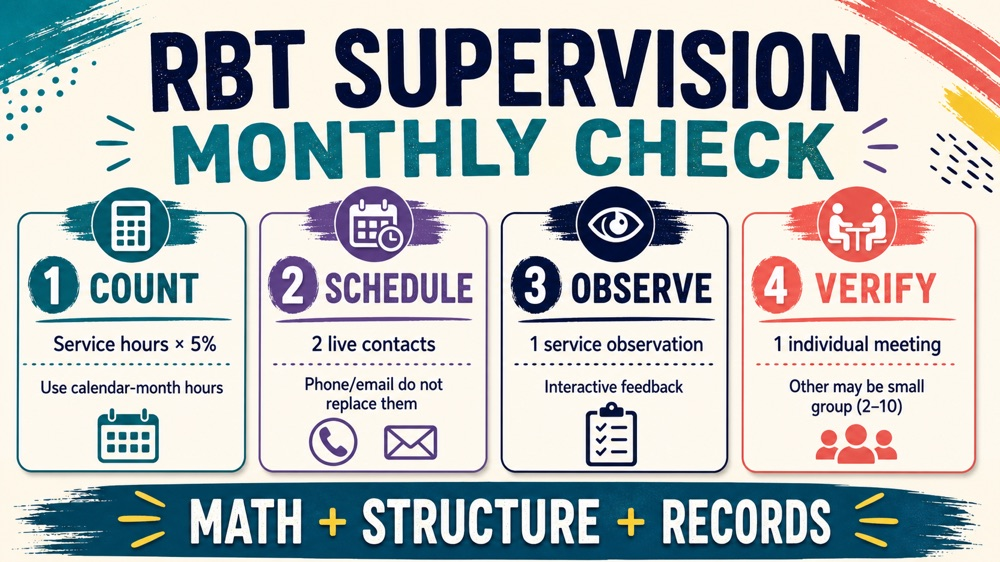
The current BACB RBT Handbook states that an RBT must receive supervision for at least 5% of the hours spent providing behavior-analytic services each calendar month. Supervision must also include at least two face-to-face, real-time contacts each month, observation of the RBT providing services in at least one monthly meeting, and at least one individual meeting. These are not substitutes for reading the current Handbook: they are the framework to verify with the responsible supervisor.
RBT Training is not a BACB certification program and is not affiliated with or endorsed by the BACB. This article is an independent study and planning guide, not a replacement for the current Handbook, supervisor direction, employer policy, applicable law, or client-specific clinical judgment. Examples are newly written for study and are not official, recalled, leaked, or BACB-endorsed questions.
No practice score, course, study guide, or supervision checklist can guarantee certification or a passing result; an independent resource cannot guarantee that outcome. Use the current BACB materials and ask the responsible professional when a requirement or client-specific situation is unclear.
For exam context, the current RBT Test Content Outline, 3rd edition, organizes 43 tasks across six domains. The written examination context includes 75 scored questions and 10 unscored pilot questions, with four answer options and 90 minutes. Supervision questions are usually testing role, documentation, ethics, and implementation reasoning—not whether a learner can memorize a percentage without its conditions.
What RBT supervision requirements cover
Think of the requirements as a monthly system with four layers:
| Layer | Question to answer | Evidence to keep |
|---|---|---|
| Amount | Did supervision reach at least 5% of behavior-analytic service hours this calendar month? | Service-hour total and supervision durations. |
| Structure | Were there at least two face-to-face, real-time contacts, including one individual meeting? | Date, format, participants, and duration for each contact. |
| Observation | Did the supervisor observe the RBT providing services in at least one monthly meeting? | Observation date, client context, and related feedback. |
| Responsibility | Is a qualified supervisor or RBT Requirements Coordinator recorded for the work and clients involved? | Portal relationship, client-specific oversight, and communication trail. |
A calculator can answer only the first row. A meeting can satisfy one condition while leaving another open. For example, a two-hour case discussion may be live and useful but still fail to include an observation of service delivery. Conversely, an observation may be documented but the month may still be short of the 5% amount. Review the whole system.
The Handbook also distinguishes ongoing supervision from professional development. A supervision event cannot simply be relabeled as professional development to satisfy both requirements. Keep the purpose, records, and requirements separate.
Calculate the monthly 5% in the right unit
The 5% calculation uses the hours you spend providing behavior-analytic services in the calendar month. It is not automatically based on payroll hours, commute time, administrative time, or every hour you are physically at work. The exact classification of hours should be confirmed with your supervisor and current organizational procedures.
| Behavior-analytic service hours in the month | 5% minimum calculation | Planning interpretation |
|---|---|---|
| 80 hours | 80 × 0.05 = 4 hours | Schedule enough supervision time to meet or exceed the minimum and still meet the contact structure. |
| 120 hours | 120 × 0.05 = 6 hours | Two contacts alone do not prove six hours; record the duration of qualifying supervision. |
| 37.5 hours | 37.5 × 0.05 = 1.875 hours | Do not round casually; ask how the organization documents the required amount. |
For example: an RBT delivers 96 hours of behavior-analytic services in April. The arithmetic minimum is 4.8 hours. The RBT has two live meetings totaling 5 hours, one individual meeting, and an observation during one meeting. The arithmetic appears complete, but the RBT should still verify that the time was qualifying supervision, that the client-specific relationship was appropriate, and that the records are complete.
Do not carry a surplus from one organization to another. The Handbook states that RBTs working at different organizations must meet the requirements independently at each organization. A strong month at Organization A cannot be used to turn a short month at Organization B into compliance.
Schedule the two live contacts
Current RBT supervision requirements require at least two face-to-face, real-time contacts per month. The Handbook says supervision may not occur over the phone or by email. Web cameras and video-conferencing may be used instead of physical presence when the arrangement complies with applicable laws. Passive video monitoring without real-time interaction or feedback may not count as supervision.
Build the calendar before the month becomes crowded:
- At the beginning of the month, confirm the assigned supervisor or Requirements Coordinator for each organization and client.
- Reserve two live supervision windows rather than waiting for a cancellation.
- Label one meeting as individual and plan the observation in at least one monthly meeting.
- Track service hours weekly so the 5% amount does not become a surprise at month end.
- Use the second contact to review progress, feedback, documentation, and any unresolved procedure question.
If one meeting is canceled, notify the supervisor promptly and reschedule within the same calendar month when possible. A future meeting may be valuable, but it does not automatically rewrite a missed monthly requirement. Ask the responsible professional how to document and report the situation.
Understand observation and individual-meeting rules
At least one of the two monthly supervision sessions must include observation of the RBT providing services. The Handbook prefers in-person, on-site observation, while allowing real-time web-camera or video-conference methods when lawful and appropriate. The observer should be able to provide interactive feedback; a recording or silent camera feed is not automatically enough.
At least one of the two sessions must be individual, meaning no other RBTs or trainees are present. The other may be a small-group meeting. The current Handbook describes a small group as an interactive meeting with 2–10 RBTs who share similar experiences. A large staff presentation, email thread, or generic webinar should not be silently treated as one of the two required contacts.
| Situation | What to check | Common reasoning error |
|---|---|---|
| Live one-to-one meeting with an observation | Amount, date, duration, client context, feedback, and record. | Assuming the observation alone proves the 5% amount. |
| Live small-group meeting | Interactive format, similar experiences, group size, and whether the other required individual contact is scheduled. | Counting any staff meeting as qualifying supervision. |
| Recorded session review without live interaction | Ask whether the method meets the current requirements and how feedback is delivered. | Calling passive monitoring face-to-face supervision. |
| Phone call or email update | Use it for communication when appropriate, but do not assume it replaces a required live contact. | Confusing communication with supervision structure. |
Separate RBT supervision from other training
Several activities can appear similar but have different purposes:
- 40-hour training: education used in the path toward initial certification; it is not ongoing monthly supervision.
- Initial or renewal competency assessment: performance assessment under the applicable packet and qualified assessor; it is not a substitute for monthly supervision.
- Ongoing RBT supervision: client-focused oversight, observation, feedback, and review while the RBT provides services.
- Professional development: a separate maintenance requirement with its own rules; do not double-count one event without confirming that both requirements allow it.
- BCBA or BCaBA supervised fieldwork: a different certification pathway with different requirements; do not answer an RBT question with fieldwork rules.
This distinction is a frequent exam trap. If a stem asks how an RBT maintains certification while providing services, start with the RBT Handbook’s ongoing-supervision section. If it asks about BCBA fieldwork, use the appropriate BCBA or BCaBA Handbook instead. The word “supervision” does not make every supervision system interchangeable.
Know your supervisor or Requirements Coordinator structure
The current Handbook describes an RBT Supervisor structure and an RBT Requirements Coordinator structure. Under the first, one or more RBT Supervisors provide supervision and are responsible for the services the RBT provides. Multiple supervisors at one organization collaborate so the requirements are met. Under the second, the Requirements Coordinator coordinates supervision across supervisors and ensures that requirements are met; the coordinator may also serve as a supervisor.
| Question | Why it matters | Safe next action |
|---|---|---|
| Who is responsible for the services I provide? | Responsibility and client-specific oversight must be clear. | Confirm the structure with the supervisor or coordinator. |
| Who must list me in the BACB portal? | The required portal relationship depends on the structure. | Verify the current Handbook and portal record. |
| Do I have coverage for every client? | Supervision must be connected to the work and client context. | Raise any uncovered client before providing services. |
| What happens when supervision ends? | Records, client transition, and portal changes need to be handled. | Discuss the end date and documentation with the responsible professional. |
Supervisors and Requirements Coordinators must meet the applicable qualifications and complete training based on the Supervisor Training Curriculum Outline (2.0) before providing supervision. The RBT should not privately appoint an unqualified person or treat a workplace title as proof of BACB eligibility.
Keep a supervision record that can be checked
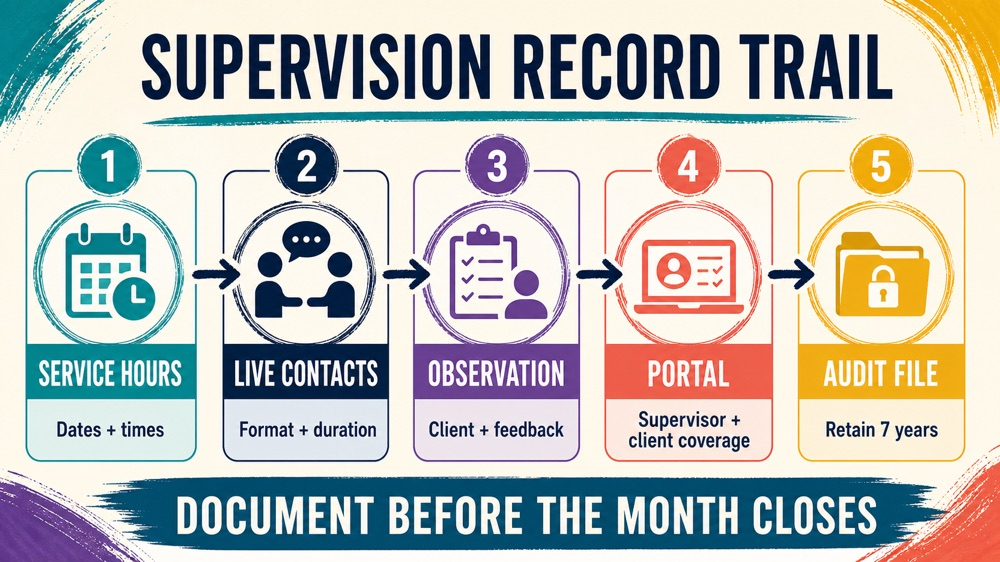
The BACB Handbook describes documentation such as the days and times of behavior-analytic services, supervision dates and durations, supervision format, direct-observation dates, supervisor names, proof of the supervisor’s relationship to the client, and additional records when documentation conflicts. The RBT and supervisor or Requirements Coordinator must retain supervision documentation for at least seven years, even after the relationship ends.
A practical private tracking sheet can include:
- calendar month and organization;
- behavior-analytic service hours used for the calculation;
- each live supervision date, start/end time, duration, and format;
- individual versus small-group status and group size when relevant;
- observation date, client context, procedures observed, and feedback;
- supervisor or Requirements Coordinator name and portal status;
- questions, gaps, rescheduling notes, and the date they were escalated; and
- confirmation that the record is stored through an approved, privacy-protective process.
Do not put identifiable client information into an unapproved study tool just to make the spreadsheet feel complete. Use the minimum necessary information and follow the employer’s privacy process. Accurate documentation is part of professional responsibility, not merely a renewal formality.
Use RBT supervision requirements as exam practice
For exam study, map the supervision topic to the current TCO instead of memorizing an isolated number:
| Domain | Tasks | Supervision reasoning to practice |
|---|---|---|
| A. Data Collection and Graphing | A.1–A.8 | Track service hours and supervision durations accurately; do not guess or backfill. |
| B. Behavior Assessment | B.1–B.3 | Use client-specific information and recognize when an assessment decision belongs to the supervisor. |
| C. Behavior Acquisition | C.1–C.11 | Implement the written teaching procedure and seek feedback when prompting or reinforcement directions are unclear. |
| D. Behavior Reduction | D.1–D.7 | Follow the assigned safety and reduction procedure; report changes or uncertainty rather than improvising. |
| E. Documentation and Reporting | E.1–E.4 | Write objective notes, protect records, and communicate a supervision gap promptly. |
| F. Ethics | F.1–F.10 | Maintain competence, boundaries, confidentiality, and respectful communication under supervision. |
Original practice scenarios:
- Math: An RBT reports 100 behavior-analytic service hours in May and 3 hours of supervision. The answer should first identify the 5-hour minimum, then check whether the two live contacts, individual meeting, observation, and documentation conditions are also satisfied.
- Format: A supervisor watches a recorded session but sends feedback two days later by email. Ask which fact controls whether the event counts as a required face-to-face, real-time contact; do not assume that watching a video alone satisfies the structure.
- Organization: An RBT has 60 service hours at Organization A and 80 at Organization B. Calculate and track each organization’s requirement separately; do not combine the hours or transfer supervision across employers.
- Role: A group meeting includes 14 RBTs and a generic slide presentation. The nearest contrast is a small, interactive group of 2–10 RBTs; ask the supervisor how the event should be classified instead of silently counting it.
- Documentation: A former supervisor says, “We remember meeting, so no log is needed.” The stronger response is to preserve the required documentation and resolve the discrepancy through the proper route because audit responsibilities can continue after the relationship ends.
For each scenario, write the controlling fact, the applicable rule, the RBT’s role, the nearest wrong answer, and one changed fact. This five-part correction routine supports the same reasoning used across all six domains.
What to do when a month is not complete
If the month appears short, do not fabricate time, relabel an email as supervision, or wait until recertification to mention it. Use a calm escalation sequence:
- Compare the service-hour total, supervision log, calendar, and portal relationship.
- Tell the supervisor or Requirements Coordinator exactly which condition appears incomplete.
- Ask what can be corrected within the current month and how the issue must be documented.
- Follow the current Handbook’s reporting, inactive-status, and self-reporting guidance when applicable.
- Do not continue providing services without the required supervisor or Requirements Coordinator on record; an RBT without one on record may be inactive and may not practice, bill, or represent themself as an active RBT.
Non-practicing RBTs have a different maintenance context: the Handbook states that monthly supervision is not required while they are not providing behavior-analytic services as an RBT, although other maintenance requirements still apply. Confirm the current status rules before making a change.
Bottom line: treat RBT supervision requirements as a monthly quality system, not a single percentage. Count the correct service hours, schedule two live contacts, include one observation and one individual meeting, keep client-focused records, understand the supervisor structure, and escalate gaps early. For exam study, use the current TCO and Handbook; an independent article can organize the reasoning, but it cannot replace BACB requirements or supervisor direction.
Ready to review RBT supervision concepts?
Use original RBT practice questions, map each decision to the current TCO, and verify supervision facts with the BACB Handbook and your responsible supervisor.
Try Free RBT Mock Exams →
Frequently Asked Questions
What are the current RBT supervision requirements?
The current BACB Handbook states that an RBT must receive supervision for at least 5% of the hours spent providing behavior-analytic services each calendar month, with at least two face-to-face, real-time contacts, an observation in at least one monthly meeting, and at least one individual meeting. Verify the current Handbook for the full conditions.
Does phone or email supervision count?
The Handbook states that supervision may not occur over the phone or by email. Real-time video-conferencing may be permitted when the arrangement follows applicable requirements; passive video monitoring alone may not count.
Can I combine supervision hours from two employers?
No. RBT supervision requirements must be met independently at each organization where you provide behavior-analytic services. Confirm the calculation and records with each responsible supervisor.
Can a group meeting replace individual supervision?
Not by itself. At least one of the two monthly supervision sessions must be individual. The other may be an interactive small-group meeting with 2–10 RBTs who share similar experiences, subject to the current Handbook.
How long should supervision records be kept?
The current Handbook states that the RBT and supervisor or Requirements Coordinator must retain supervision documentation for at least seven years, including after the supervisory relationship ends.
Are RBT supervision requirements the same as BCBA fieldwork?
No. RBT ongoing supervision, BCBA or BCaBA supervised fieldwork, professional development, training, and competency assessment are different systems. Use the handbook that matches the credential and question.
References
- Behavior Analyst Certification Board. Registered Behavior Technician Handbook. Current Handbook source for ongoing supervision, structures, records, and maintenance.
- Behavior Analyst Certification Board. Supervision, Assessment, Training, and Oversight.
- Behavior Analyst Certification Board. Supervision Checklist for RBTs.
- Behavior Analyst Certification Board. RBT Test Content Outline, 3rd edition.
- Behavior Analyst Certification Board. RBT Test Content Outline, 3rd-edition PDF.
- RBT Supervision Calculator. Reviewed for competitor research; not an endorsement.
- The RBT Renewal Guide. Reviewed for competitor research; not an endorsement.