
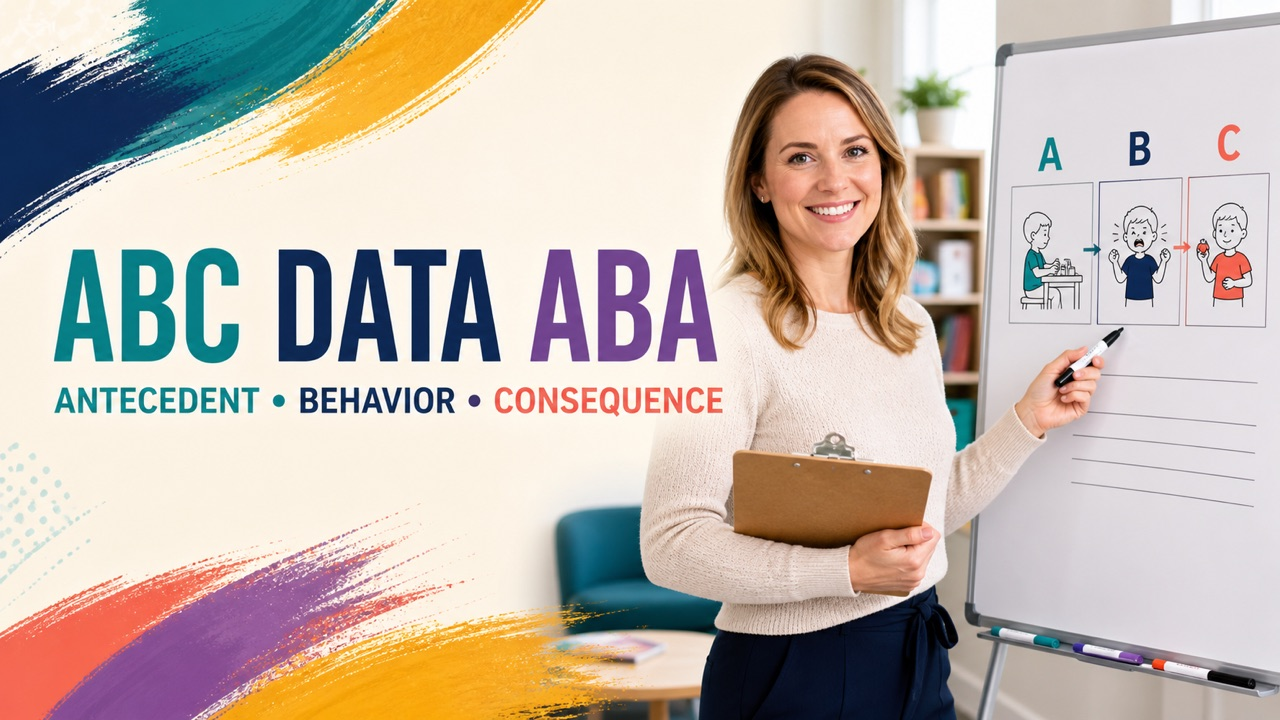
ABC data ABA recording is a direct-observation method for describing what happened around a behavior: the antecedent before it, the behavior itself, and the consequence immediately after it. For an RBT, the quality of the record depends on operational definitions, neutral language, accurate timing, and knowing what the record can and cannot establish.
Table of Contents
- What ABC data ABA means
- Define the three terms
- Write an operational behavior description
- Record antecedents objectively
- Record consequences without overclaiming
- Separate consequence from intervention
- Map ABC data to six TCO domains
- Original ABC data ABA examples
- Audit an ABC data sheet
- Fix common ABC data errors
- Frequently Asked Questions
- References
ABC data can reveal patterns that help a supervisor evaluate assessment or intervention decisions, but one entry does not prove a behavior’s function. Descriptive observation is not the same as a functional analysis, and an RBT should not independently announce a clinical conclusion or change a plan based on a single ABC form.
The current BACB RBT Test Content Outline, 3rd edition, organizes 43 tasks across six domains. ABC recording connects especially to Behavior Assessment, Data Collection and Graphing, Documentation and Reporting, and Ethics, but it can appear in acquisition, reduction, and supervision scenarios too. The examination context includes 75 scored questions and 10 unscored pilot questions.
RBT Training is an independent study resource, not a clinical supervisor or BACB certification program. The examples below are newly written for study and are not official, recalled, leaked, or BACB-endorsed questions. No ABC form, data pattern, course, or practice score can guarantee certification or a passing result.
What ABC data ABA means
The phrase ABC data ABA combines the recording method with its applied behavior-analysis context:
| Letter | Meaning | Question to answer |
|---|---|---|
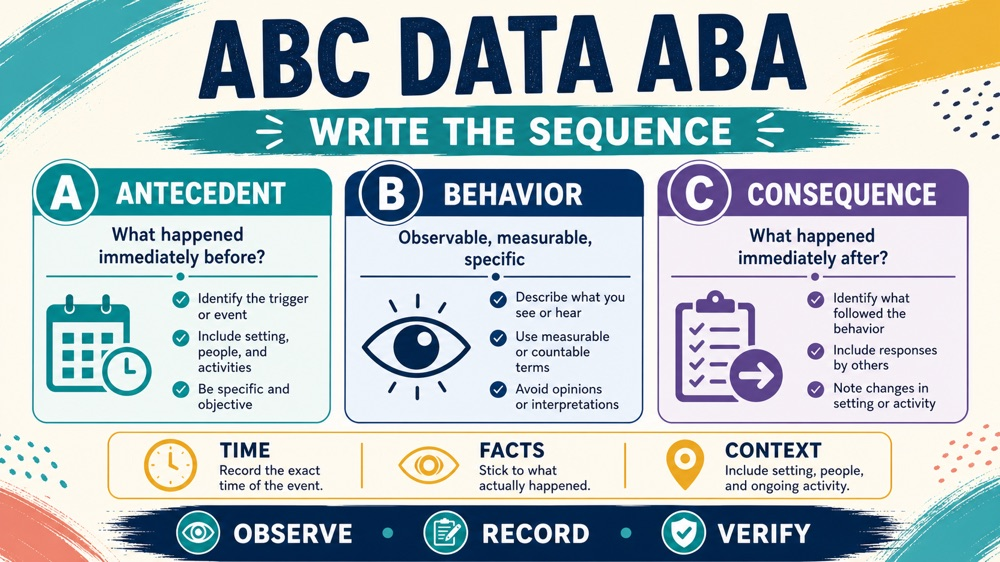
| A | Antecedent: relevant event or condition immediately before the behavior. | What happened right before, and what did the observer actually see or hear? |
| B | Behavior: the target response described in observable and measurable terms. | What did the person do, how often, how long, or with what intensity if defined? |
| C | Consequence: immediate environmental change or event after the behavior. | What changed next, including what others did or what became available? |
ABC data is often called a descriptive assessment method because it describes naturally occurring events. The pattern may suggest a hypothesis for further assessment, but the RBT’s job is to collect and communicate accurate information under direction. The RBT should not label a function as certain just because an antecedent looks familiar.
For example: if a demand is presented, the learner pushes the worksheet away, and the demand is removed, the record should describe those events. It may be consistent with an escape-related pattern, but the record itself is not a guarantee that escape is the only variable or the confirmed function.
Define the three terms
Before collecting ABC data ABA, prepare a form that matches the written observation direction:
- Choose the target: record the behavior named in the plan or supervisor direction, not every movement that seems unusual.
- Anchor the time: use the required date, session, time, or observation window so the sequence is understandable.
- Use the operational definition: write the topography, onset, offset, examples, and nonexamples required by the plan.
- Observe the sequence: record the relevant event before, the defined response, and the immediate change afterward.
- Mark uncertainty: write “unknown” or ask the supervisor when the observer did not see a relevant event; do not fill the blank with a guess.
An ABC form is not improved by adding every contextual detail. Include information that is relevant to the target, observable, and required by the procedure. A long narrative can still be poor data if it mixes observations with motives, diagnoses, or judgments.
Write an operational behavior description
The B column should be the clearest part of the form. Avoid labels such as “tantrum,” “defiant,” “attention-seeking,” or “noncompliant” unless the plan has operationally defined exactly what the label includes. A useful description answers what the observer could count or time.
| Weak wording | Observable wording |
|---|---|
| Client had a tantrum. | Client lay on the floor, cried above conversational volume, and kicked the chair twice. |
| Client was aggressive. | Client placed an open hand on the staff member’s forearm and pushed forward for approximately two seconds. |
| Client refused work. | After the instruction, client turned away from the worksheet and did not touch it for 30 seconds. |
| Client wanted attention. | Client called the staff member’s name three times while the staff member spoke with the caregiver. |
Do not infer private events or motives in the behavior field. “Wanted attention” is a possible hypothesis, not what the observer directly saw. If the target definition includes intensity, duration, or a safety code, follow the exact plan rather than inventing a new scale.
Record antecedents objectively
An antecedent is not always the event that occurred ten minutes earlier or the reason someone believes the behavior happened. Start with the immediate observable context:
- what instruction, demand, transition, question, or interaction occurred;
- what item, activity, person, or event was presented, removed, delayed, or unavailable;
- what the learner and staff were doing immediately before the response;
- what relevant change in setting, schedule, materials, or attention was visible; and
- whether the observer actually saw the event or is reporting it secondhand.
Some forms also include motivating-operation or setting-event fields. Use those fields only as defined by the procedure. Do not rewrite an inferred “attention deprivation” as if it were directly observed. A precise form can distinguish “staff began speaking with caregiver” from “client was deprived of attention.”
Record consequences without overclaiming
The consequence is the immediate event or environmental change after the behavior. It is not automatically the intervention selected by the treatment team, and it is not automatically “the function.” Record what happened next:
- the instruction continued, stopped, or changed;
- an item, activity, break, or attention became available or remained unavailable;
- staff blocked, redirected, prompted, waited, or called for help;
- the learner moved, paused, returned, or made another observable response; and
- the next event that ended the observation sequence.
Imagine a learner screams after an iPad is removed and staff return the iPad. The consequence entry can state that the iPad was returned. It should not automatically state “the behavior was reinforced” unless the relevant behavioral effect and analysis support that conclusion. In a direct ABC record, keep observation and interpretation separate.
Separate consequence from intervention
Many templates add a fourth column called “intervention.” That can be useful when the supervisor specifically asks for it, but do not merge it with the C column:
| Field | What belongs there | Example |
|---|---|---|
| Consequence | What immediately changed after the target behavior. | Staff removed the worksheet and client left the table. |
| Intervention | The authorized procedure implemented in response. | Staff followed the written break-request protocol and represented the demand. |
| Outcome | What happened after the procedure or later in the sequence. | Client requested a break and returned after the timer. |
| Hypothesis | Supervisor’s interpretation or assessment question, not a guessed fact. | Review whether escape-related variables recur across observations. |
An RBT may need to record both the natural consequence and the plan-based response, but the form and supervisor direction control the fields. If the intervention was not implemented as written, record the discrepancy honestly and notify the supervisor rather than editing the consequence to make the session look cleaner.
Map ABC data to six TCO domains
ABC data is not isolated from the rest of the RBT exam:
| Domain | ABC connection | Exam or work boundary |
|---|---|---|
| A. Data Collection and Graphing | Use observable definitions, direct observation, time anchors, and reliable recording. | Do not change the measurement or definition independently. |
| B. Behavior Assessment | Collect descriptive antecedent, behavior, and consequence information as assigned. | Do not claim a confirmed function from one descriptive entry. |
| C. Behavior Acquisition | Record events around skill opportunities, prompts, reinforcement, and errors. | Follow the teaching procedure; do not treat every consequence as reinforcement. |
| D. Behavior Reduction | Document patterns around target behavior and assigned reduction or safety procedures. | Protect the client and follow the plan when escalation occurs. |
| E. Documentation and Reporting | Write objective notes, communicate patterns, correct errors, and protect records. | Do not backfill, guess, or use identifying details unnecessarily. |
| F. Ethics | Respect dignity, privacy, competence, supervision, and client rights. | Ask or report when the request exceeds role or creates risk. |
Original ABC data ABA examples
The examples below are newly written for independent study. They show how to describe events without turning a single observation into a clinical conclusion.
- Demand context: A: staff placed a math worksheet on the table and said, “Start problem one.” B: client pushed the worksheet to the floor and said, “No.” C: staff picked up the worksheet and the demand remained in place while the client stood up. Do not add: “Client wanted escape.”
- Attention context: A: staff began speaking with the caregiver for 20 seconds while the client played. B: client called staff’s name three times and tapped staff’s arm. C: staff turned toward the client and said, “What do you need?” Record: the interaction, not a motive.
- Tangible context: A: staff said, “Tablet time is finished,” and reached toward the tablet. B: client screamed and held the tablet against the chest. C: staff blocked access and presented the transition card according to the plan. Keep separate: the observed response and the plan-based procedure.
- Automatic-variable question: A: no immediate change was observed before the response during a quiet activity. B: client hummed continuously for 15 seconds. C: client continued humming while staff recorded. Write: “No immediate antecedent observed,” not “automatic function confirmed.”
- Unclear sequence: The observer entered after the behavior began. A: unknown because the preceding event was not observed. B: client threw two blocks toward the wall. C: staff cleared nearby materials and called the supervisor. Quality: unknown is more accurate than a guessed demand or attention event.
- Skill acquisition: A: staff presented the picture card and delivered the planned instruction. B: client touched the correct card after a gestural prompt. C: staff delivered the programmed consequence and recorded the prompt level. Use: the same ABC logic can describe skill trials, not only problem behavior.
- Safety: A: the transition was announced. B: client moved quickly toward the exit. C: staff followed the written safety procedure, blocked unsafe access as authorized, and notified the supervisor. Do not: invent a restraint or omit the event.
- Privacy: A data sheet contains a client’s identifying information. Best action: store and transmit it through the authorized secure system; do not photograph or post it for convenience.
Audit an ABC data sheet
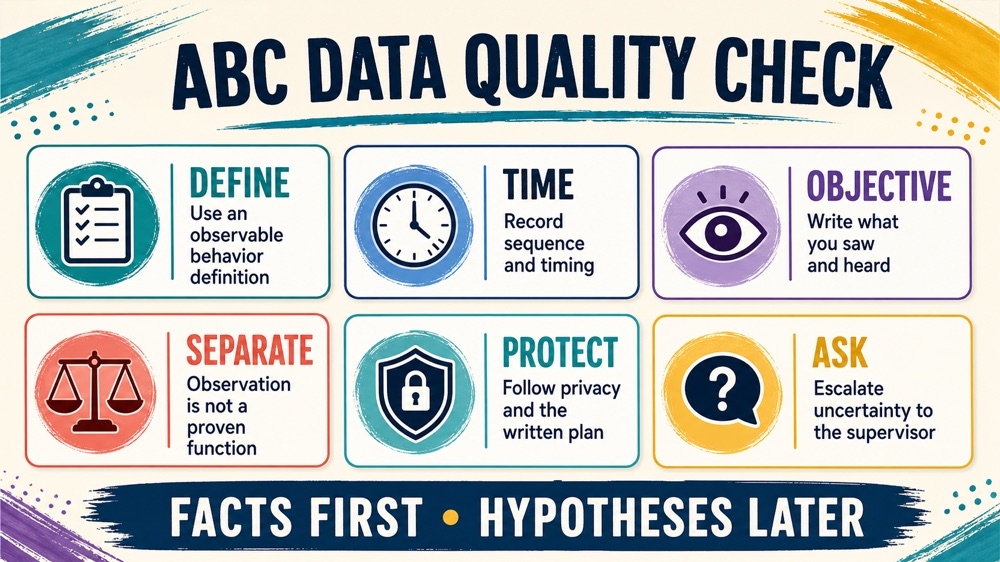
Before submitting, use this five-part quality check:
- Sequence: can another reader tell what happened before, during, and after?
- Definition: is the behavior observable, measurable, and consistent with the plan?
- Timing: are the date, time, session, and observation window clear?
- Neutrality: are motives, diagnoses, and function hypotheses separated from direct observation?
- Integrity: are unknowns marked, errors corrected transparently, and private information protected?
| Question | Pass condition | Repair |
|---|---|---|
| Could the behavior be counted or timed? | Topography and boundaries are clear. | Ask the supervisor for the operational definition. |
| Did the observer see the antecedent? | Event is described or marked unknown. | Do not reconstruct from a guess. |
| Is the consequence observable? | Environmental change is stated. | Remove “got what they wanted” unless the item is defined. |
| Was an intervention also implemented? | It appears in its own field or note. | Do not merge it into the consequence. |
| Does the form expose private information? | Only authorized information is shared securely. | Use the approved record system and access controls. |
Fix common ABC data errors
- Writing the function as the antecedent: replace “wanted attention” with the observed interaction or event.
- Writing the behavior as a label: use the operational definition and observable topography.
- Writing the intervention as the consequence: record the immediate environmental change separately from the planned response.
- Assuming one row proves a function: describe the pattern and let the qualified supervisor determine the next assessment step.
- Leaving an unknown blank: mark unknown and explain what was not observed.
- Backfilling later: correct the record through policy and preserve an honest audit trail.
- Overcollecting: follow the assigned target and measurement system so the record is feasible and reliable.
- Sharing a screenshot: protect client privacy even when the screenshot seems educational.
Bottom line: strong ABC data ABA work is specific, timed, observable, humble about conclusions, and faithful to the plan. Record the sequence you saw, keep consequence and intervention separate, report patterns to the supervisor, and use multiple observations before anyone treats a pattern as a hypothesis worth testing.
Ready to practice ABC data?
Review original RBT scenarios, compare the nearest distractor, and choose the next concept to study.
Try Free RBT Mock Exams →
Frequently Asked Questions
What does ABC data ABA mean?
It refers to direct observation of the antecedent before a behavior, the observable behavior, and the consequence or immediate environmental change after it in an applied behavior-analysis context.
Does one ABC data entry prove the function of behavior?
No. ABC data is descriptive information that may help a qualified supervisor evaluate patterns and next steps. One row does not independently confirm a function or replace a functional analysis.
What should go in the behavior column?
Write what was observed using the operational definition: topography, count, duration, intensity or other required measurement. Avoid motives and labels such as “attention-seeking.”
Is the consequence the same as the intervention?
Not always. The consequence is what changed immediately after the behavior. An intervention is the authorized procedure implemented in response. Record them separately when the form or supervisor requires both.
What if I did not see what happened before the behavior?
Mark the antecedent as unknown or not observed according to the form and ask the supervisor how to proceed. Do not fill the gap with a guess.
Can ABC data ABA study materials guarantee a passing score?
No. An ABC form, article, course, or practice score can support study but cannot guarantee certification or a passing result.
References
- Behavior Analyst Certification Board. RBT Test Content Outline, 3rd edition.
- Behavior Analyst Certification Board. RBT Handbook.
- Behavior Analyst Certification Board. RBT Ethics Code (2.0).
- Indiana Institute on Disability and Community. Observing Behavior Using A-B-C Data.
- ABA Notes Pro ABC data guide. Reviewed for competitor research; not an endorsement.
- StudyBee ABA ABC data guide. Reviewed for competitor research; not an endorsement.
- TallyFlex ABC data guide. Reviewed for competitor research; not an endorsement.