

RBT test study guide searches are useful only when the guide matches the current examination blueprint and helps you make better decisions in new scenarios. The safest starting point is the BACB RBT Test Content Outline, 3rd edition, plus the current RBT Handbook—not a recycled list that quietly uses an older edition.
Table of Contents
- RBT test study guide: start with the current blueprint
- Build a six-domain map
- Use practice questions correctly
- Turn errors into a review loop
- Study Domains A and B: data and assessment
- Study Domains C and D: acquisition and reduction
- Study Domains E and F: documentation and ethics
- Pace an 85-question session
- Original RBT test study guide scenarios
- Audit a free study resource
- Use a seven-day plan
- Frequently Asked Questions
- References
The current outline describes 43 tasks across six domains. The RBT examination includes 75 scored questions and 10 unscored questions; the current Handbook describes 85 multiple-choice questions, four options per question, and 90 minutes. Those facts can shape your practice format, but third-party practice questions are independent study materials rather than official examination content.
This guide gives you a study map, a question-review loop, pacing rules, and original examples. It does not reproduce, recall, reconstruct, or imply access to secure BACB questions. RBT Training is an independent study resource; the examples are newly written and are not official, recalled, leaked, or BACB-endorsed. No guide, practice score, or course can guarantee certification or a passing result.
RBT test study guide: start with the current blueprint
A study guide is a navigation tool, not a replacement for the source document. Read the TCO once for structure, then use the Handbook for current examination preparation and policy details. If a page says “Task List 2nd edition” but presents itself as a 2026 guide, mark the version difference before using it. Core ABA concepts may overlap, but names, task groupings, and emphasis can change.
| Source or tool | Best use | What not to infer |
|---|---|---|
| Current TCO | Identify the six domains, 43 tasks, examples, and question distribution. | It is not a complete textbook or a promise that every task receives the same number of items. |
| RBT Handbook | Check preparation guidance, exam logistics, rules, and the current certification pathway. | A practice result is not an official score report. |
| 40-hour training materials | Relearn demonstrations, procedures, and examples from your own course. | Finishing training alone does not mean the exam or certification requirements are complete. |
| Independent questions | Practice retrieval, discrimination, pacing, and explanation quality. | They are not recalled or BACB-endorsed questions. |
For example: if a guide gives you 20 flashcards for “reinforcement” but never asks you to choose a consequence in context, it may support vocabulary recognition without testing application. Add a scenario, state the observable response, identify the programmed consequence, and explain why the nearest alternative is wrong.
Build a six-domain map
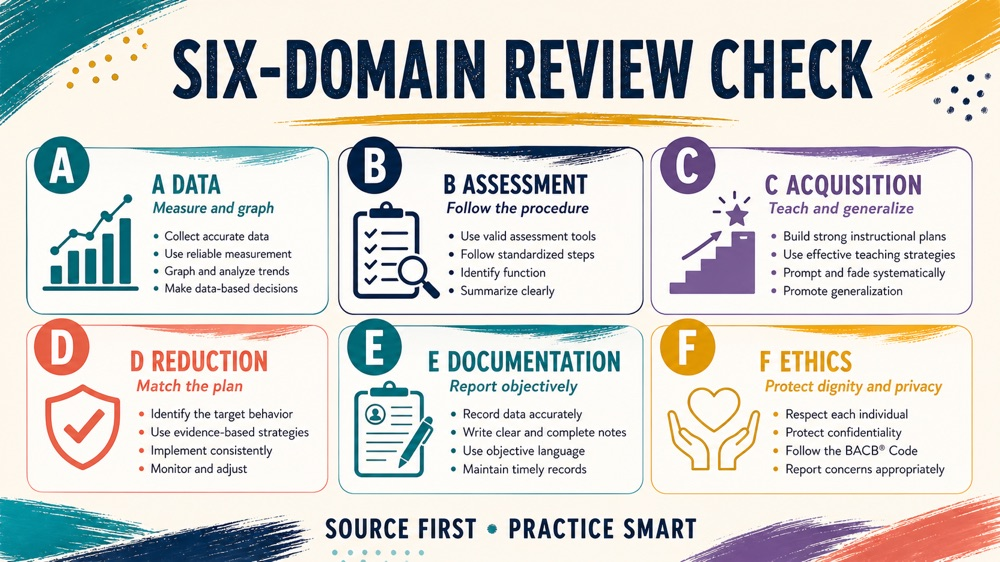
Use the current names first, then keep familiar older terms in parentheses only when they help you recognize a transition. The official TCO lists these domains and approximate proportions of the scored examination:
| Domain | Official question count | Study emphasis |
|---|---|---|
| A. Data Collection and Graphing | 13 (17%) | Measurement, calculations, graphs, observable definitions, reliability and fidelity. |
| B. Behavior Assessment | 8 (11%) | Preference, skill, and functional-assessment components under direction. |
| C. Behavior Acquisition | 19 (25%) | Reinforcement, teaching formats, prompts, chaining, generalization, shaping, and token economies. |
| D. Behavior Reduction | 14 (19%) | Functions, antecedent strategies, differential reinforcement, extinction, punishment effects, and safety. |
| E. Documentation and Reporting | 10 (13%) | Objective communication, data irregularities, clinical direction, and session variables. |
| F. Ethics | 11 (15%) | Competence, supervision, confidentiality, public statements, boundaries, gifts, and cultural responsiveness. |
The counts help allocate time; they do not authorize you to ignore a smaller domain. A weak ethics or documentation area can still affect safe practice, and the examination result is based on overall performance. Build a card for every domain with four fields: definition, decision rule, original example, and common distractor.
Use practice questions correctly
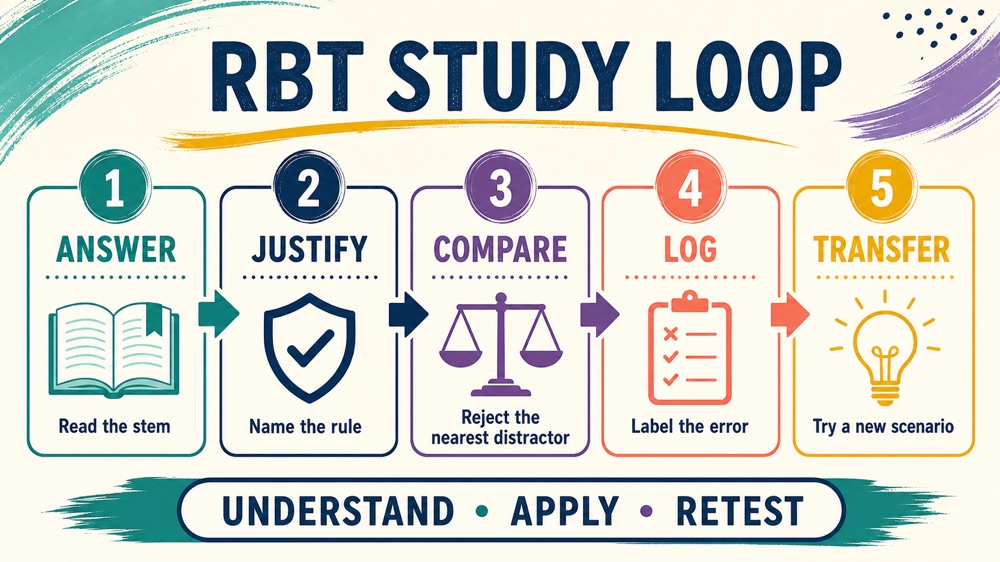
A practice question should do more than tell you whether the selected letter is right. Before looking at an explanation, write four short responses:
- What is the task? Name the skill being tested: choose a measurement, follow a prompt-fading plan, document a variable, or protect confidentiality.
- What is observable in the stem? Underline the action, time relation, consequence, or instruction that controls the answer.
- What is the best answer and why? Explain the match to the written plan, measurement rule, supervisor direction, or ethical standard.
- Why is the nearest distractor wrong? Identify the one word or assumption that makes it less appropriate.
Then compare your reasoning with the independent explanation. If you selected the right answer for the wrong reason, mark the item as a review miss rather than a clean win. A useful guide teaches transfer: the same principle should appear with a different learner, setting, behavior, or wording.
Protect the boundary around secure content. Do not search for “real,” “leaked,” or “recalled” BACB questions, and do not upload examination material to a study group. Original scenario practice can be rigorous without pretending to reproduce a protected form.
Turn errors into a review loop
Use a five-column error log:
| Column | Write |
|---|---|
| 1. Item signal | The exact clue: “rate per hour,” “after the response,” “supervisor says,” or “client information.” |
| 2. Your choice | The answer you selected and the assumption behind it. |
| 3. Correct rule | A one-sentence rule grounded in the TCO, training material, or ethics source. |
| 4. Nearest distractor | The tempting alternative and the precise reason it fails. |
| 5. New transfer item | A fresh scenario that changes the surface details but keeps the same decision. |
Review the log in stages. Immediately after a set, correct the explanation. The next day, answer only the transfer items. Three days later, mix those items with a different domain. This prevents the familiar wording of one question bank from becoming a false confidence signal.
Track error type, not only percentage: definition confusion, measurement calculation, plan-fidelity mistake, distractor overreading, ethics boundary, or careless timing. A 70% set with a clear error pattern is more useful than an 85% set where you cannot explain what changed.
Study Domains A and B: data and assessment
For Domain A, practice selecting the measurement that matches the behavior and question. Frequency counts occurrences; rate adds a time basis; duration measures how long; latency measures time from an instruction or event to the response; IRT measures time between responses. Discontinuous systems such as partial interval, whole interval, and momentary time sampling answer different questions. Permanent-product recording uses a lasting outcome rather than watching every response.
Graph questions require more than naming a trend. Ask what the axes represent, whether the scale is consistent, whether a change coincides with a procedural event, and whether unreliable data or poor fidelity could distort the conclusion. An RBT should record and communicate what the plan requires rather than invent a new measurement system.
For Domain B, separate assisting with assessment from independently diagnosing or deciding treatment. A preference assessment identifies likely reinforcers under a procedure; a skill assessment describes strengths and deficits; descriptive or functional-assessment components collect information about behavior and context. The RBT follows the written direction and brings uncertainty to the supervisor.
For each practice item, state the role boundary in your answer: “I can implement or record this as directed; I would ask the supervisor before changing the procedure or making a clinical claim.”
Study Domains C and D: acquisition and reduction
Domain C questions often test a sequence. Identify the discriminative stimulus or instruction, the response, the prompt if one is used, the consequence, and the fading or generalization plan. Distinguish acquisition from maintenance: acquisition builds a new response, while maintenance checks whether an established response persists over time. Chaining questions require attention to task-analysis order and the selected forward, backward, or total-task procedure.
Domain D questions often hide the function or safety issue in a short context. Do not choose an intervention because its label sounds familiar. Match antecedent interventions, differential reinforcement, extinction, or crisis procedures to the written plan and the supervisor’s direction. Consider secondary effects such as an extinction burst, resurgence, response variation, emotional responding, or escape and avoidance when the stem asks what might occur.
Keep reinforcement definitions functional: positive and negative describe whether a stimulus is added or removed, not whether the procedure is “good” or “bad.” Punishment questions likewise require the programmed contingency and the plan, not a moral judgment. When safety is involved, follow crisis/emergency procedures and the chain of command rather than improvising.
Study Domains E and F: documentation and ethics
Documentation questions reward neutral, timely, complete communication. A strong session note distinguishes what was observed from what someone inferred, reports variables that might affect progress, and communicates concerns to the supervisor. It does not hide a missed trial, rewrite a data point to make a graph look better, or include unnecessary identifying details.
Ethics questions can look like ordinary workplace stories. Ask whether the action stays within competence, supervision, confidentiality, public-statement, gift, multiple-relationship, or cultural-responsiveness boundaries. If a caregiver asks for a new intervention, the safe answer is usually to acknowledge the request, document or communicate it, and seek clinical direction—not to change the program independently.
Use a “pause, protect, report” routine: pause when the request exceeds your role, protect client information and dignity, and report or ask through the correct supervisor. The routine is useful for social media, gifts, conflicts of interest, suspected misconduct, and unclear instructions.
Pace an 85-question session
The current RBT examination is 90 minutes and 85 questions, but the time includes the testing experience described in the current Handbook. Use pacing as a practice skill, not a promise about the exact amount of time available for every item. A simple benchmark is about 64 seconds per presented question, with a buffer for navigation and review.
- First pass: answer clear items, identify the task, and flag stems that require calculation or careful reading.
- Second pass: return to flagged items and compare the two strongest options against the exact wording.
- Final check: verify that every item has a selection and that you did not change an answer without a reason.
Practice both untimed and timed. Untimed work builds discrimination and explanation quality; timed work reveals reading speed, calculation hesitation, and fatigue. Do not use a single score as a readiness guarantee. Look for stable reasoning across new questions.
Original RBT test study guide scenarios
The following examples are newly written for study. They are not official, recalled, leaked, or BACB-endorsed questions.
- Measurement: A learner engages in 12 responses during a 30-minute session, and the question asks for responses per hour. Reasoning: convert the count to a one-hour rate rather than reporting the raw frequency. The nearest distractor ignores the time basis.
- Prompt fading: A learner completes a target only after a full verbal prompt, and the written plan specifies least-to-most prompting with a fading step. Reasoning: follow the programmed sequence and record the response; do not invent a faster prompt change because the current prompt feels inefficient.
- Function: A learner pushes materials away after a difficult demand, and an RBT concludes “escape function proven.” Reasoning: the observation may contribute descriptive information, but one event does not independently prove function or authorize a treatment change.
- Documentation: A caregiver reports a medication change before session. Reasoning: document and communicate the variable according to the workplace and supervisor direction; do not omit it because the behavior looked typical.
- Ethics: A neighbor asks whether a child seen at the grocery store receives ABA services. Reasoning: do not confirm or deny client status. Confidentiality is not solved by saying “I will not share details.”
- Study diagnosis: A learner gets four questions wrong because “most correct” was chosen over the option that followed the written plan. Reasoning: label this as plan-fidelity and stem-reading error, write a transfer item, and retest the rule later.
- Graphing: A graph changes after staff stop recording one setting. Reasoning: consider a data-collection or procedural-fidelity change before declaring a client improvement or deterioration.
- Study resource: A guide advertises a 99% pass rate but does not identify its edition or sources. Reasoning: audit the claims and use official materials to verify the blueprint; a marketing percentage is not evidence of your readiness.
Audit a free study resource
Free does not mean current, and paid does not mean official. Before using a guide, check:
- Does it name the RBT Test Content Outline, 3rd edition and show the official source?
- Does it cover all six domains rather than only the largest topic?
- Does it distinguish 75 scored questions from 10 unscored questions and avoid using the old blueprint?
- Are questions original, with explanations that teach the decision rule and nearest distractor?
- Does it avoid “real,” “recalled,” “leaked,” or “guaranteed pass” claims?
- Are author credentials, update dates, privacy terms, and correction practices visible?
- Can you export or keep an error log rather than only seeing a percentage?
Use a current official source for changing facts. Use an independent guide for practice structure and explanations. That source split gives you a safer way to study without confusing a helpful teaching page with the certification authority.
Use a seven-day plan
- Day 1: read the current TCO and Handbook; label every study resource by edition.
- Day 2: study Domains A and B, including calculations, measurement choice, and assessment role boundaries.
- Day 3: study Domain C with prompts, reinforcement, teaching sequences, maintenance, and generalization.
- Day 4: study Domain D with functions, differential reinforcement, extinction, safety, and plan fidelity.
- Day 5: study Domains E and F with notes, privacy, supervision, competence, and professional boundaries.
- Day 6: complete an original mixed set; log every miss and write one transfer scenario for each error type.
- Day 7: take a timed set, review the error log, and return to all domains rather than studying only one weak score report.
Bottom line: the best RBT test study guide gives you current sources, six-domain coverage, applied original scenarios, clear explanations, and a repeatable error-review loop. Use it to build understanding, not to chase a guarantee or memorize a protected question form.
Ready for the next RBT study session?
Use original scenarios, track your nearest-distractor errors, and review the current six-domain blueprint.
Compare RBT Exam Prep Materials →
Frequently Asked Questions
What should an RBT test study guide include?
It should use the current TCO and Handbook, cover all six domains, teach application through original scenarios, explain why distractors fail, include timing practice, and identify the source for changing exam facts.
How many questions are on the current RBT exam?
The current examination includes 85 multiple-choice questions: 75 scored questions and 10 unscored questions. It is 90 minutes, and each question has four possible answers with one correct answer.
Should I study only the domain where I miss questions?
No. Use the miss report to target review, but return to all six domains. A small set of questions may not predict your full understanding of a task, and the official examination evaluates overall performance.
Are online RBT practice questions official?
Third-party practice questions should be treated as independent study material. Do not use resources that claim to provide recalled, leaked, reconstructed, or BACB-endorsed examination questions.
Can a study guide guarantee that I will pass?
No. A guide can organize practice and improve reasoning, but no study guide, course, practice score, or provider can guarantee certification or a passing result.
How can I study faster without lowering quality?
Use a source-first loop: answer a new scenario, explain the rule, reject the nearest distractor, record the error type, and retest with a different scenario. This is faster and more durable than rereading the same glossary.
References
- Behavior Analyst Certification Board. RBT Test Content Outline (3rd ed.).
- Behavior Analyst Certification Board. RBT Handbook.
- Behavior Analyst Certification Board. Examination Information.
- Behavior Analyst Certification Board. RBT examination resources.
- RBT Exam Practice study topics. Reviewed for competitor research; not an endorsement.
- The RBT Practice Test study guide. Reviewed for competitor research; not an endorsement.
- RBT Practice Exam study guide. Reviewed for competitor research; not an endorsement.
- RBT Hub study guides. Reviewed for competitor research; not an endorsement.