
If you are searching how to get RBT certified, the safest answer is a current sequence of requirements, documents, and study decisions—not a promise that one course or practice score will produce a credential. The Behavior Analyst Certification Board (BACB) controls the certification process, while independent providers may offer training and study support.
Table of Contents
- How to get RBT certified: the current path
- How to get RBT certified: check eligibility and document timing
- Complete a compliant 40-hour RBT training
- Complete the initial competency assessment
- Prepare and submit the BACB application
- Schedule and take the RBT examination
- Use the current six-domain study map
- Study the domains through decisions
- Prevent common certification delays
- Follow a 14-day RBT certification study plan
- Frequently Asked Questions
- References
For applicants using the current pathway, the practical sequence is: check eligibility, complete a qualifying 40-hour training, complete the initial competency assessment, submit the application with the required documents, receive an approved determination, schedule through Pearson VUE, and pass the RBT examination. Timing and document windows matter at every handoff.
This is independent educational content. RBT Training is not the BACB, is not a BACB certification program, and is not affiliated with or endorsed by the BACB. Examples are newly written and are not official, recalled, leaked, or BACB-endorsed questions. No course, guide, provider, employer, practice score, or mock exam can guarantee certification or a passing result.
How to get RBT certified: the current path
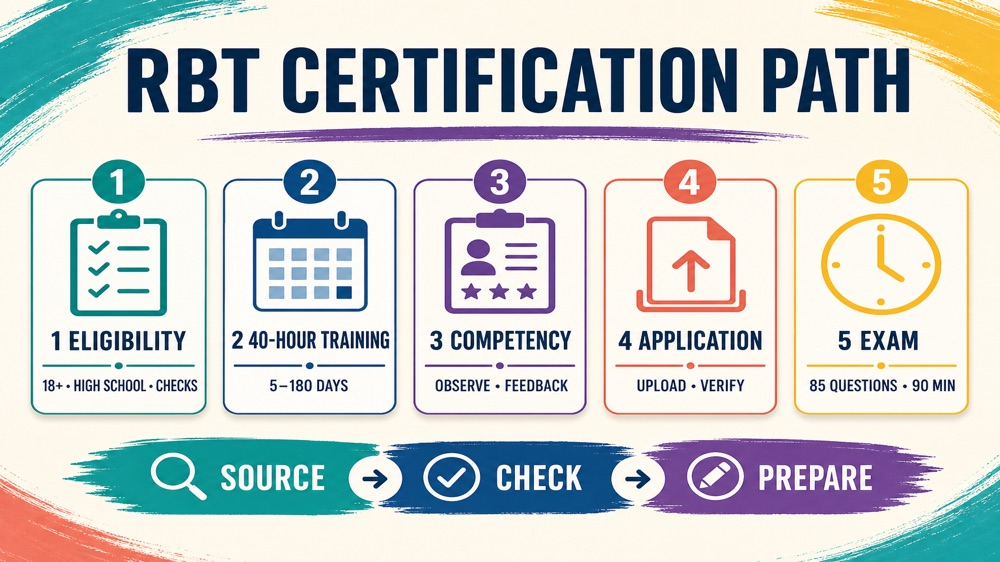
Think of certification as a chain of gates. Each gate has a responsible person, an evidence file, and a deadline or status check.
| Gate | What you complete | Evidence to keep |
|---|---|---|
| 1. Eligibility | Age, education, background, abuse-registry, and attestation requirements. | Personal account, checks, and attestation record. |
| 2. Training | At least 40 hours under the current training curriculum and delivery rules. | Certificate with the required 2026 statement. |
| 3. Competency | Demonstrate applicable technician skills with a qualified assessor. | Completed and signed initial competency assessment. |
| 4. Application | Upload complete documents and pay through the BACB portal. | Submitted application and determination messages. |
| 5. Examination | Schedule through Pearson VUE after approval and pass the RBT exam. | Appointment, result, and certification record. |
The gates are related but not interchangeable. Finishing a course does not itself make you an RBT. Passing a practice test does not replace the competency assessment. An employer’s onboarding checklist does not override a current BACB requirement.
How to get RBT certified: check eligibility and document timing
Before you pay for a course or application, open the current RBT Handbook and verify the requirements that apply to your situation. The current Handbook states that an applicant must be at least 18 years old and have at least a high-school-level education or equivalent. The application process also requires a criminal background check and an abuse-registry check, with the current document windows and attestation process followed as written.
The important point is not only whether a check was completed, but whether it is still usable when the application is paid for and submitted. The Handbook describes a 180-day window for the relevant checks and a separate 90-day timing requirement for the attestation form. Confirm the dates in the live Handbook before relying on this summary because BACB procedures can change.
Use a personal BACB account and an email address you control. Create a folder with:
- education information and identity details;
- background-check and abuse-registry dates;
- attesting certificant details and signed form;
- 40-hour training certificate;
- initial competency assessment; and
- application receipts, messages, and examination authorization.
Do not upload a document merely because its filename sounds right. Check that every required field, date, printed name, certification number, page, and signature is present. One missing field can turn a simple submission into a correction cycle.
Complete a compliant 40-hour RBT training
For applicants applying on or after January 1, 2026, the BACB 2026 40-Hour Training Requirements and Curriculum Outline is the relevant training reference. The trainee must complete at least 40 hours covering the curriculum in no fewer than 5 days and no more than 180 days. The start and end dates count in the total day calculation.
The training may be in person, online, or a combination. It must include behavioral-skills-training components such as instruction, modeling, role-play with feedback, quizzes, interactive activities, or discussion. Assigned reading alone may not count toward the training duration. The course provider should be able to explain who the responsible trainer is, how the curriculum is covered, and how completion is documented.
The current training outline requires a responsible trainer who is a BCaBA, BCBA, or BCBA-D with the required 8-hour supervision training. Assistant trainers may be used under the responsible trainer’s oversight and must meet the current credential rule. The trainer and trainee relationship restrictions also matter; a provider should not ask the applicant to certify a conflict away.
Check the certificate language before enrolling. The 2026 certificate statement must say that the training program is designed to meet the 2026 training eligibility requirement for RBT certification and that the training is offered independent of the BACB. The BACB does not provide the 40-hour training, certificates of completion, or training-program recommendations.
Training audit: ask for the curriculum outline, dates, responsible-trainer identity, delivery format, interactive components, record-retention process, refund terms, and certificate sample. A low price is not evidence of compliance, and a course completion badge is not automatically the required certificate.
Complete the initial competency assessment
After the qualifying training, you must demonstrate that you can perform applicable RBT tasks with a qualified assessor. This is a hands-on competency step, not the same thing as the multiple-choice RBT examination. You should be able to explain what the assessor will observe, how the assessment will be documented, and which version of the packet applies to an initial certification application.
The current initial assessment has its own timing rule. The Handbook and BACB application guidance should control the exact date window, assessor qualifications, task initials, assessment method, printed name, certification number, and signature requirements. Do not assume that an old checklist or a supervisor’s informal observation is enough.
Prepare by practicing the behavior, not by memorizing the form. Review:
- objective definitions and measurement;
- preference or skill-assessment participation as directed;
- prompting, reinforcement, teaching, and data collection;
- behavior-reduction procedures and safety boundaries;
- objective documentation and supervisor communication; and
- confidentiality, dignity, competence, and professional boundaries.
For example: if a trainee can recite the definition of least-to-most prompting but immediately gives the most intrusive prompt on every trial, the skill is not ready for transfer. Practice the sequence with feedback, fade help when the plan requires it, and ask the assessor or supervisor what must be corrected.
Prepare and submit the BACB application
Once eligibility, training, and competency evidence are ready, submit the RBT certification application through your BACB portal account. The application is a document-control task as much as it is an eligibility task. Use the current Handbook as the checklist, and keep a copy of every file exactly as uploaded.
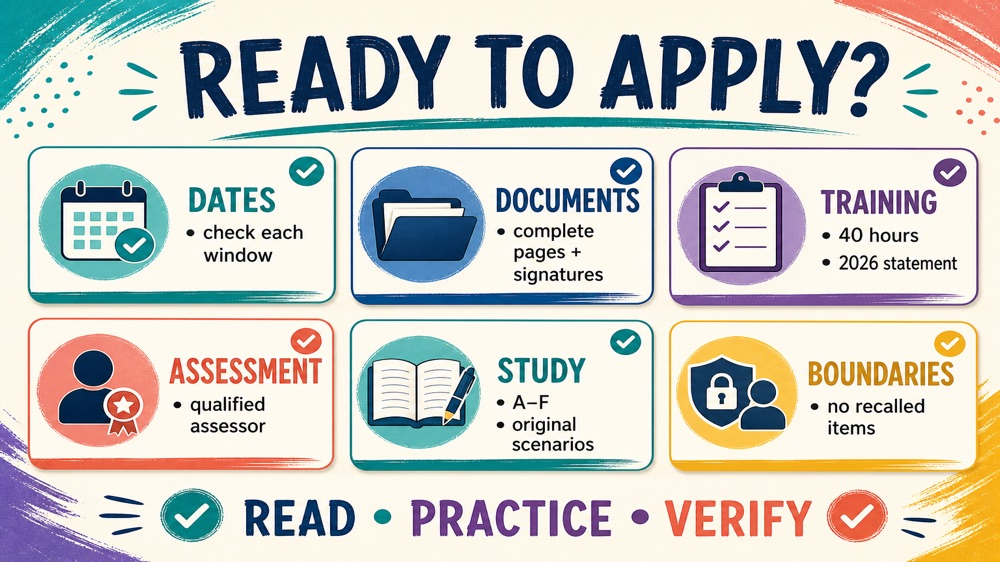
- Review dates: confirm the background, registry, attestation, training, and assessment dates fall inside their current windows.
- Review signatures: confirm the correct person signed each form and that the signature follows the BACB acceptable-signatures policy.
- Review identifiers: check names, certification numbers, account details, and page order.
- Review statements: make sure the 2026 training certificate uses the required independence statement.
- Upload and pay: use the portal’s current application tab, pay the required application fee, and save the receipt.
- Watch the account: respond to requests for corrections and wait for an approved determination before scheduling the exam.
An attesting certificant, training provider, assessor, or employer may help with their part, but the certification account belongs to you. Never give someone else control of the login or submit a form you have not reviewed.
Schedule and take the RBT examination
After you meet the applicable eligibility requirements, submit an approved application, and receive authorization, schedule and pay for the examination through your Pearson VUE account. The BACB examination information page currently describes the RBT exam as 85 multiple-choice questions with four possible answers per item and 90 minutes to complete it.
The current TCO explains the content frame: 43 tasks across six domains. The examination information also distinguishes scored and unscored questions; the current RBT exam context is 75 scored questions plus 10 unscored questions. These numbers tell you how to organize practice, not how many items you must answer correctly. The BACB does not publish a universal practice-score guarantee.
Read the appointment instructions, identification rules, rescheduling terms, and examination terms before test day. Use original practice questions that test the same concepts, but do not seek recalled, leaked, or protected examination content. A website claiming to sell secure questions is offering a compliance risk, not a shortcut.
For time management, practice a first pass that identifies the task and eliminates clearly weaker options, then return to flagged questions. Do not let one ambiguous scenario consume the entire section. Your goal is careful application of the current content, not speed for its own sake.
Use the current six-domain study map
The exam blueprint and the 2026 training curriculum are related but not identical documents. Use the 3rd-edition TCO to organize exam concepts, and use the 2026 training outline to audit whether a training course covered the required preparation. A study guide that merges the two without labels can make the reader think a training-hour topic is an exam-domain name.
| Domain | Official question distribution | Study question |
|---|---|---|
| A. Data Collection and Graphing | 13 (17%) | What was directly observed, and which measurement fits? |
| B. Behavior Assessment | 8 (11%) | What information is gathered under direction, and what interpretation is outside role? |
| C. Behavior Acquisition | 19 (25%) | What teaching sequence, prompt, consequence, or generalization step is specified? |
| D. Behavior Reduction | 14 (19%) | Which written intervention and safety procedure should be followed? |
| E. Documentation and Reporting | 10 (13%) | What must be recorded and communicated objectively and promptly? |
| F. Ethics | 11 (15%) | Which option protects confidentiality, dignity, competence, and supervision? |
The distribution is a planning aid, not permission to skip a smaller domain. Make one concept card, one original scenario, one answer rationale, and one transfer item for every weak task cluster.
Study the domains through decisions
Domains A and B: practice frequency, rate, duration, latency, IRT, discontinuous measurement, graph reading, preference assessment, skill assessment, and descriptive observation. Ask what the stem lets you know and what it does not let you conclude. If a question supplies a single event, do not invent a functional diagnosis.
Domains C and D: practice identifying the antecedent, response, prompt, reinforcement, fading, chaining, generalization, function, differential reinforcement, extinction effects, and safety direction. RBTs implement procedures under supervision; they do not rewrite the plan because a different intervention seems easier.
Domains E and F: practice objective session notes, timely reporting of illness or medication changes, privacy, boundaries, feedback, gifts, multiple relationships, public statements, and competence. When in doubt, protect the client and consult the correct supervisor.
For example: a caregiver asks you to skip data because the learner had a difficult morning. The better response is to follow the written procedure, record relevant variables, and communicate with the supervisor. It is not to erase the session or promise that the missing data will not matter.
Prevent common certification delays
| Risk | Preventive check |
|---|---|
| Using an old form | Open the current Handbook and application resources immediately before submission. |
| Training date error | Count calendar days from the training start date through the end date; confirm the 5-to-180-day window. |
| Wrong certificate wording | Verify the 2026 independence statement and responsible-trainer information. |
| Incomplete assessment | Check every applicable field, task initial, method, identifier, and signature with the assessor. |
| Expired checks or attestation | Recalculate the relevant 180-day and 90-day windows before paying or submitting. |
| Confusing application with approval | Wait for the official determination and exam authorization before booking. |
| Relying on a mock score | Use errors to guide review; never treat a third-party score as an official result. |
If the BACB asks for a correction, read the request literally and respond with the requested document or clarification. Keep the original submission, corrected file, and response date in your certification folder.
Follow a 14-day RBT certification study plan
- Day 1: read the current RBT Handbook and write the five certification gates in your own words.
- Day 2: confirm eligibility, checks, account ownership, and the document folder.
- Day 3: audit the 40-hour training provider, certificate language, and date window.
- Day 4: review competency-assessment tasks and practice with feedback.
- Day 5: map the 3rd-edition TCO’s 43 tasks to Domains A through F.
- Day 6: study measurement, data quality, and assessment decisions.
- Day 7: study acquisition: prompting, reinforcement, chaining, and generalization.
- Day 8: study reduction: function, differential reinforcement, extinction, safety, and plan fidelity.
- Day 9: study documentation, reporting, confidentiality, and supervision.
- Day 10: study ethics and professionalism with boundary scenarios.
- Day 11: complete an original mixed set and write a rationale for every miss or guess.
- Day 12: complete a timed 85-question practice session without using recalled or protected content.
- Day 13: review the error log, retest weak concepts, and check the nearest distractor.
- Day 14: verify appointment instructions, identification, timing, and a calm test-day plan.
A practice routine should make you better at reading new scenarios. If you remember only that an answer was “C” on one website, the practice has not transferred. Explain the rule, change the setting, and answer again.
Bottom line: knowing how to get RBT certified means managing a current eligibility and application pathway while building entry-level competence. Start with BACB sources, keep your evidence organized, separate training from assessment and examination, and use original practice to strengthen the six-domain decisions that the credential expects.
Organize your RBT exam review
Use source-first concepts, original scenarios, and six-domain error review to prepare with a clearer next step.
Review RBT Study Materials →
Frequently Asked Questions
How do you get RBT certified?
Meet the current eligibility requirements, complete a qualifying 40-hour training, complete the initial competency assessment, submit a complete BACB application, receive an approved determination, schedule through Pearson VUE, and pass the RBT examination. Confirm the live Handbook for current dates and documents.
How long is the RBT training?
For applicants applying on or after January 1, 2026, the required training is at least 40 hours completed in no fewer than 5 days and no more than 180 days, using the current BACB training curriculum and delivery requirements.
Is the competency assessment the same as the RBT exam?
No. The initial competency assessment is a supervised demonstration of technician skills. The RBT exam is a separate multiple-choice examination scheduled through Pearson VUE after the application is approved.
How many questions are on the RBT exam?
The current BACB examination information describes 85 multiple-choice questions and 90 minutes. The current scoring context includes 75 scored questions and 10 unscored questions. Check the official sources for updates.
Can an online course certify me as an RBT?
An online course may satisfy a training component when it meets the current BACB requirements, but course completion alone does not grant the RBT credential. You still need the assessment, application determination, and examination steps.
Can a study guide guarantee RBT certification?
No. A study guide can support learning, but no guide, score, course, provider, or employer can guarantee certification or a passing result.
References
- Behavior Analyst Certification Board. RBT Handbook.
- Behavior Analyst Certification Board. Registered Behavior Technician resources.
- Behavior Analyst Certification Board. Guidance for Meeting RBT Requirements During the 2026 Transition.
- Behavior Analyst Certification Board. RBT 2026 40-Hour Training Requirements and Curriculum Outline.
- Behavior Analyst Certification Board. Supervision and Training.
- Behavior Analyst Certification Board. Examination Information.
- Behavior Analyst Certification Board. RBT Test Content Outline (3rd ed.).
- Behavior Analyst Certification Board. RBT 3rd-Edition Test Content Outline PDF.
- Counseling Psychology RBT career guide. Reviewed for competitor research; not an endorsement.
- RBT Practice Exam competency assessment guide. Reviewed for competitor research; not an endorsement.