

RBT questions are useful only when they make you explain a behavior-analytic decision. A large number can create familiarity, but it cannot tell you whether you can define a behavior, choose a measurement, follow a teaching plan, protect confidentiality, or ask for supervision in a new situation.
Table of Contents
- RBT questions: what good practice should test
- Map RBT questions to the current TCO
- How to review RBT questions before looking at the answer
- Build a four-part answer rationale
- Practice Domains A and B with evidence
- Practice Domains C and D with plan fidelity
- Practice Domains E and F with boundaries
- Try an original mini set of RBT questions
- Audit a question bank before spending study time
- Use a seven-day RBT questions plan
- Frequently Asked Questions
- References
The current RBT examination context is 85 multiple-choice questions, four possible answers per question, and 90 minutes. The current Handbook identifies 75 scored questions and 10 unscored questions. Use those facts to practice pacing, not to infer a passing score or to search for unscored items.
This is independent study content. The examples are newly written and are not official, recalled, leaked, or BACB-endorsed questions. RBT Training is not the BACB, is not a certification program, and is not affiliated with or endorsed by the BACB. No question bank, mock score, course, or practice routine can guarantee certification or a passing result.
RBT questions: what good practice should test
A strong item asks you to select the most appropriate entry-level action in a defined situation. It gives enough observable information to support one best answer, keeps the RBT’s role visible, and avoids asking you to guess a diagnosis, function, or treatment change that the stem does not establish.
| Quality feature | What to look for | Warning sign |
|---|---|---|
| Observable stem | Behavior, setting, plan, and relevant consequence are described. | Only labels such as “defiant” or “unmotivated” are supplied. |
| One best answer | The keyed option follows the written facts and role boundary. | Two choices are equally correct because the stem is incomplete. |
| Useful distractors | Wrong choices represent common errors, not nonsense. | Three silly answers make the item a guessing game. |
| Explanation | It explains the rule and why the nearest distractor fails. | It only says “A is correct.” |
| Current source | Domain and task labels can be traced to the current TCO. | Old counts or unnamed “official” categories are presented as fact. |
| Independence | The page states whether the item is original and independent. | It advertises real, recalled, or leaked examination items. |
Use the item to practice reasoning, not to rehearse the provider’s exact wording. If you can answer a question only because you remember a phrase, change the person, setting, behavior, or consequence and test the rule again.
Map RBT questions to the current TCO
The RBT Test Content Outline, 3rd edition, is the current exam blueprint used in this workflow. It describes 43 tasks across six domains. The domain distribution is a study-allocation aid:
| Domain | Question distribution | Practice emphasis |
|---|---|---|
| A. Data Collection and Graphing | 13 (17%) | Measurement selection, calculations, graphs, operational definitions, and data quality. |
| B. Behavior Assessment | 8 (11%) | Preference and skill assessment participation, ABC information, and interpretation limits. |
| C. Behavior Acquisition | 19 (25%) | Teaching, prompting, reinforcement, chaining, discrimination, shaping, and generalization. |
| D. Behavior Reduction | 14 (19%) | Functions, antecedents, differential reinforcement, extinction, punishment effects, and safety. |
| E. Documentation and Reporting | 10 (13%) | Objective notes, variables affecting progress, timely reporting, and supervisor direction. |
| F. Ethics | 11 (15%) | Competence, confidentiality, supervision, public statements, relationships, gifts, and cultural responsiveness. |
Do not confuse a third-party page’s “Task List” wording with the official document title. When a question bank uses a familiar label, record the mapping but verify the current domain and task against the BACB TCO.
How to review RBT questions before looking at the answer
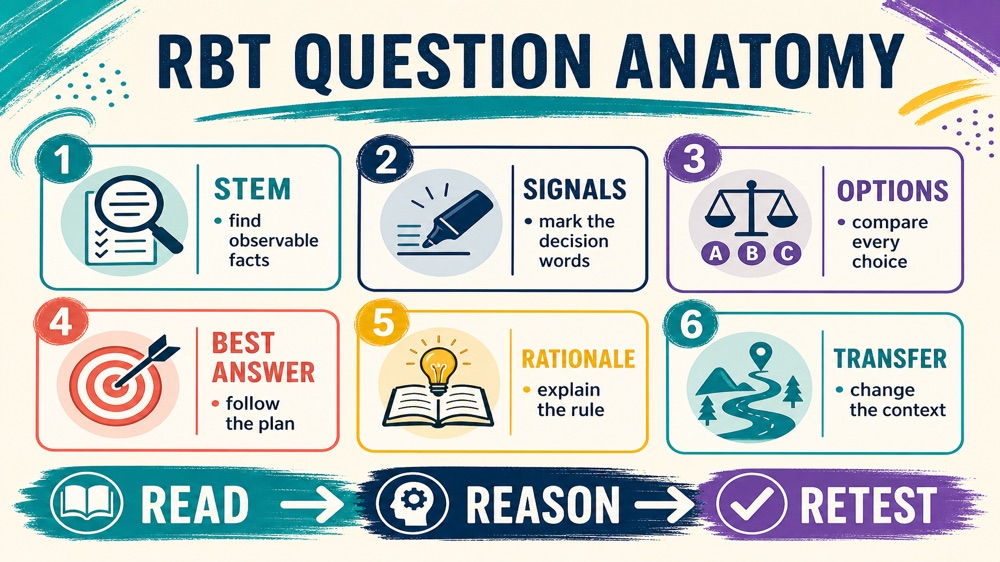
- Locate the actor: is the person an RBT, supervisor, caregiver, or assessor?
- Underline the observable behavior: replace vague labels with what was seen, heard, counted, or recorded.
- Find the plan: identify the written prompt, reinforcement, measurement, or safety procedure.
- Find the decision word: “first,” “most appropriate,” “best,” and “next” change what the item asks.
- Mark the boundary: note whether the answer requires following the plan, documenting, or contacting the supervisor.
- Predict before reading choices: state the action in your own words so the options do not lead your reasoning.
This routine is especially useful when options are all behavior-analytic terms. A question may include reinforcement, extinction, prompting, and functional language, but only one option may follow the actual plan and the RBT’s role.
Build a four-part answer rationale
After choosing an answer, write four short lines:
- Best answer: what action fits the observable facts?
- Rule: which measurement, teaching, reduction, documentation, or ethics principle supports it?
- Nearest distractor: why does the tempting alternative miss a fact or exceed the RBT’s role?
- Transfer: what new setting or behavior would test the same rule?
For example, if the best answer is to follow the supervisor’s written prompting sequence, the nearest distractor may be to change the prompt because the learner is slow. The transfer item can move from table work to a community routine while keeping the prompt-fading rule constant.
Practice Domains A and B with evidence
For Domain A, ask which measurement matches the question. Frequency counts occurrences; rate adds a time unit; duration measures how long; latency measures the time from an event to a response; and IRT measures time between responses. Partial-interval, whole-interval, and momentary time sampling answer different questions and can bias estimates in different directions.
For Domain B, separate participation from independent clinical interpretation. An RBT may implement a preference or skill-assessment component as directed, collect accurate data, and report what happened. An RBT should not announce a function, select a treatment, or change the assessment procedure without direction.
For example: a stem says a learner chose a toy twice when it was offered alongside another toy. The best answer may concern recording the choice under a paired-choice procedure; it does not prove that the toy will function as a reinforcer in every task.
Practice Domains C and D with plan fidelity
For Domain C, identify the instruction, response, prompt, consequence, and fading or generalization plan. Reinforcement is defined by its effect on future behavior, not by whether an item looks pleasant. Chaining, shaping, discrete-trial teaching, naturalistic teaching, stimulus control, and token systems should be applied according to the written procedure.
For Domain D, match the response to the function and intervention plan. Do not treat extinction, differential reinforcement, antecedent intervention, punishment, and crisis response as interchangeable. A strong question may test an extinction burst, resurgence, response variation, or the need to follow a safety protocol without improvising.
For example: if the plan specifies a visual prompt followed by a least-to-most sequence, an RBT should not jump to a full physical prompt on every trial merely to make the data look better. The correct reasoning is plan fidelity, data collection, and supervisor communication.
Practice Domains E and F with boundaries
Domain E questions often hide the answer in documentation detail. Record what happened, when it happened, what variable may affect progress, and who should receive the report. Do not turn “the learner was anxious” into an objective note without describing observable behavior. Do not omit a medication, illness, schedule, or staffing change when the procedure requires it.
Domain F questions ask what protects the client and the professional relationship. Look for confidentiality, dignity, competence, supervision, public statements, multiple relationships, gifts, feedback, and cultural responsiveness. If an option says to keep a concern secret, post a client story, accept a large gift, or practice outside training, it should trigger a boundary check.
Use the three-step ethics routine: pause, protect, and communicate. Pause before acting outside your role, protect the client’s information and safety, and communicate through the supervisor or reporting channel named by the policy.
Try an original mini set of RBT questions
These items are newly written for this article. They are not official examination questions.
- Measurement: A session lasts 20 minutes and includes 10 instances of a response. The question asks for rate per hour. What should you do? Answer: convert the observed count to the requested time unit. Why: rate includes time; reporting 10 alone is a frequency, not the requested rate. Transfer: change the session length and calculate again.
- Assessment: An RBT sees a response after a difficult task once and says the function is escape. What is the best correction? Answer: record the observable sequence and seek supervisor direction. Why: one observation does not independently establish function. Transfer: use several recorded examples and distinguish description from interpretation.
- Acquisition: A plan says to fade a verbal prompt after an independent response. What should the RBT do? Answer: follow the programmed prompt and fading steps. Why: changing the prompt hierarchy can create prompt dependence and reduces procedural integrity. Transfer: apply the same rule to a dressing routine.
- Reduction: A target response temporarily increases after an extinction component begins. What is the safest reasoning? Answer: recognize a possible extinction burst, follow the plan and safety direction, and report the pattern. Why: improvising a new consequence can change treatment fidelity. Transfer: identify another possible secondary effect without assuming it always occurs.
- Documentation: A caregiver reports a new medication before session. What should the RBT do? Answer: document and report the relevant variable according to the written procedure. Why: it may affect progress and must not be hidden by a vague note. Transfer: use a schedule or staffing change.
- Ethics: A neighbor asks whether a child at the store is a client. What is the best response? Answer: do not confirm or deny client status. Why: confidentiality applies to the relationship itself. Transfer: apply the same rule to a social-media comment.
- Source quality: A bank advertises “recalled BACB questions.” Should you use it? Answer: no; use original independent practice and report the concern when appropriate. Why: secure examination content is not a legitimate study shortcut. Transfer: audit whether a “real-style” claim has an originality and source statement.
- Distractor logic: A question offers both “ask the supervisor” and “change the plan,” but the stem says the plan is unclear. Which is better? Answer: seek direction before changing the procedure. Why: an RBT implements under supervision and does not independently revise treatment. Transfer: change the setting but keep the ambiguity.
Audit a question bank before spending study time
| Audit field | Pass evidence | Red flag |
|---|---|---|
| Version | Links the current 3rd-edition TCO and labels update date. | Uses “official” without a source or mixes old counts. |
| Coverage | Maps questions across Domains A through F. | Only tests definitions or overweights one popular topic. |
| Explanation | Explains the best answer and nearest distractor. | Shows a letter, score, or generic praise only. |
| Originality | States that questions are newly written and independent. | Offers recalled, leaked, or secure exam content. |
| Role boundary | Includes supervision, documentation, privacy, and plan fidelity. | Rewards independent diagnosis or treatment changes. |
| Access terms | Explains free limits, trial, pricing, privacy, and account requirements. | Hides the paywall or calls a short sampler complete. |
Also check whether the page distinguishes study mode from timed mode. Untimed review is usually better for learning an explanation; timed practice is useful later for pacing. Use both, but do not mistake speed for conceptual accuracy.
Use a seven-day RBT questions plan
- Day 1: read the current TCO and Handbook; create an A–F error log.
- Day 2: complete Domain A items and write a measurement rule for every miss.
- Day 3: complete Domain B and C items; mark assessment boundaries, prompts, and reinforcement.
- Day 4: complete Domain D items; review function, differential reinforcement, extinction, and safety.
- Day 5: complete Domain E and F items; review objective documentation, privacy, supervision, and ethics.
- Day 6: take an original mixed set untimed; write best-answer and nearest-distractor rationales.
- Day 7: take a timed set in an 85-question/90-minute format, then retest only the rules behind errors and guesses.
For every miss, record the error type: definition, measurement, reading, calculation, plan fidelity, prompt sequence, function, documentation, ethics, or pacing. A correct guess also belongs in the log. The next question should change the context so you can see whether the rule transferred.
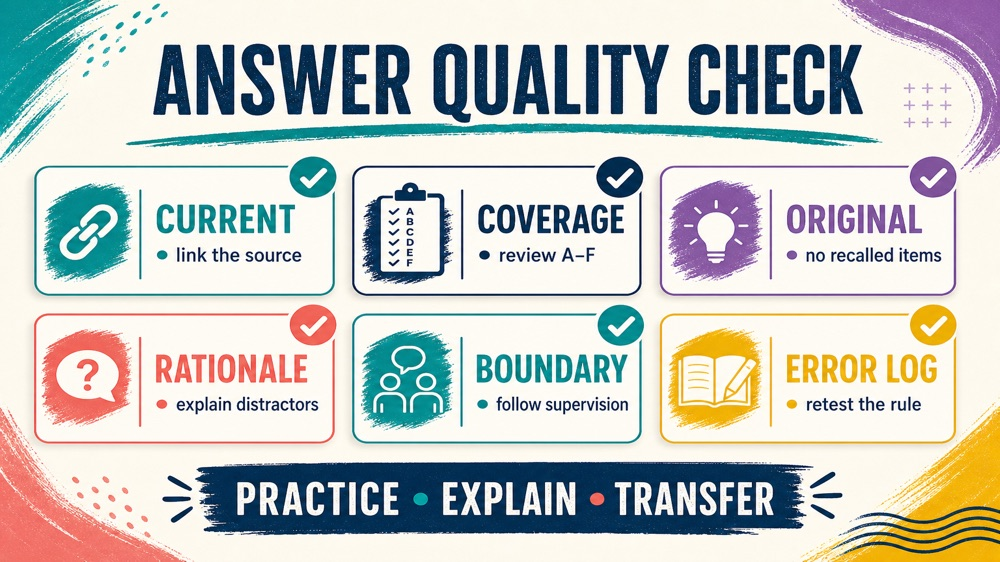
Bottom line: the best way to use RBT questions is to move from stem evidence to one role-appropriate answer, then to a clear rationale and a new transfer item. Choose current, original, source-linked practice and let your error log—not a headline question count—decide what to study next.
Turn practice questions into a study plan
Use original scenarios, answer rationales, and domain-based review to find the next concept worth practicing.
Try Free RBT Practice Questions →
Frequently Asked Questions
Are online RBT questions official?
Most online practice questions are independent study materials. The BACB publishes the official TCO, Handbook, examination information, and related requirements; a third-party question bank should not call its items official, recalled, leaked, or BACB-endorsed.
How many questions are on the RBT exam?
The current RBT exam has 85 multiple-choice questions and 90 minutes. The Handbook identifies 75 scored questions and 10 unscored questions, with four possible answers per item.
Should I use 75-question or 85-question practice?
Use both for different purposes. A 75-question set can focus on scored-item endurance, while an 85-question set can rehearse the full exam length. Neither practice score is an official result or a guarantee.
What makes an RBT question difficult in a useful way?
A useful item requires you to identify observable facts, apply a current concept, follow the written plan, and choose the RBT-appropriate action. Difficulty should come from reasoning, not vague wording or trick answers.
How should I review a wrong answer?
Write the task or domain, the signal in the stem, the rule behind the best answer, the nearest distractor, and a new transfer scenario. Then retest the rule later in a different context.
Can RBT questions guarantee a passing score?
No. Practice can improve familiarity and reasoning, but no question bank, course, mock score, or study guide can guarantee certification or a passing result.
References
- Behavior Analyst Certification Board. RBT Handbook.
- Behavior Analyst Certification Board. Examination Information.
- Behavior Analyst Certification Board. RBT Test Content Outline (3rd ed.).
- Behavior Analyst Certification Board. RBT 3rd-Edition Test Content Outline PDF.
- Behavior Analyst Certification Board. RBT Ethics Code (2.0).
- RBT Hub practice questions. Reviewed for competitor research; not an endorsement.
- RBT Practice Exam. Reviewed for competitor research; not an endorsement.
- My RBT Prep practice test. Reviewed for competitor research; not an endorsement.
- StudyBee ABA practice exam. Reviewed for competitor research; not an endorsement.
- RBT Exam Practice sampler. Reviewed for competitor research; not an endorsement.