

Types of preference assessment ABA is a search phrase for a practical question: how can an RBT tell which items or activities a learner is choosing right now, and how does the assessment format change what gets recorded? The answer is not one universal checklist. The format controls how choices are presented, what response is measured, and how much inference is justified.
Table of Contents
- What a preference assessment tells you
- Types of preference assessment ABA: the core formats
- How to compare the formats
- How the written plan determines the method
- What an RBT should record
- Original exam-style examples
- Common exam traps and distinctions
- Map preference assessment to six RBT domains
- Frequently Asked Questions
- References
A preference assessment identifies relative selection or engagement among candidate stimuli. It does not by itself prove that an item will function as a reinforcer, establish the function of problem behavior, or replace a supervisor-directed behavior plan. The result is a current set of candidates that must be interpreted with the written program and subsequent learning data.
The current RBT Test Content Outline, 3rd edition, places preference assessment in Domain B, Behavior Assessment, task B.1: conduct preference assessments, including multiple stimulus, paired stimulus, and free operant examples. The same outline contains 43 tasks across six domains. For the RBT exam, the skill is recognizing the procedure and implementing the assigned steps accurately—not independently inventing an assessment.
For exam-context calibration, the current RBT examination presents 75 scored questions and 10 unscored pilot questions. Those numbers describe the written exam, not a preference-assessment procedure and not a promise that a practice set will mirror secure content.
This article is independent educational content. RBT Training is not the BACB, is not a certification program, and is not affiliated with or endorsed by the BACB. All examples are newly written and are not official, recalled, leaked, or BACB-endorsed questions. No article, assessment, or study guide can guarantee certification or a passing result.
What a preference assessment tells you
A preference assessment is a structured way to observe choices or engagement among possible stimuli. Stimuli can include toys, food items when permitted, activities, social interaction, sensory materials, locations, or other program-approved options. The assessment may produce a rank order, a set of selected items, or a pattern of engagement depending on the format.
| Question | What preference data can support | What it cannot prove alone |
|---|---|---|
| What does the learner select? | Relative preference under the presented conditions. | That the learner will choose the same item tomorrow. |
| How long does the learner engage? | A measure of contact or engagement in a free-operant arrangement. | That duration is a reinforcer test for a target response. |
| What does the learner choose after work? | A possible reinforcer candidate when the choice follows the programmed response. | That the item increased the target behavior without checking acquisition data. |
| What does the learner avoid? | Information to report and use when the plan addresses access, assent, or safety. | A diagnosis of motivation, function, or intent from one observation. |
Preference is conditional and can change with satiation, deprivation, novelty, illness, context, communication access, and recent learning history. A list made during intake is not automatically a permanent hierarchy. An RBT records what happened under the assigned conditions and reports meaningful changes rather than treating a single rank as a personal trait.
Types of preference assessment ABA: the core formats
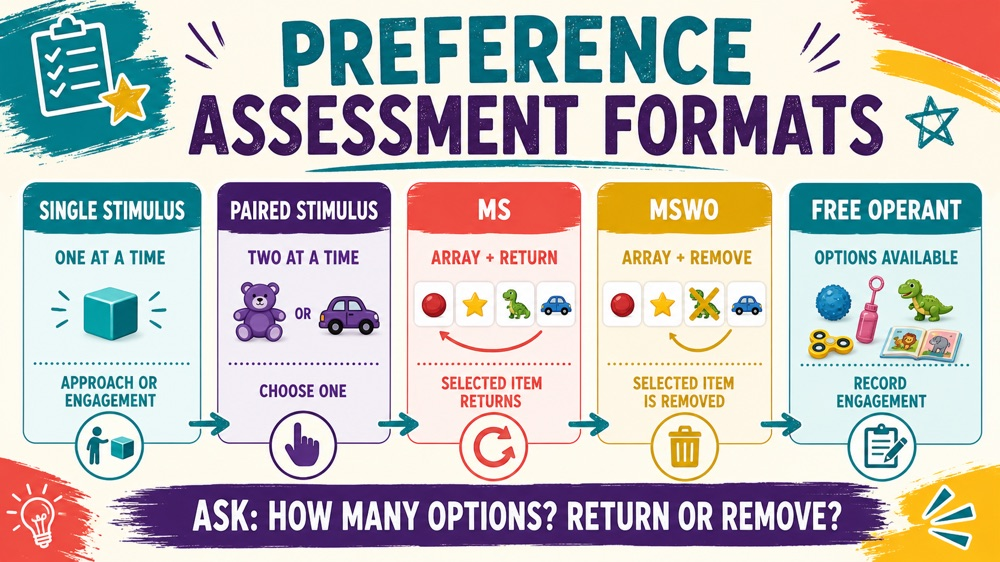
Several formats appear in the research and in RBT study materials. The quickest way to identify a method is to ask: how many stimuli are visible at once, is the learner required to choose, and is a selected stimulus returned?
| Format | What is presented | Common response or data | Exam clue |
|---|---|---|---|
| Single stimulus (successive choice) | One item or activity at a time. | Approach, selection, acceptance, or engagement is recorded for each item. | There is no simultaneous competitor; items are presented one after another. |
| Paired stimulus (forced choice) | Two items at the same time, with planned pairings. | Which item is selected from each pair; selections can be summarized as a percentage. | Exactly two options appear in each choice trial. |
| Multiple stimulus with replacement (MS or MSW) | An array of several items; the chosen item is returned before the next array. | Selection order across repeated arrays can create a preference ranking. | The chosen item comes back, so it can be selected again in later trials. |
| Multiple stimulus without replacement (MSWO) | An array of several items; the chosen item is removed before the next choice. | Rank order is built as choices are made from the shrinking array. | The chosen item is not returned during that sequence. |
| Free operant | Several options are freely available without a forced choice trial. | Contact, approach, or engagement duration for each option. | The learner can move among available options; the practitioner records engagement. |
Academic overviews also describe restricted-response variants and indirect methods such as interviews or caregiver questionnaires. An interview can help generate candidate stimuli, especially when direct assessment is not yet practical, but a report of what someone thinks the learner likes is not the same as observed choice data. On an exam, read the procedure actually described instead of selecting a method because the item sounds familiar.
How to compare the formats
There is no single “best preference assessment ABA” format for every learner or every session. Format selection depends on the supervisor’s plan, the learner’s communication and discrimination skills, the available materials, time, safety, and the information the team needs. The comparison below is a study organizer, not permission to change a real protocol.
| If the goal is to… | A format that may fit the plan | Tradeoff to remember |
|---|---|---|
| Observe natural engagement with several available activities | Free operant | Engagement time may reflect location, novelty, or ease of access; it is not a forced ranking trial. |
| Offer one item at a time to a learner who has difficulty comparing choices | Single stimulus | It can show approach or engagement but may not produce the same relative ranking as head-to-head choices. |
| Compare every option directly with another option | Paired stimulus | Many pairings can require more trials, and the learner must discriminate between two simultaneous choices. |
| Build a rank from a small array efficiently | Multiple stimulus without replacement | Position, removal, satiation, and limited array size can affect results; follow the prescribed arrangement. |
| Allow repeated selection of an item across arrays | Multiple stimulus with replacement | The same option can keep winning, which may be useful or may reduce information about lower-ranked items. |
Research comparing formats has examined predictive validity, administration time, and problem behavior. That evidence supports careful selection and fidelity, not a slogan that one procedure always wins. If the assessment produces distress, aggression, unsafe grabbing, or unclear responding, the RBT should follow the safety and escalation steps in the plan and contact the supervisor.
How the written plan determines the method
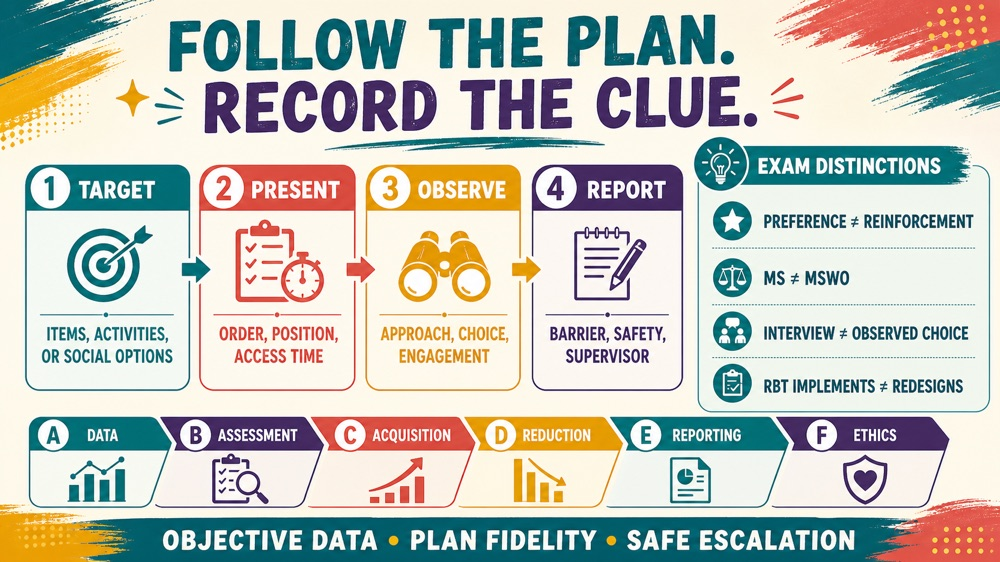
- Confirm the target of the assessment: identify whether the plan asks for item preference, activity preference, social-interaction preference, or another defined category.
- Read the presentation rule: check the number of stimuli, placement, rotation, trial order, access duration, and whether selected items return.
- Check the response definition: know whether the plan counts approach, touch, selection, exchange, first contact, or engagement time.
- Follow access and safety limits: use only approved materials and the written stop, pause, or consultation rule.
- Record the required data: do not substitute a casual impression for the assigned measurement.
- Report uncertainty: if the learner does not respond, the stimuli are unavailable, or the procedure no longer fits the situation, contact the supervisor rather than improvising.
For example: the plan says to present four activities, allow a choice, remove the selected activity, rearrange the remaining activities, and repeat until the array is empty. The identifying clue is not the type of toy; it is the repeated array with removal. That is an MSWO-style sequence. If an RBT returns the selected activity because it seems motivating, the data no longer represent the assigned procedure and the supervisor should be told.
The role boundary matters because an RBT may implement the steps without being the person who designs the assessment, changes the response definition, declares a new reinforcer, or interprets a complex pattern beyond the plan. Accurate implementation and timely communication are the testable skills.
What an RBT should record
| Data field | Example entry | Why it protects interpretation |
|---|---|---|
| Date, time, and context | Session start, setting, and relevant program condition. | Preference can vary with context and recent access. |
| Stimulus identity | Use the plan’s labels for each item or activity. | Prevents “toy” or “food” from hiding meaningful differences. |
| Position and order | Left-to-right arrangement or randomized order when prescribed. | Allows the team to notice a possible position effect. |
| Response | Approach, touch, exchange, selection, refusal, or no response. | Separates an observed action from an interpretation. |
| Engagement or access | Duration or access interval if required by the procedure. | Free-operant and other plans may use time rather than choice count. |
| Sequence rule | Returned, removed, or unavailable after selection. | This is often the distinction between MS and MSWO. |
| Exception and safety note | Item unavailable, distress, unsafe behavior, or supervisor contact. | Explains why a trial changed or stopped. |
Objective notes might say, “The learner reached toward the blue ball within 5 seconds and engaged for 40 seconds,” if those are the defined measures. “The learner loved the blue ball” is an interpretation unless the plan defines how “loved” is observed. Keep client identifiers out of independent study logs and use approved channels for real documentation.
Original exam-style examples
Example 1—single stimulus: a technician presents one activity, records whether the learner approaches, then presents the next activity. The clue is one option at a time. A paired-stimulus answer is incorrect because no simultaneous comparison occurs.
Example 2—paired stimulus: two items are placed in front of the learner on each trial, and the item selected is recorded across planned pairings. The clue is a two-item head-to-head choice. A free-operant answer is incorrect because the learner is not freely moving among all options.
Example 3—MSWO: five items are presented, the learner chooses one, that item is removed, and the remaining items are presented again. The clue is removal after selection. “With replacement” is the nearest distractor and fails because the selected item does not return.
Example 4—free operant: four activities are available at the same time and the RBT records how long the learner engages with each one. The clue is freely available access and duration. A forced-choice answer adds a response requirement that the stem never described.
Example 5—interview versus observation: a caregiver names three activities the learner usually enjoys. That information can help the team choose candidate stimuli, but it is not direct preference data. The RBT should follow the assigned next step and avoid presenting the caregiver’s report as a completed assessment.
These examples are newly written for study. They are not official, recalled, leaked, or BACB-endorsed questions. The goal is to identify the procedural clue, then apply the rule to a new context.
Common exam traps and distinctions
- Preference is not reinforcement: a chosen item is a candidate. Reinforcement is demonstrated by a change in future behavior under a programmed contingency.
- Preference is not function: selecting a toy does not establish why a behavior occurs or what consequence maintains it.
- Interview is not direct choice data: someone’s report can generate options but does not show what was selected under the assessment conditions.
- MS is not MSWO: the replacement rule is the key difference. Return means MS; remove means MSWO.
- Free operant is not paired choice: free access and engagement duration are different from selecting one of two presented items.
- A rank is not permanent: changes in access, context, novelty, health, or learning may change the order.
- Implementation is not redesign: an RBT follows the written plan and reports barriers; the RBT should not alter the assessment because a different format seems easier.
- Safety beats completion: the correct action during distress or unsafe behavior is the plan’s pause, safety, and supervisor-contact procedure, not forcing the next choice.
When two answer choices both sound plausible, underline the procedural facts: number of choices, access arrangement, return/removal, response measure, and who has authority to change the plan. Those facts usually resolve the distinction.
Map preference assessment to six RBT domains
| Domain | Connection to this topic | Review question |
|---|---|---|
| A. Data Collection and Graphing | Record choice, approach, duration, sequence, and update the assigned data display. | What is the observable response and what unit is required? |
| B. Behavior Assessment | Identify and implement the assigned preference-assessment format. | What presentation and selection rule does the stem describe? |
| C. Behavior Acquisition | Use approved preference information to support teaching and reinforcement procedures. | What evidence would show the item actually strengthened responding? |
| D. Behavior Reduction | Follow safety and behavior-reduction procedures if choice presentation evokes unsafe behavior. | What is the authorized pause or escalation step? |
| E. Documentation and Reporting | Write objective notes and report unavailable stimuli, changes, and barriers. | Can another reader reproduce what was observed? |
| F. Ethics | Protect dignity, assent, privacy, competence, and role boundaries. | Am I implementing the plan without coercion or unauthorized redesign? |
Domain B is the center of this article, but the skill is not isolated. A preference result only becomes useful when it is measured, documented, used within the teaching plan, and handled with safety and dignity.
Bottom line: types of preference assessment ABA questions are solved by procedure clues, not by memorizing a single “best” method. Identify whether the learner has one option, two options, an array with replacement, an array without replacement, or free access. Then check the response measure, follow the written plan, record objectively, and report uncertainty.
Build the assessment distinction into your next study set.
Use original RBT practice questions to identify the presentation rule, the data rule, and the supervision boundary behind each answer.
Try Free RBT Practice Questions →
Frequently Asked Questions
What are the main types of preference assessment ABA procedures?
Common formats include single stimulus, paired stimulus, multiple stimulus with replacement, multiple stimulus without replacement, and free operant. Indirect interviews can help identify candidate stimuli but are not the same as direct observed choice data.
What is the difference between MS and MSWO?
Both present an array of multiple stimuli. In multiple stimulus with replacement, the selected item returns before the next array. In MSWO, the selected item is removed, so the array gets smaller as the rank is built.
Is a preference assessment the same as a reinforcer assessment?
No. Preference assessment identifies what a learner selects or engages with under stated conditions. A reinforcer is demonstrated when a consequence increases future behavior under a programmed contingency.
What should an RBT do if the assigned preference procedure is unclear?
Pause according to the safety and program rules, document the barrier, and contact the supervisor. The RBT should not independently change the format, response definition, or access rule.
Can a preference ranking stay the same?
Not necessarily. Preference can change with access, context, novelty, health, and learning history. Follow the plan’s reassessment schedule and report meaningful changes.
Are these preference-assessment examples official BACB questions?
No. They are newly written educational examples and are not official, recalled, leaked, or BACB-endorsed questions. Do not buy or share secure exam content.
References
- Behavior Analyst Certification Board. RBT Test Content Outline, 3rd edition.
- Behavior Analyst Certification Board. RBT Test Content Outline, 3rd edition PDF.
- DeLeon, I. G., & Iwata, B. A. (1996). Evaluation of a multiple-stimulus presentation format for assessing reinforcer preferences. Journal of Applied Behavior Analysis.
- Stimulus Preference Assessment Decision-Making System. Behavioral research review and decision model.
- Evaluation of the multiple-stimulus-without-replacement preference assessment method using activities as stimuli.
- Problem behavior during preference assessments: An empirical analysis and practical recommendations.
- Preference Assessments. Vanderbilt Kennedy Center handout.
- Raven Health preference assessment glossary. Reviewed for competitor research; not an official exam source.
- LEARN Behavioral free-operant guide. Reviewed for competitor research; not an endorsement.