
An RBT quiz is most useful when it tells you what to repair, not just whether you got a number right. A short set can test one distinction—such as duration versus latency—or sample several domains before a longer practice session. The quiz should be a diagnostic tool with original questions, clear explanations, and a next study action.
Table of Contents
- What an RBT quiz should do
- Quiz mode, study mode, and full mock mode
- A six-step RBT quiz workflow
- Original RBT quiz examples with explanations
- How to interpret an RBT quiz score
- How to judge RBT quiz quality
- Map an RBT quiz to six domains
- Frequently Asked Questions
- References
Do not confuse an independent quiz with the secure BACB examination. The current official exam presents 85 multiple-choice questions with four answer choices and 90 minutes; 75 questions are scored and 10 are unscored pilot questions. A short quiz is not a scaled score, a pass prediction, or a source of secure content.
The current RBT Test Content Outline, 3rd edition, describes 43 tasks across six domains. A quality quiz uses that blueprint to label the concept being practiced. It does not copy, recall, leak, or imply access to official exam questions. It also does not replace the Initial Competency Assessment, 40-hour training, application, supervision, or written examination.
This is independent educational content. RBT Training is not the BACB, is not a certification program, and is not affiliated with or endorsed by the BACB. All sample prompts and explanations below are newly written and are not official, recalled, leaked, or BACB-endorsed questions. No quiz, course, or article can guarantee certification or a passing result.
What an RBT quiz should do
A useful quiz turns a concept into a decision. It should provide enough observable information to select the best answer, include plausible distractors, and explain the rule that separates the correct choice from the nearest wrong choice.
| Quiz feature | What it gives the learner | Warning sign |
|---|---|---|
| Domain label | Shows whether the question targets measurement, assessment, acquisition, reduction, reporting, or ethics. | Every item is labeled “general RBT” with no repair direction. |
| Observable stem | Provides a behavior, setting, procedure, data rule, or boundary that supports the decision. | The answer depends on guessing what the client “really feels.” |
| Nearest distractor | Explains why a tempting alternative fails under the facts in the stem. | The explanation only repeats the letter of the correct answer. |
| Transfer prompt | Asks you to solve a new person, setting, material, or task after the explanation. | You can remember the answer order but cannot explain the rule. |
| Honest boundary | States that the content is original and independent. | Promises “real questions,” leaked items, or a guaranteed result. |
A quiz is not automatically better because it has more questions. A 10-question set with a clear error log can be more useful than 100 repeated definition items. Quality comes from the decision, explanation, and repair loop.
Quiz mode, study mode, and full mock mode
| Mode | Best use | What to record |
|---|---|---|
| Untimed quiz | First exposure to a concept or a small domain. | Answer, confidence, clue used, and the rule you missed. |
| Study mode | Immediate feedback after each item while learning. | Why the correct choice fits and why the nearest distractor fails. |
| Timed quiz | Practice reading and choosing under modest time pressure. | Time spent, flagged items, and whether speed changed accuracy. |
| Full mock | Build endurance and rehearse a longer multiple-choice session. | Domain pattern, pacing decisions, and a complete error log after submission. |
| Official examination | Secure BACB certification assessment at the authorized testing location. | Follow BACB and Pearson VUE rules; do not treat a quiz as a substitute. |
Use an untimed quiz when you are still learning the distinction. Add timing after you can explain the rule. A timed quiz taken before the concept is understood may measure anxiety or reading speed more than knowledge.
A six-step RBT quiz workflow
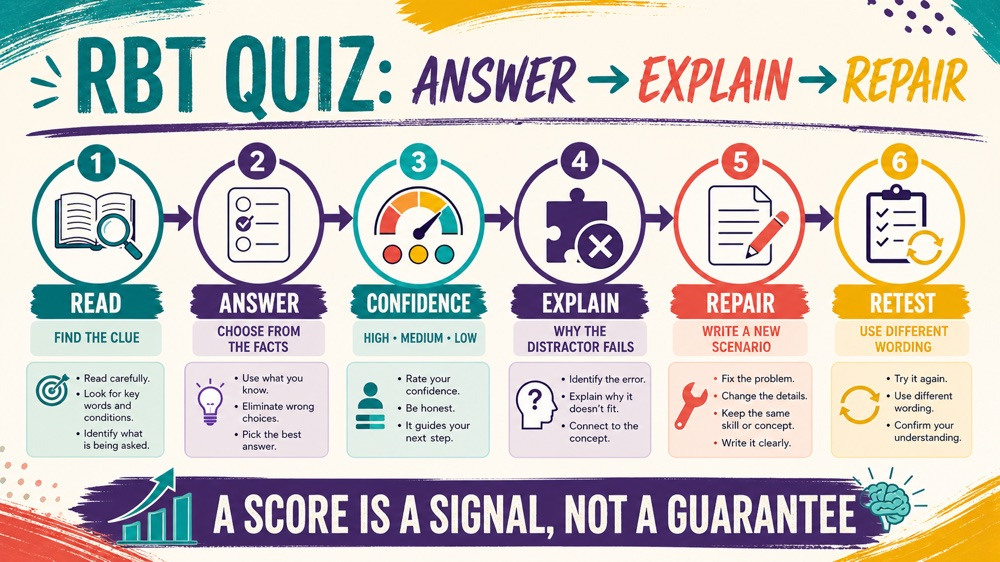
- Choose the purpose: select one domain, one task family, or a mixed diagnostic set.
- Answer from the stem: note decision words such as best, first, except, not, or most appropriate.
- Mark confidence: label high, medium, or low confidence before seeing the answer.
- Read the explanation: identify the observable clue, the governing rule, and the nearest distractor.
- Write the repair: create one new scenario that changes the person, setting, or material but preserves the concept.
- Retest later: use a different item or short set after the repair, not the same memorized answer sequence.
For example: if you miss a question because you confused partial interval with whole interval, do not simply reread the definition. Write a new scenario with a 30-second interval and decide whether a 2-second occurrence marks “yes” under each system. The repair should make you discriminate the rule.
Keep the quiz log free of identifiable client information. Real session data belong in the approved documentation system, not in an independent study account or a public screenshot.
Original RBT quiz examples with explanations
Question 1—measurement: an RBT records the time from the instruction “start” until the learner begins the target response. Which measure is being used?
Answer and rationale: latency. The interval begins with a defined event and ends when the response starts. Duration would continue from onset to offset; frequency would count responses; IRT would measure the time between two responses.
Question 2—assessment: four items are presented, the learner selects one, and the selected item is removed before the remaining items are presented again. Which format is described?
Answer and rationale: multiple stimulus without replacement, or MSWO. The key clue is the array plus removal. Multiple stimulus with replacement would return the selected item before the next trial.
Question 3—acquisition: the teaching plan specifies least-to-most prompting, but the learner does not respond after the first prompt. What is the best RBT action?
Answer and rationale: follow the next step in the written prompting sequence and record the response according to the plan. The RBT should not invent a new prompt hierarchy because it feels faster.
Question 4—behavior reduction: a learner engages in the target behavior during an intervention. The plan lists a safety response and a supervisor-contact rule. What should guide the RBT’s next action?
Answer and rationale: the written safety and intervention procedure. The RBT should not select an unrelated consequence from a quiz explanation or improvise outside the plan.
Question 5—documentation: which note is most objective: “The learner was rude,” or “The learner pushed the worksheet away and said ‘no’ after the instruction was repeated”?
Answer and rationale: the second note describes observable actions and words. “Rude” is an interpretation that does not tell another reader what happened.
Question 6—ethics: a friend asks an RBT to send a client video to demonstrate a behavior technique. What is the safest response?
Answer and rationale: protect privacy, decline the informal transfer, and use the approved supervisory or documentation channel. A friend’s interest or experience does not authorize sharing client information.
These are original study examples, not official BACB questions. A quality quiz would attach each item to a task or domain, explain the nearest distractor, and invite a new repair scenario rather than presenting the answer as a memorization target.
How to interpret an RBT quiz score
| Result pattern | What it may suggest | Next action |
|---|---|---|
| Low score with low confidence | New concept or broad knowledge gap. | Study the source-grounded rule, then use a small untimed set. |
| High score with low confidence | Recognition may be present but the explanation is unstable. | Explain each answer aloud and write a transfer example. |
| Low score with high confidence | A definition, boundary, or distractor pattern may be misunderstood. | Audit the clue and the rule; do not simply take more quizzes. |
| Mixed score by domain | One task family may need targeted repair. | Study the weakest domain and retest with new items. |
| Improvement on repeated items | Memory of the answer may be improving. | Use new scenarios to test generalization. |
A short quiz score is an internal learning signal, not a BACB pass-rate conversion. It cannot tell you which items on a secure exam are scored, cannot predict a personal result, and cannot compensate for missing training, competency assessment, application, or supervision requirements.
For a longer simulation, remember the current format context: 85 presented questions, 75 scored questions, 10 unscored pilot questions, four answer choices, and 90 minutes. Answer every practice item seriously because a third-party quiz cannot identify which official items are scored or unscored.
How to judge RBT quiz quality
- Blueprint alignment: the page names the current RBT Test Content Outline, 3rd edition, instead of relying on a legacy list without explanation.
- Balanced coverage: questions span all six domains rather than repeating only popular vocabulary.
- Decision-level stems: each scenario gives enough facts to select the best action.
- Explanation depth: the rationale names the clue, rule, and nearest distractor.
- Original content: no official, real, recalled, leaked, or BACB-endorsed claim.
- Accessible workflow: study mode, quiz mode, and review mode have different purposes.
- Privacy protection: no client-identifying information is needed to practice.
- Honest score language: the page does not promise certification or turn a quiz result into a personal prediction.
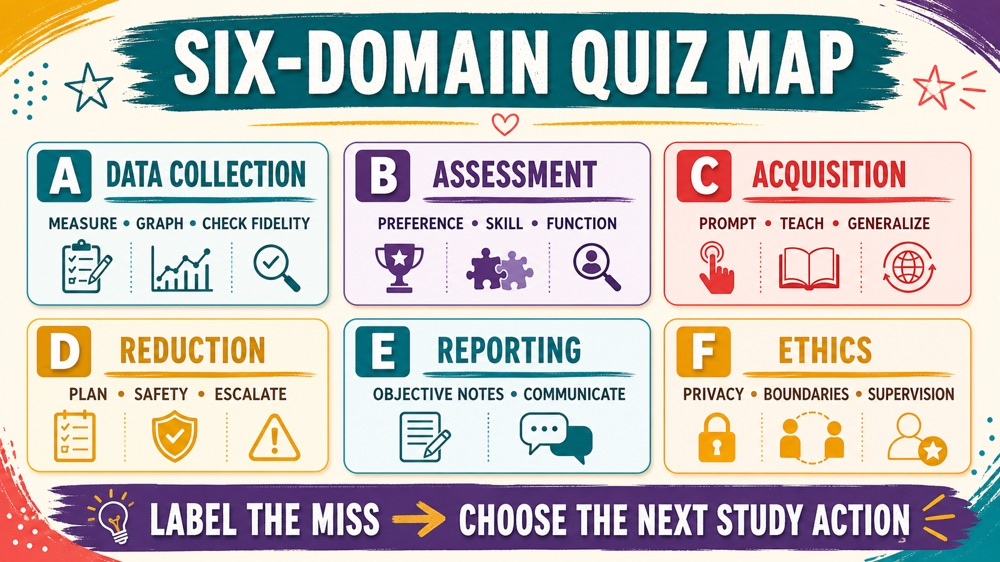
Map an RBT quiz to six domains
| Domain | Quiz focus | Repair question after a miss |
|---|---|---|
| A. Data Collection and Graphing | Measurement, permanent product, data entry, graphing, trends, and fidelity. | What behavior dimension and unit does the stem define? |
| B. Behavior Assessment | Preference, skill, and functional-assessment participation. | What is observed, and what would be an unsupported conclusion? |
| C. Behavior Acquisition | Reinforcement, teaching, prompting, chaining, shaping, and generalization. | What does the written teaching procedure say happens next? |
| D. Behavior Reduction | Plan fidelity, differential reinforcement, safety, and escalation. | What is authorized, and when should the RBT contact the supervisor? |
| E. Documentation and Reporting | Objective notes, communication, barriers, and data summaries. | Could another reader separate observation from interpretation? |
| F. Ethics | Privacy, dignity, competence, boundaries, and supervision. | What action protects the client and stays within the RBT role? |
A mixed quiz is valuable only when the domain label changes what you review. If your misses cluster in Domain A, reread measurement definitions and write new unit-matching examples. If they cluster in Domain F, review boundaries and communication rules rather than taking another random set.
Bottom line: use an RBT quiz as a short diagnostic loop: answer, explain, label the error, write a repair item, and retest with a new scenario. Keep the content independent and current, and use the official TCO and Handbook as the authority for exam requirements.
Ready for a longer practice session?
Move from a short RBT quiz to three original mock exams with answer explanations and a clear review path.
See the Three RBT Mock Exams →
Frequently Asked Questions
What is an RBT quiz?
An RBT quiz is a short set of independent practice questions used to check a concept or domain. It should include original scenarios, explanations, and a next review action; it is not the secure BACB examination.
How is an RBT quiz different from a full mock exam?
A quiz is usually shorter and more targeted. A full mock emphasizes endurance, pacing, and mixed-domain decision-making. Both should use original content and honest score language.
How many questions are on the official RBT exam?
The current official format presents 85 multiple-choice questions: 75 scored questions and 10 unscored pilot questions, with four answer choices and 90 minutes.
Can an RBT quiz predict whether I will pass?
No. A quiz can reveal review needs within that resource, but it cannot convert a practice score into a personal BACB prediction or guarantee certification.
What should I do after missing a quiz question?
Write the domain, observable clue, decision word, error type, nearest distractor, and a new repair scenario. Then retest later with different wording.
Are these RBT quiz examples official?
No. They are newly written educational examples and are not official, recalled, leaked, or BACB-endorsed questions. Do not buy or share secure exam content.
References
- Behavior Analyst Certification Board. RBT Test Content Outline, 3rd edition.
- Behavior Analyst Certification Board. RBT Handbook.
- StudyBeeABA RBT study guide. Reviewed for competitor research; not an official exam source.
- RBT Practice Exam study guide. Reviewed for competitor research; not an endorsement.
- Independent 85-question practice exam. Reviewed for competitor research.
- Independent RBT practice sampler. Reviewed for competitor research.
- Independent RBT practice exam hub. Reviewed for competitor research.