
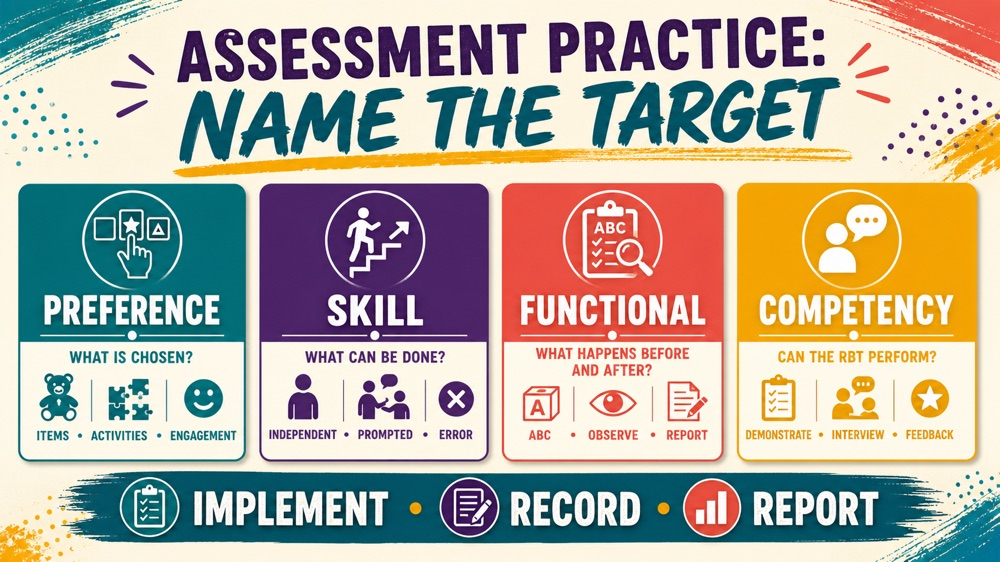
RBT assessment practice is not one topic with one answer pattern. The word “assessment” can refer to a preference assessment, an assessment of skill strengths and deficits, participation in functional-assessment procedures, or the technician’s own Initial Competency Assessment. A strong practice set makes the target of the assessment visible before it asks you to choose an action.
Table of Contents
- The RBT assessment practice map
- Preference assessment practice: identify the choice rule
- Skill assessment practice: identify the learner response
- Functional-assessment participation: observe before you infer
- RBT assessment practice versus the Initial Competency Assessment
- A six-step RBT assessment practice review workflow
- Original RBT assessment practice questions
- Map RBT assessment practice to six domains
- Frequently Asked Questions
- References
The current RBT Test Content Outline, 3rd edition, places three tasks in Domain B, Behavior Assessment: conduct preference assessments; participate in assessments of relevant skill strengths and deficits; and participate in components of functional assessment procedures. The same outline describes 43 tasks across six domains. The written exam context is 85 presented questions, including 75 scored questions and 10 unscored pilot questions, with four choices and 90 minutes.
Practice content should help you recognize procedures and role boundaries. It should not make an RBT the independent designer of a functional analysis, the person who declares a diagnosis, or the person who changes a skill-assessment protocol without direction.
This is independent educational content. RBT Training is not the BACB, is not a certification program, and is not affiliated with or endorsed by the BACB. All examples below are newly written and are not official, recalled, leaked, or BACB-endorsed questions. No practice resource, course, or article can guarantee certification or a passing result.
The RBT assessment practice map
| Assessment target | What it asks | What an RBT should notice |
|---|---|---|
| Preference assessment | Which items or activities are selected or engaged with under the defined conditions? | Presentation format, response measure, access rule, and whether the result is a candidate for reinforcement. |
| Skill assessment | What can the learner do independently, with prompts, or not yet do? | Task definition, materials, response criteria, prompt level, and data recording. |
| Functional assessment | What environmental events may relate to the target behavior? | ABC information, direct observation, plan steps, safety, and the need to participate under supervision. |
| Competency assessment | Can the RBT candidate perform the required technician skills? | Practical demonstration or interview, not a client assessment and not a written mock quiz. |
The phrase “assessment practice” should therefore be followed by a question: assessment of what? If the stem says “two toys are presented and the selected toy is recorded,” it is pointing to preference. If it says “the learner is asked to wash hands and the RBT records independent steps,” it is pointing to skill. If it says “the team observes what happens before and after a target behavior,” it is pointing to functional-assessment participation. If it says “the assessor observes the technician implementing a protocol,” it is pointing to competency.
Preference assessment practice: identify the choice rule
A preference assessment identifies relative choice or engagement among possible stimuli. Common formats include single stimulus, paired stimulus, multiple stimulus with or without replacement, and free operant. The exam clue is the arrangement, not the name of the item.
| Stem clue | Likely format | Nearest distractor |
|---|---|---|
| One item is presented, then another item is presented. | Single stimulus or successive choice. | Paired stimulus, which requires two simultaneous options. |
| Two items are offered at the same time and the learner chooses one. | Paired stimulus. | Free operant, which does not require a forced two-option choice. |
| Several items are presented and the chosen item is returned. | Multiple stimulus with replacement. | MSWO, where the chosen item is removed. |
| Several items are presented and the chosen item is removed before the next array. | Multiple stimulus without replacement. | Multiple stimulus with replacement. |
| Several activities are freely available and engagement time is recorded. | Free operant. | Paired stimulus, which restricts the choice field. |
For example: the plan says to present five cards, allow the learner to select one, remove the selected card, and repeat until the sequence is complete. The answer is MSWO because the replacement rule is the decisive clue. The RBT follows the written arrangement and records the defined response; the RBT does not change the array because a different format seems easier.
Preference is not the same as reinforcement. The assessment identifies a candidate stimulus. Whether it strengthens a target response must be evaluated under the teaching plan and subsequent data.
Skill assessment practice: identify the learner response
A skill assessment samples what a learner can do under defined conditions. It may address communication, social, academic, self-help, or other functional skills. The practice question may ask you to identify independent performance, prompted performance, an error, a missing step, or the next measurement—not to infer a global ability from one trial.
| Skill-assessment element | What to read for | Common error |
|---|---|---|
| Task or target | What exact response or step is being assessed? | Replacing the target with a broader label such as “communication.” |
| Antecedent or instruction | What instruction, material, model, or opportunity is provided? | Ignoring a prompt that changes the condition. |
| Response level | Independent, prompted, partial, incorrect, or no response. | Calling a prompted response independent. |
| Prompt level | What support was used and what does the plan say about fading? | Adding a new prompt or changing the hierarchy during the assessment. |
| Criterion | What counts as correct, mastered, or needing more teaching? | Declaring mastery from one successful trial. |
An RBT may collect and report these data according to the plan. The supervisor or qualified team determines how the results change goals, teaching procedures, or the broader assessment. The exam often tests whether you can distinguish “record the prompted response” from “the learner independently mastered the skill.”
Functional-assessment participation: observe before you infer
Functional assessment procedures examine relationships between environmental events and behavior. The current TCO describes RBT participation in components such as descriptive assessment and functional analysis. “Participation” is an important role word. It does not mean that an RBT independently makes a functional diagnosis or selects an experimental condition without authorization.
| Procedure clue | What the practice answer should protect | What not to do |
|---|---|---|
| ABC or descriptive observation | Record observable antecedents, behavior, and consequences under the assigned definitions. | Write “the learner wanted attention” as if it were direct observation. |
| Interview or indirect information | Report the informant’s response as reported information. | Present an interview hypothesis as proof of function. |
| Supervisor-directed functional analysis component | Implement the assigned condition and safety procedure with fidelity. | Design conditions, extend exposure, or alter consequences independently. |
| Unexpected or unsafe behavior | Follow the safety plan, pause or escalate as written, and document the event. | Continue a procedure merely to complete the practice sequence. |
Assessment practice questions often include a tempting answer that sounds clinically sophisticated: “determine the function,” “change the consequence,” or “start a new intervention.” The in-scope answer is usually to implement the assigned step, collect objective information, and communicate with the supervisor.
RBT assessment practice versus the Initial Competency Assessment
| Resource | What it measures | Why it is different |
|---|---|---|
| Written assessment practice | Whether you can recognize concepts and choose the best answer in original scenarios. | It is study content, not a BACB credentialing decision. |
| Full mock exam | Mixed-domain written practice, pacing, and explanation review. | It still cannot reveal secure items or guarantee a result. |
| Initial Competency Assessment | Whether the RBT candidate demonstrates required practical skills under the current packet. | It is a supervised practical assessment, not a client preference or skill assessment. |
| Official RBT examination | Selected responses on the secure BACB examination. | It is administered under official testing rules and is not reproduced by independent pages. |
This distinction matters when a quiz asks, “What should the RBT do?” A written answer can identify the correct procedure, but it does not prove that the technician can perform the procedure with a client. Conversely, passing a practical demonstration does not make a third-party quiz official.
A six-step RBT assessment practice review workflow
- Name the target: write preference, skill, functional-assessment participation, or competency before reading the options.
- Underline the procedure clue: look for array, prompt, ABC, condition, assessor, or direct-observation language.
- Mark the role boundary: ask whether the RBT is implementing, recording, reporting, or being asked to redesign.
- Choose the best action: select the option supported by the stem and the written plan.
- Explain the nearest distractor: state which fact makes the tempting option wrong.
- Write a transfer item: change the learner, material, or setting while keeping the same assessment rule.
Use a short set while learning one distinction, then use a mixed set to check transfer. Keep a log with the domain, task, clue missed, error type, supervisor-boundary issue, and next repair item. A score without that information is only a headline.
Original RBT assessment practice questions
Question 1—preference: an RBT presents two snacks at once and records which one the learner selects across planned pairings. What procedure clue matters most?
Answer: paired stimulus. The two simultaneous options define the arrangement. Free operant is the nearest distractor but would allow free movement among multiple options rather than a forced two-item choice.
Question 2—skill: a learner completes a handwashing sequence only after a verbal prompt. How should the response be recorded if the plan separates independent and prompted performance?
Answer: record the prompted response at the defined prompt level, not as independent mastery. The prompt changes the condition under which the step occurred.
Question 3—functional assessment: an RBT is asked to observe what happens immediately before and after a target behavior using an ABC form. What is the core task?
Answer: record observable antecedent, behavior, and consequence information according to the definitions. “The learner wanted escape” is an interpretation unless the plan and analysis support that conclusion.
Question 4—competency: a qualified assessor watches a candidate implement a prompting procedure and asks follow-up questions. What assessment is this?
Answer: an Initial Competency Assessment component. It measures the technician’s performance, not the learner’s preference or skill profile.
Question 5—scope: a preference result is inconsistent across two sessions. What should the RBT do first?
Answer: check the procedure and data, document the context, and contact the supervisor according to the plan. The RBT should not independently select a new assessment format or declare the learner “unmotivated.”
These examples are newly written for study and are not official, recalled, leaked, or BACB-endorsed questions. Their purpose is to practice reading the assessment target, procedure clue, and role boundary.
Map RBT assessment practice to six domains
| Domain | Connection | Question after a miss |
|---|---|---|
| A. Data Collection and Graphing | Record assessment responses, skill performance, ABC events, and data quality. | What is the operational response and unit? |
| B. Behavior Assessment | Identify and participate in assigned preference, skill, and functional-assessment procedures. | What is being assessed, and what procedure clue proves it? |
| C. Behavior Acquisition | Use assessment information to support teaching, prompting, reinforcement, and generalization. | What does the written teaching plan say happens next? |
| D. Behavior Reduction | Collect assessment information safely and follow behavior-reduction procedures. | What safety or supervisor-contact step controls the response? |
| E. Documentation and Reporting | Write objective notes and report barriers, patterns, and uncertainty. | Could a reader separate what was observed from what was inferred? |
| F. Ethics | Protect privacy, dignity, assent, competence, and role boundaries. | Does the answer keep the RBT within assigned responsibility? |
Domain B is the center of this article, but assessment work only helps when the data are reliable, the teaching team can use them, and communication stays within ethical and supervisory boundaries.
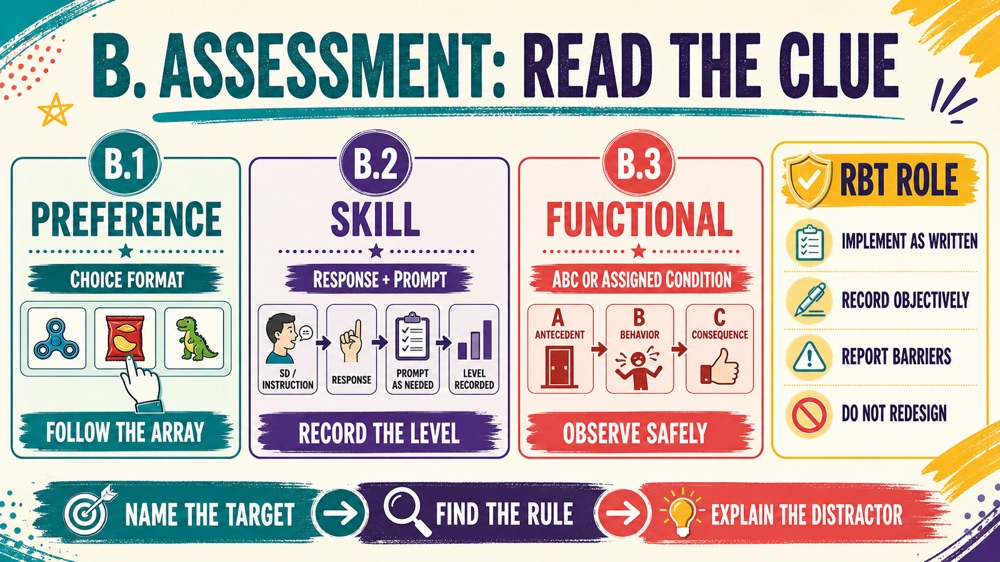
Bottom line: start every RBT assessment practice item by naming what is being assessed. Then identify the procedure clue, choose the in-scope action, explain the nearest distractor, and write a transfer example. That process builds usable judgment without confusing independent practice with the official exam or competency assessment.
Practice the assessment distinction before a full mock.
Move from targeted RBT assessment questions to three original mock exams with explanations and a structured review path.
See the Three RBT Mock Exams →
Frequently Asked Questions
What does RBT assessment practice cover?
It commonly covers preference assessments, assessments of relevant skill strengths and deficits, and RBT participation in functional-assessment procedures. It should also explain the difference between these procedures and the technician’s Initial Competency Assessment.
What is the difference between a preference assessment and a skill assessment?
A preference assessment observes selection or engagement among possible stimuli. A skill assessment examines what a learner can do under defined instructions, materials, prompts, and response criteria.
Can an RBT independently conduct a functional analysis?
An RBT may participate in assigned components under the current plan and supervision. The RBT should not independently design conditions, change consequences, or make a functional diagnosis outside assigned responsibility.
Is the Initial Competency Assessment a client assessment?
No. It evaluates whether an RBT candidate can perform required technician skills. It is different from assessing a learner’s preference, skills, or behavior function.
How many questions are on the official RBT exam?
The current format presents 85 multiple-choice questions: 75 scored questions and 10 unscored pilot questions, with four answer choices and 90 minutes.
Are these assessment practice questions official?
No. They are newly written educational examples and are not official, recalled, leaked, or BACB-endorsed questions. Do not buy or share secure exam content.
References
- Behavior Analyst Certification Board. RBT Test Content Outline, 3rd edition.
- Behavior Analyst Certification Board. RBT Initial Competency Assessment Packet, effective January 1, 2026.
- RBT Hub preference assessment practice. Reviewed for competitor research; not an official exam source.
- RBT Hub assessment study guide. Reviewed for competitor research.
- RBT Practice Test Section B. Reviewed for competitor research; not an endorsement.
- RBT Practice Test behavior assessment guide. Reviewed for competitor research.
- Special Learning preference-assessment guide. Reviewed for competitor research.